You arrive in Osaka, a city buzzing with an energy that feels different, more grounded, more… human. You’ve probably seen the big sights. You’ve navigated the polished, subterranean maze of Umeda Station and been blinded by the neon canyons of Dotonbori. You’ve done your grocery shopping in the silent, fluorescent-lit aisles of a Life or a Gyomu Super, a temple of efficiency where the only interaction is a polite nod and the beep of a barcode scanner. It’s all perfectly functional, clean, and convenient. And yet, you might feel a disconnect, a sense that the true, beating heart of the city remains just out of reach. You hear that Osaka people are friendly, loud, and funny, but in these modern, sterile spaces, you see little evidence of it. You’re living in the city, but you don’t yet feel a part of its rhythm.
The key to unlocking that rhythm, to understanding the soul of this merchant city, isn’t found in a tourist guide or a gleaming skyscraper. It’s found under the faded plastic roofs of the local shotengai, the neighborhood shopping arcades that snake through Osaka’s residential districts. These are not merely collections of shops. They are the city’s public living rooms, the grand, messy, boisterous stages where the drama of daily life unfolds. Forget the idea of shopping as a sterile transaction. In Osaka, and especially in the shotengai, commerce is community. It’s a conversation. It’s a relationship built over decades, one daikon radish and one fried croquette at a time. This is where the abstract concept of “Osaka’s warmth” becomes a tangible, everyday reality, but it’s a reality that’s far more nuanced and pragmatic than a simple cliché. It’s an ecosystem of give-and-take, a network of mutual reliance that has sustained these neighborhoods for generations. To understand the shotengai is to understand the very DNA of Osaka. It’s where you stop being a visitor and start becoming a local.
To truly grasp this interconnected community spirit, you can also see it in action at the local Osaka sento, where bathing is just the beginning of the social exchange.
The Anatomy of a Living Room: Beyond the Arcade Roof

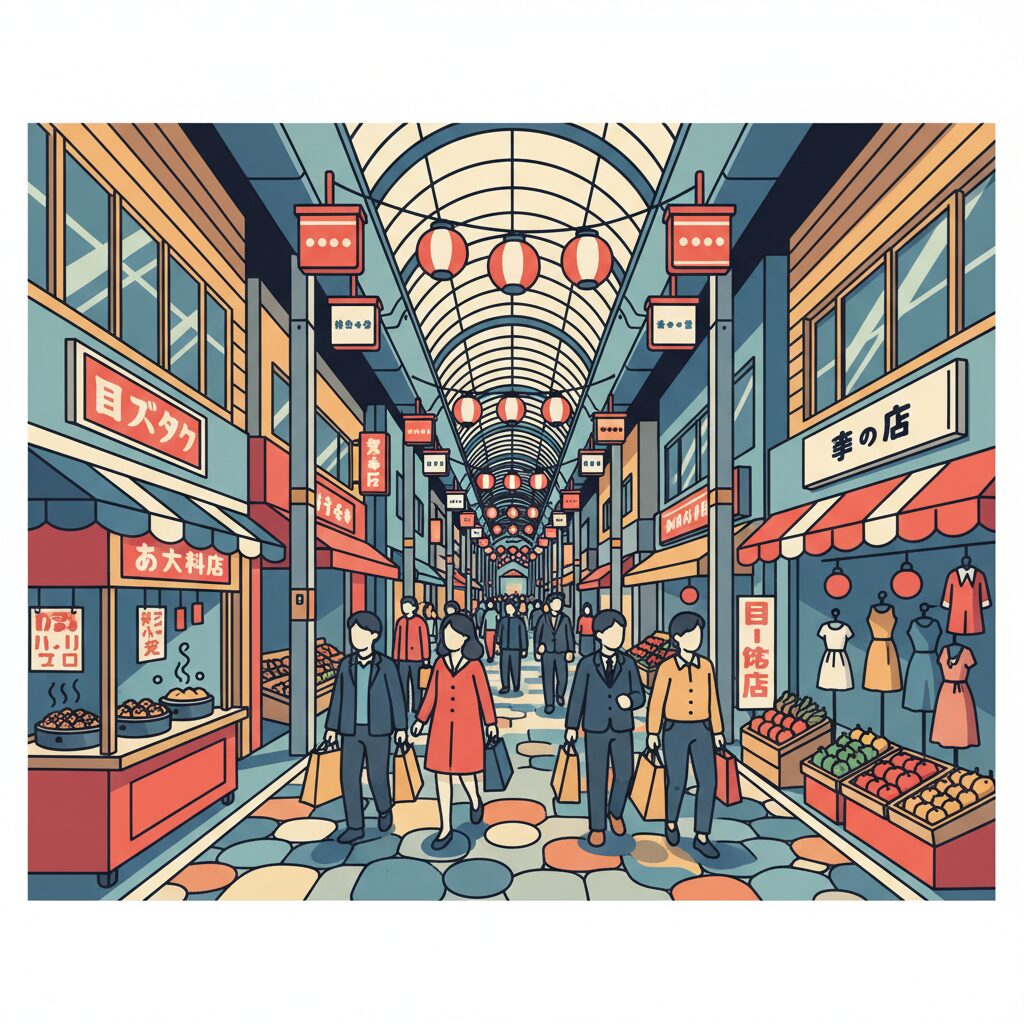
Step away from the main thoroughfares, turn a corner, and you’ll discover the entrance to a shotengai. It might be marked by a grand archway adorned with flashing lights, like the famous Tenjinbashisuji, or it could be a modest, rusted sign hanging above a narrow alley. The instant you step beneath that roof, the atmosphere changes. The city’s distant hum gives way to a focused, high-fidelity symphony of human activity. This shift is your first lesson: a shotengai is a unique territory with its own rules, pace, and sensory language. To the untrained eye, it might seem chaotic. But it’s not chaos; it’s a complex, living entity, where every detail—from the hand-painted signs to the scent of aged soy sauce—is part of its grammar.
The Sensory Overload is the Point
First, the sound strikes you. It’s a rich, layered composition. At its base, the steady, rhythmic clatter of geta sandals and bicycle wheels against tiled floors. Above that, the human voices. This isn’t the hushed, polite murmur of a Tokyo department store. It’s a raw, unfiltered chorus of communication. Shopkeepers shout out the day’s specials in the gravelly, sing-song Osaka dialect: “Yassui de! Oidenna!” (It’s cheap! Come on in!). Housewives chat as they haggle, their voices rising and falling in animated negotiation. The sharp sizzle of tempura hitting hot oil, the metallic clang of a butcher’s cleaver, the gentle hiss of steam from a tofu shop’s boiler. In the background, the tinny, cheerful jingle of a supermarket’s theme song clashes with the dramatic, wailing melody of an enka ballad drifting from a tiny CD shop. This wall of sound isn’t noise pollution; it’s information. It tells you what’s fresh, what’s on offer, who’s working today. It’s the sound of a community actively engaged in the business of living.
Next come the smells—a potent blend that narrates the neighborhood’s story. The sweet, nutty aroma of roasting hojicha tea leaves from the local tea vendor, evoking warmth and tradition. This mingles with the savory, deeply comforting smell of dashi broth simmering at an udon stand, embodying the essence of Japanese home cooking. Follow your nose to the source of a rich, greasy scent: a korokke (croquette) shop, its glass case packed with golden-brown patties of potato and minced meat, a local delicacy sold for pennies. There’s the clean, slightly sweet fragrance of freshly made tofu and the sharp, salty tang of pickled vegetables—tsukemono—fermenting in large wooden barrels. Intertwined throughout is the faint, damp scent of old wood and concrete, a smell steeped in decades of seasons and stories. Unlike the sterile, odorless air of a modern mall, the shotengai smells authentic—of food, people, and time itself.
The visual scene is equally dense. Your eyes strain to absorb it all. Corporate branding guidelines are nowhere to be seen. Every sign reflects its owner’s personality. A fishmonger’s prices are scrawled in thick black ink on cardboard, emphasized with exclamation points and hand-drawn fish to highlight freshness. An old vegetable stand displays prices on wooden slats, many crossed out and rewritten so often the wood is barely visible. Faded plastic cherry blossoms, remnants of a spring festival from years past, hang from the ceiling, gathering dust alongside bright red lanterns and banners advertising a summer sale. Bicycles—the preferred transport for local shoppers—are parked in every imaginable angle, their baskets overflowing with leeks and cabbages. It’s a visual tapestry of contrasts: high and low, old and new. A sleek, modern bakery with minimalist décor might sit next to a cluttered, dimly lit hardware store that hasn’t changed since the 1960s. This visual clutter is the arcade’s history made tangible, a testament to its resilience and its ability to embrace change without losing its essential character.
The Unspoken Rules of Engagement
Navigating this environment means understanding a set of unwritten social codes that differ greatly from those of typical retail spaces. The foremost rule is the idea of being a regular, a joren. In a supermarket, you are an anonymous shopper. In a shotengai, you are part of a community, and your status is earned through consistency. This practice is called kao wo dasu, literally “showing your face.” By visiting the same shops week after week, you aren’t just buying groceries; you are performing a quiet social ritual. You signal your commitment to the neighborhood’s ecosystem.
At first, interactions may be brief—a nod, a simple “Maido” (a classic Osaka greeting for regulars, meaning “every time,” as in “thanks for your continued business”). Gradually, conversations deepen. The woman at the vegetable stand moves from asking “What are you looking for?” to “The spinach is great today, perfect for ohitashi.” The butcher stops pushing the priciest cuts and begins recommending the best value, remembering you prefer pork thinly sliced for shabu-shabu. This personalized system is the shotengai’s algorithm, far more nuanced than anything Amazon could design. It’s built on observation, memory, and genuine human connection.
This relationship culminates in the custom of omake. Omake means “a little extra.” It’s when the fruit seller, after weighing your apples, slips in an extra mikan orange. It’s when the baker adds a small bread roll to your bag. A foreigner might see this as a random kindness or discount, but it’s not. An omake is a powerful social gesture—a tangible acknowledgment of your status as a joren. It’s the shopkeeper’s way of saying, “I see you. I appreciate you. You belong here.” It strengthens bonds of mutual obligation. You receive the omake, and in return, your loyalty to that shop deepens. This soft reciprocity forms the unseen framework holding the entire shotengai community together. It transforms a simple economic exchange into a moment of social recognition—something no self-checkout machine could ever replicate.
Merchants as Mayors: The Shotengai’s Social Fabric
To view the shop owners in a shotengai as merely vendors is to completely overlook their true role. Within these enclosed neighborhood realms, they serve as anchors, information centers, and unofficial community leaders. They act as guardians of the social fabric, weaving it together one conversation at a time. Their shops are more than just points of sale; they function as listening posts, informal counseling centers, and central hubs for local gossip. It is this role that truly transforms the shotengai from a market into a living room.
The Tofu Maker Knows Everything
Consider Mr. Sato, who has operated the neighborhood tofu shop for forty years, just as his father did before him. He rises at 4 AM daily to prepare fresh tofu, soymilk, and aburaage (fried tofu pouches). His earliest customers are the elderly residents who come not only for the silken tofu that’s easy to eat but for the daily ritual of conversation. As he bags their purchases, Mr. Sato also conducts a subtle, informal wellness check. He knows that Mrs. Suzuki typically arrives at 8:15 AM, and if she hasn’t appeared by 9, he might casually ask a customer, “Have you seen Suzuki-san today?” This isn’t mere gossip; it is a low-tech social safety net. In a country with an aging population, where elderly people risk isolation, the daily check-in at the tofu shop is a crucial lifeline. Mr. Sato is aware of who is unwell, whose children are visiting from Tokyo, and which neighborhood cat just had kittens. He is both the keeper of the community’s oral history and its real-time social ledger.
This stands in sharp contrast to the anonymity found at a convenience store. The part-time employee at a 7-Eleven is trained for efficiency rather than connection. Such workers often stay only a few months before moving on. They don’t know your name, and you don’t know theirs. The relationship remains purely transactional. But in the shotengai, the relationship is foundational. When buying fish from Mrs. Yamamoto, you engage with someone who has likely known the area for half a century. She can tell you not only the best way to grill that mackerel but also stories about what stood on your apartment site before it was built. This deep-rooted presence offers a sense of stability and continuity increasingly rare in modern urban life. These merchants embody the neighborhood’s living memory.
A Theater of Commerce: The Art of the Osaka Sale
Commerce in Osaka carries a distinctly theatrical flair, and the shotengai is its main stage. The act of buying and selling becomes a performance, a lively piece of interactive theater where both shopkeeper and customer assume roles. The Osaka merchant’s style is far removed from the deferential, nearly silent service seen in upscale Tokyo boutiques. It is loud, direct, and infused with humor.
Language plays a key role in this performance. The classic Osaka business greeting is “Mokarimakka?” which literally means, “Are you making a profit?” The usual reply is “Bochi bochi denna,” a delightfully vague phrase roughly meaning “So-so” or “Can’t complain.” To an outsider, this might seem blunt or even rude—why ask someone about their profits? But this isn’t a serious financial question. It’s a social ritual, a verbal handshake that acknowledges a shared, fundamental reality of commerce. It says, “We are both players in this buying and selling game. Let’s recognize it openly and enjoy ourselves.” It reflects the pragmatic, unsentimental, business-oriented mindset that has defined Osaka for centuries.
The sales pitch itself often combines self-deprecation with exaggeration. A takoyaki vendor might shout, “If you don’t buy these, I’ll have to eat them all myself and my wife will be angry!” A vegetable seller might dramatically slash prices on a sign, declaring, “I’m practically giving it away! My kids won’t eat tonight!” This is not a sign of desperation but a joke, an invitation to playful banter. The expected response is not sympathy but a witty comeback. A customer might reply, “At that price, you must be making a fortune!” This back-and-forth, this kakeai, serves as entertainment. It turns the ordinary act of buying potatoes into a memorable, human exchange. The goal isn’t merely to close a sale but to create a shared moment of lightheartedness. This distinction sets Osaka apart from the rest of Japan. In Tokyo, customer service aims to maintain a smooth, respectful distance. In Osaka, it aims to dissolve that distance and forge a connection, however brief.
Surviving and Thriving: The Shotengai in Modern Osaka
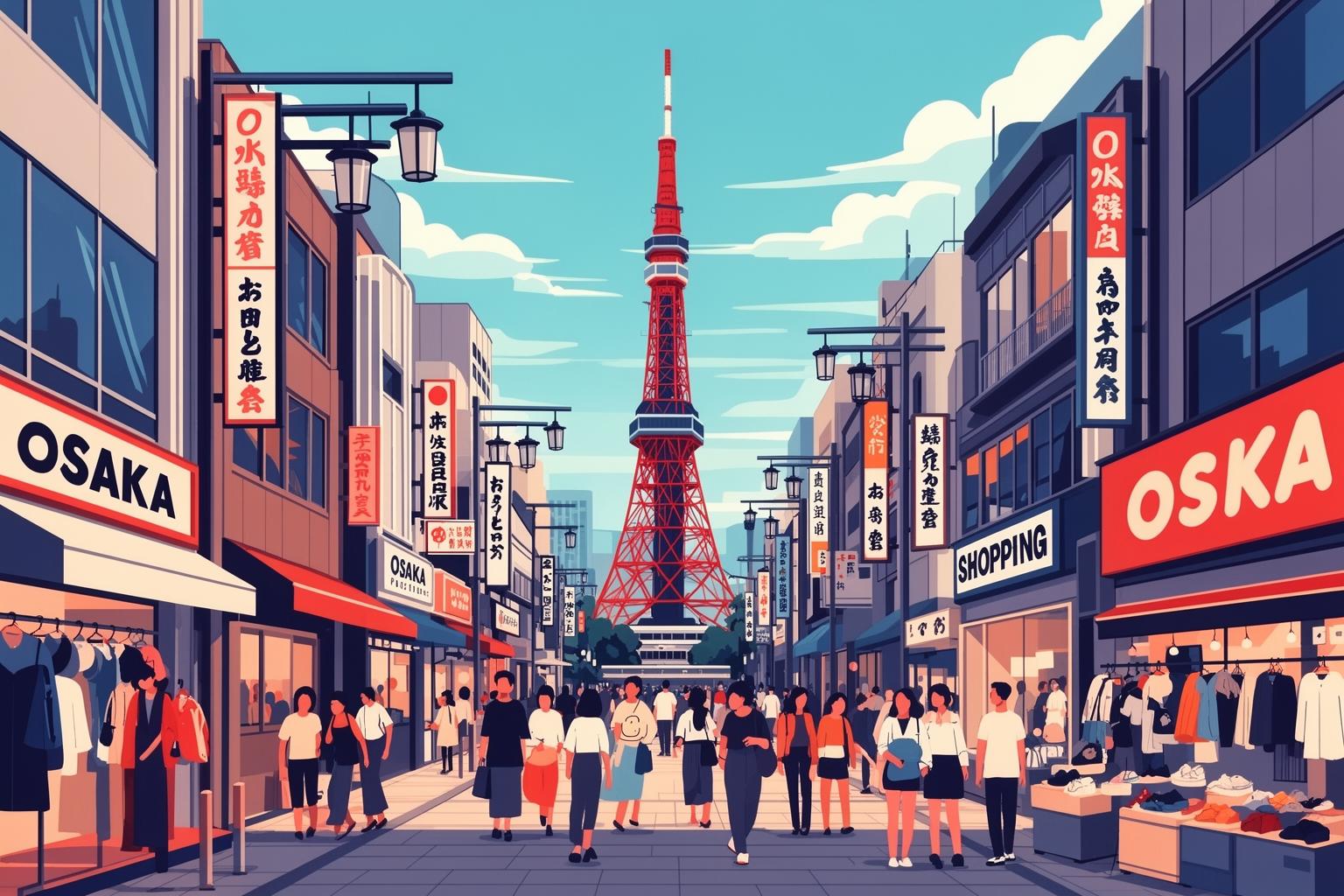
It would be misleading to portray a purely romantic image of the shotengai. In truth, many are grappling with an existential crisis. The relentless advance of modernization, the emergence of enormous shopping malls, and shifting consumer behaviors have placed these traditional shopping arcades under significant strain. Stroll through any neighborhood in Osaka, and you will likely encounter a shotengai where more than half of the storefronts are closed, their metal shutters rusted shut permanently. These are known as “shutter shotengai,” eerie reminders of a once-thriving past. Yet, many are not only enduring but actively reinventing themselves, discovering new ways to stay relevant in the 21st century by emphasizing their unique strengths.
The Battle Against the Supermarket Giants
The main rivals in this story are the massive supermarket chains and sprawling Aeon Malls that have become fixtures in suburban Japan. They provide one-stop shopping, plentiful parking, climate-controlled environments, and competitive prices due to their enormous buying power. A small, independent butcher in a drafty shotengai simply cannot match a supermarket’s prices on mass-produced sausages. The shotengai that fade away often try to compete on the same terms as these giants. They fail to present customers with a compelling reason to choose them over the cheaper, more convenient option.
Those that thrive, however, grasp their distinct value proposition. They shift from being generalists to specialists. They capitalize on what supermarkets cannot offer: specialized knowledge, exceptional quality, and a personal touch. The shotengai butcher survives because he can provide a particular cut of wagyu beef, aged perfectly, and then spend ten minutes advising on the best way to cook it for a special occasion. The fishmonger endures because he personally visits the wholesale market at dawn to select the finest fish and can tell you exactly which boat it came from. The tsukemono shop persists because it offers pickles made from a family recipe passed down through three generations, delivering a flavor you simply cannot find in vacuum-packed products.
These shops succeed by turning grocery shopping from a mundane task into a rich experience. Customers don’t visit just to buy goods; they come for the advice, the stories, and the personal connection. They appeal to those who value quality over quantity and relationships over anonymity. They demonstrate that even in the age of Amazon and automated checkouts, there remains a strong demand for curated, artisanal, and deeply human commerce.
The New Blood: Young Entrepreneurs and Shotengai Revival
Another compelling trend revitalizing these old arcades is the arrival of a new generation of entrepreneurs. Young people, often in their twenties and thirties, are turning away from corporate careers to open their own small businesses. They are drawn to the shotengai for both practical and aesthetic reasons. Rents are typically much lower than in newer commercial centers, reducing the barrier to starting a business. More importantly, they are attracted by the authentic atmosphere, the built-in foot traffic, and the sense of belonging to a genuine community.
This new wave is not about replicating the past but blending old and new. Now, you can find striking contrasts: a third-generation rice cracker shop standing alongside a sleek, minimalist café serving single-origin pour-over coffee. A traditional kimono fabric store sharing a wall with a craft beer bar offering a dozen local IPAs on tap. A vintage clothing store stocked with American denim operating opposite an old-fashioned shop selling seaweed and dried mushrooms. Places like Karahori Shotengai in Osaka exemplify this revival, where historic wooden townhouses, or machiya, have been transformed into trendy boutiques, galleries, and restaurants, blending historical charm with contemporary cool.
This influx of new energy creates a vibrant and mutually beneficial ecosystem. New businesses attract a younger, more affluent clientele to the arcade, who then discover the appeal of the older, traditional shops. The established merchants, in turn, provide the authenticity and sense of place that the newcomers seek. Naturally, there can be tensions—disagreements over opening hours, noise, or aesthetics. But more often, a symbiotic relationship develops. The young coffee shop owner might source his beans from a long-standing roaster nearby, and the veterans gradually come to appreciate the fresh vitality these new entrepreneurs bring. This organic evolution, rather than a top-down, developer-driven gentrification, is what enables the strongest shotengai to adapt and thrive for a new generation.
Your Role in the Living Room: How to Be a Resident, Not a Tourist
For someone who is not a Japanese resident, the shotengai can initially feel intimidating. The language barrier, rapid-fire banter, and unspoken social rules can make it appear like an exclusive club. However, it is a club surprisingly welcoming to new members, as long as you are willing to put in the effort. Integrating into the fabric of the shotengai is a process that demands patience, careful observation, and a genuine desire to connect. Here’s how you can move from being an outsider to becoming an active participant in your local community space.
It’s a Marathon, Not a Sprint
Consistency is the most important factor. Building relationships cannot be achieved in a single visit. The currency of the shotengai is familiarity. Pick your neighborhood arcade and start small. Make a deliberate choice to buy your vegetables from one particular stand, your fish from a specific monger, and your bread from one particular bakery. Create a routine. Go every week, even if you only need a few items. Simply showing up regularly is the first and most crucial step.
Avoid pushing for deep conversations during your initial visits. Begin with basic Japanese courtesies: a cheerful “Konnichiwa” when you arrive, a clear “Kore wo kudasai” (I’ll have this, please), and a sincere “Arigatou gozaimasu” when you leave. In time, as shopkeepers start to recognize you, you can gradually expand your phrases. Ask a straightforward question: “Kyo no osusume wa nan desu ka?” (What’s your recommendation today?). Merchants are experts in their fields and are typically happy to share their knowledge. Ask how to prepare something. This shows respect for their expertise and opens the door to richer interactions. Don’t be discouraged if the first responses are brief and business-like. Trust develops gradually. Eventually, when you ask for a recommendation, instead of a simple reply, you might get an in-depth explanation about the seasonal variations of sea bream. That’s the moment you know you’ve arrived.
Reading Between the Lines of “Friendliness”
You may have heard the stereotype that people from Osaka are “friendly.” While true, this friendliness is not the passive, polite warmth you might find elsewhere. It’s an active, engaging, and occasionally intrusive form of connection. As you become more familiar, be prepared for more personal questions: “Where are you from?” “What do you do for work?” “Are you married?” “How many children do you have?” In many Western cultures, such questions from a shopkeeper could feel intrusive. Here, they have a different purpose. It’s the community’s way of mapping out who you are and where you fit in the local social fabric. Responding openly and with good humor is part of the initiation. They are collecting the information needed to build a relationship with you.
This aligns with the Japanese notion of uchi-soto, or inside-outside. As a newcomer, you start firmly within the soto (outside) group. Every positive interaction, consistent visit, and shared laugh gradually moves you closer to the uchi (inside) circle. The boundaries aren’t always clear, but there are signs. When the butcher begins calling you by a nickname, you’re moving inside. When the woman at the pickle shop sets aside your favorite variety because she knows you’re coming, you’re moving inside. And when you receive your first unprompted omake—an extra potato tucked into your bag—you’ve arrived. You’re no longer just a customer; you are a recognized member of the neighborhood.
A Practical Guide to Your First Foray
To ease your initial steps, here are a few practical tips. First, find your local shotengai. It may not be the largest or most well-known, and that’s beneficial. The smaller and more residential it is, the easier it will be to become a regular. Second, bring cash. Although Japan is gradually adopting cashless payments, many small, family-run stalls in a shotengai remain cash-only. Having the correct change ready shows you’re considerate and respectful of their traditional way of doing business. Third, bring your own bag. This not only supports environmental friendliness but also signals that you are a seasoned shopper, not a tourist. Finally, observe. Before purchasing anything, take a slow walk through the arcade. Notice where locals gather. Watch how they interact with shopkeepers. Listen to the rhythm of their conversations. The shotengai has its own pulse. Your goal is to learn to match it.
The Soul of the City
Ultimately, the shotengai is much more than a place to purchase food. It is a vibrant, living microcosm of Osaka itself. It captures the city’s defining traits: its practicality, its lively energy, its deep-rooted emphasis on human connection, and its commercial foundation. These arcades are where Osaka’s historical identity as the “nation’s kitchen” and a city of merchants is not a relic but a daily, lived experience. This world thrives on countless small, repeated interactions and on the trust between the fishmonger and the customer.
This creates a striking contrast to urban life in many other cities, including Tokyo. In Tokyo, efficiency and anonymity are often valued. You might live there for years without ever speaking to your neighbors. The city’s vastness and formality maintain a polite distance. But in Osaka, if you choose to engage with your local shotengai, anonymity is impossible. Your life becomes intertwined with those who nourish you. The tofu maker will inquire about your sick cat. The fruit seller will congratulate you on your new job. The butcher will know your children by name. You become part of a dense, sometimes chaotic, yet ultimately supportive community web.
So, if you truly wish to understand this city, look beyond the guidebooks and tourist spots. Find the nearest covered arcade. Walk beneath its weathered roof and let the sounds and smells envelop you. Buy a warm, freshly fried croquette from a small, family-run stall. Exchange a few words with its maker. And most importantly, return next week and do it all again. Because the soul of Osaka isn’t found in its castles or skyscrapers. It lies right here, in its noisy, vibrant, and deeply human living rooms.