
You hear it before you even arrive, a whisper that grows into a full-blown reputation. “Oh, you’re moving to Osaka? Get ready, everyone there is a comedian.” It’s one of the first things anyone tells you about Japan’s boisterous second city. The image it conjures is of a place where shopkeepers tell punchlines instead of giving change and every train ride is a rolling stand-up special. You brace yourself for a city of clowns, a 24/7 comedy festival where you’re the only one who hasn’t read the script.
Then you land, and reality is both more subtle and more profound. There are no pie-in-the-face greetings at the airport. Your landlord doesn’t deliver your keys with a vaudeville hook. Yet, you start to notice it. A flicker of something different in the way people talk. A rhythm in the banter at the local market that feels less like a transaction and more like a performance. The stern-looking grandmother at the bus stop who suddenly deadpans a joke about the weather, making the person next to her erupt in a wheezing laugh. This isn’t the slapstick circus you were told to expect. It’s something else entirely. It’s owarai, the culture of comedy, woven so deeply into the fabric of daily life that it functions as a second language, a social lubricant, and a worldview all in one. But what does this really mean for a foreigner trying to build a life here? How do you navigate a world where a simple question can turn into a playful comedy routine? The truth is, not everyone in Osaka is a comedian, but everyone is expected to understand the language of comedy. This isn’t about telling jokes; it’s about a shared rhythm of interaction that defines what it means to be Osakan. It’s the key to unlocking the city’s heart, and learning its grammar is your first, most important lesson.
Exploring how locals masterfully blend humor into everyday exchanges can offer newcomers practical insights, as seen in Osaka boke and tsukkomi.
The Roots of Owarai: More Than Just Jokes
To truly understand Osaka, you need to grasp owarai (お笑い). While the word simply means “laughter” or “comedy,” that description is as superficial as calling the ocean “wet.” It doesn’t convey the full depth and breadth of what owarai represents. In Osaka, owarai is an industry, a cultural cornerstone, and an educational institution all at once. At its core is the entertainment giant Yoshimoto Kogyo, based in the neon-lit district of Namba. For over a century, Yoshimoto has been the driving force behind Japanese comedy, producing generations of comedians who become household names. These performers are more than entertainers; they are cultural icons whose catchphrases, gestures, and comedic styles become embedded in the public consciousness.
Growing up in the Kansai region, including Osaka, means being immersed in this world from an early age. Children watch Yoshimoto’s comedy shows on TV after school just like kids elsewhere watch cartoons. They see their parents laughing at the same comedians and quoting the same lines. The rhythm of manzai—the traditional two-person comedy act—becomes as familiar as the chime of the local train station. This continual exposure creates a shared comedic literacy. Everyone understands the archetypes, timing, and classic punchlines. When someone on the street uses a famous comedian’s gesture or drops a well-known catchphrase, it’s not random; it’s a cultural nod, a wink to all those who share the joke. That is why humor feels so deeply ingrained here. It’s not that people are inherently funnier; it’s that they’ve all graduated from the same unofficial school of comedy, with television serving as their primary textbook.
Manzai: The Blueprint for Conversation
The essential concept to grasp is manzai (漫才). This comedic duo format is the Rosetta Stone for understanding social interaction in Osaka. It features two roles: the boke (ボケ) and the tsukkomi (ツッコミ).
The Boke: The Fool
The boke is the funny one, the airhead, the person who says or does something absurd, nonsensical, or out of place. Their role is to create an opening for laughter by breaking logic or social norms. They might misinterpret a simple question, make an outrageous claim, or pretend to be clueless. The boke throws the ball into the air.
The Tsukkomi: The Straight Man
The tsukkomi acts as the straight man, grounding the interaction in reality. Their job is to highlight the boke’s absurdity with a sharp, witty retort, often accompanied by a light, playful smack (traditionally with a paper fan but in everyday life, a tap on the arm or shoulder). The tsukkomi brings the ball back down, delivering the punchline. Their signature line is “Nande ya nen!,” roughly meaning “Why?!” or “What the heck?!”—a universal cue that a boke has been spotted and called out.
This dynamic isn’t limited to the stage; it operates as the underlying software of most casual conversations in Osaka.
Manzai in the Supermarket: The Rhythm of Daily Banter
Once you recognize the boke-tsukkomi dynamic, you start noticing it everywhere. It’s a playful, ongoing dance that transforms ordinary interactions into moments of shared fun. The aim isn’t always a loud belly laugh but a small spark of connection, a mutual nod that life doesn’t always have to be so serious.
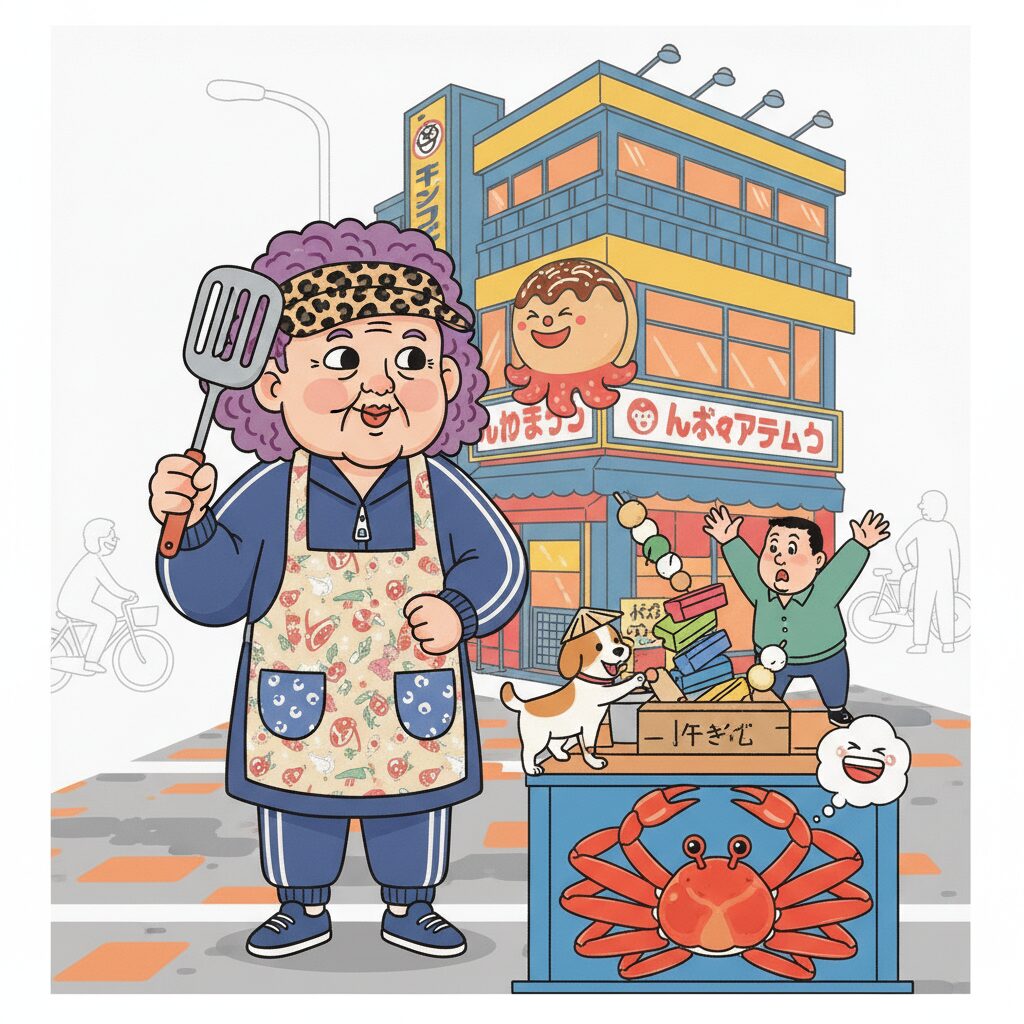
Imagine you’re at a local shotengai (shopping arcade) buying vegetables. You pick up a daikon radish and ask the elderly shopkeeper, “Is this one fresh?” In many places, you’d receive a simple “Yes, it is.” In Osaka, the shopkeeper might squint at the radish, hold it up to her ear like listening to its heartbeat, and declare, “It’s so fresh, it was complaining about the weather this morning!” That’s the boke. She’s done something absurd. Your expected response as the customer is the tsukkomi. You might laugh and say, “Okay, okay, I’ll take the grumpy one!” or simply smile and reply, “Honma ka?” (Really?). You’ve completed the exchange. You didn’t just buy a radish; you joined a brief, two-second performance. This is the spirit of the city.
Here are more examples you might come across:
- At the Takoyaki Stand: While waiting for your order, the vendor hands you the boat of steaming octopus balls with a serious expression and says, “Be careful, they might jump out. The octopus was a black belt in karate.” He’s the boke. Your role is to play along: “I’ll be ready for them!” you say, striking a playful fighting pose. That’s the tsukkomi.
- Paying a Compliment: You tell a coworker you like their new jacket. Instead of a simple “Thank you,” they might look at it with mock disgust and say, “This thing? It was 100 yen on sale. I think a pigeon owned it before me.” This self-deprecating boke is a classic Osaka move, inviting your tsukkomi: “No way, it looks great! You’ve got better taste than a pigeon!”
- Minor Mishaps: If you stumble accidentally on the pavement, a passerby might call out, “Nice dance!” This isn’t meant to mock you. It’s a boke to ease your embarrassment. The ideal tsukkomi is to laugh at yourself and maybe give a small bow, acknowledging the “performance.”
In all these instances, the humor has a function. It bridges the gap between strangers, builds connection, and turns everyday tasks into something more like a shared human experience. It’s an exchange of energy, not merely goods or services.
The Unspoken Rules of Osaka Humor
For a foreigner, this constant invitation to join a comedy routine can feel intimidating. You might worry about saying the wrong thing, missing the joke, or your own attempts at humor falling flat. However, the system is more forgiving than you might expect. That said, there are a few unspoken rules that can help you navigate it.
Rule 1: Participation is Encouraged, Not Required
You are not expected to be a world-class boke right from the start. In fact, trying too hard to be funny without fully understanding the cultural nuances may come off as awkward. The simplest and safest role for a newcomer is the tsukkomi. Your task is just to react. A laugh, a smile, a shake of the head, or a well-timed “Nande ya nen!” is a perfect response. It shows you got the intent, appreciated the effort, and are willing to join in. The person who started the boke isn’t expecting a flawless comedic comeback; they want a warm reception.
Rule 2: It’s About Connection, Not Offense
Osaka humor can seem surprisingly direct, even bordering on what might be considered rude in other cultures. An obachan (older woman) might openly comment on your height, your poor Japanese, or the loud color of your shirt. In Tokyo, this would be nearly unthinkable. In Osaka, it’s often an olive branch. The teasing tests your ability not to take yourself too seriously. They’re seeking a partner in banter, not a victim. The best response is never to get offended. Instead, lean into it. If she comments on your shirt, you might say, “I know! It’s so bright, I’m trying to guide ships in the harbor.” You’ve just turned her boke into a shared joke. This is how friendships form in Osaka—through a shared, good-natured insult.
Rule 3: Self-Deprecation is a Strength
While Osakans may tease others, they are ruthless when it comes to teasing themselves. Bragging or showing off is considered uncool. The fastest way to build rapport is through self-deprecation. Complaining about your own stinginess (kechi), lack of talent, or a recent failure isn’t a plea for sympathy; it’s a strategic boke. It makes you relatable and non-threatening. When you admit a flaw with humor, you invite others to laugh with you, not at you. For a foreigner, this is a powerful tool. Admitting your struggles with Japanese in a funny way (“My Japanese is so bad, I ordered a cat instead of a coffee the other day”) will get you much further than pretending you have it all figured out.
Osaka vs. Tokyo: The Comedy Divide
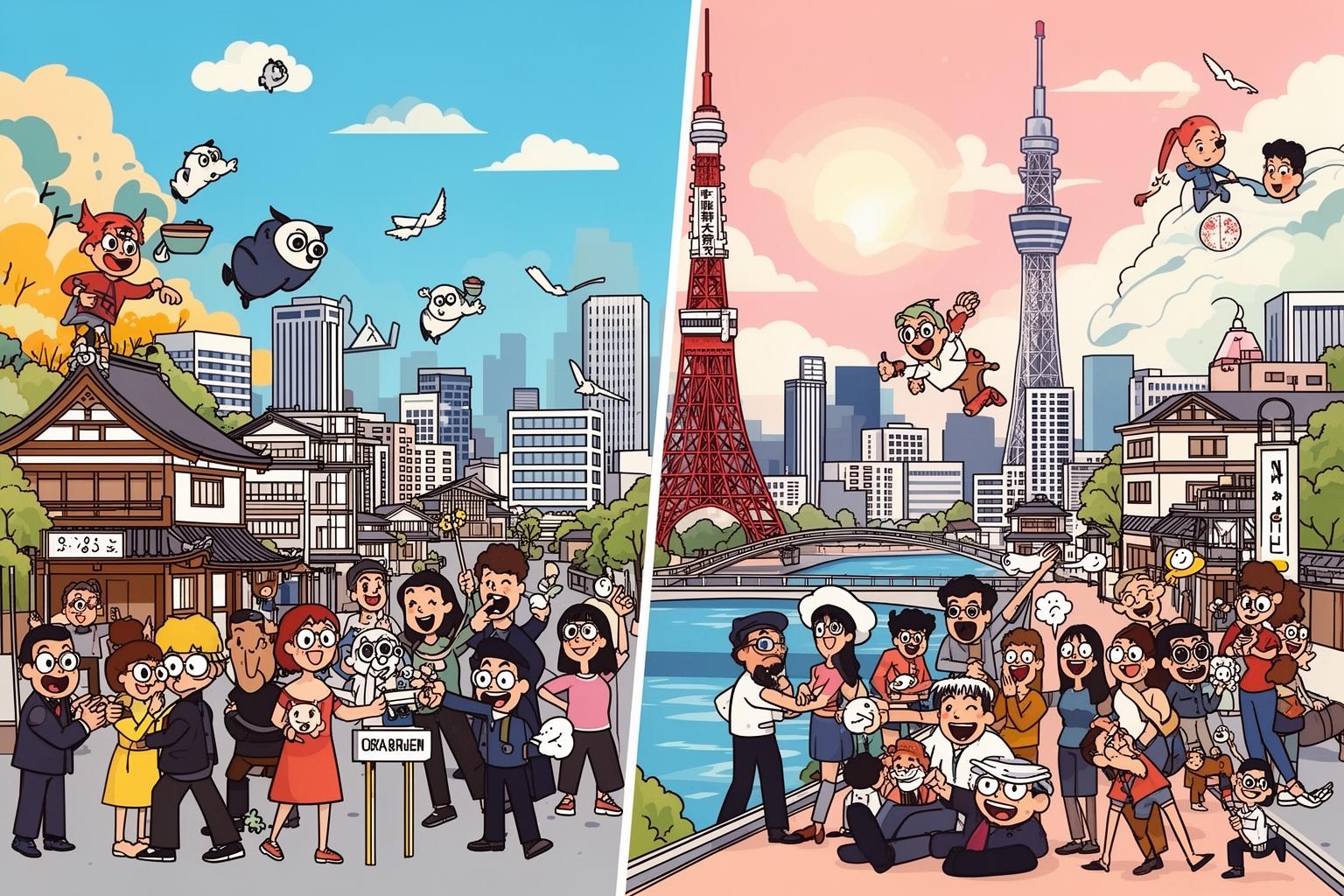
The contrast in communication styles between Osaka and Tokyo is striking, with humor playing a central role. It exemplifies a cultural rivalry expressed through countless daily interactions.
In Tokyo, communication often emphasizes tatemae—the public facade or polite fiction. Harmony is preserved by avoiding direct confrontation and employing layers of politeness and ambiguity. Conversations can feel like a delicate, intricate dance aimed at minimizing friction. Spontaneous, personal humor, especially in professional or service settings, may be deemed inappropriate or unprofessional, as it disrupts the expected rhythm.
Conversely, Osaka values honne—one’s true feelings—albeit cushioned with humor. People tend to be more direct, using laughter to soften criticism and foster connection. Harmony is achieved not through avoidance, but through engagement. An Osaka shopkeeper might frankly advise you that another product offers better value, framing it as advice from one savvy consumer to another. A Tokyo shopkeeper, by contrast, would likely allow you to purchase the less suitable item rather than risk offending you with a straightforward suggestion. The Osaka style prioritizes efficiency in building relationships. Why waste time on polite facades when a shared laugh can create trust instantly?
Consider this: a business meeting in Tokyo might begin with a long, formal exchange of pleasantries and bows. In Osaka, it might start with the host complaining about the terrible coffee they’re about to serve. Tokyo’s method establishes respect through formality, while Osaka’s builds rapport through candid, down-to-earth humanity. Neither approach is better, but they represent profoundly different worlds.
Navigating the Humor as a Foreigner
So, how do you, as a non-native speaker and cultural outsider, manage to survive and thrive in this environment? It’s a gradual process of learning to listen, observe, and eventually join in.
Stage One: The Observer
When you first arrive, just listen. Don’t feel the need to perform right away. Watch the interactions at the supermarket, the ramen shop, and between neighbors. Notice the rhythm. Who plays the boke? Who is the tsukkomi? What kinds of jokes work? What is the physical language—the exaggerated shrug, the look of feigned shock, the quick tap on the arm? You’re gathering data, learning the patterns. Your main role is to be a good audience. Smile, laugh when others laugh, and show you appreciate the atmosphere.
Stage Two: The Reactive Participant
At this stage, you start playing the tsukkomi role. You don’t have to create your own jokes just yet. Your task is to respond to the boke attempts directed at you. Master a few key phrases:
- Nande ya nen! (なんでやねん!): The ultimate classic. Use it when someone says something absurd. Perfect pronunciation isn’t necessary; your effort will be appreciated.
- Honma ka? (ほんまか?): “Really?” or “For real?” A simple and effective reply to an exaggerated story.
- Akan! (あかん!): “No good!” or “Don’t do that!” A playful way to react to mischievous suggestions.
- Meccha omoiroyan! (めっちゃおもろいやん!): “That’s hilarious!” A straightforward compliment for their humor.
Using these phrases—even hesitantly—shows you’re part of the joke. You’re no longer just an observer but an active player. This marks a major milestone.
Stage Three: The Initiator
This is the advanced phase. After months or years of observing and reacting, you may feel ready to start the boke yourself. This requires stronger language skills and a deeper grasp of context. The safest way to begin is through self-deprecating humor. Joking about your own clumsiness or difficulties with Japanese is a low-risk, high-reward approach. For instance, if you’re having trouble with chopsticks, you might say, “These chopsticks are smarter than me today.” This classic boke invites a tsukkomi like, “Don’t worry, you’ll have it next year!”
So, What’s the Reality?
Let’s revisit the original question: Is everyone in Osaka a comedian? The answer is a clear no. However, everyone speaks the language of comedy fluently. It serves as the city’s default mode of operation, the preferred way to ease social tension and forge quick, genuine connections.
Living in Osaka is like moving to a place where everyone loves to dance. You’re not expected to be a professional dancer, but you’ll enjoy yourself much more if you’re willing to at least tap your foot to the beat, and maybe even let someone pull you onto the dance floor now and then. The humor isn’t a performance to passively watch; it’s an invitation to participate. It’s the sound of a city that refuses to take itself too seriously, a place where the most precious currency is a shared laugh. Grasping this won’t just help you get by in Osaka—it will let you truly connect with its lively, chaotic, and wonderfully human spirit.








