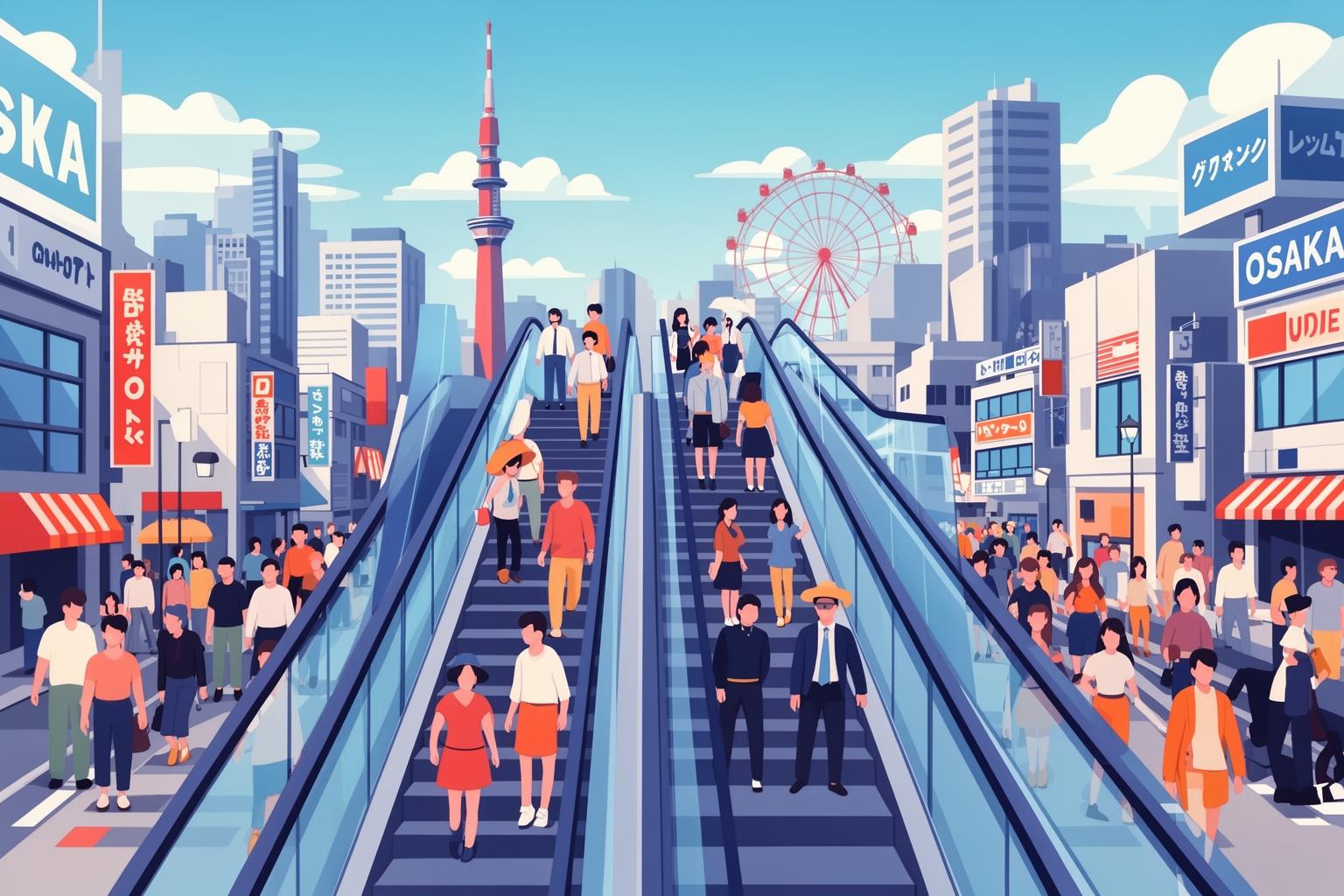
My first real ‘Welcome to Osaka’ moment didn’t happen at a restaurant, a temple, or even with a friendly local saying hello. It happened on an escalator. I was in the controlled chaos of Umeda Station, a place that feels less like a train station and more like a subterranean city designed by a creature with a love for labyrinthine corridors. Fresh from a week in Tokyo, my body was programmed. I stepped onto the moving stairs, slid neatly to the left, and stood still, ready for the metallic ascent. Within seconds, I felt it. A subtle pressure from behind. A rustling. A gentle but firm ‘chotto, suimasen’ – ‘excuse me, just a moment’. I glanced back to see a salaryman, briefcase in hand, trying to get past me on the left. Confused, I looked to my right. A solid, unmoving wall of people. Commuters, shoppers, students, all standing placidly on the right side. The entire left lane was empty, a clear runway for people in a hurry. In that split second, I realized I was the obstruction. I was the tourist clog in the city’s arteries. I quickly shuffled to the right, blushing, and the man zipped past with a quick nod. It was a tiny interaction, over in a flash, but it was a lightning bolt of cultural realization. I wasn’t in Tokyo anymore. I was in Osaka, a city that literally moves in a different direction.
This small, seemingly trivial difference—standing on the right side of the escalator in Osaka versus the left in Tokyo and most of Japan—is one of the first and most potent signs that you’ve entered a different cultural sphere. It’s a rule that isn’t written on any sign, a piece of etiquette learned through observation and gentle social correction. And once you see it, you can’t unsee it. It’s a silent, daily referendum on Osaka’s unique identity. Why would a city, in a country known for its incredible social cohesion and standardization, adopt a rule that directly contradicts the norm of its own capital? The answer isn’t just a historical footnote; it’s a living, breathing testament to the Osakan mindset. It’s a key that unlocks the city’s character: its pragmatic soul, its history as a merchant’s hub, its subtle but fierce rivalry with Tokyo, and its fundamentally people-first approach to life. To understand the escalator rule is to begin to understand the rhythm and pulse of Osaka itself, a city that proudly and unapologetically marches to the beat of its own drum. It’s not just about where you stand; it’s about what you stand for.
This unique rhythm is also evident in the city’s vibrant cultural expressions, such as the infectious energy of Osaka’s rhythmic soul.
The Great Escalator Divide: Osaka vs. The World (and Tokyo)
To truly understand how distinctive Osaka’s habit is, you first need to grasp the established norm. The unspoken rule throughout most of Japan, especially in the vast metropolis of Tokyo, is straightforward and strictly observed: stand on the left, walk on the right. This practice creates a smooth, two-lane system on any escalator. Those who want to stand and ride can do so without blocking those in a hurry, who use the right side as a passing lane. It’s a model of urban efficiency, a small part of the social contract that keeps a city of millions moving in relative harmony. When you step onto an escalator at Shinjuku Station, the world’s busiest train station, you instinctively move to the left. It’s muscle memory for millions of Tokyoites, an ingrained part of the daily commute requiring no conscious thought.
The “Tokyo Standard” and Its Global Context
Tokyo’s practice of standing on the left often connects to Japan’s system of driving on the left side of the road. This reasoning aligns with the United Kingdom, another country that drives on the left and similarly stands on the left on escalators. The idea is that road rules naturally extend to pedestrian flow. Another, more historical explanation traces the habit back to samurai culture. Because most people are right-handed, samurai wore their swords sheathed on their left hip to allow a quick draw with the right hand. Walking on the left side of a road or corridor prevented scabbards from clashing, signaling potential conflict. This ancient custom, it is argued, created a deeply rooted cultural preference for keeping to the left. In modern Tokyo, this adherence to a standardized rule feels very characteristic. Tokyo is the center of government, finance, and national culture. It’s a city that sets the standard, where conformity and respect for established norms are highly valued to maintain order in a hyper-dense environment. The left-side rule is just one of thousands of small, collective agreements that make life in the capital workable.
The Osaka Anomaly: A City Marching to Its Own Beat
Then there’s Osaka. Arrive at Shin-Osaka via the Shinkansen, transfer to the Midosuji subway line, and descend into the bustling depths of Umeda or Namba stations. The rule is completely reversed. Here, the right side is for standing, a solid wall of human stillness. The left lane is the express route, a clear path for the city’s famously impatient—or more charitably, efficient—residents. The change is immediate and unquestioned. There are no signs announcing it. There are no official instructions. You are simply expected to know, observe, and adapt. And you learn quickly. Standing on the left will earn you a series of polite but pointed ‘suimasen’s, the all-purpose Japanese word for ‘excuse me,’ ‘sorry,’ and ‘let me through.’
This isn’t just a quirk limited to a few train stations. It is a city-wide, culturally ingrained phenomenon. From the grand Hankyu and Daimaru department stores in Umeda to the neon-lit shopping arcades of Shinsaibashi, from Kansai International Airport to local municipal offices, the rule stands firm: Osaka stands on the right. This consistent defiance of the national standard is what makes it so intriguing. It’s a collective choice, an unspoken pact among millions to do things their own way. It’s a subtle yet powerful declaration of regional identity, a daily reminder that Osaka is not a carbon copy of Tokyo. It has its own history, logic, and unique rhythm. For a foreigner learning to navigate the city, mastering the escalator habit isn’t just about politeness; it’s your first genuine step toward thinking like a local.
Digging for Answers: The “Why” Behind Osaka’s Right-Side Stance
The burning question, naturally, is why. Why would an entire region adopt a convention that is the exact opposite of the national standard? There is no single, universally accepted explanation, which only deepens the intrigue. Instead, multiple competing theories exist, each shedding light on fascinating aspects of Osaka’s history, commerce, and culture. Delving into these possibilities is like an archaeological excavation of the city’s spirit, uncovering the values and events that shaped its modern identity.
The 1970 World Expo Theory: A Global Influence
One of the most widely accepted and compelling theories attributes this to the 1970 Japan World Exposition, commonly known as Expo ’70, held in Suita near Osaka. This event was monumental for the city and all of Japan. It was the first World’s Fair hosted in Asia, an impressive showcase of Japan’s post-war economic miracle and its resurgence on the global stage. The theme was “Progress and Harmony for Mankind,” and for six months, Osaka was the world’s focal point. The Expo drew over 64 million visitors, a staggering figure, many of whom came from abroad.
The theory suggests that, to accommodate the huge influx of international guests—many from countries where standing on the right was customary (such as the United States and much of continental Europe)—Expo organizers and local railway companies promoted a “stand on the right” practice to prevent confusion. Announcements were made, and staff directed crowds, establishing a temporary, localized norm for the event’s duration. The Expo was a source of tremendous civic pride. Osaka shone on the world stage, presenting a modern, international image. The infrastructure built for the fair, including new subway lines and expanded stations, influenced the city’s flow for decades afterward. It is entirely possible that a habit formed during such a formative, globally focused period simply endured. The international standard, introduced for visitors’ convenience, was seen as modern and efficient, and Osakans, proud of their successful global event, maintained it. This theory paints Osaka as a progressive, cosmopolitan city, willing to adapt to a global standard rather than blindly conforming to a domestic one.
The Hankyu Railway Hypothesis: A Corporate Decision Becomes Culture
Another strong theory points to a corporate powerhouse: Hankyu Railways. To appreciate this theory, one must understand that Kansai’s development was driven not by government but by powerful, competing private railway companies. These firms—Hankyu, Hanshin, Kintetsu, Nankai, Keihan—did far more than lay tracks. They were master urban planners, building department stores at terminals, developing suburban housing along their lines, and creating cultural institutions like the renowned all-female Takarazuka Revue, a Hankyu innovation. Their impact on daily life and local habits is immense.
The hypothesis focuses on Hankyu’s Umeda Station, one of Japan’s busiest and most complex transit hubs. Legend has it that Hankyu, seeking to improve passenger flow and safety in its vast station, was the first to encourage passengers to stand on the right side. This policy may have been influenced by the station’s specific platform layout or the flow of traffic between train lines and their flagship department store. Hankyu’s corporate color, a distinctive maroon, and its strong brand loyalty lent weight to such directives. When other railway companies observed the efficiency of a unified system within the city, they adopted it. This theory underscores a key aspect of Osaka’s identity: the powerful influence of commerce and private enterprise. Unlike Tokyo, where the state-run JR and public metro dominate, Osaka’s identity was forged in capitalist competition. It is a city built by merchants and entrepreneurs, making it logical that a daily life rule could stem from a corporate decision aimed at maximizing efficiency and customer flow. This reflects a pragmatic, business-first mindset that has defined Osaka for centuries.
The Merchant’s Logic: A Pragmatic Explanation
A third viewpoint delves into Osaka’s historical identity as “Tenka no Daidokoro,” or “The Nation’s Kitchen.” Since the Edo period, Osaka was Japan’s commercial heart, a bustling port where rice, sake, and other goods were traded and distributed nationwide. This heritage fostered a culture famously pragmatic, efficient, and straightforward. Osakans are known for their directness, practical mindset, and sharp sense of what works. The spirit of the shonin (merchant) permeates all aspects of life. Time is money, and efficiency reigns.
From this angle, the right-side rule may lack a grand origin story altogether. It might have emerged naturally as the most logical solution in a particular setting. Perhaps the design of a key staircase in a major station favored right-side standing to ease congestion. Osakans, practical as they are, recognized its effectiveness and adopted it. Once enough people followed suit, it became the norm through social pressure. This explanation does away with a top-down decree from an expo or corporation. Instead, it suggests a grassroots, crowd-sourced response to a daily challenge. This resonates deeply with Osaka’s character. Osaka culture values smart, efficient solutions over rigid rules set for their own sake. This sharply contrasts with the generally more formal, procedure-driven culture of Tokyo. Seen this way, the escalator rule perfectly exemplifies Osakan pragmatism: if it’s not broken, don’t fix it; and if you can improve it, do so—regardless of what others do.
More Than Just Escalators: Reading the Signs of Osaka’s Public Transport Vibe
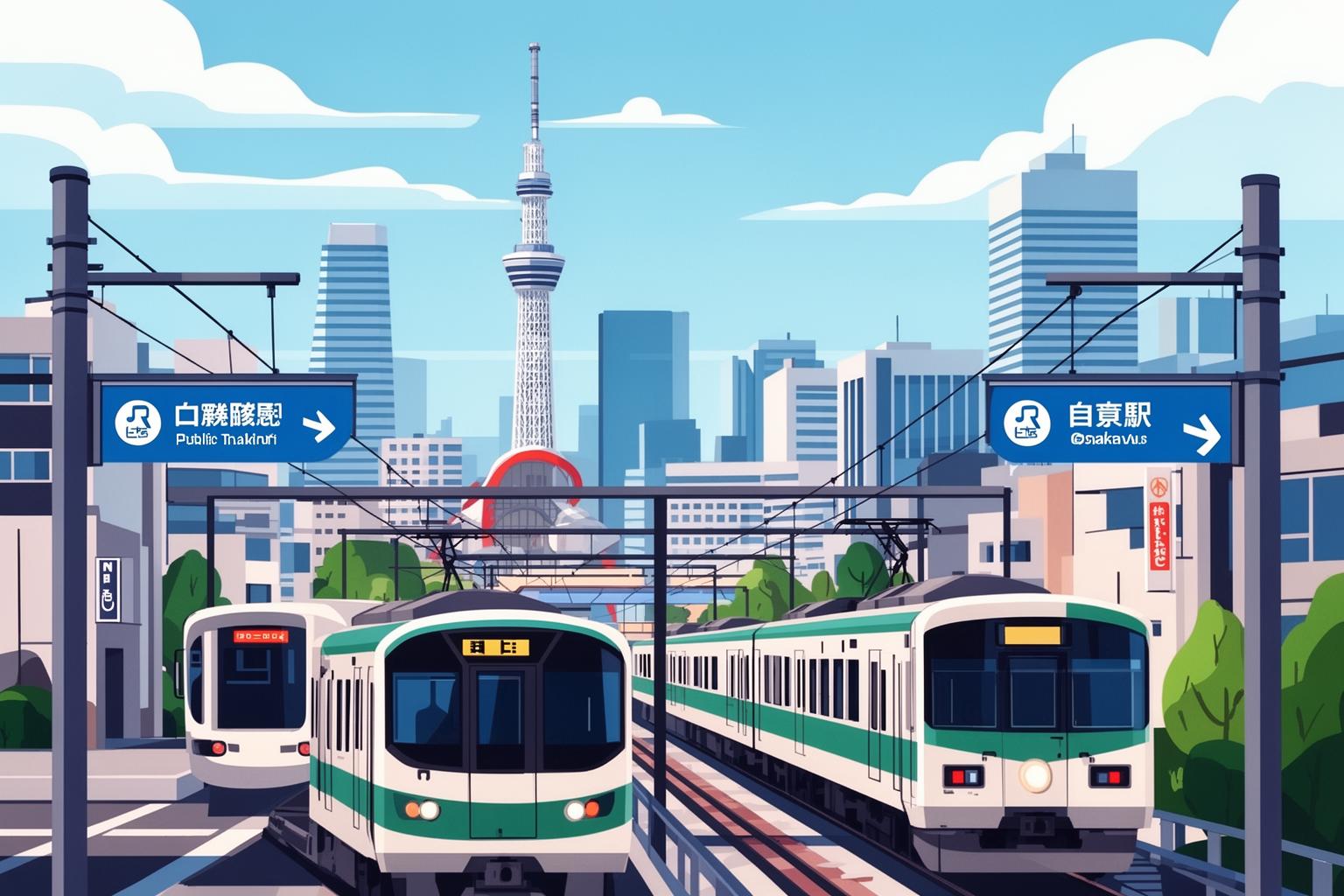
The escalator rule serves as an ideal introduction to grasping the wider etiquette and atmosphere of public transportation in Osaka, which contrasts sharply with the quiet, almost reverential commuting experience in Tokyo. Osaka’s train and subway cars mirror the city’s character: somewhat louder, far more expressive, and buzzing with a distinctly human energy. Mastering this system means tuning into a different set of social signals, where efficiency and straightforwardness blend with an unexpected warmth and sociability.
The Symphony of the Train Platform
At first sight, the behavior on an Osaka train platform appears identical to Tokyo’s. People line up orderly in designated spots, waiting for the train’s arrival. Yet, on closer inspection, subtle differences emerge. The lines seem more… organic. There’s a slight shuffle, a collective leaning forward as the train nears, an unspoken urgency. The key rule of allowing passengers to exit before boarding remains intact, but once the way is clear, the rush to get on feels quicker and more assertive. It’s not aggressive, yet undeniably efficient—there’s no time wasted.
The notorious Japanese rush hour, tsukin jigoku or “commuting hell,” is just as intense in Osaka as in Tokyo, especially on the crucial Midosuji subway line running north to south across the city. Being squeezed so tightly on a train that you can’t even move your arms is a common rite for the city’s workforce. Still, even in this crush, the atmosphere differs. You’ll hear more grumbling, sighs, and audible responses to the squeeze. It’s a shared experience endured with resigned, dark humor rather than quiet, stoic anonymity. Somehow, the struggle feels more communal.
The Soundscape of the Commute
The most notable difference, often surprising to Tokyo visitors, is the sound. Tokyo trains are known for their silence. Conversations are kept to a whisper, and phone calls are largely taboo. In contrast, Osaka train cars are filled with noise. While phone calls remain generally frowned upon, chats among friends, colleagues, and family happen at normal volume. Laughter breaks out. Friends animatedly discuss their day’s events. This creates an atmosphere more akin to a lively public square than a library on wheels.
Here, you’ll also be fully immersed in Osaka-ben, the local dialect. It’s faster, more melodic, and earthier than standard Japanese, dotted with unique words and phrases. You’ll hear the common ‘meccha’ (very), the puzzled ‘nande ya nen?’ (what the heck?), and the friendly negative suffix ‘-hen’ instead of the standard ‘-nai.’ Hearing Osaka-ben in its natural setting is one of the great pleasures of living here. It’s the city’s soundtrack, reflecting the openness and expressiveness of its residents.
This expressiveness is embodied by the Osaka obachan—a term for middle-aged and older women. They are the unofficial queens of the city’s public transit. Often dressed in bold patterns (frequently leopard print, as the stereotype suggests), they are candid, warm, and completely unafraid to speak their minds. An obachan might unexpectedly strike up a conversation, offer you a piece of hard candy (ame-chan), or bluntly tell a young person to give up their seat for someone more in need. They are the enforcers of a practical, people-centered social order, and their presence adds a lively and often heartwarming dimension to any journey.
A Note on Politeness: Direct vs. Indirect
This atmospheric difference points to a fundamental contrast in communication styles. Foreigners often find Osaka’s directness easier to navigate compared to Tokyo’s subtle, indirect approach. In Tokyo, preserving group harmony (wa) is crucial, so people often avoid confrontation or saying ‘no’ outright. Osaka’s communication is more transactional and frank. People generally say what they mean, often softened with humor or a friendly tone. That “suimasen” on the escalator wasn’t passive-aggressive; it was a straightforward request: “I need to get by.” This directness can be mistaken for rudeness by those unfamiliar with it, but it usually stems from a desire for clarity and efficiency, not hostility. For many non-Japanese residents, this frankness is refreshing, making social interactions clearer and easier to interpret.
The Ripple Effect: How One Habit Explains a City
The choice to stand on the right side of the escalator is far from a mere quirk. It serves as the tip of an iceberg, a visible sign of deeper cultural currents that influence every part of life in Osaka. This single, collective habit stands as a powerful symbol, reflecting the city’s core identity, its historical awareness, and its relationship with the rest of Japan. Grasping this ripple effect is essential to fully appreciating what makes Osaka such a unique and captivating place to live.
A Healthy Dose of Skepticism Towards “The Standard”
At its core, the escalator rule is a quiet act of rebellion. It represents a daily, non-confrontational declaration of independence from the standards imposed by Tokyo. Osaka boasts a long and proud history. For centuries, it was Japan’s main economic hub and, in many respects, its cultural center. The transfer of political and economic power to Edo (now Tokyo) during the Tokugawa shogunate marked a historical turning point never fully forgotten. A playful, sometimes serious rivalry with Tokyo endures to this day. Osakans often view Tokyo as overly formal, bureaucratic, and obsessed with appearances. In contrast, they take pride in being more pragmatic, innovative, and down-to-earth.
Standing on the right perfectly embodies this spirit. It’s a way of saying, “We know the rules in Tokyo, but we have our own way of doing things here, and it works for us.” This attitude extends into many areas. Osaka has its unique comedy style (manzai), its distinct foodie culture (kuidaore, meaning to eat oneself into ruin), and a business environment often regarded as more agile and risk-taking than Tokyo’s. Living in Osaka means recognizing that “the way it’s done in Japan” often means “the way it’s done in Tokyo,” but Osaka operates by its own rules and logic.
People-First, Logic-Driven
Osaka’s culture is fundamentally human-centered. While rules and procedures matter, they often take a backseat to common sense and the immediate needs of people in any given moment. The city’s merchant heritage fostered a culture of negotiation, flexibility, and personal relationships. This creates a daily life that often feels warmer and less rigid than other parts of Japan. A shopkeeper in the Tenjinbashisuji shopping arcade might add a little something extra for free (omake) as a goodwill gesture. A stranger asked for directions might accompany you halfway, chatting animatedly all the while. This same spirit explains why chatting on the train is acceptable and why an obachan offering candy is a familiar sight.
This people-first logic means Osakans constantly calculate the most efficient and sensible way to engage with their environment and each other. The escalator rule fits perfectly here. Whether it originated at the Expo or with Hankyu Railways, it was embraced because it made sense to people on the ground. It helped smooth the flow of pedestrian traffic. This pragmatic, results-focused mindset defines the Osakan character—a city fueled by a powerful mix of human warmth and street-smart practicality.
What This Means for You, the Foreign Resident
For anyone living in Osaka or considering moving here, these cultural currents carry real, practical meaning. First, go with the flow. Don’t resist local customs. Watch how people behave on the subway, in shops, and in your neighborhood, and adapt accordingly. Standing on the right is your first lesson in this—it signals respect for local ways.
Second, learn to value directness. Don’t confuse straightforward remarks or quick requests with rudeness. More often, they reflect honesty and an effort to be clear and efficient. This can actually simplify life, reducing the uncertainty often involved in navigating Japan’s typically indirect communication styles. Third and most importantly, use public transportation as your classroom. Listen to the rhythm of Osaka-ben. Observe interactions between people. Notice the thousands of small, unspoken rules that shape daily life. Here you will discover the city’s true, unfiltered personality—in the friendly chaos of the train platform, the lively chatter inside the carriage, and the simple, shared act of standing on the right.
Final Thoughts: Beyond the Escalator
It starts with an escalator. It begins with a brief moment of confusion, a gentle nudge, a subtle shifting of feet from left to right. Yet it concludes with a deep understanding. The simple act of choosing where to stand on a moving staircase in Osaka is a thread that, when pulled, unravels the entire beautiful and intricate tapestry of the city’s culture. It’s a daily ritual reflecting a proud history, a practical present, and a fiercely independent spirit. It tells the story of a city that has always looked outward, built by the hands of merchants and entrepreneurs, and that values human connection and common sense above strict formality.
This single habit serves as a constant, visible reminder that Osaka is more than just another Japanese city. It is a place with its own logic, its own soundtrack, and its own distinctive way of moving through the world. To live here is to learn its rhythm, adjust to its flow, and appreciate the direct, warm, and genuinely human energy that makes it so unique. When you find yourself instinctively stepping to the right side of the escalator without hesitation, you’ll know you’re no longer simply a visitor. You are beginning to grasp the heart of Osaka—a city that rewards those who pay attention with an experience that is authentic, vibrant, and unforgettable.