
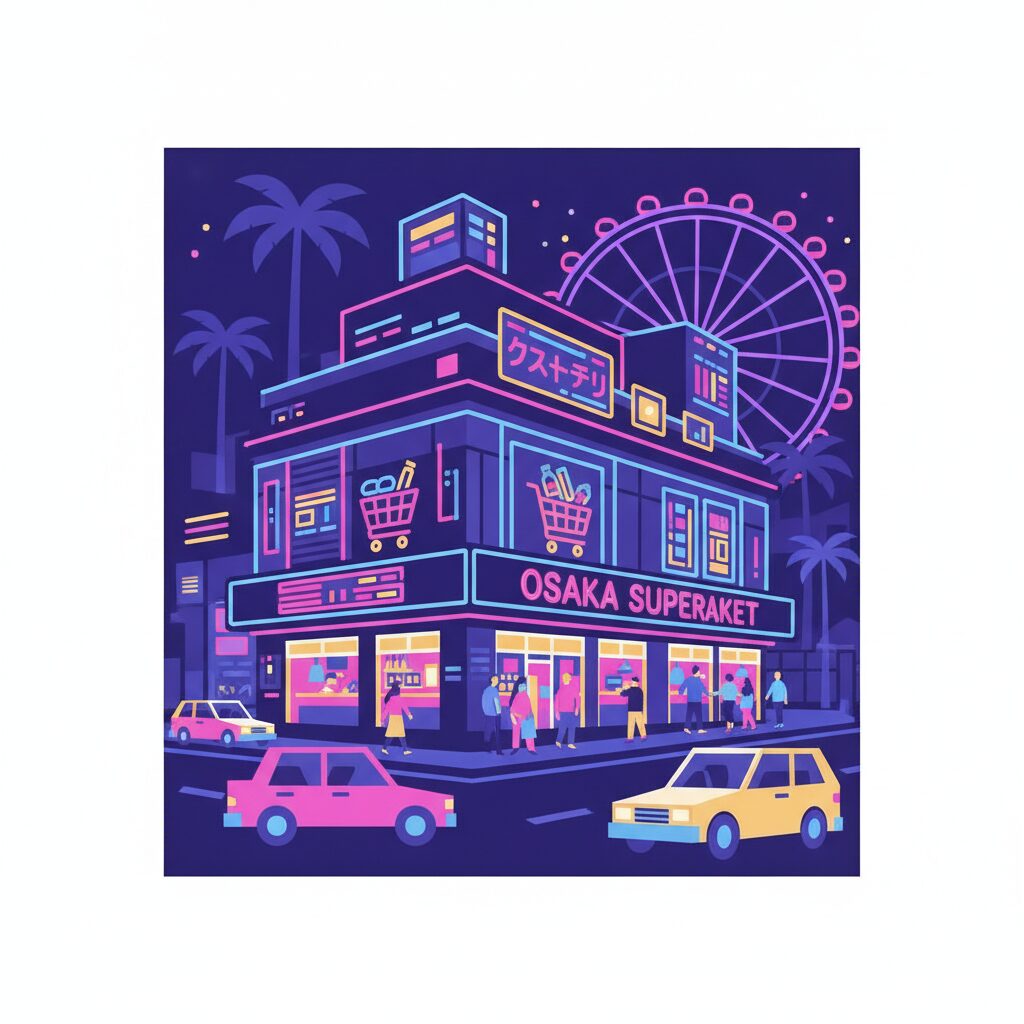
Your first time seeing a Super Tamade is a rite of passage in Osaka. You’re walking down a quiet residential street, past weathered apartment buildings and tiny local shrines, when you’re suddenly hit by a visual and sonic boom. A building, plastered in screaming yellow and red, is flashing like a pachinko parlor on a three-day bender. Blinking neon signs outline everything from the entrance to the rooftop. Giant, crudely painted billboards advertise impossibly low prices. It feels less like a place to buy milk and eggs and more like a portal to a forgotten, hyper-saturated dimension of 1980s Japan. It’s a sensory overload, an aesthetic assault, a place that seems to defy every stereotype you’ve ever held about Japanese subtlety and minimalist design.
If you’ve come from Tokyo, the contrast is staggering. Tokyo supermarkets, even the budget-friendly ones, maintain a certain level of chic composure. They are clean, organized, and quietly efficient. Super Tamade is none of those things. It is loud, chaotic, and unapologetically gaudy. Your first thought might be, “Is this a joke? A tourist trap?” But then you look closer. You see the crowds of locals—grandmothers with their shopping carts, students in their uniforms, salarymen with their briefcases—all streaming in and out with a sense of determined purpose. This isn’t a gimmick. This is where Osaka lives. And if you want to understand the city’s true character, its merchant soul, and its relentless pragmatism, you need to step through those flashing doors. Super Tamade isn’t just a supermarket; it’s the key to understanding why life in Osaka feels fundamentally different, and for many, far more grounded and real, than anywhere else in Japan.
Amid the striking visuals of Super Tamade, Osaka’s broader economic vitality also emerges in the form of its rising Kansai hotel investment, which underscores the region’s post-Expo momentum.
The Unspoken Philosophy: “Yasui Mon Kachi” (Cheap is Winning)
To understand why Super Tamade thrives, you need to grasp a key principle of the Osaka mindset: yasui mon kachi, which roughly means “cheap things are a victory.” This isn’t about poverty or stinginess; it’s about being savvy. In Osaka, a city historically dominated by merchants and traders, value is the highest virtue. Paying full price when a cheaper, perfectly good option is available is considered illogical, almost foolish. Conversations among friends are more likely to boast about a great bargain than to praise a luxury brand. “You paid how much? I got the same item for half the price over in Tennoji!” is common and highly respected social currency.
This outlook is a direct legacy of Osaka’s past as Japan’s commercial center, known as the “nation’s kitchen.” For centuries, this city was a hub of commerce where fortunes hinged on the smallest margins. The skill to evaluate true value, to negotiate, and to secure the best deal was essential for survival. That mindset remains today. While Tokyo may emphasize presentation, impeccable service (`omotenashi`), and the prestige of a premium experience, Osaka focuses on the bottom line. The best service you can offer an Osakan is a good price.
Super Tamade embodies this philosophy in every way. The store’s atmosphere shouts “we save you money.” Its interior is cluttered with handwritten signs, narrow aisles packed with cardboard boxes, and harsh fluorescent lighting that makes everyone look a bit unwell. There’s no soothing music or carefully arranged pyramids of flawless apples. It’s pure, unfiltered practicality. The intentional absence of aesthetic polish is a feature, not a flaw. It signals to customers: “We’re not spending a single yen on fancy displays or interior designers. That money goes straight back into your pocket through lower prices.” It’s a straightforward, if striking, pact between the store and its shoppers.
Deconstructing the Tamade Experience: A Symphony of Savings
So how exactly does Tamade manage to offer such mythically low prices? It’s not a single secret but rather a multi-faceted approach that challenges the traditional grocery model. Shopping at Tamade feels like an interactive experience—a game where the reward is a noticeably lighter grocery bill. Mastering its unique systems is crucial for any local aiming to live affordably.
The Legendary 1-Yen Sale: More Than Just a Gimmick
Tamade’s most renowned tactic is the 1-yen sale. The rules are straightforward: spend 1,000 yen on your total purchase, and you gain the chance to buy a specific, heavily promoted item for just one yen. This item varies daily. It could be a carton of eggs, a block of tofu, a can of coffee, a packet of udon noodles, or a head of cabbage. From a business standpoint, it’s a classic loss leader designed to entice customers inside and encourage spending at least the 1,000 yen minimum.
But for Osaka shoppers, it means much more. It’s a ritual. You check the flyer or the sign outside to discover the day’s 1-yen item. You calculate your shopping list mentally to ensure you reach the 1,000 yen threshold. Leaving the store with a bag of groceries plus an almost-free item feels like a small but tangible win in everyday life. This transforms a mundane chore into a game you can actually win. It’s this gamification of thriftiness that deeply resonates with local culture. You’re not just saving money; you’re outsmarting the system.
The Bento Box Battlefield and Sozai Sanctuary
For students, singles, and anyone too worn out to cook, Tamade’s prepared foods section (`sozai`) is an absolute lifesaver. Here, the store’s value offer becomes genuinely transformative. While a bento box from a convenience store might cost between 500 and 700 yen, Tamade routinely sells full, hearty bentos for 250 yen. You can find large bowls of yakisoba for 180 yen, trays of sushi for 300 yen, and individual fried snacks like croquettes or tempura for under 100 yen.
The quality is, to be polite, utilitarian. This isn’t gourmet fare. But it’s hot, filling, and unbelievably affordable. For anyone living on a tight budget, the difference between a 600-yen lunch and a 250-yen lunch, day after day, is enormous. It frees up a significant portion of disposable income. This dedication to offering affordable, ready-to-eat meals reflects a deep understanding of the community it serves. It’s a practical solution for modern urban life that prioritizes accessibility over culinary finesse.
The Time Sale Gauntlet: An Evening Ritual
As night falls over Osaka, a distinct kind of excitement builds in the aisles of Super Tamade. This is the moment for the `nebiki` (discount) stickers. Around 7 PM, a staff member wielding a sticker gun begins to roam the perishable sections. A silent, unspoken game begins. Shoppers trail behind, carts ready. As the stickers appear—10% off, 20% off, and finally the prized `hangaku` (half price)—a polite but competitive frenzy unfolds.
This isn’t the chaotic scramble one might expect. It’s a rapid game of strategy and timing. When that half-price sticker hits the last pack of premium tuna, you have a split second to grab it before someone else does. Hesitate, and it’s gone. This ritual showcases the sharp, competitive, and quick-thinking nature of Osaka shoppers. They are not passive consumers but active hunters. The thrill of the chase and the satisfaction of landing a deeply discounted dinner item is a central part of the Tamade experience.
Questionable Quality? Unpacking the Tamade Supply Chain
Newcomers often ask, “Why is it so cheap? Is the food safe?” Yes, the food is perfectly safe, complying with Japan’s stringent food safety regulations. The secret lies in a business model focused on efficiency and a rejection of aesthetic perfection. Tamade lowers prices by sourcing products that other supermarkets reject—crooked cucumbers, undersized onions, and blemished apples that are nutritionally just as good but visually imperfect.
They maintain strong ties with local suppliers and ports, enabling them to purchase fish that must be sold the same day, eliminating middlemen and storage expenses. They use minimal packaging, stock their own no-frills house brands, and operate on a high-volume, low-margin basis. This is the `mottainai` (aversion to waste) philosophy applied to capitalism. Where a Tokyo supermarket sees a flawed product damaging its brand image, Super Tamade and its Osaka customers see a perfectly good ingredient and a bargain opportunity.
More Than a Supermarket: It’s an Osaka Mood
To dismiss Super Tamade as merely a cheap food market is to miss its deeper significance entirely. The store is a vibrant, living embodiment of Osaka’s distinctive cultural vibe. Its presence actively shapes the character and tempo of the neighborhoods it serves.
The Aesthetics of “Gote Gote”: Loud, Proud, and Unapologetic
Japanese design is frequently linked to `wabi-sabi`—the beauty found in imperfection, impermanence, and subtle simplicity. Super Tamade is its exact opposite. Its look is pure `gote gote`—gaudy, cluttered, flamboyant, and overflowing with visual noise. Neon lights, clashing colors, hand-drawn mascots—everything is part of a purposeful design.
This aesthetic directly reflects the commercial energy found in places like Dotonbori and Shinsekai, where gigantic mechanical crabs and towering pufferfish lanterns compete for attention. In Osaka’s merchant culture, shouting to be noticed is essential. A quiet, minimalist storefront is simply a dead storefront. Tamade’s design is the clearest possible form of communication. It doesn’t whisper; it shouts, “WE ARE CHEAP! COME IN!” This bold, upfront style often parallels the communication style of Osaka’s residents themselves—direct, honest, and unambiguous.
The Soundtrack of Savings: That Unforgettable Jingle
Step inside any Super Tamade, and you’re immediately wrapped in its theme song. It’s a maddeningly simple, cheerful, endlessly looping jingle that seeps into your mind and refuses to leave. It merges into the city’s ambient sounds. Mention the “Tamade song” to any local, and you’ll get an immediate, knowing response—a groan, a chuckle, maybe a hummed rendition. It’s a shared cultural touchstone, an audio thread that connects the community in a strange, hypnotic beat. It’s irritating, unforgettable, and utterly Tamade.
The People of Tamade: A Unifying Force
Take a look at those shopping around you. You’ll see every layer of Osaka society. An elderly woman in a fashionable hat, carefully selecting daikon radishes. A university student with bleached hair, filling his basket with instant ramen and discounted meat. A mother with two kids in tow, picking up snacks for school. An office worker in a sharp suit, heading straight for the half-priced sushi after a long day. Even local restaurant owners shopping in bulk. Tamade acts as a great equalizer. Within its bright walls, social status, occupation, and age fade away. Everyone is united by one common purpose: chasing a good bargain. In a country often marked by social divisions, the aisles of Tamade offer a refreshingly democratic space.
How to Shop at Tamade Like a Pro

For foreign residents ready to embrace both the chaos and the savings, here’s how to navigate Super Tamade as if you were born to it.
Master the Timing
Understand the rhythm of your local store. The best selection of fresh meat and produce typically arrives in the morning. Deep discounts on prepared foods and perishables start in the late afternoon and peak around 7-8 PM. Many stores hold major sales on specific days—often Wednesdays or Thursdays. Be sure to check the flyers.
Come Prepared
Although many Tamade locations now accept credit cards, cash remains the most reliable and often quicker option, especially at older stores. Importantly, bring your own shopping bags. While plastic bags are available for purchase, carrying a `my baggu` is the customary and expected practice. Wear comfortable shoes and get ready for crowded, narrow aisles.
Adopt the Mindset
Don’t enter Tamade with a fixed, unchangeable shopping list. Instead, approach it with an open mind. Be a hunter. Notice what’s on special today. Is pork belly incredibly cheap? Looks like butabara is on the menu for dinner. Were the avocados discounted? It’s guacamole night. Flexibility is key to maximizing your savings. Spot a good deal? Snatch it without hesitation. This agile, opportunistic approach to shopping is the true Osakan way.
What Tamade Teaches You About Osaka
Living in Osaka and growing to love Super Tamade is an education. It teaches you to look beyond surface appearances and discover true value. It demonstrates that communication doesn’t always need to be subtle and indirect; sometimes, the clearest way to be understood is to be loud, bright, and impossible to ignore. It unveils a community spirit founded not on shared luxury, but on the shared, joyful pursuit of a bargain.
If you can grasp why a garish, noisy, chaotic supermarket is not only tolerated but cherished by its community, you’ve started to understand the soul of Osaka. You’ve realized this is a city that prioritizes substance over style, practicality over presentation, and a good laugh over rigid formality. Super Tamade is more than a place to cut your grocery bills. It’s a daily lesson in the brilliant, unpretentious, and deeply human spirit of Japan‘s most vibrant city.








