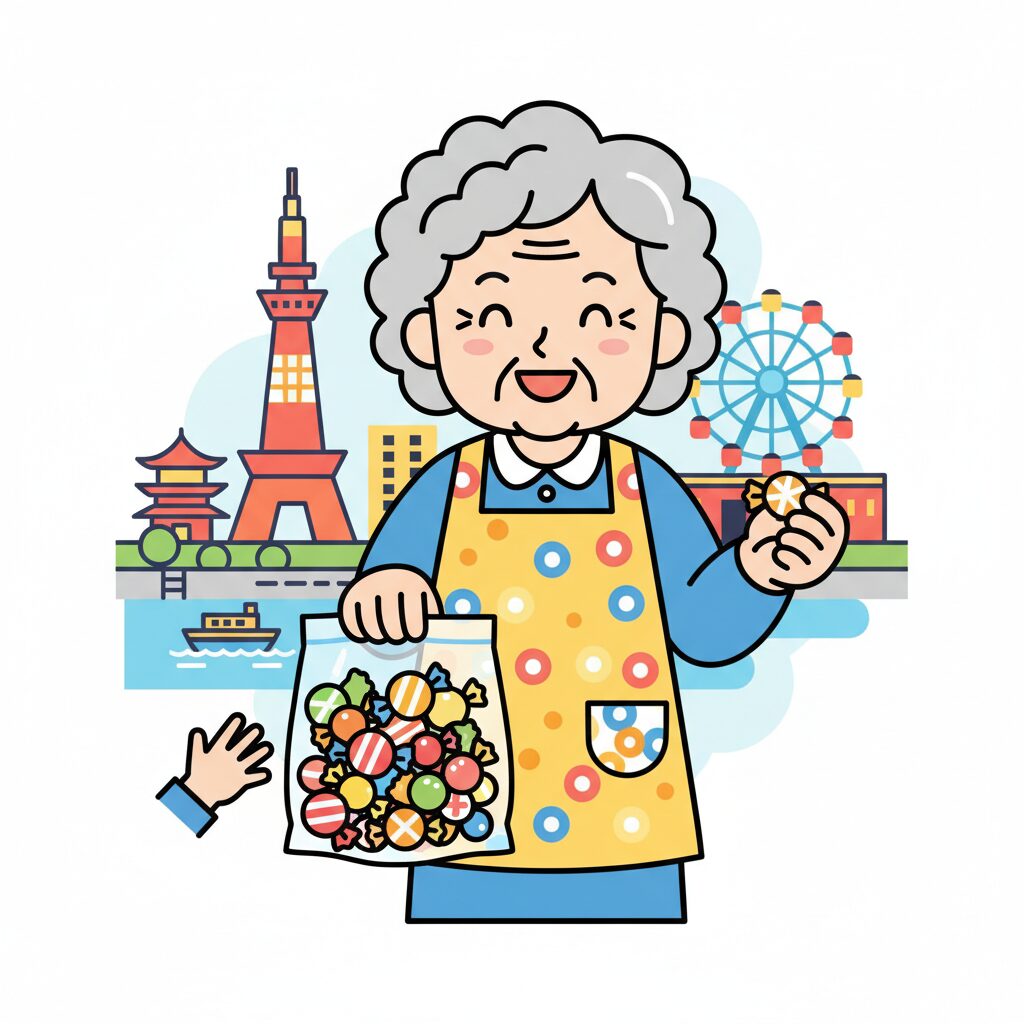
It happened on a Tuesday, on the rattling train from Umeda to Kobe. I was new, not just to Osaka, but to the whole beautiful, bewildering country of Japan. I was doing what you do when you’re new: staring out the window, trying to look like I belonged while feeling profoundly like an alien. A few seats away, a toddler, who had previously been a picture of calm, decided his patience had expired. He began to wail, a rising siren of toddler-sized despair that filled the quiet carriage. His mother whispered, she bounced, she offered a toy. Nothing worked. The air grew thick with that universal tension of a public tantrum. Then, something incredible happened. An elderly woman, her hair a perfect silver helmet, rustled in her handbag. She leaned across the aisle, a crinkled smile on her face, and extended a small, brightly wrapped candy towards the child. ‘Ame-chan, douzo,’ she chirped. The crying stopped, replaced by a hiccup and a curious stare. The mother bowed deeply, a wave of relief washing over her face. The interaction was over in ten seconds, a tiny, silent play in three acts. But for me, it was a revelation. This wasn’t just a piece of candy. It was a message. It was a tool. It was a key to understanding the city I’d chosen to call home. This was my first encounter with Osaka’s legendary ‘ame-chan’ culture, a phenomenon that says more about the soul of this city than any guidebook ever could.
Living in Osaka is a fundamentally different experience from living in Tokyo, or even Kyoto. It’s a city that runs on a different operating system, one programmed with directness, humor, and a deep-seated desire for human connection. The ame-chan is the symbol of that system, a small, sweet piece of code that unlocks the city’s unique social software. It’s the unofficial currency of kindness, a conversation starter wrapped in cellophane, and a daily reminder that you’re part of a community, not just a commuter. For anyone looking to truly live here, understanding the ame-chan is understanding the heart of Osaka itself.
This unique social currency is just one facet of Osaka’s distinct character, which is also reflected in other surprising aspects of the region’s culture, such as the staggering economic impact of cats in Japan.
What Exactly is ‘Ame-chan’ Culture? More Than Just a Sweet Tooth
On the surface, ‘ame-chan’ seems simple. ‘Ame’ means candy in Japanese, and ‘chan’ is a common affectionate suffix often used for children or close friends. Thus, ‘ame-chan’ literally translates to ‘little candy.’ However, the culture surrounding it is a complex and beautiful social mechanism. It involves the spontaneous and unsolicited act of giving a small, individually wrapped candy to someone—a stranger, a neighbor, a shopkeeper, or a crying child on a train. This gesture carries a surprisingly significant meaning, serving as an apology, a thank you, an icebreaker, or simply a way to acknowledge a shared moment of humanity. In a country often seen by outsiders as reserved and formal, this casual exchange of sweets offers a warm, informal connection that is quintessentially Osaka.
The Unspoken Rules of the Exchange
Like many traditions in Japan, the ame-chan exchange comes with its own unwritten rules. The foremost rule is that it is never, ever transactional. There is no expectation of anything in return beyond a simple acknowledgment. This isn’t a business deal; it’s a human interaction. The typical giver of ame-chan is the ‘Osaka obachan’—the energetic, often leopard-print-wearing middle-aged or elderly woman who acts as the city’s unofficial mascot. They are the guardians of this tradition, the high priestesses of the candy ritual. Yet, this practice isn’t limited to them. Shopkeepers, taxi drivers, and even businessmen might surprise you with a small sweet. Timing is important. An ame-chan may be offered to soothe a crying child, as I witnessed on a train. It might be given after a minor bump in a crowded market. It can be a little ‘thank you’ from a cashier tucked into your shopping bag, or it might appear unexpectedly while you’re waiting in a long line—a silent gesture of solidarity from the person beside you. The candy is almost always a hard candy, something that won’t melt in a pocket or purse. Popular varieties include ‘Kuro-ame’ (a rich black sugar candy), ‘Nodo-ame’ (herbal throat lozenges, for unexpected coughs), or simple fruit-flavored sweets. Crucially, they are individually wrapped, hygienic, and ready to be offered at a moment’s notice.
The ‘Ame-chan’ Pouch: An Essential Osaka Accessory
If you want to identify a true Osakan, don’t just look at their clothes or listen for their accent—check inside their bag. There’s a good chance you’ll find a small dedicated pouch filled with a variety of candies. This isn’t merely a quirky habit; it represents a state of readiness. The ame-chan pouch acts as a social first-aid kit, a tool belt for navigating the city’s human landscape. It signals a willingness to engage, to comfort, to connect. It says, ‘I’m prepared for any social situation that might come up.’ This fascinating piece of material culture reveals a deeper truth about the local mindset. While in many cultures a handbag contains items for oneself—a wallet, keys, makeup, or a phone—in Osaka, it often holds something explicitly for others. This outward consideration, this readiness to interact with the community, is central to the city’s identity. Witnessing this in action—seeing someone carefully select the perfect candy for the moment—is like watching a skilled diplomat at work, using sweets instead of words to build bridges and ease the small tensions of daily urban life.
The Psychology Behind the Candy: Why Osaka?
To truly understand the ame-chan phenomenon, you need to look beyond its surface and explore the city’s history and spirit. Why did this particular tradition take such strong hold in Osaka, rather than in cities like Tokyo or Sapporo? The key lies in Osaka’s history as Japan’s commercial hub, known as the ‘nation’s kitchen,’ a city shaped not by samurai or nobility, but by merchants and craftsmen. This mercantile heritage fostered a culture that is pragmatic, resourceful, and deeply centered on human relationships. The merchant’s spirit—one that requires connection, persuasion, and trust to thrive—is embodied in the simple gesture of offering a small piece of candy.
Breaking Down Barriers in a Merchant City
For centuries, Osaka was a center of trade. ‘Akinai,’ the art of business, was the city’s lifeblood. A merchant’s success depended on quickly establishing rapport. You had to be perceptive, quick-witted, and adept at creating a warm, personal environment. Formality was considered a luxury; connection was essential. Deals were sometimes sweetened—quite literally—by small tokens of goodwill. The ame-chan culture stems directly from this approach. It serves as a tool to instantly bridge the psychological gap between two people. It conveys, ‘Let’s skip formalities and simply be human together.’ It acts as a tiny negotiation with simple terms: I offer this small kindness, you accept it, and for a moment, we share a connection. In a city where livelihoods were built on personal relationships, such shortcuts to familiarity became ingrained cultural instincts. That spirit still resonates today when a stranger offers you a candy; it’s the echo of centuries of commerce done with a human touch.
Communication Over Formality: The Osaka Way
This highlights a crucial contrast between Osaka and Tokyo. Tokyo, as Japan’s political and aristocratic center for 400 years, cultivated a culture that values ‘tatemae’—the public facade, proper etiquette, and adherence to social protocols. Interactions can be polite and efficient but often maintain a formal distance. Osaka, in contrast, tends to emphasize ‘honne’—true feelings and genuine intent. Osakans are known for their directness and value honest, straightforward communication. The ame-chan perfectly expresses this. It is a pure ‘honne’ gesture—not about observing etiquette, but about a spontaneous feeling. It represents a direct form of communication that bypasses polite but empty phrases. It’s a tangible way of saying, ‘I see you. We share this space and moment.’ For foreigners grappling with the nuances of Japanese communication, the ame-chan can feel like a welcome relief. It’s simple, clear, and its meaning unmistakably conveys friendliness.
It’s Not Charity, It’s a Conversation Starter
Newcomers often wonder how to interpret this gesture. Is it pity? Does the giver see me as sad, hungry, or in need? The answer almost always is no. It’s vital to recognize that giving ame-chan isn’t an act of charity. It’s an act of community—an invitation. By offering the candy, the giver opens a small window for social interaction. They are not looking down on you; they are reaching out. The expected response is not overwhelming gratitude but a warm, simple acknowledgement. A smile, a nod, or a quiet ‘arigatou gozaimasu’ suffices. This exchange completes the social circuit. While refusing is understandable, it can feel like closing that window and might be seen as declining the offered connection. Accepting the candy—even if you later tuck it away—is the polite and gracious way to honor the gesture and participate in this distinctive Osakan custom.
Ame-chan in Action: Where You’ll Encounter This Sweet Phenomenon
The charm of ame-chan culture lies in its presence beyond specific venues or special events. It’s intricately woven into the rhythm of everyday life, appearing in the most ordinary places and momentarily transforming them into spaces of warm human connection. Once you learn to recognize it, you’ll notice it everywhere—a constant, gentle undercurrent running through the city’s pace. These are not exaggerated tales; they are the daily fabric of life in Osaka.
On Public Transport
In many major cities, trains and buses are often silent, isolating spaces, but in Osaka, they become prime settings for ame-chan exchanges. The train car is seen as a shared environment, and Osakans treat it accordingly. Like in my first experience, a crying baby often sparks action. Ame-chan serves as a communal tool to restore calm—not just the mother’s issue, but the carriage’s concern, with anyone carrying candy empowered to help. You might also notice someone offering their seat to an elderly passenger, accompanied by a discreet candy handed over with a ‘thank you.’ Or when delays cause frustration, a shared sigh might lead to an offered throat lozenge—a simple act fostering shared endurance. It’s a way of transforming a group of strangers into a brief, close-knit community.
At the Local Shotengai (Shopping Arcade)
Nowhere is Osaka’s spirit more vivid than in its shotengai, the covered shopping arcades threading through residential neighborhoods. These are the lifelines of local life, and ame-chan culture pulses at their core. Unlike the sterile efficiency of supermarkets, shopping here is a social experience. While buying vegetables, the vendor may chat about the weather while tossing a lemon candy into your bag. “Maido!” she’ll greet you—the classic Osaka merchant’s phrase meaning “thanks for your continued business.” The butcher might say “Otsukaresama” as he returns your change, slipping in a small milk candy. This isn’t a calculated loyalty scheme, but a sincere, human connection being nurtured. The candy symbolizes that bond—a small gesture that builds goodwill and encourages you to return, not just for goods but for the relationship.
In Unexpected Places: The Doctor’s Office, the Bank, the Ward Office
Some of the most surprising and meaningful encounters with ame-chan culture occur in places often linked to stress, boredom, and bureaucracy. Waiting in a slow-moving line at the ward office to renew your residence card is a universal trial. But in Osaka, that shared hardship can spark connection. The person beside you might catch your eye, shake their head with a knowing smile, and offer you a candy. Suddenly, you’re not strangers trapped in red tape, but comrades facing it together. At the doctor’s office, a nurse might hand you a candy after a tough blood draw. At the bank, the teller could slip one into your new passbook. These small acts carry great meaning. They humanize sterile settings and remind us that even within the machinery of a modern city, we are all just people—and a little sweetness can brighten the day.
How to Navigate Ame-chan Culture as a Foreign Resident
For someone who is not a Japanese resident, encountering this culture for the first time can be both charming and a bit puzzling. What’s the proper etiquette? Am I doing it correctly? Embracing ame-chan culture is a lovely way to connect more deeply with the city. It offers a chance to move from being an outside observer to becoming an active participant in local life. With just a few simple tips, you can handle these sweet exchanges with confidence and ease.
The Art of Receiving
When you’re offered an ame-chan, the key is to stay relaxed. The gesture is intended to be casual and friendly, so your response should mirror that. No need for a deep, formal bow—a slight nod or a small dip of the chin will do. Make eye contact and smile; a genuine smile is the most important part of the exchange. The verbal response is straightforward: ‘Arigatou gozaimasu’ (thank you) is always appropriate. In very casual situations, you might hear ‘Sumimasen,’ which usually means ‘excuse me’ but is often used to express ‘thank you for your trouble.’ Either phrase is perfectly fine. Accept the candy with one or both hands. What if you don’t eat sugar or dislike the taste? That’s not an issue. The social agreement is fulfilled by accepting the candy, not by eating it. Simply receive it graciously and tuck it into your pocket or bag. The giver won’t be offended if you don’t eat it immediately—they’ve already moved on, completing the social exchange.
To Give or Not to Give? Becoming an Ame-chan Ambassador
After living in Osaka for a while, you might wonder: Should I start carrying candy? There’s absolutely no requirement to do so. No one expects a foreigner to have mastered this local custom. However, if you choose to participate, it can be a truly rewarding experience. It’s a way to show that you recognize, understand, and appreciate the local culture. It sends a strong message that you’re not just living in Osaka, but you’re trying to live like an Osakan. If you decide to join in, select your candies carefully. Individually wrapped hard candies work best. Keep a small, neat pouch in your bag and wait for the right opportunity. Did someone give you directions? Offer them a candy along with your ‘arigatou.’ Sitting next to someone on a long bus ride? Sharing a candy can be a quiet, thoughtful gesture. The response you’ll usually get is one of surprised delight. It can instantly break down barriers and spark wonderful, unexpected conversations. You shift from being a ‘gaijin’ (foreigner) to ‘someone who gets it.’
Misinterpretations to Avoid
Our own cultural backgrounds naturally influence how we interpret things. To fully embrace ame-chan culture, it helps to clear up some common misunderstandings foreigners might have. First, this is not a romantic gesture. A shopkeeper or elderly woman handing you a candy isn’t flirting. It’s a friendly, communal act without romantic intent. Second, for those from cultures where accepting food from strangers is taboo, trust is essential here. This gesture comes from a place of strong community trust—it’s safe. Third and most importantly, it’s not a comment on your mood or appearance. You could be smiling and looking your best, and still be offered a candy. It’s not because you seem like you ‘need’ it. It’s a proactive, not reactive, gesture—meant to create a positive moment, not to fix a negative one.
The Bigger Picture: What Ame-chan Tells Us About Living in Osaka
The delightful custom of candy-giving is more than just an endearing habit—it offers a glimpse into the core philosophy of Osaka. It symbolizes how the city operates daily and conveys the atmosphere of the place in a way that data on population density or economic output never could. Ame-chan embodies Osaka’s social ecosystem in miniature, and understanding it is essential to deciding if this city’s distinctive style of urban life suits you.
A City Built on Human-Scale Interactions
At its essence, Osaka is a city that treasures human-scale interactions. While Tokyo can sometimes seem like a vast, impersonal machine where people are merely parts of a smoothly running system, Osaka feels more like an expansive patchwork of villages. Life here revolves around personal connections—with your local shopkeepers, neighbors you greet on the street, and even strangers with whom you share a piece of candy on the train. The culture encourages—and almost requires—a certain level of casual engagement. People will strike up conversations, ask where you’re from, and crack jokes at the checkout. For those who thrive on spontaneous connection, Osaka is a paradise. But for those who prefer the quiet anonymity of a big city, it may sometimes feel intrusive. Ame-chan serves as an ideal litmus test: if the thought of a stranger offering you candy feels warm and inviting, you’ll probably love Osaka’s social vibe. If it feels awkward or uncomfortable, the city’s natural “nosiness” might feel overwhelming.
Osaka vs. Tokyo: The Sweet Contrast
The difference from Tokyo is striking and best illustrates Osaka’s uniqueness. Picture the ame-chan scenario on Tokyo’s Yamanote Line: an elderly woman offering candy to a stranger’s child would seem highly unusual, likely met with confusion or suspicion. It would break the unspoken social rule of keeping a respectful distance and avoiding imposition on others. This doesn’t mean Tokyo’s people are cold or unfriendly; they simply adhere to a different social code that values harmony through non-interference. In Osaka, harmony is often created through active, positive involvement. The ame-chan is a friendly interruption—a way of saying, “I’m briefly entering your personal space to share a moment of kindness.” This fundamental difference in what defines positive social behavior is perhaps the greatest distinction between Japan’s two largest cities and a crucial factor for anyone choosing where to live.
The Future of Ame-chan
Is this tradition fading? It’s a fair question. Ame-chan culture is undeniably strongest among older generations—the obachan who grew up in a less digital, more face-to-face world. Younger Osakans are less likely to carry dedicated candy pouches. Yet, the spirit behind ame-chan remains alive. The directness, humor, and willingness to engage with strangers continue, just expressed differently. It might be a young shopkeeper sharing a joke or a concert attendee starting a conversation while waiting for a band. The medium may evolve, but the message of open, accessible humanity endures. The candy itself is a beautiful, tangible symbol of Osaka’s soul, but the true culture lies in the mindset—a mindset as vibrant and resilient as the city itself.
So next time you’re in Osaka and a hand extends toward you with a small, cellophane-wrapped offering, you’ll know what to do. You’ll realize you’re not simply receiving a piece of candy—you’re receiving an invitation. You’re being welcomed, in the most Osakan way possible, into the lively, warm, and wonderfully human conversation of the city. Accept it, smile, and you’ll have taken your first genuine step toward becoming not just a resident but a true member of the community. In Osaka, the sweetest things in life aren’t just those you taste—they’re the small, daily connections you share.