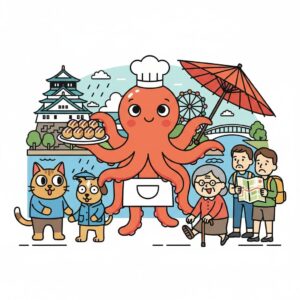
Step off the Shinkansen into the electric embrace of Osaka, and the first thing you’ll notice isn’t the towering Umeda Sky Building or the neon-drenched chaos of Dotonbori. It’s the sound. There’s a different rhythm here, a distinct melody that hums through the subway stations, echoes in the labyrinthine shopping arcades, and spills out of bustling izakayas. This is the sound of Osaka-ben, the city’s vibrant, energetic, and wonderfully expressive dialect. It’s more than just a regional accent; it’s the linguistic soul of Japan’s kitchen, a dialect cooked up in centuries of commerce, comedy, and an unshakeable sense of local pride. To understand Osaka is to understand its language, a key that unlocks a deeper, more authentic connection to this incredible city and its famously friendly people. Forget the polite, measured tones you might associate with standard Japanese; here in Osaka, language is a full-contact sport played with a wink and a smile. It’s direct, it’s warm, it’s funny, and sometimes, it’s a little bit loud. This guide is your invitation to tune in, to not just hear but to feel the city’s unique pulse. We’ll explore the phrases that define it, the cultural habits that shape it, and how a few simple words can transform you from a visitor into a participant in the daily life of this dynamic metropolis. Get ready to listen closely, because the story of Osaka is waiting to be told, one emphatic ‘Honma!’ at a time.
To truly immerse yourself in the city’s dynamic culture, finding the right place to stay is key, and you can currently discover some excellent Kansai hotel bargains before potential rate increases.
The Rhythm of the City: What Makes Osaka-ben So Special?

Before we delve into the details of vocabulary, it’s important to capture the essence of Osaka-ben. Unlike the relatively flat and predictable intonation of standard Japanese, known as Hyojungo and mainly spoken in Tokyo, Osaka-ben is a melody of varying pitches and rhythms. Conversations ebb and flow with a musicality, words are frequently extended or shortened for emotional impact, and the overall tempo feels noticeably quicker, brimming with an energy that perfectly represents the city itself. This unique sound is shaped by its distinct history, geography, and the character of its people.
A Dialect Shaped in the Marketplace
To grasp the straightforward, practical, and often humorous tone of Osaka-ben, one must look back to the Edo Period (1603-1868). While Tokyo (then Edo) was the political center, home to the shogun and samurai class, Osaka stood as Japan’s commercial hub. Known as “Tenka no Daidokoro,” or “The Nation’s Kitchen,” it was a bustling marketplace where rice, sake, and numerous other goods were traded. The city was built and managed by a powerful merchant class, the chonin, whose lives centered on business, negotiation, and community.
This setting deeply influenced the local language. In a commerce-driven world, clarity, efficiency, and building rapport were essential. There was little room for the flowery, indirect speech favored by the aristocracy in Kyoto or the formalities of the samurai in Edo. Osaka merchants needed to be direct, foster trust quickly, and close deals. This gave rise to a dialect known for its bluntness. When someone from Osaka speaks their mind, they usually mean it—a trait that outsiders might see as abrupt but is locally interpreted as honest and respectful. You always know where you stand with an Osakan, and their language reflects this straightforwardness.
The merchant culture also nurtured a strong appreciation for humor. Laughter served as a social adhesive, helping to ease tense negotiations and strengthen relationships. The sharp comeback, the playful tease, the self-deprecating joke—all became integral to daily conversation. This tradition planted the seeds for Japan’s modern comedy scene, especially the manzai stand-up style, which remains a hallmark of Osaka speech today.
The Pride of the Kamigata Region
Osaka-ben is the most prominent dialect within Kansai-ben, a broader linguistic family spoken throughout the Kansai (or Kamigata) region, which includes cities like Kyoto, Kobe, and Nara. For centuries, this region was Japan’s cultural, political, and economic heart before power shifted to Edo. As a result, the dialects here have deep, prestigious origins. Yet each city has its own distinct flavor. Kyoto-ben, for example, tends to be softer, more refined, and aristocratic, echoing its history as the imperial capital. Kobe-ben carries its own stylish, port-city nuances.
Osaka-ben, in contrast, is celebrated for its lively energy and worn with pride. In a country where regional dialects were once discouraged in favor of a standardized national language, Osakans have passionately preserved and honored their linguistic roots. Speaking Osaka-ben is a bold statement of identity. It immediately conveys a shared cultural background, enthusiasm for the Hanshin Tigers baseball team, fondness for takoyaki and okonomiyaki, and a love of humor. It creates a sense of camaraderie, an invisible bond linking everyone from high-rise CEOs to grandmothers running small tobacco stands. When you hear Osaka-ben on a Tokyo train, you’ll often notice heads turning and smiles exchanged among Kansai natives—a quiet recognition of their shared home.
The Essential Osaka-ben Phrasebook: Beyond “Arigatou”
Learning a few essential phrases in Osaka-ben is the quickest way to connect with the city’s spirit. It signals that you’re not just a passing tourist but someone who has taken the time to embrace the local culture. The response you receive is almost always warm and welcoming. Here’s an in-depth look at the words and expressions that capture the sound of Osaka, offered not as a list, but as a flowing conversation.
Everyday Greetings and Key Expressions
Let’s begin with the fundamentals that bring daily interactions to life. These are the phrases you’ll hear from the moment you enter a local shop or meet a neighbor.
Maido! (まいど!)
Standard Japanese: Irasshaimase! / Konnichiwa / Arigatou English: Welcome! / Hey! / Thanks!
When you step into a family-run shop, restaurant, or local business in Osaka, you will almost certainly be greeted with a cheerful “Maido!”. Literally, it means something like “each time” or “every time,” stemming from the phrase “maido arigatou gozaimasu,” which means “thank you for your continued support.” Today, it carries a wonderfully flexible meaning—it’s a warm “welcome,” a casual “hello” to regular customers, and a hearty “thanks for your patronage” all rolled into one. It’s the quintessential sound of Osaka’s commerce and hospitality. For visitors, a simple smile and nod in return is ideal. Hearing it feels like receiving a small, audible hug from the city itself. Much less formal than the standard “Irasshaimase,” it instantly creates a more personal and down-to-earth atmosphere.
Ookini (おおきに)
Standard Japanese: Arigatou (gozaimasu) English: Thank you (very much)
Although “Arigatou” is widely used and understood, “Ookini” is the traditional Osaka way of expressing gratitude. It feels warmer, more heartfelt, and carries a touch of old-world charm. The word literally means “greatly” or “big,” implying a deep sense of thankfulness. You’ll hear it from shopkeepers as they hand you your change, from friends after doing a favor, or as a polite refusal: `ookini, kekko desu` (“no, thank you”). Using “Ookini” yourself will likely earn a surprised and pleased smile. It’s a simple word but carries the weight of Osaka’s history and kindness. Try it after enjoying a delicious okonomiyaki meal—the grateful reaction is definitely worth experiencing.
Honma? (ほんま?)
Standard Japanese: Hontou? (本当?) English: Really? / Seriously?
This is among the most frequently used and versatile words in Osaka-ben. “Honma” is Osaka’s equivalent of “hontou,” meaning “truth” or “reality.” As a question, “Honma?” is perfect for expressing surprise, disbelief, or seeking confirmation. Its power lies in its flexibility. With a rising intonation, it’s a genuine question: “You’re moving to America? Honma?!” With a flat, low tone, it can mean “Wow, really,” expressing admiration or astonishment. You can also emphasize a statement: “Kono takoyaki, honma ni oishii!” (“This takoyaki is really delicious!”). It’s a conversational Swiss Army knife. Mastering the different intonations of “Honma?” is like learning a secret handshake—it shows you’re truly tuned into the rhythm of Osaka speech.
Soya nen (そやねん)
Standard Japanese: Sou nan desu yo (そうなんですよ) English: That’s right. / Exactly. / That’s how it is.
This phrase represents ultimate agreement and affirmation. “Soya nen” is a warm, gentle way of saying “Yes, that’s it.” The “nen” ending is key in Osaka-ben, adding emphasis and a personal touch that standard “desu yo” often lacks. It feels inclusive, as if you’re sharing mutual understanding rather than merely confirming a fact. If a friend complains about the summer heat with “Atsui naa…” (“It’s hot, isn’t it…”), a perfect response is a sympathetic “Honma, soya nen.” (“Totally, that’s for sure.”) It’s the glue that holds many conversations together—a verbal nod that means, “I’m with you.”
Expressions of Feeling and Emphasis
Osaka-ben truly shines in conveying emotions. The dialect is rich with expressions that add vividness, punch, and personality to any statement.
Meccha (めっちゃ) / Bari (バリ)
Standard Japanese: Totemo (とても) English: Very / Super / Really
“Meccha” has become so popular it’s now used by young people throughout Japan, but its roots are firmly in Kansai. It’s the go-to intensifier for almost anything: “Meccha oishii” (super delicious), “meccha kakkoii” (super cool), “meccha tsukareta” (super tired). It sounds youthful and energetic. The even stronger Kansai alternative is “bari,” which carries a similar meaning. For something incredibly good, you might hear, “Kore, bari umai yan!” (“This is insanely good!”). While “totemo” is correct, it can sound a bit formal or textbook-like casually. Sprinkling “meccha” shows you’re comfortable and in tune with the local vibe.
Akan (あかん)
Standard Japanese: Dame (だめ) / Ikenai (いけない) English: No good / Not allowed / Oh no!
“Akan” is an essential word in Osaka. It’s a versatile term for negation and prohibition, meaning “no good” or “impossible.” If you try to cross at a red light, a concerned local might say, “Akan de!” (“Don’t do that!”). If you inquire about stock and it isn’t available, the shopkeeper might reply, “Akan wa.” (“Sorry, can’t do.”). It’s also used as an exclamation of frustration or failure, like “Oh no!” or “Damn!” in English. Forgetting your wallet might prompt the mutter, “Akan! Saifu wasureta!” (“Oh no! I forgot my wallet!”). Knowing “akan” is crucial for navigating daily life and heeding local warnings.
Nande ya nen! (なんでやねん!)
Standard Japanese: Doushite desu ka? (どうしてですか?) / Nanda yo! (なんだよ!) English: Why?! / What the heck?! / You’ve got to be kidding!
This is the single most iconic Osaka-ben phrase, popularized in manzai comedy routines. “Nande ya nen!” is the quintessential tsukkomi (straight man) retort to absurd or foolish statements. Though literally “Why?”, it’s packed with exasperation, humor, and affectionate disbelief. If a friend says they tried to make toast in a rice cooker, a quick “Nande ya nen!” perfectly captures the playful rebuke. It’s a non-angry expression used among friends, family, and colleagues. It signals close relationships where teasing is welcome. Using it requires good timing and context, but simply understanding it gives you a front-row seat to Osaka’s comedic spirit.
Chau chau (ちゃうちゃう)
Standard Japanese: Chigaimasu (違います) English: No, no, that’s not it at all. / You’re mistaken.
This charming repeated phrase is how Osaka-ben expresses “no” or “that’s wrong.” The repetition of “chau” (to be different or wrong) softens the correction and adds a rhythmic charm. It’s friendlier and less formal than “chigaimasu.” For instance, if someone confuses your dog for a cat, you might say with a smile, “Chau chau, inu ya de” (“No no, it’s a dog”). It’s so well-known it inspired a tongue-twister joke: A man points to a Chow Chow dog and asks, “Are, chau chau chau?” (“Is that a Chow Chow?”) The owner replies, “Chau chau, chau chau chau chau,” (“No no, it’s not a Chow Chow”). It perfectly reflects the playful spirit of the dialect.
Shiran kedo (知らんけど)
Standard Japanese: Shirimasen ga (知りませんが) English: …but I don’t really know for sure. / …or so I’ve heard.
A modern classic and true gem of Kansai communication, adding “shiran kedo” at the end of a sentence offers information, opinion, or advice without full commitment to its accuracy. It’s a conversational “get-out-of-jail-free” card. For example, “I heard that new ramen shop is the best in town, shiran kedo.” This means: “I’m sharing this info, probably true, but if you go and it’s bad, don’t blame me.” It’s not evasive but a social lubricant enabling relaxed exchange without pressure. It perfectly captures Osaka’s easy-going, pragmatic mindset. Once you notice it, you’ll hear it everywhere, quietly weaving through conversations.
The Subtlety of Osaka Sentence Endings
The true charm of Osaka-ben often lies not just in words, but in how sentences end. These particles bring warmth, emphasis, and emotion to the dialect.
The `-nen` Ending
As with “soya nen,” the `nen` particle is fundamental. It’s used for emphasis and adds a personal, explanatory nuance, similar to `no da` or `n desu` in standard Japanese but much warmer and more intimate. For example, “I love Osaka” in standard Japanese is “Osaka ga suki desu.” In Osaka-ben, it becomes “Osaka, suki ya nen.” The “ya nen” transforms a simple statement into a heartfelt expression, making it more like confiding in the listener. It’s the difference between “I like it” and “You know, I really like it.”
The `-hen` Negative Form
In standard Japanese, you make verbs negative with `-nai`, like “wakaranai” (“I don’t understand”). In Osaka-ben, this changes to “wakarahen” or simply “wakaran,” which sounds softer and less abrupt. So, “I can’t go” becomes “ikahen” instead of “ikanai.” This subtle shift contributes to the dialect’s melodic and informal tone.
The `-yan` and `-yan ka` Endings
Used to seek agreement or make exclamations—similar to “…isn’t it?” or “…right?” in English—these endings come from a contraction of “ya nai ka.” Seeing a beautiful view, you might say, “Meccha kirei yan!” (“It’s really beautiful, isn’t it!”). The `-yan ka` form is a stronger, more persuasive version: encouraging a friend with “Oishisou yan ka, tabete mi!” (“Looks delicious, right? Just try it!”). These endings make conversations feel more interactive and inclusive, as if inviting listeners to share your view.
The `-haru` Respectful Form
Standard Japanese has a complex honorific system (keigo), but Osaka also has a unique, warmer respectful form using `-haru`. Adding `-haru` to a verb stem shows respect without the social distance formal keigo sometimes creates. Instead of the formal “Sensei ga irasshaimashita” (“The teacher has arrived”), an Osakan might say, “Sensei ga kiharimashita.” It expresses familiar respect suitable for esteemed community members, senior colleagues, or older loved ones. Hearing `-haru` used about you conveys subtle but clear deference and affection.
Conversational Habits: The Unspoken Rules of Osaka Talk
Beyond specific words and grammar, the true essence of Osaka-ben shines through in the way people engage with one another. Osakan conversation is a lively, interactive process, guided by unspoken cultural norms that emphasize humor, directness, and connection.
The Culture of Tsukkomi: Life as a Comedy Duo
At the heart of Osaka communication lies the boke and tsukkomi dynamic, the two roles in a traditional manzai comedy act. The boke is the funny character who says or does something silly, absurd, or nonsensical, while the tsukkomi is the straight man who quickly points it out, often with a sharp verbal retort like “Nande ya nen!” and sometimes a playful flick with a paper fan. In Osaka, this interplay isn’t limited to the stage; it’s a core part of daily conversation.
People continuously and affectionately switch between these roles. If you say something a bit illogical, expect a friend to jump in with a tsukkomi. For instance, if you complain about feeling cold while wearing just a t-shirt in winter, someone will likely respond, “Atarimae yan! Motto ki ya!” (“Of course you are! Put on more clothes!”). This isn’t meant to criticize; it signals engagement and affection. It shows they’re paying close attention and feel comfortable enough to tease you. Joining in this playful exchange, even as a listener who simply laughs along, is to take part in the city’s social life. Don’t shy away from it; embrace the back-and-forth banter. It’s how friendships form and deepen here.
Valuing Directness and Honesty (Honne)
Japanese culture is often seen as indirect, with harmony prioritized above all else. While this is true in many situations, Osaka runs on a slightly different wavelength. Rooted in its practical merchant history, the culture here values honne (true feelings) over tatemae (public facade) more openly. Osakans tend to say what they really think, whether about a business deal, the taste of food, or a friend’s new haircut.
For newcomers, this can be surprising. A shopkeeper might bluntly suggest a better deal, or a stranger may ask more personal questions than you expect. It’s important to realize this is rarely rude; it’s sincere. In Osaka, being overly indirect can seem untrustworthy or wishy-washy. This straightforwardness extends to compliments, which are offered freely and with enthusiasm. If someone likes your outfit, they’ll say with gusto, “Sono fuku, meccha ee yan!” (“That outfit is awesome!”). This candid honesty is one of the most refreshing aspects of the local culture.
The Art of Banter and Bargaining (Nekiri)
The Osakan love for direct, playful exchange is most visible in its shopping culture, especially in sprawling shotengai (covered shopping arcades). While Japan generally isn’t known for bargaining, Osaka is an exception. The custom of nekiri (price negotiation) thrives in certain places, especially smaller independent shops or market stalls.
But nekiri is more than just haggling for a discount — it’s a form of communication, a playful game. It starts with friendly conversation with the shop owner: asking about the product, complimenting the store. Then you might tease, “Chotto dake makete kureru?” (“Can you give me a little discount?”). The owner often laughs and responds with a counteroffer or a joke. The whole exchange is a performance, a test of wit and charm. The modest savings are secondary to the enjoyment of the interaction. Even if you don’t get a discount, the shared laughter creates a bond. Avoid trying this in department stores, but bargaining in a market or a small electronics shop in Den Den Town can be a highlight of your shopping experience.
The Legendary “Ame-chan” Culture
This is a phenomenon you truly have to witness to believe. In Osaka, it’s an unwritten rule that middle-aged and older women, affectionately called Osaka no obachan, always carry a stash of candies (ame-chan) in their purses. The suffix `-chan` expresses affection, like calling it a “sweetie” rather than just “sweet.” These candies aren’t just for themselves; they function as a public good, handed out freely to crying children on trains, friendly shop assistants, people sitting nearby at bus stops, or even tourists who look a bit lost or tired.
Receiving an ame-chan from an obachan is like a rite of passage. It’s a small, sweet gesture of communal kindness — a silent way of saying, “You’re part of our community, even if just for a moment. Have a little something to brighten your day.” This tradition perfectly captures the warm, meddlesome (in a good way), and caring spirit of Osaka. If offered one, accept it with a smile and a hearty “Ookini!”
Where to Hear and Practice Your Osaka-ben
The best way to learn a language is through immersion. Here are some of the top spots in Osaka to open your ears and experience the dialect in its natural setting.
The Shotengai (Shopping Arcades)
These bustling streets are the lifeblood of the city and the perfect stage for Osaka-ben. Visit Tenjinbashisuji Shotengai, Japan’s longest shopping arcade, or the more central Shinsaibashisuji. As you wander, you’ll be surrounded by a lively chorus: vendors calling out “Maido!” and “Yasu shitoiteんで!” (“I’m giving you a good price!”), shoppers bargaining enthusiastically, friends chatting and laughing. Pause at a fruit stall or butcher shop and just listen. Engage the shopkeepers by asking questions about their products. Their replies will be authentic, pure Osaka-ben.
Tachinomi (Standing Bars)
For an evening of immersion, nothing beats a tachinomi. These standing-only bars are popular for after-work drinks, often crowded, cozy, and very welcoming. Find a spot at a bar near Umeda or Namba stations, order a beer and some kushikatsu, and soon you’ll be part of the local banter. The relaxed atmosphere encourages conversation between strangers, and locals are often eager to chat with visitors. It’s an excellent place to hear natural, unfiltered conversation and even practice your newly learned phrases.
Kuromon Ichiba Market
Known as “Osaka’s Kitchen,” this vibrant food market is a feast for the senses in the best way. It’s also an ideal place to hear the dialect at work. Listen to the loud calls of fishmongers selling fresh tuna, the playful exchanges between pickle vendors and regular customers, and the delighted shouts of people sampling fresh scallops or sea urchin. The language here is quick, efficient, and full of passion for food—an essential element of the Osakan spirit.
A Manzai Comedy Show
To see Osaka-ben at its finest, catch a live manzai show. Head to the Namba Grand Kagetsu, the famous home of comedy giant Yoshimoto Kogyo. Even if you don’t catch every word, you’ll grasp the rhythm, timing, and physicality of the humor. Watching a boke and tsukkomi duo perform is the ultimate lesson in the dialect’s comedic timing and style. It offers deep insight into the wit and linguistic agility that Osakans cherish.
A Traveler’s Guide to Navigating Osaka-ben

Feeling ready to jump in? Here are a few final tips to help you confidently and gracefully navigate Osaka’s linguistic landscape.
Don’t Be Intimidated
First and foremost, stay relaxed. Osaka-ben can sound fast, and its intonation may sometimes seem aggressive or argumentative to unfamiliar ears. However, it’s important to remember that this is rarely the case. What you’re actually hearing is passion, enthusiasm, and straightforwardness. No one expects you to be fluent, and everyone understands standard Japanese perfectly well. The goal isn’t mastery; it’s connection.
A Few Words Go a Long Way
You don’t need an extensive vocabulary. Learn a handful of essential phrases like “Ookini,” “Honma?,” and “Meccha oishii.” Using even one of these at the right moment can work wonders. It shows respect and genuine interest in the local culture, and Osakans greatly appreciate the effort. It’s a magic key to unlocking warmer, more memorable interactions.
Listening Is Your Superpower
Before attempting to speak, just listen. Pay attention to the melody of conversations around you—in the subway, cafes, and on the street. Notice the pitch’s rise and fall, the rhythm of the exchanges. Tuning your ear is the first and most crucial step. You’ll begin to recognize patterns and phrases, and the dialect will start to feel less like a foreign language and more like the city’s unique soundtrack.
Embrace the Laughter
Humor is the currency of Osaka. If your pronunciation is a little off or your timing isn’t perfect when trying a phrase, you might be met with laughter. Don’t mistake this for mockery. It’s almost always a laugh of surprise and delight. It’s the sound of someone genuinely charmed by your effort to connect. Laugh along with them, and you’ll have made a friend.
The Heart of the Matter: Why Osaka-ben Connects Us
Ultimately, learning Osaka-ben is about much more than just memorizing a new set of words. It involves understanding that language is a living, breathing expression of a city’s spirit. The dialect carries within its rhythms the history of the merchants who founded the city, the humor of the comedians who bring it laughter, and the genuine warmth of the people who call it home.
To engage with Osaka-ben is to uncover a layer and experience the city on a deeper, more personal level. It’s the difference between watching a performance from the audience and being invited behind the scenes. It’s an invitation to share a joke, to express heartfelt gratitude in a local way, and to feel the strong sense of identity that unites this extraordinary community. So as you wander the vibrant streets of Osaka, keep your ears open. Listen for the cheerful calls of “Maido!” and the playful replies of “Nande ya nen!”. Let the unique, melodic, and wonderfully human sound of Osaka-ben become part of your journey. It is the city’s true, unfiltered voice, ready to welcome you in.