As an event planner in Tokyo, I live a life built on logistics and aesthetics. Every weekend getaway is a production. It’s a carefully curated experience, a performance of relaxation. We’ll book the trendy ryokan in Hakone three months out, ride the Romancecar, and follow a pre-planned route of museums and cafes, each stop perfectly calibrated for Instagram. It’s beautiful, it’s efficient, but sometimes it feels like another project to manage. The pressure to have the “perfect” weekend, to escape the city in the most stylish way possible, can be just as draining as the work week itself. So when my Osaka friends suggested a weekend trip, I braced myself for the Kansai equivalent. A famous temple in Kyoto? A hot spring in Arima? Instead, they said, “Let’s go to Nose. To Myoken-san.” I’d never heard of it. A quick search revealed it was in Osaka Prefecture. Osaka? A hike in Osaka? I pictured smokestacks and concrete, the endless urban sprawl of the Keihanshin megalopolis. The idea seemed absurd, a contradiction in terms. But that contradiction is precisely where you start to understand the real Osaka, the city that exists beyond the neon lights of Dotonbori and the business suits of Umeda. It’s in the forgotten corners, the places that aren’t polished for tourists, that the city’s true character reveals itself. Nose is the northernmost town in Osaka, a pocket of deep green mountains and quiet farmland pressed against the borders of Hyogo and Kyoto prefectures. It’s a world away from the Osaka you think you know, and the journey there is a lesson in the city’s unpretentious soul.
For those craving a break from meticulously planned getaways, exploring a tranquil hike and cafe escape in Minoh offers a refreshing contrast to Osaka’s urban rhythms.
The Journey North: Leaving the “Osaka” You Think You Know
The journey starts not with a sleek, bullet-nosed Shinkansen but with a clunky, charming local train. From the modern cathedral of Hankyu Umeda Station, a vast hub that feels like a city unto itself, you take the Takarazuka Main Line. This is commuter territory. The train cars are packed with shoppers, students, and families, filled with the raw, unfiltered energy of everyday life. There’s no pretense here. No one is faking relaxation. They’re simply living. At Kawanishi-Noseguchi Station, you change trains. And this is where the real transformation starts. You board the Nose Electric Railway, a name that sounds quaintly historic, and indeed, it is. The train itself is shorter, the pace slower. With every rattle and clack, the concrete sprawl of Osaka begins to fade. High-rises give way to suburban houses, which then dissolve into weathered farmhouses and green fields. In Tokyo, the shift from urban to rural often feels like an abrupt divide. You’re in the city, and then suddenly in a polished tourist town designed as a getaway. Here, the change is gentle, natural. You feel like you’re moving through the authentic fabric of the region, not just jumping between designated work and leisure zones. The passengers shift, too. The crowds thin, replaced by elderly locals carrying groceries and hikers in well-worn boots. The conversations are in the rich, musical Kansai dialect, spoken with a casual volume that would draw stern looks on Tokyo’s Yamanote Line. It’s a rolling, living diorama of life on the city’s outskirts, a reminder that Osaka isn’t a monolith. It’s a dense core surrounded by layers of history and lifestyles that challenge the simple stereotype of a hectic commercial hub. The final stop, Myokenguchi Station, feels like the end of the line in more ways than one. It’s a tiny station tucked into a valley. The air is cooler, smelling of damp earth and woodsmoke. The silence is broken only by birdsong and the distant hum of farming machinery. You haven’t just traveled forty-five minutes from Umeda; you’ve arrived at a completely different version of Osaka.
Nature, Unfiltered: The Osaka Approach to the Great Outdoors
From the station, you start the hike toward Nose Myoken-san. The trail isn’t immediately obvious, nor is it marked with the kind of pristine, multilingual signs you’d find at a place like Mount Takao near Tokyo. Instead, there’s a rustic, hand-painted map and a path that weaves past old houses and into the forest. It feels less like a designated tourist route and more like simply walking out of a village and into the mountains. This is the first hint at the Osaka mindset toward nature. In Tokyo, the outdoors are often treated as a commodity, an experience to be consumed. Mount Takao is a masterpiece of accessibility, featuring a cable car, paved paths, and a mountaintop beer garden. It’s nature made easy, sanitized for mass consumption—wonderful, but also a highly controlled environment. The trails in Nose, however, are different. They are rugged, muddy in spots, and unapologetically real. The path is a path, not an exhibit. Its purpose is to get you up the mountain. This focus on function over form, pragmatism over polish, is pure Osaka. Why spend a fortune on fancy paving stones when a simple dirt path works just as well? The emphasis isn’t on creating a perfect aesthetic experience but on offering direct access to the place itself. The people you encounter on the trail embody this spirit. They aren’t outfitted in the latest high-performance gear from Montbell or Patagonia, as is typical for Tokyo hikers. Their clothing is practical, comfortable, and often well-worn. An elderly man in work pants and rubber boots might pass you with a friendly nod. A group of women in their sixties, laughing heartily, might stop to offer you an “ame-chan,” a small candy. This quintessential Osaka gesture isn’t just about friendliness; it’s about creating a brief, informal community. It’s a small act of connection that says, “We’re all in this together, hiking up this hill.” There’s a lack of social anxiety, an absence of the invisible barriers that often exist between strangers in Tokyo. Here, you don’t just observe nature—you participate in a communal activity, and the shared effort of the climb seems to dissolve social boundaries. The mountain itself feels wilder, more alive. The forests are a dense mix of towering cedar and bamboo, the trails intersected by streams and dotted with small, almost hidden shrines. It doesn’t feel curated; it feels like you’ve been welcomed into a place with its own life and rules, not a park designed for your entertainment.
Myoken-san: Where Spirituality Meets Pragmatism
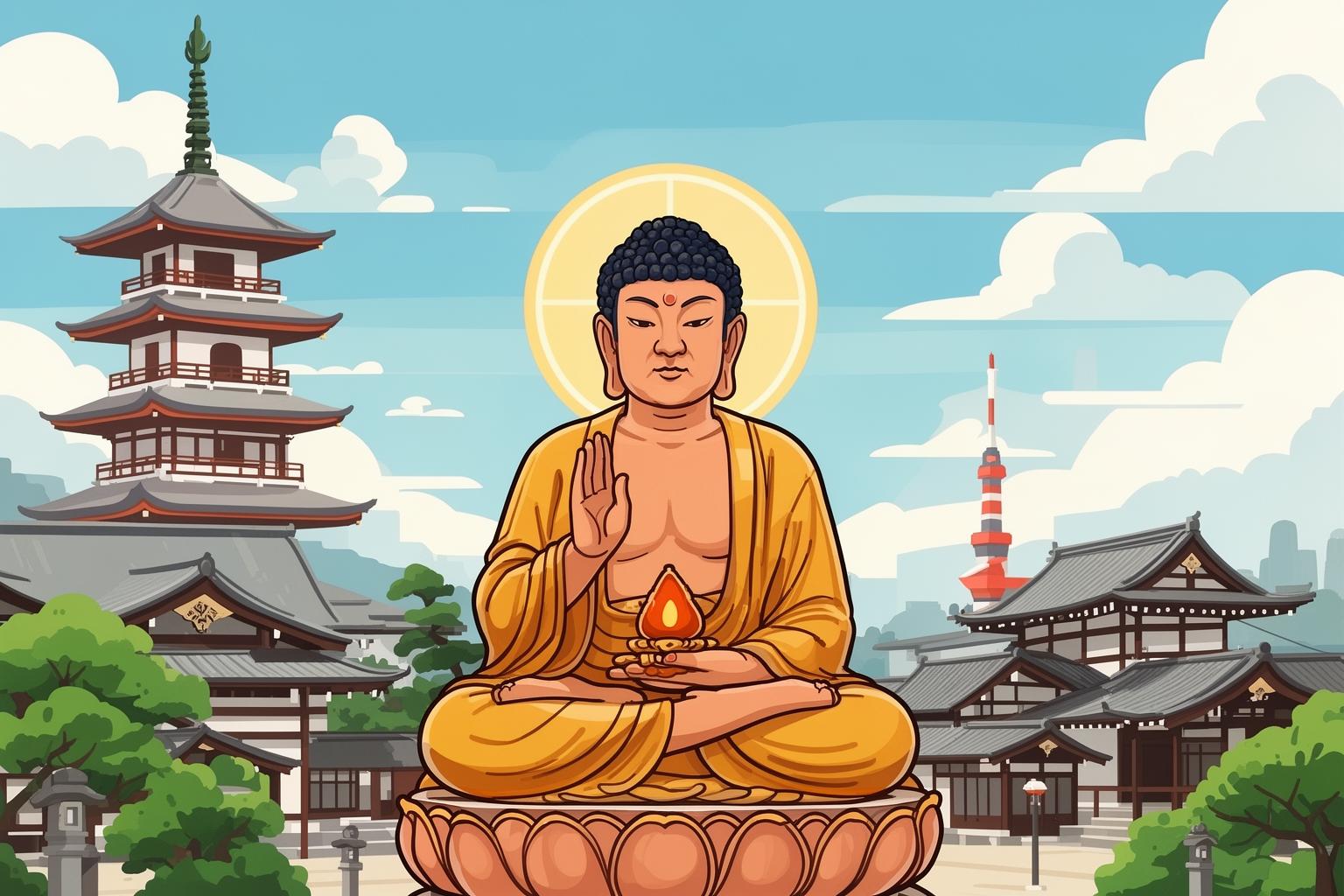
After a steady ascent, you arrive at the temple complex of Nose Myoken-san. It isn’t a sprawling, golden pavilion like those found in Kyoto. Rather, it’s a group of sturdy, unembellished wooden buildings clinging to the mountainside, appearing to grow naturally from the forest. The air is thick with the scent of incense and the deep, resonant chanting of sutras. This is a major center for Nichiren Buddhism, a sect known for its powerful and direct approach to faith. At its core is the worship of Myoken Bosatsu, the deification of the North Star. Here lies the essence of the Osaka spirit, where the practical and the spiritual merge. The North Star, Polaris, is the fixed point in the night sky that never moves, serving as a celestial anchor. For centuries, travelers and sailors have used it to navigate. It symbolizes guidance, protection, and an unshakeable destiny. For Osaka’s merchants, a people who have always relied on their savvy to navigate the treacherous currents of commerce, what deity could be more fitting? The worship here feels strikingly direct, almost like a business transaction with the divine. It is less about quiet contemplation or seeking abstract enlightenment, and more about securing tangible benefits: good fortune, protection from harm, and above all, success in business. This is not the serene, philosophical Zen popularized in the West; it is a robust, pragmatic faith for a working city.
The Star and the Merchant
As you walk through the temple grounds, this pragmatism is evident everywhere. The ema, small wooden plaques on which visitors write their wishes, tell the story. Alongside the usual prayers for health and exam success, countless requests for “shobai hanjo”—business prosperity—are found. Names of companies, both large and small, are inscribed on the wood. Business leaders come here to pray for a prosperous year, shopkeepers to ask for a steady flow of customers. It serves as a spiritual headquarters for Osaka’s merchant spirit. The temple even has a separate hall dedicated to horses, the traditional symbol of trade and transport, reinforcing its connection to commerce. In Tokyo, spirituality often feels like a lifestyle accessory—a yoga class, meditation app, or weekend temple visit for aesthetics. Here, it functions as a tool. It is a fundamental, practical part of life’s toolkit, something actively used to improve one’s fortunes in the material world. This may be misunderstood by outsiders as transactional or superstitious, but it is rooted in a deep-seated belief that the spiritual and material realms are intertwined. A successful business isn’t just built on hard work; it also requires luck, good timing, and favorable conditions—factors beyond one’s control. Praying to Myoken-san is a way to align oneself with those greater forces, to find a steady point in a chaotic world. It is an act of cosmic navigation, and it is profoundly Osakan.
A Different Kind of Sacred
The atmosphere here contrasts sharply with the great temples of Kyoto. Kyoto’s sacred sites are often breathtakingly beautiful but can feel like museums—preserved in amber, weighted with imperial history and a sense of untouchable perfection. There is a hushed reverence, a feeling of being a visitor in a place that belongs to the past. Nose Myoken-san, by contrast, feels alive and very much in the present. It is a working temple. You hear the sounds of daily rituals, see monks moving purposefully across the grounds, and sense the energy of a place actively engaged with its community. The sacred here is inseparable from the everyday; it is woven directly into people’s lives and pressing concerns. Families come to have their new cars blessed for safety. Students seek amulets for exams. It is a place of active hope and petition. The grandeur lies not in the architecture, but in its relevance. It powerfully reminds us that in Osaka, value is measured not by appearance, but by utility. A temple is not just beautiful; it is useful. A mountain isn’t just scenic; it is a place to strengthen body and community. This unfiltered, purpose-driven approach to life defines the city, visible from its northernmost mountain top to the bustling streets at its core.
The Town of Nose: An Antidote to “Cool Japan”
Descending from the mountain leads you into the small town of Nose itself. If the hike served as an escape from a curated experience, the town is the final confirmation of that. This is not a charming tourist village like those you might find near Mount Fuji. There are no rows of souvenir shops selling novelty snacks, nor trendy cafes with minimalist decor. Instead, it’s a quiet, working agricultural town. You’ll see old storefronts with faded awnings, a local farmer’s market offering giant daikon radishes and bags of local rice, and a handful of simple restaurants serving soba and udon to mainly local patrons. This is the reality of rural Japan, a reality often glossed over by the “Cool Japan” branding heavily promoted from Tokyo. It’s neither exciting nor dynamic. It’s slow, quiet, and deeply, genuinely itself. This lack of pretense is characteristic of the broader Kansai region. Things are just as they are. A town is a place where people live and work, not a backdrop for your vacation photos. Stopping for lunch at a small, family-run soba shop is revealing. The elderly woman who runs it isn’t playing the part of the graceful, bowing hostess. She’s straightforward, a little gruff, but sincerely curious. “Where are you from? You hiked the mountain? It’s tough, huh?” The questions are plain, the interaction free from the layers of politeness (keigo) that dominate Tokyo’s service industry. It’s not rude; it’s simply genuine. She treats you not as a customer to be served, but as a person who has wandered into her space. This directness is often misunderstood by foreigners, and even other Japanese people, about Osaka. The communication style prioritizes forming a quick, honest connection over observing delicate social protocols. It may seem blunt at first, but underneath there is warmth and a lack of judgment that is remarkably refreshing once you come to appreciate it. The town of Nose exemplifies this principle: it isn’t trying to impress you, and by not trying, it becomes far more impressive than any perfectly polished tourist trap.
The Return Trip: Re-entering the Concrete Jungle
The train ride back to Umeda is a reverse journey, a gradual recompression moving from the quiet greenery of the mountains to the electric buzz of the city. The fields and forests fade away, while the familiar density of the urban landscape rises to meet you. Yet, the city now appears different. After spending a day in its quiet, pragmatic outskirts, the frantic energy of the city center becomes more understandable. Osaka’s intensity isn’t the full story. It serves as the engine, but is fueled and balanced by the vast, unpretentious hinterland that surrounds it. This trip revealed a fundamental truth about living in Osaka: the escape is always nearby. You don’t need a three-month plan or a fat wallet to get away from it all. You only need a train ticket and a willingness to explore places off the beaten path. This easy, low-stakes access to authentic nature and quiet spaces profoundly contrasts with life in Tokyo, where a similar escape demands a much greater investment of time and money. It fundamentally alters the rhythm of life, providing a pressure-release valve embedded in the region’s geography. The weekend in Nose wasn’t a staged relaxation—it was the genuine article. It was a journey to a place that, like Osaka’s people, is unapologetically functional, deeply pragmatic, and utterly unconcerned with appearances. It was a hike up a mountain to a temple dedicated to a star, where people pray not for abstract salvation, but for tangible success. It was a masterclass in the soul of Osaka: a city with its feet firmly on the ground and its eyes fixed on a steady star in the sky.