When we first moved to Osaka, my three-year-old had a public meltdown that felt seismic. It was on the Midosuji Line, peak afternoon, a metal tube humming with the quiet friction of a city on the move. My son, however, was not quiet. He was a small, screaming vortex of injustice over a dropped snack. I was doing the parent juggle—apologizing with my eyes to the stoic passengers, trying to soothe a creature beyond reason, and sweating with a familiar mix of love and humiliation. Suddenly, a hand reached across the aisle. In it, a small, crinkling treasure. An elderly woman with a perfectly coiffed perm and a glint in her eye offered my son a little milk candy. She didn’t say much, just a soft, “Hai, douzo,” and a nod. My son, stunned into silence by this unexpected offering, took it. The crisis was over. The train hummed on. I was grateful, but also deeply confused. In Australia, we have a deeply ingrained rule: don’t take candy from strangers. Yet here, it seemed to be a standard-issue emergency response. This wasn’t a one-time thing. It happened at the park, in the supermarket, at the local clinic. It took me a while to understand that this wasn’t just random kindness. This was a system. This was ame-chan, and in Osaka, it’s a language all its own. It’s a tiny, sugary key to unlocking the entire social operating system of this vibrant, complicated city. It’s one of the first and most important lessons in how to not just live in Osaka, but to belong.
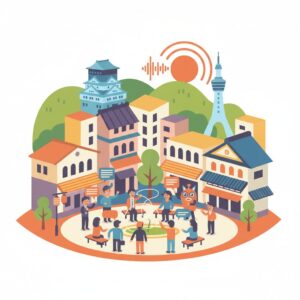
This unexpected sweetness is a reminder of how everyday gestures, like ame-chan communication, subtly knit together the vibrant tapestry of Osaka neighborhoods.
What in the World is ‘Ame-chan’?
Let’s break it down, because this isn’t just about candy. The word perfectly captures Osaka’s unique linguistic character. ‘Ame’ (飴) is the standard Japanese term for hard candy. But in Osaka, it’s almost never simply ‘ame’. It’s ‘ame-chan’. The suffix ‘-chan’ is a diminutive, a term of affection typically used for children, pets, or those you feel close to. So, right from the start, the candy isn’t just an object. It’s personalized. It’s a ‘little candy’, a ‘dear candy’. This small linguistic change transforms it from a basic sweet into something warm, familiar, and intimate.
This is a core difference you’ll notice between Osaka and, say, Tokyo. In Tokyo, precision in language and social roles takes precedence. An object is an object. In Osaka, boundaries are softer and more flexible. Everything—even a piece of candy—can carry personality and emotion. It’s a playful, human-centered way of viewing the world.
And what kind of candy qualifies as ame-chan? It’s not a chocolate bar or a bag of gummies. The classic ame-chan is an individually wrapped hard candy. Think of the classics: Kasugai milk candies, Kuro-ame (a deep black sugar candy), fruit drops, and the undisputed star of Osaka ame-chan, Pine Ame. This pineapple-flavored hard candy with a hole in the center is iconic. The key is that these candies are portable, sturdy, and easy to share. They’re made for giving out. An Osaka local, especially a woman of a certain age, will carry a small, dedicated pouch of these in her handbag, ready to hand out at any moment. It’s a standard accessory, as essential as her wallet or keys.
The Unspoken Protocol of the Sweet Exchange
Like any genuine cultural ritual, the ame-chan exchange has unspoken rules, a choreography that everyone seems to know instinctively. As a foreigner, learning these steps is your ticket into the local social scene. It’s a performance, and your participation shows you understand it.
The Giver: The ‘Osaka Obachan’
The primary distributor of ame-chan is a formidable and wonderful figure: the ‘Osaka Obachan‘. She is not just any middle-aged or elderly woman; she embodies a specific archetype. Pragmatic, no-nonsense, and often dressed with a hint of animal print, she is the keeper of the neighborhood’s social harmony. Her handbag is a mobile command center, holding not only a plentiful supply of various ame-chan but also tissues, wet wipes, a small sewing kit, and probably a bandage or two. She moves through the city purposefully, seeing it as her civic duty to smooth over the small frictions of daily life. The ame-chan is her preferred tool.
The Occasion: When is Ame-chan Used?
Ame-chan serves many social purposes. The most common, as I first experienced, is for a crying child. It’s a clever tactic: it distracts the child, quiets the noise, and sends a silent message of solidarity to the flustered parent: “I’ve been there. Here’s a little help.” But its uses go beyond that. It can be a thank you for a small favor, like holding a door or helping lift a stroller up stairs. It can act as an icebreaker, a way to spark conversation while waiting in line at the post office. It can even function as a tiny apology. If someone bumps into you on a crowded street, instead of a curt “sumimasen,” you might receive a quick bow paired with an offered ame-chan, instantly easing any potential annoyance.
The Reception: How to Accept
This is critical. Your natural instinct, especially if you come from a culture wary of strangers, may be to politely decline. Try to resist that urge. Refusing an ame-chan can be seen as rejecting the gesture of connection itself — like turning down a handshake. The correct response is a slight bow of the head, a warm smile, and a clear “Arigatou gozaimasu” (Thank you very much). You don’t have to eat it right away; you can simply slip it into your pocket. The exchange is about the connection, not the immediate consumption. The bond has been made. Naturally, if you have allergies or a legitimate reason, a polite explanation is understood, but the default should always be gracious acceptance.
The Next Level: Becoming a Giver
Once you’ve lived here a while, you’ll know you’re truly integrated when you start carrying your own supply of ame-chan. This is the final step. It shows you understand the reciprocal nature of this system of care. You’ve received kindness, and now you’re ready to pass it on. Buying your first bag of ame-chan specifically to give away feels like a rite of passage. The first time you soothe a stranger’s fussy toddler with a candy of your own, the look of grateful recognition from the parent is a powerful reward. You are no longer just an observer; you are an active participant in the neighborhood’s intricate social dance.
Ame-chan as a Social Lubricant
To dismiss this as merely ‘people being friendly’ misses the point entirely. Osaka’s friendliness is not passive; it is an active, practical strategy for coexisting in a densely populated urban environment. Ame-chan perfectly embodies this philosophy. It serves as a low-cost, high-impact method for managing shared spaces and sustaining what sociologists refer to as ‘weak ties’—the network of casual acquaintances that underpins a strong community.
Consider the contrast with Tokyo. In Tokyo, the dominant social norm often revolves around mutual non-interference. Respect is shown by giving people their space, not imposing, and maintaining a polite but clear distance. A crying child on a Tokyo train is frequently met with averted eyes and subtle tension as everyone quietly endures. It is the parent’s problem to handle, and others politely act as if it isn’t happening. In Osaka, the approach differs. The philosophy is more communal. That crying child is seen as a temporary disturbance to shared peace, so the community offers a means to help resolve it. The obachan with the ame-chan is indeed intervening, but her action comes from a sense of shared responsibility.
This act works wonders. It turns a moment of stress and isolation for a parent into a moment of connection. You are no longer a struggling individual but part of a community that cares for one another. It lowers the social barriers that can make urban life feel impersonal and lonely. You may not know the name of the woman who gave your child a candy, but you recognize her face. You’ve shared a positive experience. The next time you see her at the local market, you’ll exchange a nod and a smile. A weak tie has been formed. The neighborhood feels a bit smaller, a bit safer.
A Foreigner’s Field Guide to Ame-chan Culture
For many non-Japanese residents, encountering ame-chan for the first time can be confusing. My initial response was a mixture of gratitude and suspicion. Is this safe? Why is this stranger giving my child candy? It requires a mental shift to adjust your social expectations.
First, let’s address the safety issue. In the case of an obachan in a public place in Osaka, handing out a pre-wrapped, factory-sealed candy is almost always a gesture of genuine kindness. This isn’t a random stranger lurking; it’s a neighborhood grandmother offering a traditional social gesture. Understanding this context is crucial. You are not in a typical ‘stranger danger’ situation; you are participating in a unique and harmless cultural practice.
Second, consider what this reveals about the Osaka mindset. It is fundamentally practical. There is a problem (noise, distress), and here is a simple, effective remedy (sugar, distraction). There’s no long discussion or formal process—just direct action. It also reflects a different view of public and private boundaries. In many Western cultures, a child’s behavior is considered the parent’s private responsibility. In Osaka, once you enter a shared space like a train or park, you become part of a temporary community, where everyone shares concern for the group’s comfort. People feel responsible for maintaining the collective environment and will act accordingly.
So, how should you approach this as a newcomer?
- Phase 1: The Receiver. When offered candy, smile, bow, and say thank you. Accept the treat and appreciate the kindness. That’s all—it means you’ve successfully completed your first exchange.
- Phase 2: The Carrier. Visit any supermarket or convenience store, find the candy aisle, and buy a mixed bag of individually wrapped hard candies. Kasugai is always a reliable choice. Carry five or six pieces in a small pocket of your bag. You are now prepared.
- Phase 3: The Giver. This is the active stage. It requires awareness of your surroundings. Spot a parent with a child who just scraped their knee? Notice a tourist struggling to read a map? After offering assistance, you can provide ame-chan as a thoughtful finishing touch. Your Japanese doesn’t have to be perfect—a simple “douzo” and a smile will suffice. You’ll be surprised how this small gesture can open doors and foster genuine connections.
Beyond the Candy: The True Meaning of the Exchange
Ultimately, the ame-chan serves as a symbol. It functions as a form of social currency within a micro-economy of kindness, representing a perspective where community is not merely an abstract idea but a series of small, everyday actions. It emphasizes taking personal responsibility for the emotional atmosphere of the space you occupy.
Living in Osaka means learning to interpret these social cues. It means recognizing that the directness of the people, which can sometimes be mistaken for nosiness or bluntness, actually stems from genuine engagement. People are interested. They are involved. They will chat with you in the elevator, comment on your groceries, and yes, they will offer candy to your child.
This is a stark contrast to the reserved anonymity found in many other large cities. It won’t appeal to everyone. But if you are willing to engage, to accept the candy, and eventually to offer it yourself, you will find yourself deeply woven into the fabric of your neighborhood in a profoundly rewarding way. The sweet exchange of ame-chan is more than just a charming tradition. It embodies the heart of Osaka, distilled into a single, sugary, shareable treat. It serves as a reminder that sometimes, the smallest gestures are the ones that make a vast city truly feel like home.