Step off the subway at Namba station, and the air changes. It’s not just the humidity or the faint, delicious smell of grilled meat and savory takoyaki sauce. It’s a shift in energy, a palpable buzz that hums up through the soles of your shoes. This is the gateway to Dotonbori, Osaka’s neon-drenched, sensory-overload theater of consumption. For the tourist, it’s a photo-op wonderland of giant mechanical crabs and the iconic Glico Running Man. For the Tokyo transplant or the foreign resident trying to understand their new home, it’s something far more profound: a living textbook on the Osakan soul. Forget what you learned about nightlife in Tokyo’s sleek, reserved cocktail bars or Shibuya’s chaotic but oddly impersonal crossings. Dotonbori’s bar and izakaya scene isn’t about curated perfection; it’s about raw, unfiltered human connection, a nightly festival of practicality, and a crash course in the city’s core philosophy: eat, drink, laugh, and don’t waste a single yen or a single minute on pretense. This guide isn’t about where to go. It’s about how to be. It’s about decoding the shouts of the chefs, the unspoken rules of the standing bar, and the gruff but warm invitation from the stranger next to you. It’s about understanding that in Osaka, a night out is never just a transaction. It’s a full-contact, high-energy immersion into a culture that values honesty over harmony, and a good joke over polite silence. This is your key to unlocking the real Dotonbori, the one that lives and breathes long after the tour buses have gone home.
To truly understand this philosophy, you need to experience the culture of Osaka’s kitchen table kingdom, where food and connection are inseparable.
Decoding Dotonbori: Beyond the Glico Man and Giant Crabs
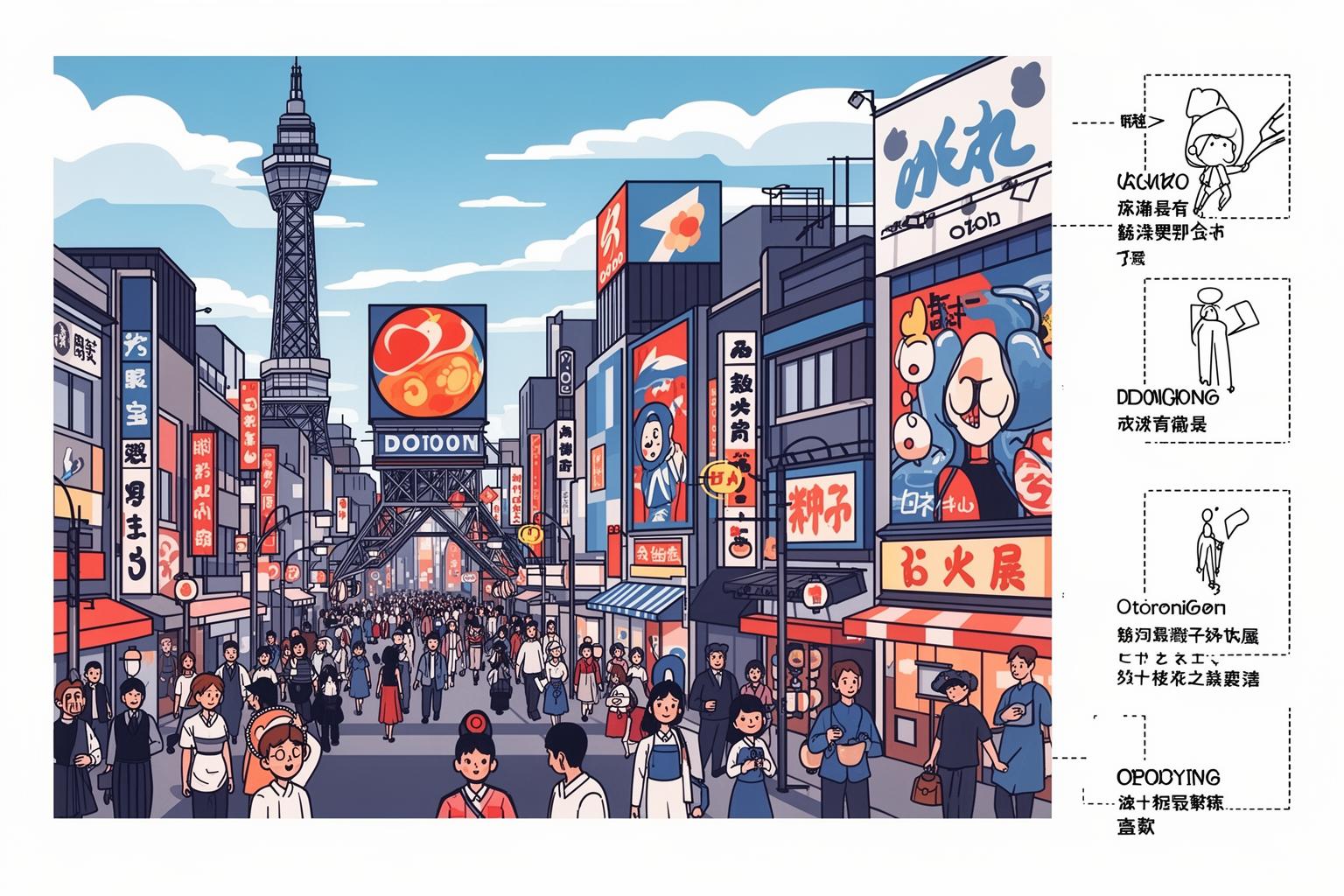
To truly understand Dotonbori, you need to learn to observe it through two perspectives. One takes in the spectacle—the bright, overwhelming facade created for mass appeal. The other perceives the system—the complex, efficient, and deeply local network operating just below the surface. Developing this dual perspective is the first step toward feeling like you belong here, rather than merely visiting.
The Two Faces of Dotonbori: Tourist Spectacle vs. Local Playground
The main street along the Dotonbori canal is a triumph of commercial theater. It’s brilliant, loud, and mostly designed for show. Locals value it as a civic landmark, much like a New Yorker does Times Square, but it’s not where they live. They function on its edges, in the veins and arteries branching off the central waterway. These are the `yokocho`, the narrow back alleys, and the `shotengai`, the covered shopping arcades that, despite their close proximity to the riverside promenade, feel like a completely different world.
A tourist sees the long queue at a famous takoyaki stand and joins it. A local sees the same line, notices the tired expression of the staff, and knows the true gem is three blocks away down a side street, at a tiny stand run by an elderly woman who’s been honing her recipe for fifty years. A tourist navigates by the giant pufferfish lantern. A local finds their way by the scent of a particular dashi broth or the sound of a specific chef’s boisterous greeting. This isn’t about elitism or secret knowledge; it’s about efficiency and purpose. The main street is for sightseeing and spectacle. The backstreets are for serious eating and drinking.
This marks a key difference from Tokyo. In Shinjuku, for example, local gems tend to be genuinely hidden—tucked away in basements or behind unmarked doors—creating a sense of exclusivity. In Osaka, they’re hidden in plain view. The challenge isn’t finding them; it’s having the confidence to walk past the flashy facade and step into the cramped, noisy, fluorescent-lit place beside it. The city doesn’t conceal its best side; it simply trusts you to recognize authenticity when you see it. It’s a test of character, not a treasure hunt.
The Language of the Street: Understanding Osaka-ben in the Wild
Before ordering a drink, you need to catch the rhythm of the language around you. Osaka-ben, the local dialect, is more than a set of unique words—it’s a different way of communicating. It’s designed for speed, clarity, and emotional expression, often at the expense of the layered politeness found in standard Japanese.
A common misconception among foreigners is to mistake this directness for rudeness. It’s far from that. It’s a form of social efficiency. For example, to get a server’s attention in Tokyo, you might catch their eye, offer a slight nod, and say “Sumimasen” politely. In a Dotonbori izakaya, that approach will leave you waiting thirsty for an hour. Here, a loud, clear, confident “SUMIMASEN!” isn’t just acceptable; it’s expected. It cuts through the noise and signals your intent clearly. It’s not aggression; it’s practical communication.
Listen to the flow of conversations around you—they’re faster, louder, and punctuated with laughter and expressive gestures. When an Osaka native tells a story, they perform it. Their voice rises and falls, their hands move, their entire body engages. This theatricality permeates every interaction. A chef might shout “Hona, iko ka!” (“Alright, let’s do this!”) before firing up the grill. A bartender might slide your drink across the counter with a dramatic “Maido!” (“Thanks for your business!”). This isn’t a performance for tourists. It’s the everyday social energy baseline. This culture believes communication should be as much felt as heard. Embracing this energy, instead of being intimidated by it, is essential to fitting in. Speak up, make eye contact, and don’t hesitate to laugh out loud. You’re not being rude; you’re speaking the local language.
The Anatomy of an Osaka Izakaya Crawl: Strategy and Unspoken Rules
A night out in Dotonbori is not a single, destination-focused event but rather a fluid, multi-stage journey—a progressive feast called `hashigo-zake`, or ladder drinking. Each step on the ladder represents a different establishment, offering a unique flavor and experience. Understanding this flow is essential, as it’s a ritual with a distinct beginning, middle, and end, guided by unwritten yet universally understood rules.
The “Zero-th Party” (0-jikai): The Tachinomi Prelude
The evening truly begins not at a seated restaurant, but at a `tachinomi`, or standing bar. These spots serve as the heart of Osaka’s social life, embodying the city’s core values: speed, value, and low commitment. You don’t visit a tachinomi for lengthy conversations; rather, it’s for a quick drink and a small bite to stimulate your appetite and kickstart social interactions. This is the `0-jikai`, the warm-up before the main event.
The atmosphere is one of controlled chaos. Salarymen with loosened ties stand shoulder-to-shoulder alongside young couples and seasoned old-timers. The air is thick with grill smoke and the hum of multiple conversations happening simultaneously. The rules are simple and highly efficient. Secure a spot at the counter. Order immediately. Often, you pay upfront with coins and bills deposited into a small tray—a system called `cash on delivery`. This isn’t a place for indecision. You order, consume, and leave. Lingering beyond 30-45 minutes is considered a faux pas, as you’re occupying valuable space.
This reflects the Osakan merchant spirit: time is money, space is limited, and efficiency is paramount. The tachinomi is a social transaction optimized for maximum return on investment. In contrast to the trendy, minimalist standing bars found in Tokyo’s Ebisu or Daikanyama—where the focus lies on aesthetics and savoring craft beers—an Osaka tachinomi functions as a fueling station. It’s practical, communal, and unapologetically unpretentious, making it the perfect, democratic starting point for any night out.
The Main Event: Choosing Your Izakaya Battlefield
After completing the `0-jikai`, it’s time for the main course. Dotonbori and its neighboring alleys present a dizzying variety of options, which generally fall into a few key categories. The choice you make reveals a lot about the kind of night you want.
First, there are specialty shops—izakayas focused exclusively on perfecting one particular dish. You’ll find yakitori spots where masters have grilled skewers over charcoal for decades, kushikatsu parlors with fiercely guarded secret recipes for their batter and dipping sauce, and okonomiyaki restaurants that elevate the humble cabbage pancake into a culinary masterpiece. Opting for a specialty shop shows respect for craftsmanship and reflects the Osakan belief in `shokunin`, the artisan spirit—not applied to pottery or swords, but to food for everyday people. The famous “No Second Dip!” rule for kushikatsu perfectly symbolizes the Osakan social contract. The communal sauce is shared by all, and the rule isn’t about complex etiquette but a simple, pragmatic measure to ensure fairness and hygiene—a small piece of shared responsibility, embodying how the city operates.
Then there are classic, all-purpose izakayas. Spotting a good one is an art. Avoid those with flashy, multi-language menus displayed outside. Instead, look for handwritten paper slips advertising daily specials stuck to the walls. Seek out crowds more local than tourist and listen for genuine, raucous laughter. These establishments serve as the neighborhoods’ living rooms, boasting vast menus with reliable quality and atmospheres brimming with authentic Osaka spirit.
Finally, for a grittier, more atmospheric experience, there are the `gaado-shita` bars squeezed into spaces beneath elevated train tracks. These are Showa-era relics, often cramped and somewhat grimy, rich with character. Drinking here means drinking with the ghosts of Osaka’s past, surrounded by the rumble of trains overhead. It’s a visceral experience that connects you directly to the city’s working-class roots.
The Art of Ordering: Be Decisive, Not Hesitant
Ordering in an Osaka izakaya is a display of confidence. Hesitation invites confusion. With servers busy and kitchens operating at frenetic speed, clarity is crucial. The universal opener is “Toriaezu, Nama!” (“A draft beer to start!”). This phrase serves as a cultural shortcut, giving you time to peruse the menu while jump-starting the process. It’s the perfect icebreaker—a signal that you understand the evening’s rhythm.
When ready to order food, don’t wait for the server to approach. Catch their attention with a confident “Sumimasen!” When ordering, be clear and direct. This straightforwardness also applies when asking for recommendations. Unlike Tokyo, where requesting an `omakase` (chef’s choice) at an izakaya might seem unusual, it’s common and welcomed in Osaka. It’s less about high-end, multi-course meals and more a practical expression of trust: “You’re the expert; please bring me what’s fresh, tasty, and offers great value today.” This creates a partnership between customer and chef, grounded in the shared goal of a satisfying, cost-effective meal.
The “Shime”: Ending the Night with Carbs
No izakaya crawl in Osaka is complete without the `shime`. This is the final dish—almost always carbohydrate-based—intended to soak up alcohol and provide a satisfying conclusion to the evening. It serves as the culinary period ending the sentence, and skipping the `shime` leaves the story incomplete.
Dotonbori offers plenty of options. The classic choice is a steaming bowl of ramen from one of the area’s legendary late-night shops, where rich, fatty broth is regarded as the perfect antidote to a night of drinking. Other favorites include a simple bowl of udon in light, clear dashi broth or grabbing a last boat of takoyaki from a street vendor. The significance of the `shime` lies more in the ritual than the specific dish. It’s a shared tradition marking the end of the `hashigo-zake` journey—the final, delicious act of `kuidaore` (“eat until you drop”)—and an essential part of the cultural script for a proper night out in Osaka.
The People You’ll Meet: Navigating Social Dynamics in Dotonbori Bars
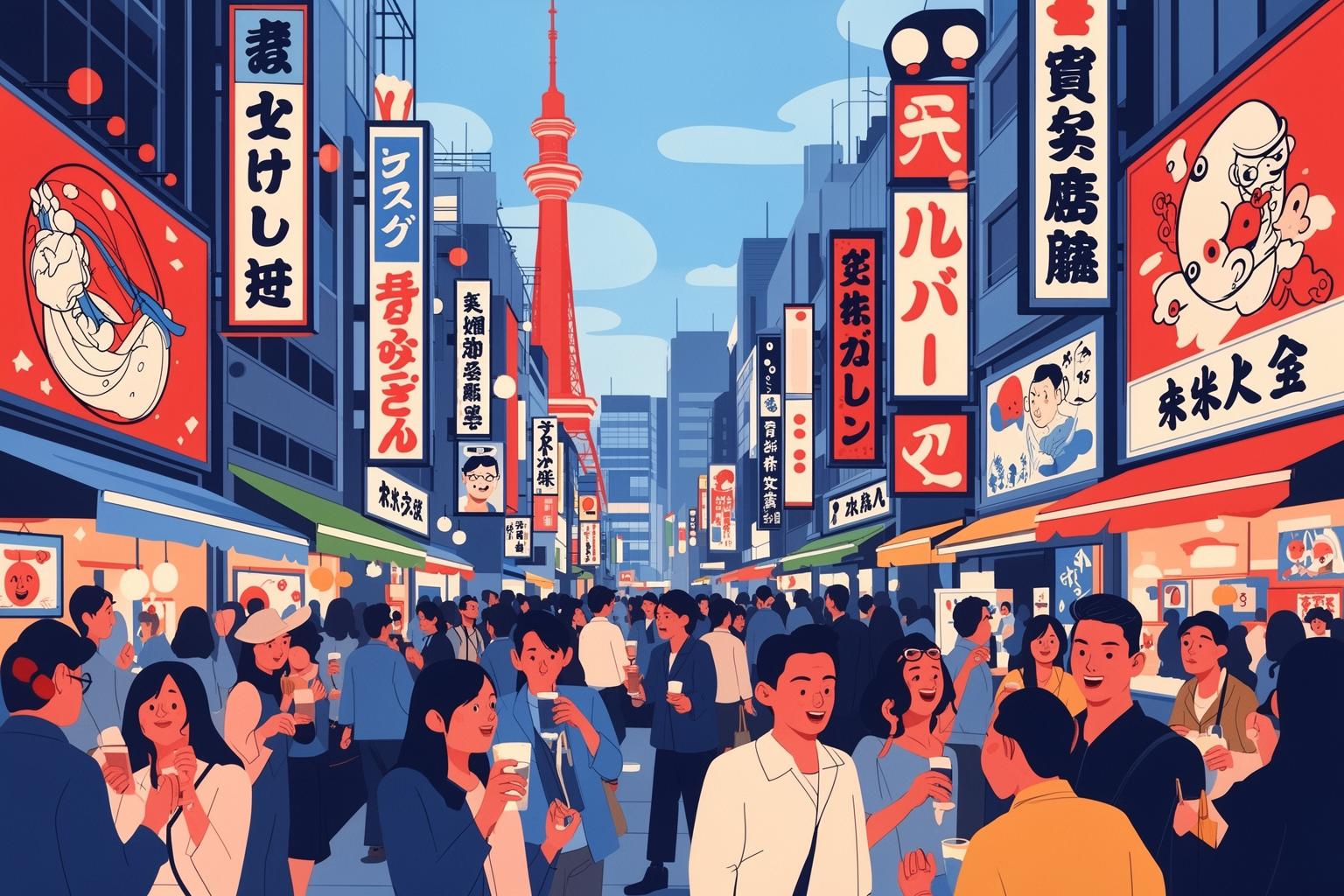
More than the food or neon lights, the true heart of Dotonbori lies in its people. An Osaka bar serves as a social stage where the city’s character is vividly displayed. Knowing the unwritten rules of interaction is what separates spectators from participants.
The “Chaimannen” Spirit: Breaking the Ice with Strangers
One of the first things you’ll observe is that people readily engage with one another. Strangers sitting side by side at the counter will strike up conversations as if they were old friends. This is often driven by the `chaimannen` spirit, a phrase loosely meaning “isn’t that something else?” or “am I right?” It’s a style of playful, teasing, and sometimes self-deprecating humor that acts as a strong social lubricant.
A foreigner might misunderstand this at first. The elderly man next to you might nod at your plate and say, “You’re going to eat all that by yourself? You’ll get fat!” He’s not being rude; he’s inviting you into a conversation. He treats you like a local, not a delicate outsider. The proper response is not to take offense but to laugh and reply with a playful comeback: “It’s too delicious, I can’t help it!” This kind of banter signals acceptance. If they’re teasing you, they see you—they’re acknowledging your presence and welcoming you into their world. Silence and polite nods create barriers; shared laughter builds bridges.
Tokyo’s “Tatemae” vs. Osaka’s “Honne” in Full Display
A bar is the ideal place to witness the sharp cultural contrast between Tokyo’s `tatemae` (the public facade, polite pretense) and Osaka’s `honne` (true feelings, honest opinions). In a Tokyo izakaya, colleagues’ conversations tend to be carefully managed, sticking to safe subjects and avoiding direct criticism. Maintaining group harmony (`wa`) is paramount.
In a Dotonbori bar, `honne` flows as freely as the beer. People openly vent about their jobs, spouses, and the government. They debate passionately, argue loudly, and laugh even louder. This is not social dysfunction but social vitality. It’s a culture that values honesty as the foundation of genuine relationships, rather than avoiding conflict. For foreigners used to the subtle, indirect communication styles found elsewhere in Japan, this can be refreshingly straightforward. You rarely need to guess what an Osakan thinks—they’ll tell you. This transparency makes navigating social situations simpler, though it may initially feel surprising.
The Hanshin Tigers: The Ultimate Social Lubricant
If you want a quick way to bond with anyone in an Osaka bar, learn two words: Hanshin Tigers. The city’s ever-underdog baseball team is more than just a sports franchise; it’s a religion. It embodies Osaka’s identity—passionate, a bit rough around the edges, and locked in a perennial rivalry with Tokyo’s corporate, polished Yomiuri Giants.
Supporting the Tigers is an expression of civic pride. On any given night, televisions in most izakayas will be tuned to the game. A dramatic play prompts a collective groan or ecstatic cheer that unites the entire room. You don’t need to be a baseball expert—just asking, “How are the Tigers doing tonight?” can open a floodgate of conversation. Showing any support for the team acts like a secret handshake. It signals that you’re not merely a tourist passing through but someone who has taken the time to understand what drives the city. In a city that loves to talk, the Hanshin Tigers are the one topic that can transform a room full of strangers into a unified chorus of hope and frustration.
What Foreigners Often Get Wrong About Dotonbori’s Nightlife
The vibrant chaos of Dotonbori often leads to common misconceptions among newcomers. Unraveling these misunderstandings is essential to truly appreciate the area as a complex, functioning neighborhood rather than just a theme park.
Misconception 1: “It’s Just a Loud, Gaudy Tourist Trap.”
Though Dotonbori’s surface is undeniably tourist-oriented, dismissing it as a soulless trap is a serious oversight. In reality, Dotonbori functions as a layered ecosystem. The ground-floor shops with their massive signs and English menus are the most visible, but they represent only the first layer. The true life of the neighborhood happens vertically.
Look up. The most unassuming buildings, which might resemble ordinary office blocks, are home to hidden treasures. Some of the city’s best and most authentic bars and restaurants occupy the second, third, fourth floors, and beyond. Access is often through a small, creaky elevator or a narrow staircase. These places thrive without flashy street signs because they depend on loyal regulars (`joren-san`) and word-of-mouth. The ground floor caters to high-rent, high-turnover businesses, while the upper floors host establishments built on relationships and reputation. Learning to look beyond street level is a crucial skill for any resident. There, you’ll discover the true heart of the neighborhood, worlds apart from the selfie sticks below.
Misconception 2: “The Directness and Loudness Are Aggressive.”
For those used to the quiet politeness found elsewhere in Japan, Osaka’s volume and directness can seem abrasive or even aggressive. A shopkeeper shouting “Irasshai!” at full volume might come as a shock. However, this is a fundamental misinterpretation of local culture.
This style of communication is rooted in Osaka’s history as a merchant city and reflects the spirit of `naniwa-bushi`. In a bustling marketplace, one had to be loud to be noticed and direct to build trust and close a deal quickly—there was no time for lengthy politeness. This merchant candor has become the norm for social interaction. That loud greeting isn’t aggression; it’s energy—an enthusiastic welcome meant to cut through the noise and create a direct connection. It’s more like the lively friendliness of a New York deli than the quiet reverence of a Kyoto tea house. In Osaka, you always know where you stand, and many find this honest clarity refreshing compared to the ambiguity encountered elsewhere.
Misconception 3: “You Need to Speak Fluent Japanese to Participate.”
While the language barrier is real, Osaka’s walls are lower and more porous than those in other cities. The idea that perfect Japanese is required for meaningful interaction is a self-defeating myth. Osakans tend to value effort and attitude much more than flawless grammar.
A willingness to try—even with just a few memorized phrases like “Oishii!” (Delicious!) or “Okini!” (Thanks!)—is often met with warmth and enthusiasm. People are more willing to engage, use gestures, pull out translation apps, or find that one person in the group who speaks a bit of English to help. This stems from genuine curiosity and a desire to connect, often outweighing any awkwardness caused by the language gap. In Tokyo, a linguistic mistake might receive a polite but distant smile. In Osaka, it might elicit laughter, gentle correction, and an invitation to share another drink. Don’t let the fear of mistakes keep you on the sidelines. In Dotonbori, diving in is the best way to learn to swim.
A Practical Guide for the Aspiring Dotonbori Regular
Transitioning from a visitor to a regular involves more than just frequent visits. It’s about understanding the social rituals and becoming woven into the local community. Here’s how to make that transition.
Finding Your “Iki-tsuke” (Your Regular Spot)
In Japanese culture, having an `iki-tsuke`—a favorite place where the staff know your name and your order—signifies adulthood and social belonging. In Osaka, it’s almost essential. Your `iki-tsuke` serves as your third place, a refuge that’s neither home nor work, where you belong to a built-in community.
Finding one requires trial and error, but persistence is key. When you discover a spot you like, return. Return on the same day each week. Sit in the same seat. Order a similar drink. The first visit marks you as a customer. The second makes you a familiar face. By the third or fourth visit, the `taisho` (master) will likely acknowledge you with a nod. The other regulars will begin noticing you, and soon a small conversation will start. This is the tipping point. Embrace it. Before long, they’ll save a seat for you as you enter. You may receive a small, off-menu dish, known as `service`. This isn’t just a complimentary snack—it symbolizes your acceptance into the group. You are no longer merely a customer; you’ve become part of the family.
Navigating the Bill: “Warikan” and the Art of Paying
Money matters are handled with Osakan practicality. For groups, the standard is `warikan`, or splitting the bill evenly. It’s typically straightforward. The total is announced, and everyone contributes their share. Avoid being the person who carefully tallies their exact yen amount; it delays the process and goes against the communal spirit.
You may also encounter the `otokomae` gesture, where one person—often the eldest in the group—insists on covering the entire bill. This act demonstrates generosity and status. Responding appropriately can be delicate. A polite refusal is customary, but if they persist, accepting graciously is best. Pushing too hard can be perceived as challenging their generosity.
At the heart of this approach lies a strong awareness of `kosupa`, or cost performance. Osakans aren’t cheap, but they are savvy consumers, expecting good value for their money. A bar or restaurant earns respect not by being the priciest or most luxurious, but by delivering the best quality experience for the price. This pragmatic mindset toward commerce and consumption is a defining trait of the city.
The Aftermath: The Last Train and Late-Night Etiquette
The nightly rush for the `shuden`, the last train, is a spectacle throughout Japan. In Osaka, it unfolds with distinct flair. The scramble to the station is more chaotic, the staff announcements more animated, and the shared sense of urgent camaraderie more intense.
But what happens if you miss it? In many cities, this would be a disaster. In Osaka, it’s merely a change of plans. The city runs around the clock, accommodating those who get left behind. The lights of Dotonbori remain glowing. Late-night and even 24-hour ramen shops, udon eateries, and izakayas flourish. Karaoke boxes become makeshift hotels for groups of friends, and capsule hotels provide an affordable, clean, and safe place to sleep until the first train resumes in the morning. This resilience, this practical acceptance that things don’t always go as planned, is quintessentially Osaka. The city works hard, plays hard, and always has a backup plan to ensure everyone makes it through the night.