Step off the train at Umeda, and you are immediately immersed in Osaka’s vision of the future. It’s a canyon of glass and steel, a symphony of escalators and digital billboards, where the flow of human traffic is managed with breathtaking, impersonal efficiency. It is polished, powerful, and utterly contemporary. Yet, walk just ten minutes northeast, past the elevated tracks of the JR Loop Line, and you fall through a crack in time. The scale of the world shrinks. The sky opens up. The roar of the metropolis softens to a murmur. You have entered Nakazakicho, a neighborhood that serves as Osaka’s living, breathing contradiction—a place not so much preserved as it is willfully persistent. For anyone trying to decipher the complex code of this city, to understand what makes an Osakan tick, Nakazakicho is not a tourist destination; it is the primary text. It’s a district that survived the widespread firebombing of World War II, not through fortune alone, but through a certain tenacity that seems to have seeped into its very foundations. This isn’t a curated historical quarter like you might find in Kyoto, where every detail is polished for presentation. This is something far more authentic, and far more revealing about the Osakan psyche: a chaotic, charming, and profoundly human testament to the belief that the past should be lived in, not just looked at. As a historian, I’ve seen countless attempts to freeze-frame history for public consumption. Nakazakicho rejects this entirely. It’s a dynamic conversation between the Showa era and the Reiwa era, happening in real-time on its narrow, winding streets. To understand this place is to understand Osaka’s deep-seated pragmatism, its unique approach to community, and its stubborn refusal to follow the sleek, uniform blueprint of modern urban development dictated by its rival to the east, Tokyo.
This authentic, lived-in approach is a key part of what makes the cost of living in Osaka’s Nakazakicho so unique and appealing for residents.
Preservation Through Pragmatism: The Anti-Museum
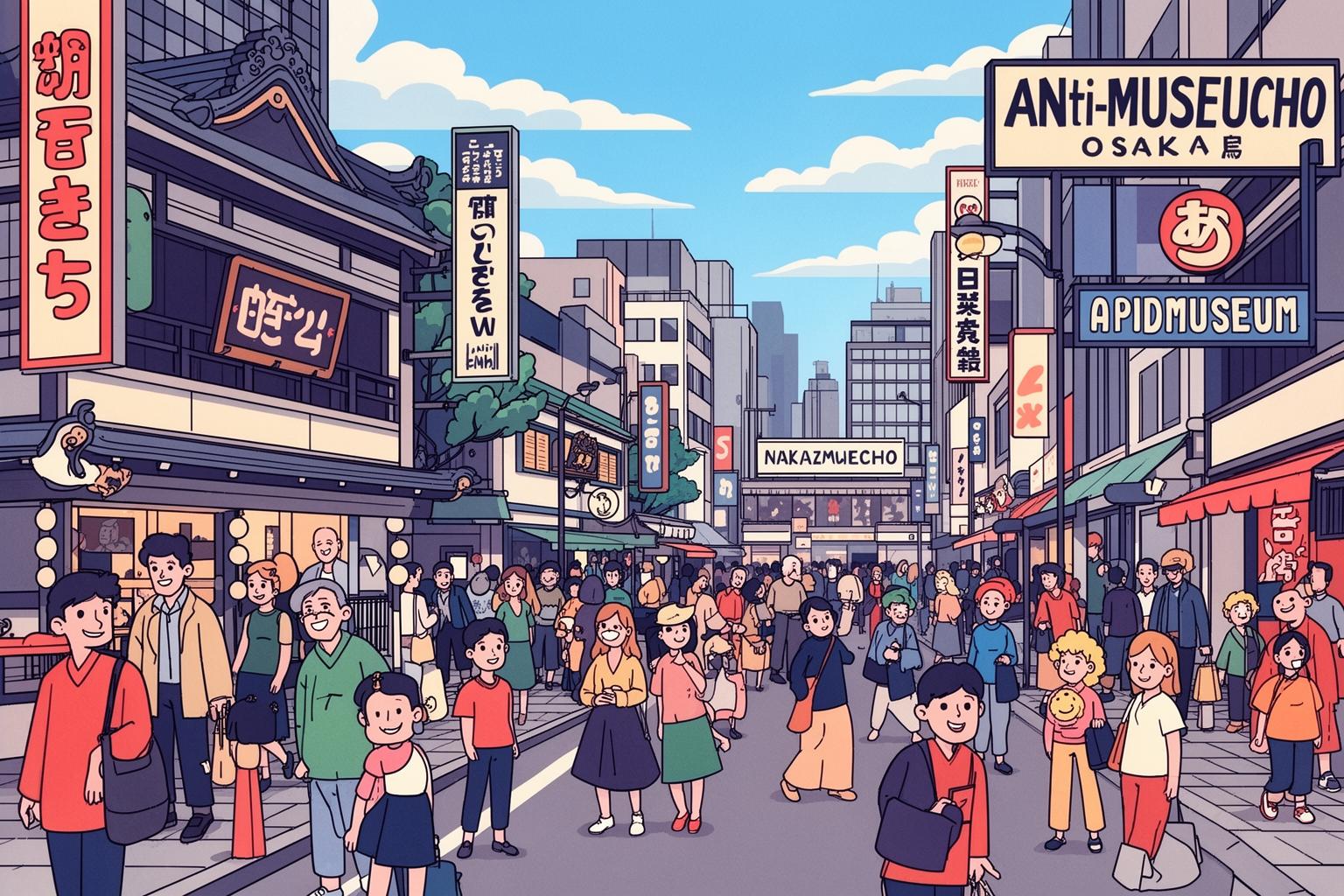
In Tokyo or Kyoto, the preservation of historic architecture is usually a top-down process, involving municipal designations, strict building regulations, and a collective understanding that certain areas should be treated as cultural artifacts, cordoned off from the chaotic energy of modern life. Nakazakicho, however, follows a completely different ethos, one that is distinctly Osakan: value is determined by utility. An old building, such as a pre-war nagaya (row house), is not inherently valuable merely because of its age. It becomes valuable when it is used. This mindset stops the neighborhood from turning into a sterile museum piece; instead, it remains a living entity, continually evolving.
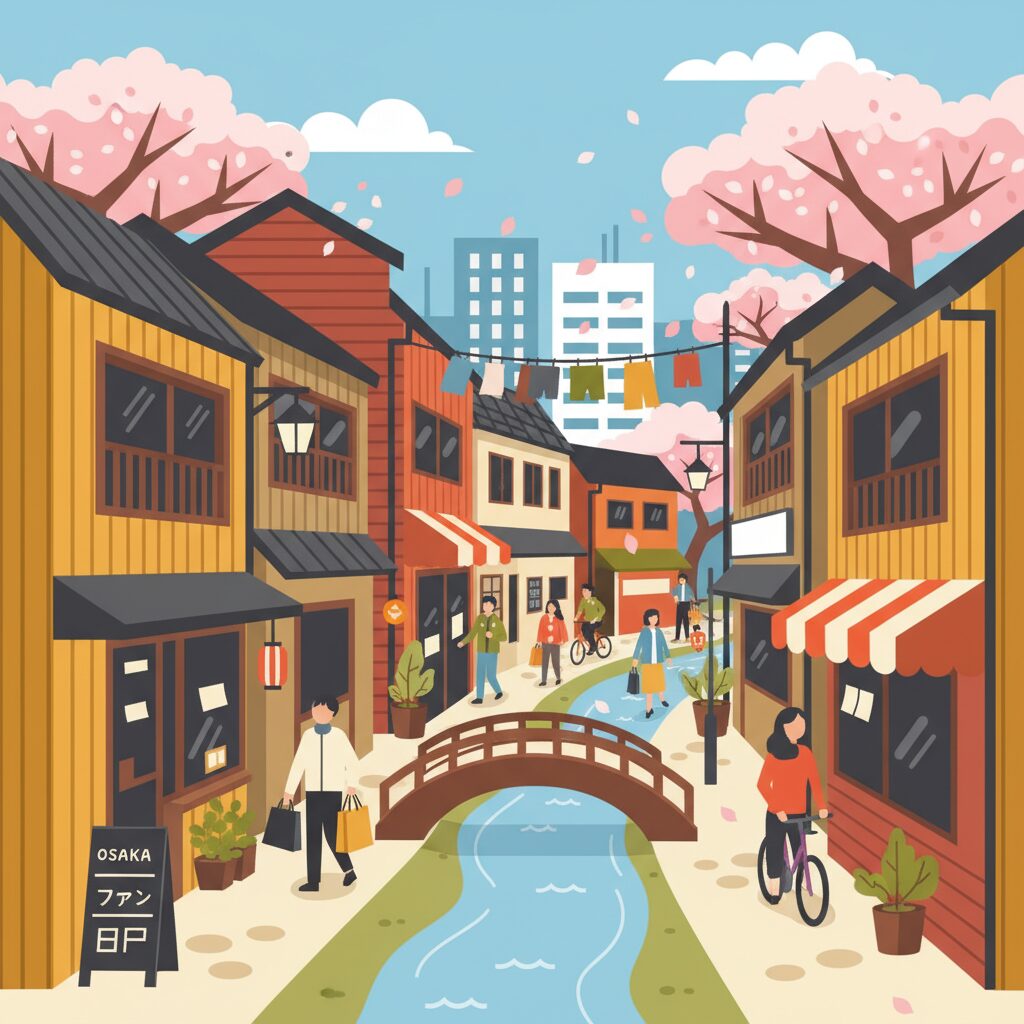
As you wander through the maze-like alleys, you can see this philosophy at work everywhere. A creaky wooden structure with sliding paper screens that once sheltered a family of six is now a stylish, minimalist coffee shop, where the scent of single-origin espresso drifts from the lattice windows. A former rice merchant’s store, with its faded but still legible kanji signage, now sells vintage American workwear. The old public bathhouse, the Sentō, might now function as a gallery or performance space. This is not gentrification in the typical Western sense, where a place’s original spirit is erased and replaced. It is transformation. The building’s exterior, history, and spirit are preserved, but its purpose is updated to meet the needs and passions of the current generation. This exemplifies Osaka’s merchant DNA at its best. The question is never just, “Is this beautiful?” or “Is this historical?” The main question is always, “Does it work? Can it serve a purpose? Can it generate income?”
This pragmatic attitude creates a unique aesthetic. There is no imposed uniformity. A beautifully restored Showa-era house with gleaming dark wood sits comfortably next to a slightly rundown home with laundry hanging from the balcony and a dense cluster of potted plants forming a small jungle on the street. This visual “noise” would be unacceptable to planners in more orderly cities. In Nakazakicho, it is visual proof of life—a community that is not performing for tourists but simply existing. The daily lives of residents are not an inconvenience to be hidden from the “attractions”; they are the attraction. This is often misunderstood by foreigners. They come expecting a picture-perfect “old Japan” and initially feel confused by the mix of old and new, neat and messy. But what they are witnessing is something far more genuine: the raw reality of a community that values function over form, and life over static preservation.
The Social Contract of the Alleyway
The physical layout of Nakazakicho shapes its social dynamics. The alleys are narrow, often too tight for cars. The houses are clustered closely, their eaves nearly touching. This architecture encourages interaction. Unlike the broad, impersonal boulevards of a modern city where one can remain in a private bubble, here life unfolds in close proximity. This closeness nurtures an unspoken social contract that feels worlds apart from Tokyo’s usual polite reserve.
In Tokyo, privacy is paramount, with the aim often to minimize one’s impact on others and remain as unobtrusive as possible. In Nakazakicho, however, the boundary between public and private space is deliberately blurred. A resident’s bonsai collection spills out from their doorway, turning into a shared public garden. A shop owner’s cat naps on the neighboring stoop. The sounds and smells of a neighbor’s cooking become an inevitable part of your evening. For someone used to the sterile isolation of a high-rise apartment, this might be overwhelming, but for locals, it’s everyday life. This closeness fosters a sense of collective ownership and subtle surveillance that keeps the community safe and connected. You know your neighbors not just by name but by the rhythms of their daily routines—you know who is home, who is away, what they’re cooking for dinner. This is not prying; it is a gentle, ambient awareness of those sharing this limited space.
This intimacy influences how people communicate. A simple walk to the local convenience store is filled with micro-interactions: a nod to the elderly woman carefully watering her hydrangeas, a brief chat with the barber outside his shop, a wave to the cafe owner setting out his sign. These are not profound conversations but vital threads in the social fabric. They acknowledge shared existence. This sharply contrasts with strolling through a Tokyo neighborhood like Shinjuku, where thousands can pass without a single glance. A foreigner might initially find this engagement intrusive, mistaking it for an invasion of privacy. But it is quite the opposite; it is an invitation. The unspoken rule is that you belong here, and your presence is recognized. Ignoring these small social rituals marks you as an outsider—not because of your nationality, but because you reject the fundamental principle of life in these alleys: we are all in this together.
Commerce as Conversation: The Osakan Art of the Sale
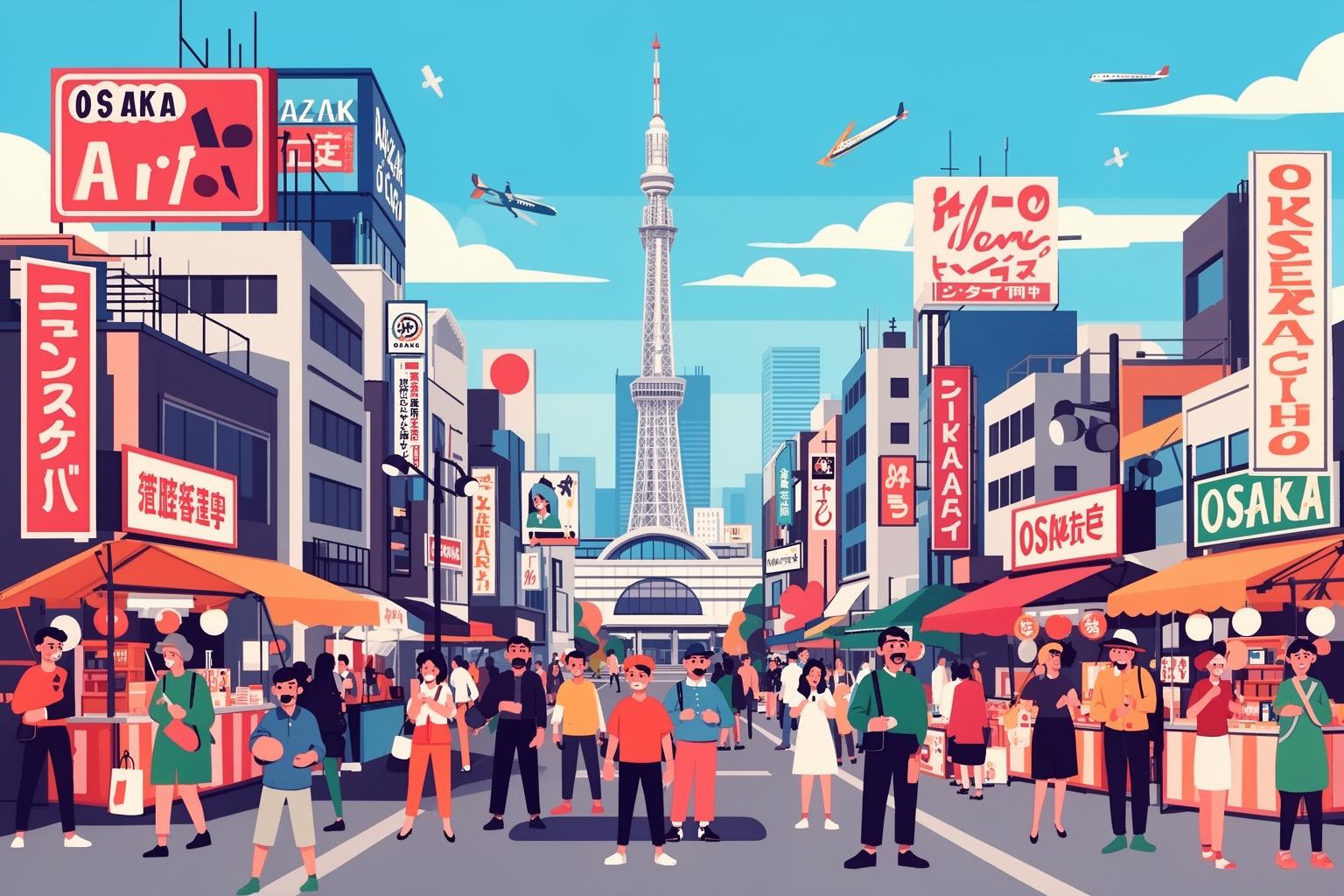
For centuries, Osaka has been Japan’s commercial hub, earning the nickname tenka no daidokoro (the nation’s kitchen). While the towering offices in Umeda symbolize the corporate side of this heritage, Nakazakicho reveals its spirit. The businesses here are predominantly small, independent, and deeply personal. Purchasing something is rarely a quick, silent exchange; it is a performance, a narrative, a dialogue.
Enter one of the many vintage clothing shops, and you won’t encounter the distant coolness often found among staff in similar stores in Tokyo’s Harajuku or Shimokitazawa. In Osaka, that would be considered bad business. Instead, the owner will likely engage you right away. “Where are you from?” “That’s a great jacket—does it date back to the ’80s?” “If you like that, you should check out this piece I just got from a collector in Okayama.” The conversation isn’t just a sales technique; it’s an essential part of the product itself. You are not just buying a shirt; you are buying the story behind it, the owner’s expertise, and a brief yet genuine human connection.
This conversational commerce arises from a fundamental Osakan belief that business should be personal. Many shops in Nakazakicho could be described as shumi no mise—stores born from a hobby or passion. The owner is more than a retailer; they are an enthusiast. The man running the small camera shop filled with vintage film Leicas and Nikons isn’t merely selling cameras; he is curating a museum of his passion and eager to share it with you. He’ll gladly spend an hour discussing the qualities of different film stocks, even if he knows you won’t buy the priciest item. His value comes not only from the yen you hand over but from the shared enthusiasm.
This often confuses foreigners used to the crisp, efficient, and typically silent service common elsewhere in Japan. They may feel pressured to buy or wonder what the ‘angle’ is. But the angle is simply the Osakan way. Business is human. A good merchant doesn’t just move products; they build relationships, however fleeting. The unspoken expectation is that customers will join in this ritual. A monosyllabic reply or dismissive attitude is seen as rude—not because it offends the owner personally, but because it disrupts the flow of interaction. To live and shop in Nakazakicho is to realize that in Osaka, a good conversation is as valuable a currency as money itself.
The New Wave Meets the Old Guard
Nakazakicho is a delicate ecosystem sustained by the balance between two distinct groups: elderly residents who have lived in these wooden houses their entire lives, and a wave of young artists, designers, baristas, and entrepreneurs who began moving in over the past two decades, attracted by the low rent and authentic atmosphere. This dynamic fuels the neighborhood’s evolution, forming a relationship that is symbiotic, sometimes tense, but ultimately successful.
On any given day, this contrast is clearly visible. An elderly woman in her eighties, wearing a traditional kappogi apron, sweeps the pavement in front of her home with a short bamboo broom. Next door, a heavily tattooed designer in his twenties organizes a window display of hand-printed t-shirts, with faint punk rock music playing inside. Though their interactions may be limited to a simple morning greeting, their coexistence is essential to the neighborhood’s vitality. The young creatives bring fresh energy, customers, and revenue that prevent Nakazakicho from quietly vanishing like many old neighborhoods in Japan. They are the ones who recognize the potential in a derelict storefront and possess the vision to transform it. In return, the older generation offers something irreplaceable: authenticity. They are the custodians of the neighborhood’s soul, the living link to its history. The very atmosphere that attracts newcomers is a product of the lives these elder residents have lived.
This relationship exemplifies Osaka’s talent for tolerance, based not on shared liberal ideals but on practical understanding. The prevailing mindset seems to be, “As long as you’re not causing major trouble (meiwaku) and contribute to the community in your own way, you’re welcome.” There is an unspoken acceptance that the loud music from the bar on Friday night is the price for a lively, populated street, and that the slightly eccentric artist who paints murals on his own walls is preferable to an empty, decaying building. This represents a notable cultural difference from other parts of Japan, where conformity and maintaining a low profile are often valued above all else. Osaka, especially Nakazakicho, shows greater tolerance for harmless eccentricity. Individuality is accepted, even celebrated, as long as it contributes positively and respects the basic, unwritten rules of communal living.
The Reality of Retro Living: Soul Over Convenience
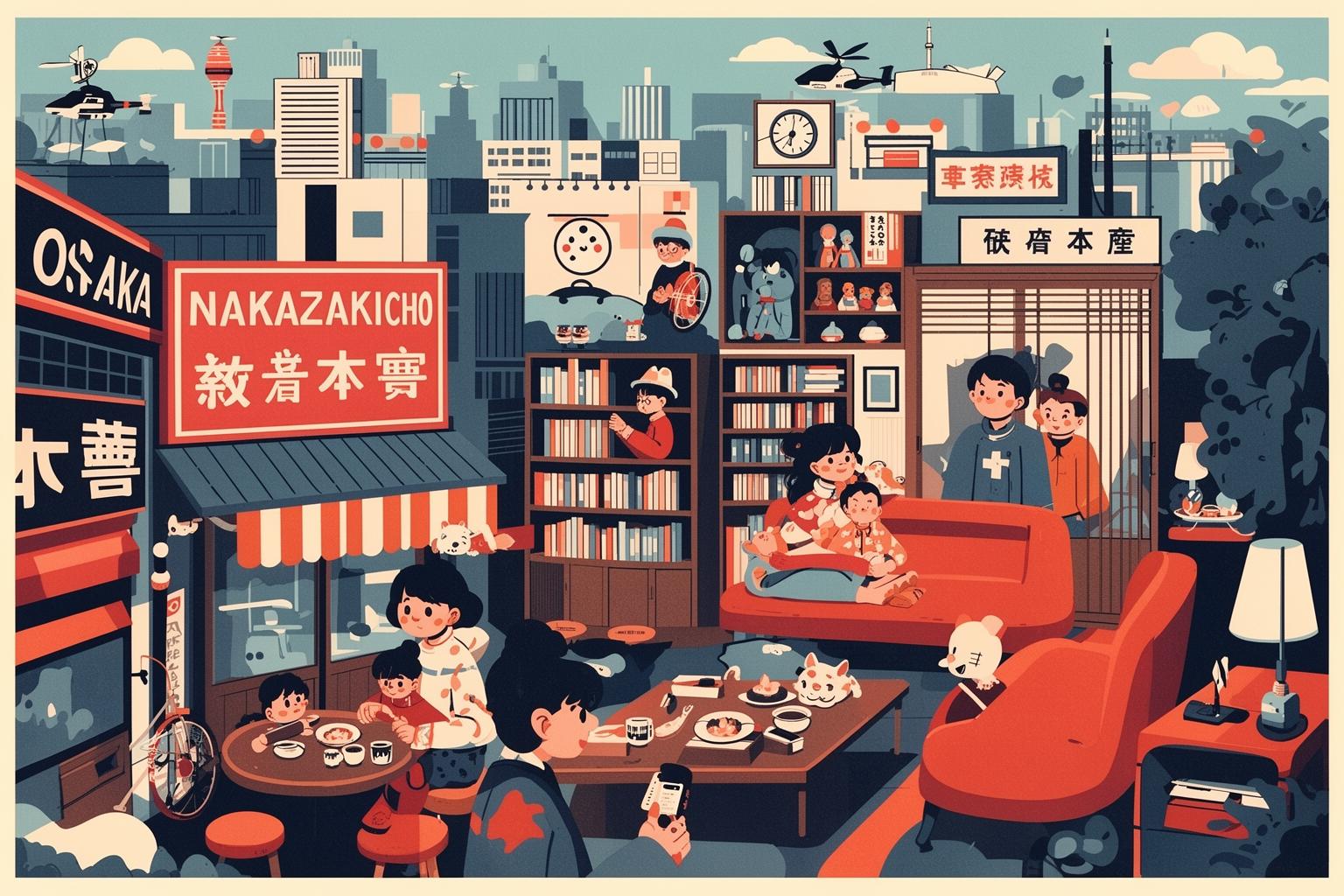
For visitors, Nakazakicho offers a charming escape. For residents, it is a deliberate lifestyle choice that involves a series of trade-offs. Living in a sixty or seventy-year-old wooden house is not a romantic ideal; it is a daily reality with distinct challenges. These are the details that guidebooks conveniently leave out.
The walls are thin. You will hear your neighbor’s television, their arguments, and their late-night conversations. Insulation is often nonexistent, a remnant from a time before central heating. Winters are bitterly cold, demanding a small army of space heaters and thick blankets. Summers are stifling, as the aged wood traps the city’s oppressive humidity. Plumbing can be temperamental, and wiring is a relic of a bygone era. These are not the sleek, technologically advanced, earthquake-proof apartments that define modern Japanese living.
So why would anyone choose this? The answer lies in a different set of priorities—one that values character over comfort, and community over convenience. Choosing to live in Nakazakicho means becoming part of a story. It means accepting the creaks and drafts as proof of the house’s history. It means valuing the human-scale architecture and the sense of belonging it fosters over the sterile anonymity of a new condominium. This willingness to sacrifice some modern comforts for something more soulful is a recurring theme in Osaka culture. It’s the same mindset that leads people to queue for an hour in the rain for a bowl of ramen from a tiny, run-down shop while a perfectly acceptable chain restaurant sits empty next door. The belief is that the best things in life often come with a bit of grit and inconvenience. Substance is always prized over surface polish.
Daily life here is fundamentally different. It is slower, more intentional. Your morning commute might mean navigating around a delivery bicycle and neighbors chatting in the middle of an alley. Grocery shopping might involve stopping at three separate tiny specialty shops—the tofu maker, the vegetable stand, the fishmonger—instead of one large supermarket. It requires more effort, more time, and more interaction. It is a life inefficient by modern standards, but rich in human connection. It constantly reminds you that a city is not just a collection of buildings, but a network of people, and that the quality of life can be measured by the number of daily greetings you exchange.
Nakazakicho is, therefore, more than just a quaint neighborhood. It is a manifesto. It declares that there is another way to live in a 21st-century metropolis. It quietly resists the relentless push toward homogenization and efficiency. It shows us that the heart of Osaka is not in the dazzling lights of Dotonbori or the corporate might of Umeda. It lies in the narrow alleys where the past is not a memory to be revered, but a foundation to build upon—a place where commerce is conversation, and community is the inevitable, wonderful result of living close together. For any foreigner seeking to truly understand the soul of this city, the lesson is clear: leave the main road and get lost in the labyrinth. What you find there will tell you everything you need to know.