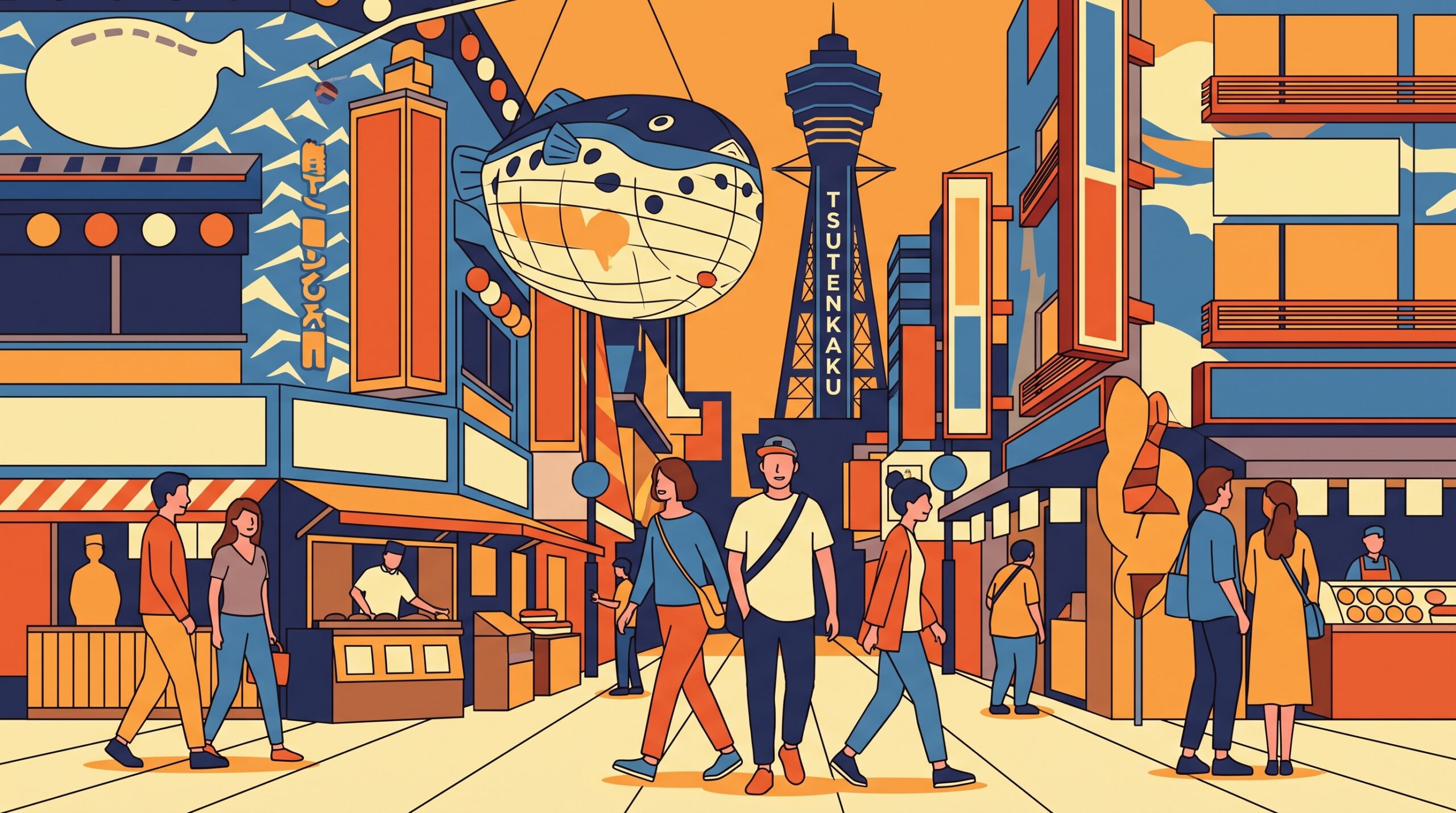
Tokyo whispers. Osaka shouts. If you have ever stepped off the Shinkansen from the capital and felt an immediate shift in the air, you are not imagining things. The polished, silent perfection of Tokyo gives way to something entirely different the moment you hit the streets of Osaka. Here, the city breathes heavily. It sweats. It laughs with its mouth open. For foreigners attempting to understand the mechanics of daily life in this sprawling metropolis, standard guidebooks offer little more than a caricature of neon crabs and running athletes. But to truly grasp the mindset of Osaka, you must look away from the glittering tourist traps of Dotonbori. You must turn your gaze southward. You must step into the sharp, jarring contrast between the towering, modern gentrification of Tennoji and the gritty, unapologetic nostalgia of Shinsekai.
Stepping out of Tennoji Station, you are immediately dwarfed by Abeno Harukas. It is a sheer cliff of glass and steel, a monument to modern retail, high-end offices, and spotless observation decks. It represents the sanitized future. Yet, if you walk just ten minutes west, down a gentle slope, the glass gives way to rust. The pristine silence of luxury department stores dissolves into the clatter of bicycles, the sizzle of deep-frying oil, and the unabashed bravado of the Kansai dialect. You have entered Shinsekai. This is not a museum of the past, nor is it a manufactured retro theme park built for social media. It is a living, breathing working-class neighborhood. It is the beating heart of the Showa era, stubbornly refusing to stop pumping. To understand this neighborhood is to understand the soul of the Osaka people. They are a people who value pragmatism over pretense, warmth over formality, and community over isolation. If you want to know what it means to actually live in Osaka, to think and act like a local, you must pull back the curtain on this deeply human landscape.
The Soul of Osaka: Why Tennoji and Shinsekai Defy Gentrification
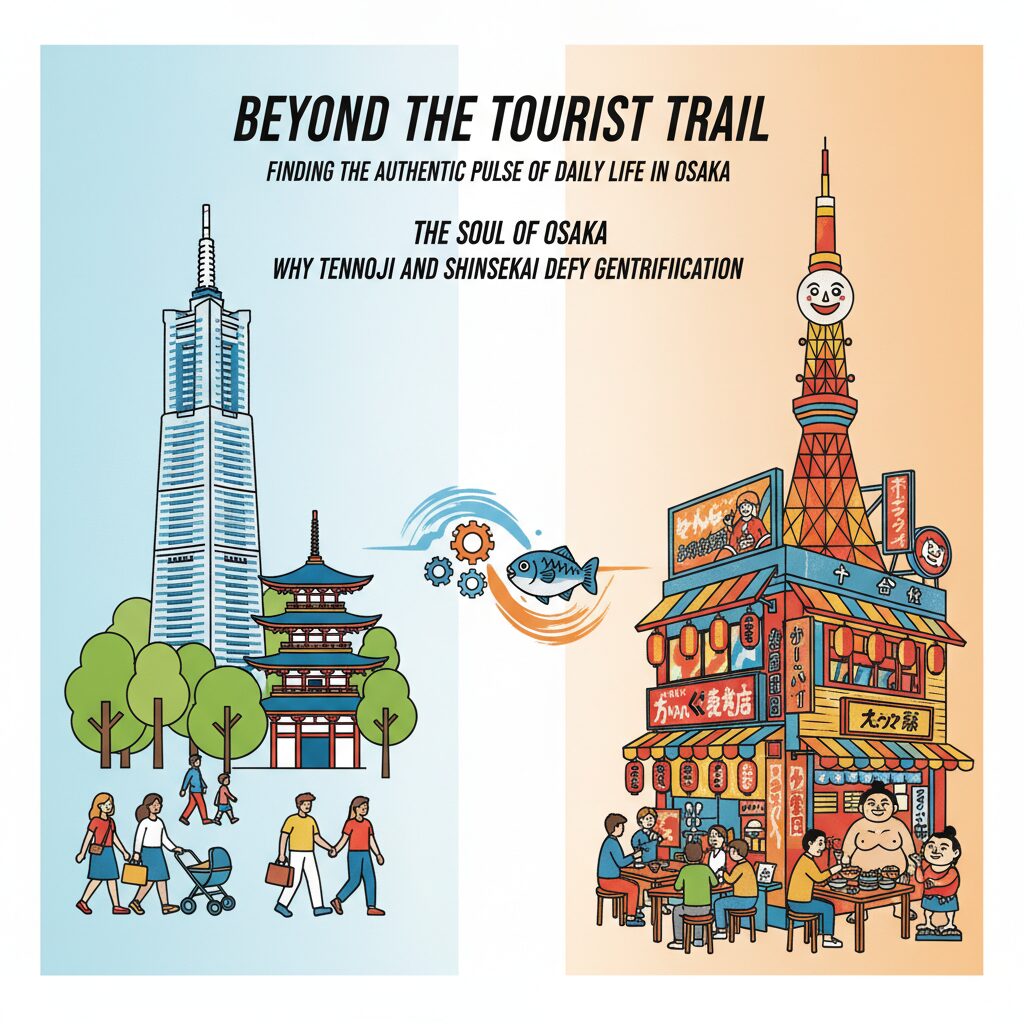
Urban development is an unstoppable force. Around the world, neighborhoods rooted in working-class history are frequently replaced by minimalist coffee shops and high-end boutiques. Tokyo has expertly cleansed its central districts of the post-war grime. However, Osaka moves to a different rhythm. The closeness of Tennoji and Shinsekai creates a compelling urban contrast that perfectly captures the local spirit.
When city planners aimed to redevelop Tennoji, they successfully built massive shopping centers and manicured parks, crafting a highly functional and visually appealing modern hub. Yet, just across the street, Shinsekai resisted assimilation. This resistance goes beyond architecture; it is deeply ingrained in the mindset of the people. Osaka’s history as a merchant city, founded by laborers, traders, and street-level entrepreneurs, fuels a strong pride in its working-class roots. To sanitize a neighborhood like Shinsekai would be to erase the struggle and resilience that define its identity.
Foreign residents often mistake this resistance to modernization as neglect. They see peeling paint, faded awnings, and narrow alleys crowded with bicycles, assuming the area is unsafe or impoverished. This reflects a fundamental misunderstanding of Osaka’s urban language. The grit is not a sign of decay but a mark of authenticity. Here, people do not want to conceal the wear of daily life behind a polished facade. They value accessibility, affordability, and fierce independence. Refusing to demolish old buildings for luxury apartments is a collective statement of identity. It is the community declaring that human connection and affordable living matter more than spotless aesthetics. The shadow of Abeno Harukas over Shinsekai’s low roofs symbolizes the city itself: a place where towering ambition coexists with a deep loyalty to its gritty roots.
Morning to Afternoon: Stepping into the Showa Era
The rhythm of daily life in this area isn’t shaped by the rush-hour commutes of office workers. Rather, it unfolds at the slow, deliberate pace set by the older generations and the independent shop owners who have been sweeping the sidewalks in front of their stores for fifty years. Walking these streets in the morning feels like stepping through a portal into the Showa era, the period of Japanese history from the 1920s through the late 1980s.
Retro Kissaten: Starting the Day with Mixed Juice
Long before modern espresso bars charged premium prices for single-origin brews, Osaka thrived on the kissaten. These traditional coffee shops serve as the living rooms of the neighborhood. Opening the heavy wooden door of a Shinsekai kissaten, you’re immediately enveloped in a sensory wave: the sharp aroma of dark-roasted coffee beans, the lingering scent of tobacco smoke, and the soft, crackling sound of jazz emanating from a vintage stereo. The seats are often covered in worn velvet, and the lighting is softly dimmed, creating a cozy, intimate atmosphere.
But the true signature of an Osaka kissaten isn’t the coffee; it’s the mixed juice. This bright yellow, thick drink is a skillful blend of milk, bananas, and canned fruits like mandarin oranges and peaches, all combined in a blender with ice. To an outsider, it might seem like a simple, overly sweet smoothie. Yet mixed juice perfectly embodies the Osaka spirit. It was born out of practical necessity. Decades ago, fresh fruit was costly and perishable. Rather than discard bruised bananas or overripe fruit, inventive cafe owners blended them with inexpensive canned fruits and milk to create something entirely new, affordable, and tasty.
This approach reflects a fundamental local philosophy known as mottainai, a deep regret over wasting anything valuable. People in Osaka are fiercely pragmatic. They don’t prize the aesthetic perfection of fruit; they value its usefulness. Sitting in a kissaten, watching locals quietly read their sports newspapers while sipping this vibrant yellow drink, you realize daily life here is about extracting the greatest joy and value from whatever resources are available.
Smart Ball and Shogi Parlors: Old-School Local Entertainment
As the morning gives way to afternoon, entertainment spots start to fill. But you won’t encounter the deafening, blinding chaos of modern pachinko parlors here. Instead, you’ll hear the gentle, analog clatter of glass balls. This is Smart Ball, a basic predecessor of modern pinball that has all but vanished from the rest of Japan.
Inside a Smart Ball parlor, the air feels heavy and the pace unhurried. For just a hundred yen, a machine dispenses a handful of glass spheres. Players sit on simple stools, carefully pulling a spring-loaded lever to launch the balls onto a slanted board, hoping they drop into the winning pockets. There are no flashing digital displays, no overwhelming soundtracks. It’s purely mechanical. Locals don’t play Smart Ball to win big; they play to pass time, maintain a familiar routine, and share a space with neighbors.
Just down the street, shogi parlors await. Through the open sliding doors, you see rows of wooden tables mostly occupied by older men. The silence is profound, broken only by the sharp, decisive snap of a wooden shogi piece landing on the board. Here, the neighborhood’s social fabric is woven. These men aren’t just playing a game; they’re engaged in a lifelong communal ritual. In an increasingly digital world, this commitment to tactile, face-to-face interaction defines the Kansai spirit. The people here value physical presence. They want to see their opponent’s face, hear their sighs of frustration, and share a real moment in time.
Evening Vibe: The Working-Class Dining Culture
When the sun sets below the horizon, the neighborhood’s atmosphere transforms dramatically. Neon signs flicker on, casting vivid, colorful shadows across the pavement. The scent of roasted coffee gives way entirely to the rich, intoxicating aroma of sizzling beef fat, bubbling deep-fryers, and spilled beer. Evening here is a tribute to working-class dining culture—an environment that strips away pretension and demands genuine human connection.
Jan Jan Yokocho Alley: The Beating Heart of Shinsekai
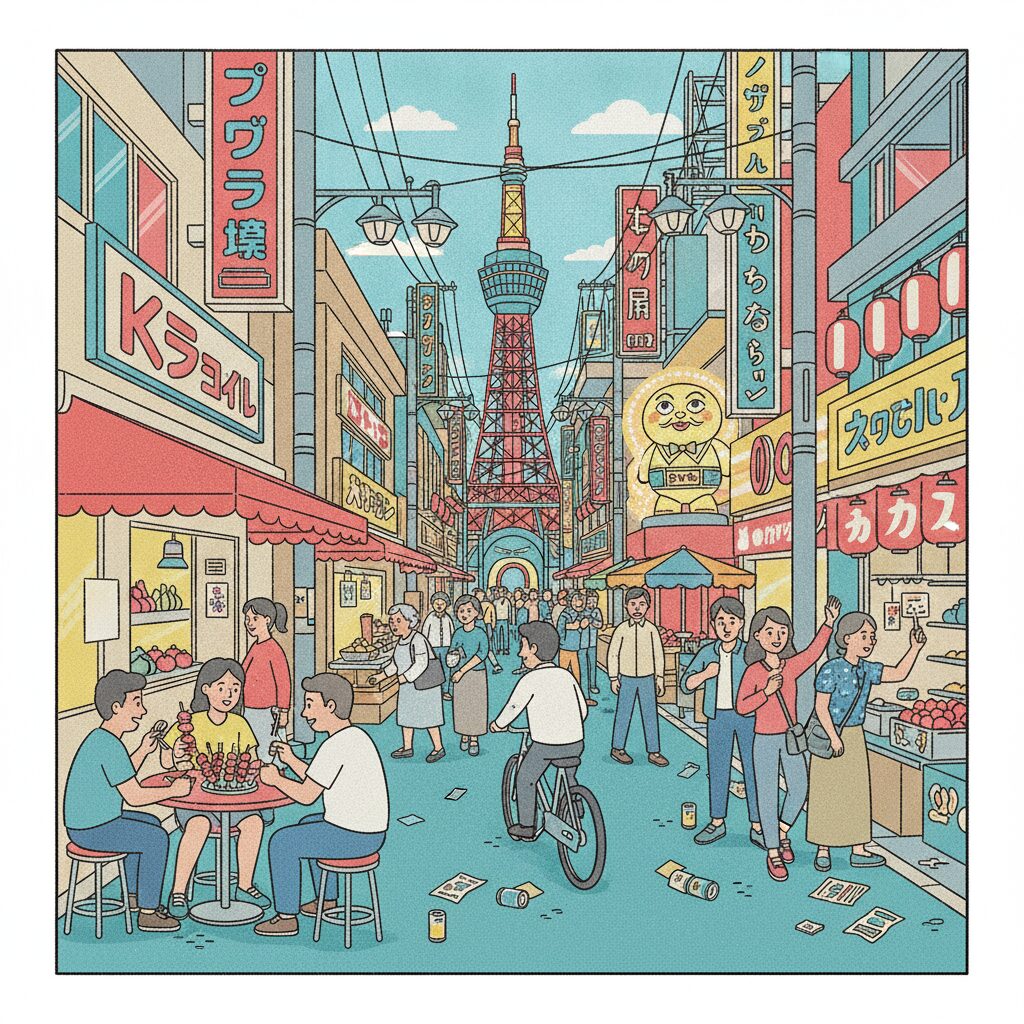
To fully capture the local spirit, you must navigate Jan Jan Yokocho. This narrow, covered arcade arguably houses the densest concentration of authentic Osaka dining culture in the city. The alley is so tight it barely fits three people walking shoulder-to-shoulder. Its name is onomatopoeic, derived from the historic sound of shamisen players aggressively strumming their instruments to draw the attention of passing laborers.
Today, the music has been replaced by the lively shouts of shop staff and the raucous laughter of patrons squeezed into tiny eateries. The physical design of Jan Jan Yokocho breaks down personal boundaries. In Tokyo, personal space is sacred—people go to great lengths to avoid touching strangers on trains. Here, bumping elbows is inevitable. You cannot remain a passive, invisible observer; you must weave through the crowd, raise your voice to excuse yourself, and recognize the physical presence of those around you. This enforced closeness fosters a unique camaraderie, breaking down the defensive walls that urban residents typically build, pulling everyone into a shared, chaotic experience.
Tachinomi (Standing Bars) and Horumon Grills
The culinary cornerstones of this evening frenzy are the tachinomi, or standing bars. To grasp Osaka’s egalitarian nature, you must drink at a tachinomi. In a typical restaurant, hierarchy is clear: you’re seated at a table where servers approach you with deference, separated by an invisible barrier. A standing bar dismantles this dynamic.
At a tachinomi, you don’t order a meal; you rent a small spot at a wooden counter. The CEO in a tailored suit stands shoulder-to-shoulder with the construction worker in dirt-streaked overalls. Removing chairs removes status. Everyone is on the same eye level. Everyone shouts their order directly to the master grilling inches away. You pass empty plates and full glasses along the line to assist the person next to you. It’s an intensely cooperative, deeply communal way to drink.
The menu prominently features horumon, which refers to beef or pork offal. Hearts, intestines, livers, and lungs are grilled over open flames or simmered in rich, dark miso stews. The word horumon is thought to originate from the Kansai dialect phrase meaning “things you throw away.” Historically, these nutrient-packed but less desirable cuts fed the laborers who built the city’s infrastructure. Eating horumon today honors their resourcefulness and working-class ingenuity. True flavor, it acknowledges, doesn’t come from luxury but from skill and thrift. The meat is chewy, intensely savory, and undeniably rich. It demands effort to eat—much like the city demands effort to truly understand. Paired with a large, ice-cold draft beer, it delivers the quintessential taste of authentic Osaka.
Unwritten Rules of the Authentic Shinsekai Experience
While the atmosphere is undeniably lively and inviting, it is a huge mistake for a foreigner to assume that this environment is a free-for-all. Like any well-functioning local ecosystem, the daily life of Shinsekai and its surroundings is governed by a strict set of unwritten rules. Understanding and respecting these boundaries is what separates being seen as an annoying tourist from being welcomed as a guest.
The Golden Rule of Kushikatsu (No Double-Dipping)
Kushikatsu, skewers of meat and vegetables battered and deep-fried to a golden crisp, is the neighborhood’s most famous culinary export. However, enjoying it locally involves a non-negotiable social contract. At authentic kushikatsu spots, the dipping sauce is not served in individual dishes. Instead, a large, deep stainless-steel container of thin, sweet-and-savory brown sauce sits on the counter, shared by everyone in that section.
The absolute, ironclad rule is that you may dip your skewer into the communal sauce only once. You cannot take a bite, decide you want more sauce, and dip it back in. This rule is clearly posted on signs in multiple languages, yet the underlying philosophy is often overlooked. It is not just a health and safety rule. It is a fundamental exercise in communal trust. By participating in this shared resource, you silently agree to preserve the experience for the person who will occupy your seat afterward.
If you need more sauce after your initial bite, you must use the raw cabbage provided on the counter. Take a crisp cabbage leaf, scoop a small amount of sauce from the communal container, and carefully pour it over your half-eaten skewer. The cabbage acts as a sterile spoon. Mastering this small, specific ritual shows locals that you are attentive, respect their customs, and understand how to share space responsibly.
How to Order at a Local Tachinomi
Foreigners often struggle with the mechanics of a standing bar because it contradicts everything they have learned about polite Japanese customer service. If you enter a tachinomi, stand quietly near the door, and wait for a staff member to bow, inquire about your party size, and guide you to a spot, you will be waiting until closing time.
Osaka values assertiveness. When you push through the noren curtains of a tachinomi, you must take initiative. Scan the counter for an opening. If there’s a small gap, make eye contact with the people standing there, offer a quick nod or polite excuse me, and physically squeeze yourself in. Do not wait to be invited.
When it’s time to order, you must find your voice. The staff are constantly moving—pouring drinks, flipping meat, and calculating bills mentally. They don’t have time to check if you’re ready. You must project your voice over the noise of the crowd. A sharp, confident excuse me is necessary. This transactional rhythm may feel aggressive to outsiders, but it is highly efficient and completely free of malice. It is the language of a city that values speed and clarity. By speaking up confidently, you align yourself with the local tempo.
Respecting the Locals: Photography and Etiquette
Perhaps the most crucial aspect of truly experiencing this area is knowing how to behave as an observer. In recent years, Shinsekai’s retro neon and gritty alleys have attracted hordes of amateur photographers. It is easy to see the neighborhood through a camera lens, treating it like an open-air museum for your visual enjoyment.
However, this is where foreigners often cross the line. The older men drinking cheap shochu at ten in the morning, the weary cooks wiping grease-stained counters, the locals engaged in passionate shogi matches—these are real people living their real, everyday lives. They are not unpaid extras in your travel documentary. Treating them as spectacles deeply disrespects the working-class dignity that defines the neighborhood.
If you truly want to experience Osaka’s daily life, put your smartphone away. Don’t stand in the middle of Jan Jan Yokocho blocking traffic to capture the perfect wide-angle lantern shot. Instead, step inside one of the tiny eateries. Order a drink. Struggle with the menu. Nod to the person next to you. If you try to speak the local dialect, even poorly, you’ll likely be met with loud, enthusiastic corrections and a flood of questions about where you’re from.
Osaka is a city that demands participation. It doesn’t want you to just watch from a safe distance. It wants you to crowd into a smoky standing bar, laugh too loudly, spill a little beer on your shoes, and embrace the messy, beautiful reality of human connection. When you stop observing the city and allow yourself to exist within it, the invisible barriers dissolve. You realize that the authentic pulse of Osaka is not found in its architecture, history, or food. It is found in the unapologetic, vibrant, and profoundly welcoming spirit of the people standing right next to you.