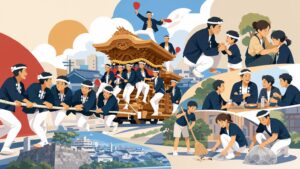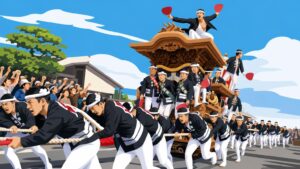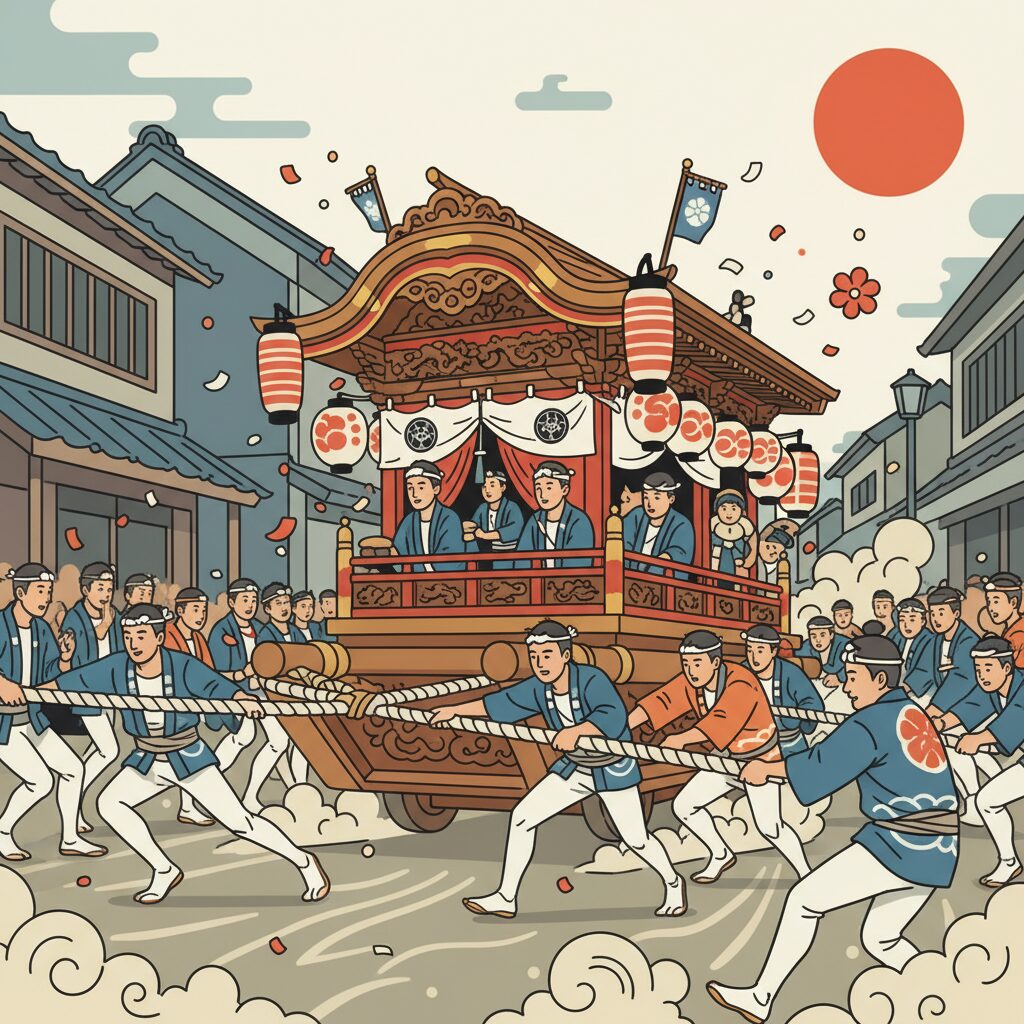
Every autumn, the internet floods with shaky phone videos from Osaka. They all show the same thing: immense, intricately carved wooden floats, weighing up to four tons, being hauled through impossibly narrow streets at a full sprint. Men in traditional attire swarm the ropes, their faces a mask of pure exertion. On the roof, a lone figure, the star of the show, leaps and dances, balancing precariously as the colossal structure beneath him lurches and skids around corners. This is the Kishiwada Danjiri Festival, a spectacle of speed, danger, and raw energy. For most, it’s a thrilling day trip, a chance to witness controlled chaos and capture an incredible video. But that view only scratches the surface. It treats the festival as a performance, a show put on for an audience. To truly understand this corner of Osaka, you have to ask a different question: Why do they do it? What possesses thousands of people to dedicate their lives, risk their bodies, and invest their fortunes in these two frantic days? The answer isn’t found in a quick visit; it reveals itself over a full weekend spent observing not just the parade, but the people. It’s a dive into a hyper-local, community-first mindset that feels worlds away from the polite individualism of Tokyo or even the commercial friendliness of central Osaka. This isn’t just a festival; it’s the explosive manifestation of a social contract that governs every aspect of daily life here. It’s the soul of the Senshu region, laid bare on the asphalt.
Consider complementing your festival adventure with a weekend exploration of Kishiwada’s historic castle town, where centuries-old traditions and vibrant local shops paint a deeper picture of the region’s soul.
The Neighborhood as a Team: A Year-Round Obsession
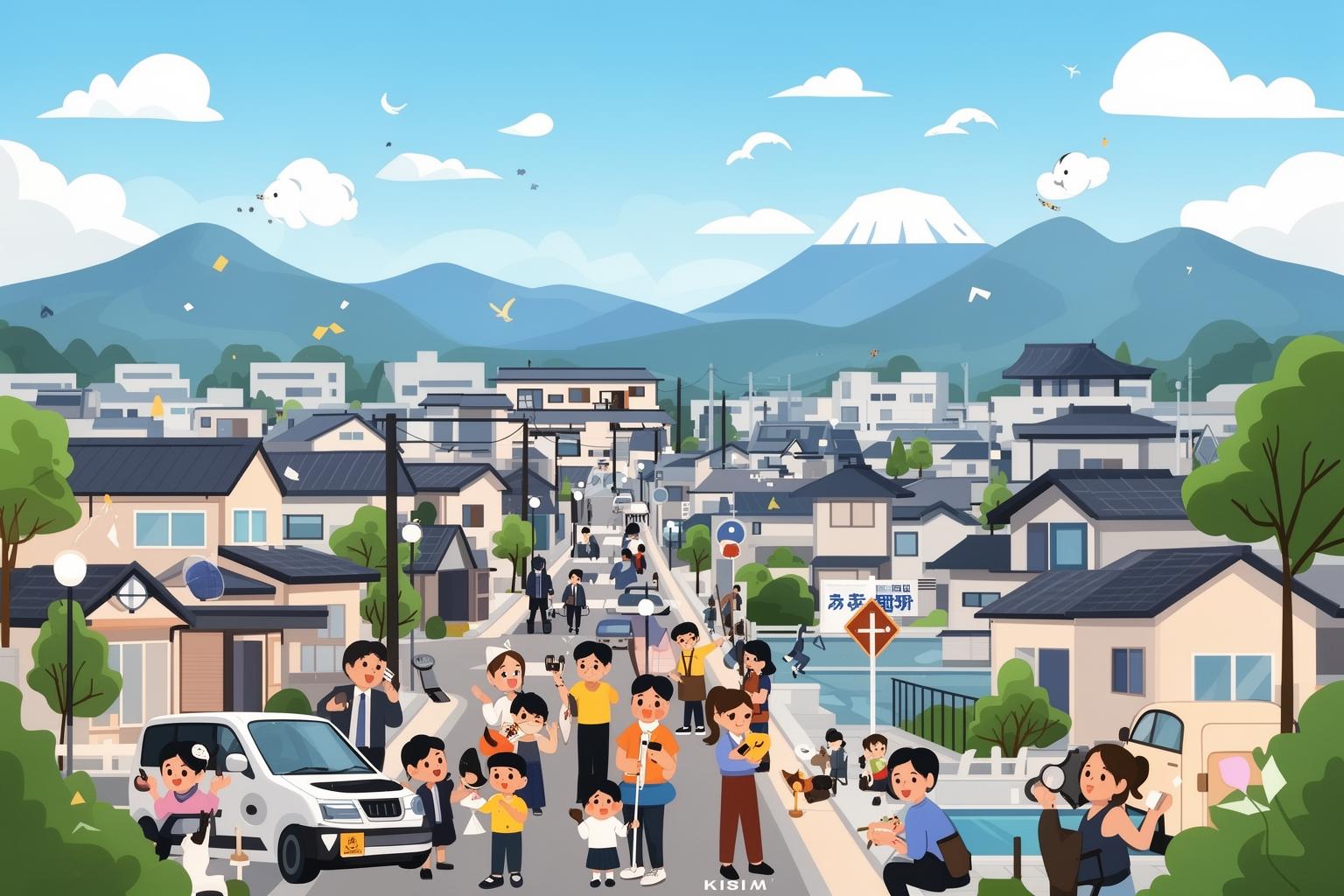
What a visitor experiences in September is merely the peak of a story that unfolds throughout the entire year. The Danjiri festival is not just a hobby; it is a way of life, an identity deeply embedded in the community’s fabric. Kishiwada is divided into dozens of neighborhoods, or `cho`, each with its own danjiri, a distinctive `hanten` (festival coat), and a rivalry with neighboring areas that is both intensely serious and warmly affectionate. Here, your address is more than just a location; it signifies your team allegiance. This represents one of the most profound contrasts between life here and in a metropolis like Tokyo. In Tokyo, your tribe is often defined by your workplace, university, or chosen subculture. In Kishiwada, your main identity is tied to geography. You are from Hamano-cho. You are from Miyamae-cho. This distinction shapes friendships, social circles, and a network of mutual responsibilities.
The organization behind each float is immense, a multi-generational structure of roles and duties. At the top is the `daiku-gata`, the master carpenter who performs the death-defying dance on the float’s roof. This position is not given lightly; it is the result of a lifetime of training and carries immense honor and pressure. Below him, the `mae-teko` (front levers) and `ushiro-teko` (rear levers) guide the colossal float, a task demanding both brute strength and precise coordination. The true driving force, however, is the `wakai-shu`, the young men’s group who pull the thick, heavy ropes. Their energy and discipline set the tempo, their unified cries of “Sorya, sorya!” providing rhythm for the entire operation. Even the children have roles, pulling smaller, decorative floats and learning the traditions from an early age.
This is not a volunteer activity you casually join. For young men born and raised in Kishiwada, participation is a rite of passage and a deeply ingrained expectation. To abstain is to distance oneself from the heart of the community. The training is intense, starting months ahead with practice runs and strategy meetings held during warm summer evenings. The financial commitment is equally substantial. The floats themselves are priceless works of art, passed down through generations and costing hundreds of millions of yen to maintain. This upkeep is supported by the community through `hana-gata`, or donations. Representatives from each `cho` go door-to-door, collecting contributions from every household and local business. A list of donors is proudly displayed during the festival. This is not merely fundraising; it is a public declaration of one’s dedication to the neighborhood. The entire system relies on shared sacrifice and collective ownership. Everyone has a stake in the outcome, which is why the emotions—the thrill of a successful run and the heartbreak of a mistake—are so profoundly intense.
The Unspoken Rules of the Street
A tourist arriving for the main event might be taken aback by the atmosphere, which feels less like a welcoming celebration and more like the tense moments before a major sporting event. The air is thick with anticipation but also carries an edge of seriousness. This is not a place designed for the comfort of casual observers. The streets belong to the danjiri, and everyone else is expected to know their place. This highlights a fundamental aspect of the local mindset: deep respect for expertise and tradition, along with an expectation that outsiders will show appropriate deference. The city transforms into a stage, governed by strict, though unwritten, rules for the audience.
The most important of these is simply to stay out of the way. When the rhythmic chants grow louder, it’s your signal to press yourself against a wall or slip into a doorway. The danjiri crews are highly focused, moving with an intensity that leaves no room for distracted onlookers. Their priority is the safety of their team and the integrity of their float, not tourists’ photo opportunities. This practical approach may be mistaken for unfriendliness, but it arises from necessity. The `yarimawashi`, a high-speed corner turn serving as the festival’s signature move, is a moment of calculated risk. Successfully executing this maneuver is the ultimate test of a team’s skill, and the pressure on the leaders is immense.
Another unwritten rule concerns a spectator’s physical positioning. While locals may be seen perched on ladders and stepladders to secure better views, this privilege is generally reserved for residents. Setting up your own ladder in a prime location, especially near critical cornering points, is considered a serious faux pas. These spots are earned through a lifetime of belonging, not claimed by a visitor for a single day. The best viewing areas in front of homes and shops belong to families who have lived and worked there for generations. They place their chairs and coolers early in the morning, a subtle declaration of their territory. Finding a place to watch requires reading social cues, understanding the crowd’s natural flow, and respecting these invisible boundaries. This sharply contrasts with more tourist-oriented festivals in Kyoto or Tokyo, where designated viewing zones are common and the line between participant and spectator is clear. In Kishiwada, you are a guest in a community’s sacred space and are expected to behave accordingly.
A Different Kind of Communication: The Senshu Dialect and Body Language
To an untrained ear, the sounds of the Danjiri Festival may come across as an overwhelming jumble of shouts, whistles, and chants. Yet, hidden within this sonic chaos is a precise and efficient language. Much of it is spoken in `Senshu-ben`, the local dialect of this southern Osaka area. Even for other Japanese speakers, `Senshu-ben` can seem rough, clipped, and aggressive. It avoids many of the polite softenings typical in standard Japanese in favor of blunt, direct commands. During the festival, this straightforwardness is essential. There is no room for ambiguity when a four-ton float races toward a ninety-degree turn. The shouts you hear are not random expressions of excitement; they are specific instructions concerning speed, timing, and rope tension, instantly communicated and implicitly understood by a team that has trained together for years.
This mode of communication extends beyond the festival into everyday life. Residents of the Senshu region are often seen as more direct and less concerned with formalities compared to their counterparts in Tokyo or even central Osaka. Small talk tends to be minimal, and opinions are expressed without hesitation. A foreigner used to the layers of politeness in Japanese interaction might find this abrupt and interpret it as rudeness. However, it is better understood as a culture rooted in efficiency and honesty. It reflects a preference for directness over social niceties—a trait shaped by the practical, working-class heritage of this port and industrial area. They aren’t being impolite; they’re simply communicating without the usual buffers.
The body language is equally expressive. The young men of the `wakai-shu` carry themselves with a distinct swagger, a confidence that borders on arrogance. They walk with their chests out, wearing their customized festival attire with visible pride. From an outsider’s perspective, especially one from more reserved Tokyo, this might appear as machismo. But within the festival’s context, it is a performance of identity. It serves as a non-verbal declaration of loyalty to their `cho` and a challenge to their rivals. This intense, localized pride is a potent social force. It drives competition, strengthens team bonds, and shapes the social fabric of the entire region. It’s less about individual ego and more about collective confidence.
Life Beyond the Festival: How Danjiri Shapes Daily Existence
When the last danjiri is returned to its storage house on Sunday evening, the city collectively exhales in relief and exhaustion. Yet, the connections and obligations that fueled the festival do not disappear; they simply fade from sight, forming the unseen framework of daily life in Kishiwada. The strong bonds created in the festival’s intensity become a powerful, hyper-local social safety net. This is perhaps the most important lesson for anyone considering living in this part of Osaka. The community is not merely for show; it is a vital aspect of life.
This system is based on mutual support. If you need help moving into a new apartment, your `cho` friends will show up with a truck before you even ask. If you start a small business, your first and most loyal customers will be families from your neighborhood. Searching for a job? An introduction from a senior member of the local festival association carries significant influence. This network of relationships offers a level of support that is increasingly rare in the anonymous, transient neighborhoods of large cities like Tokyo. Here, you are known. Your family is known. Your history is known.
However, this deep interconnectedness has its drawbacks. The privacy one takes for granted in a bigger city is less guaranteed here. To some extent, your business is everyone’s business. There is considerable social pressure to conform to community norms and participate in local activities. Choosing to stay aloof or uninvolved can be seen as rejecting the community, making it hard to form relationships. For a foreigner, integrating into this world can be difficult. It’s not hostility; it’s that social circles are already established and deeply rooted. Acceptance isn’t automatic; it must be earned by showing genuine respect for the local culture, by participating, and by understanding that you are entering a system with a long history and clear expectations. A common misconception among foreigners is to view this as exclusivity. It’s better understood as social cohesion built on shared responsibility. You give loyalty to the community, and in return, the community supports you.
Not Just Kishiwada: The Danjiri Spirit Across Southern Osaka
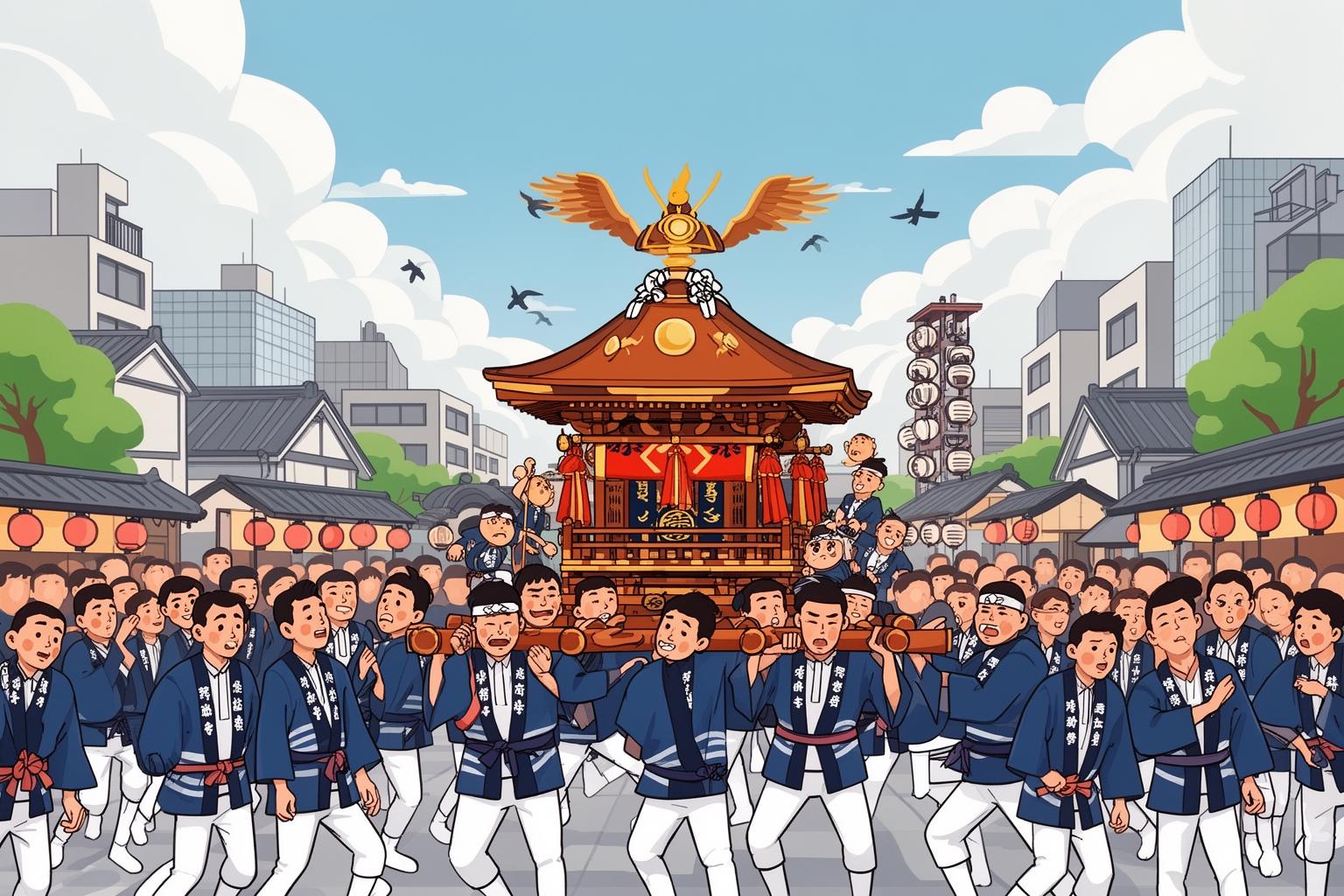
Although Kishiwada’s festival is the largest and most renowned, it is by no means the only one. The danjiri spirit forms the cultural foundation of the entire Senshu region, the coastal area of southern Osaka extending to the border of Wakayama. Numerous other cities and towns, including Kaizuka, Izumiotsu, and Hannan, host their own danjiri festivals throughout September and October. Each festival has its own unique style, rules, and traditions. Some are famous for their speed, others for the impressive size of their floats, and yet others for their more musical, rhythmic processions. This regional diversity highlights the deeply local sense of identity here. Someone from Kishiwada senses a vast difference between themselves and a person from neighboring Kaizuka, a distinction that might completely elude an outsider.
This mosaic of proud, independent communities shapes the daily life in southern Osaka. It is less a single, unified suburban area and more a collection of distinct towns, each with its own focal point—its own festival, loyalties, and unique character. This dynamic influences everything from where you buy groceries to which local politicians wield influence. The long-standing neighborhood loyalties, reinforced annually during the festival, extend into every facet of civic and social life.
For anyone moving to Osaka, understanding this distinction is crucial. Living in the Senshu area feels fundamentally different from residing in the urban centers of Umeda or Namba. Life in the south is slower, more rooted, and far more community-focused. It demands a social approach centered on building local relationships and appreciating the complex histories of the area. While it may lack the cosmopolitan convenience of the city center, it provides a strong sense of belonging for those willing to invest in it. This is the Osaka beyond the tourist maps—a place defined not by its famous landmarks, but by the strength of its neighborhood connections.
Final Thoughts: A Spectacle with a Soul
To view the Kishiwada Danjiri Festival as merely a dangerous parade is to miss its true essence. It is a raw, unfiltered expression of a community’s spirit. It stands as a testament to a lifestyle that values the collective over the individual, tradition over convenience, and shared identity over personal ambition. In a time when much of Japanese culture can seem polished and packaged for consumption, the Danjiri festival remains unapologetically authentic, and at times, intimidatingly so. It is not meant for outsiders. It is for the community. And that is exactly what makes it so captivating.
For a foreigner living in Osaka, spending a weekend in Kishiwada is more enlightening than a dozen museum visits. It reveals the fierce local pride that forms the foundation of the region’s identity. It showcases the straightforward, no-nonsense communication style that contrasts with much of Japan. Most importantly, it exposes the profound strength of community—a network of obligation and support that shapes the lives of hundreds of thousands. You may never pull the ropes of a danjiri yourself, but by witnessing the passion and dedication of those who do, you gain a deeper insight into the soul of Osaka. The lasting image is not just the speed of the float or the bravery of the man atop it. It is the roar of the crowd, the sound of thousands shouting in unison—not as spectators, but as participants. It is the sound of a people united by place, by history, and by the shared burden of the ropes in their hands. It is the sound of home.