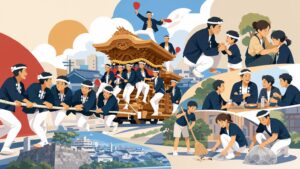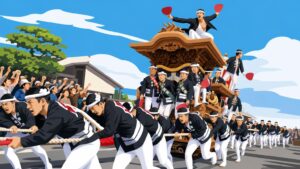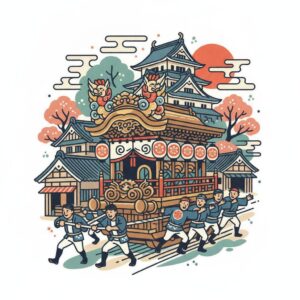
When most people in Osaka, Japanese and foreigners alike, hear the word “Kishiwada,” one image explodes into their minds: the Danjiri Festival. It’s a vision of beautiful, colossal wooden floats, weighing up to four tons, being hauled through narrow streets at terrifying speeds by hundreds of men in traditional festival garb. They don’t slow down for corners; they execute a maneuver called the yarimawashi, a violent, drifting pivot that’s as breathtaking as it is dangerous. It’s a spectacle of raw energy, controlled chaos, and a kind of collective madness that grips this coastal city for two days every September. It’s famous, it’s thrilling, and for most, it’s the beginning and end of the Kishiwada story. But I’ve always been more curious about the quiet days. What happens in the city for the other 363 days of the year? What kind of community spirit forges the iron-clad trust needed to pull off such a risky feat? The festival isn’t a performance for tourists; it’s an expression of something much deeper. To understand Osaka beyond the neon glare of Namba, you have to look at its edges, at places like Kishiwada, where identity isn’t just a postcode but a lifelong commitment. This isn’t the sprawling, anonymous metropolis of Tokyo, or even the commercially driven buzz of Umeda. This is a city built on a different set of rules, a place where community is the bedrock of existence. So I took a short train ride south from Namba, not to see the festival, but to find the soul that powers it.
Beyond the lively traditions of Kishiwada, urban explorers may also uncover a different facet of Osaka by experiencing Sakai’s exquisite craftsmanship.
The Danjiri DNA: More Than Just a Festival, It’s a Social Contract

To truly understand Kishiwada, you must first discard the notion that the Danjiri is merely an event. It’s not simply a festival the city hosts; it functions as the city’s entire operating system. It shapes social structures, defines neighborhood identities, and imparts a set of values from birth. This is one of the most striking contrasts to the more individualistic lifestyles found in major urban centers like Tokyo or even central Osaka. In those places, life is often shaped by your career, personal hobbies, or chosen social groups. In Kishiwada, your identity is primarily tied to your neighborhood, your cho, and your role within its Danjiri organization.
The Year-Round Presence of the Floats
Strolling through Kishiwada on a quiet weekday, you might not see the festival, but its presence is felt everywhere. Nestled among residential streets, between modest houses and small factories, are the danjiri-goya — the garages that shelter the magnificent floats. These are not mere storage sheds; they are sacred spaces, clubhouses, and symbols of each neighborhood’s pride. Peering through the slatted doors, you might glimpse the intricately carved wood of a resting float, scented faintly with cypress and polish. More often, you’ll find groups of men gathered there in the evenings—not just in August or September, but also in March, May, and November. They maintain the ropes, polish the brass, or simply share a beer and conversation. This is their social life, forming bonds that extend beyond work or family. As the festival approaches, the atmosphere shifts. The rhythmic beat of taiko drums and the sharp, melodic notes of flutes resonate through the streets as youth groups rehearse. This becomes the city’s evening soundtrack—a constant, tangible reminder of the shared mission uniting everyone. This contrasts sharply with life in a Tokyo suburb, where the soundscape is dominated by train announcements and traffic. Here, the sounds serve as a public declaration of a shared cultural commitment.
A City Divided, Yet United
The Danjiri spirit creates a paradox: it divides the city into fiercely competitive districts while simultaneously forging a strong, unified identity. Each of Kishiwada’s neighborhoods, especially in the old castle town and coastal areas, has its own Danjiri, its own uniform (happi coat and headwear), and its own deep-rooted pride. The rivalry is earnest. Residents of the Kamincho area will passionately argue that their yarimawashi technique surpasses that of the Numacho district. This is more than playful banter—it’s a fundamental part of their identity. This intense localism permeates daily life. Families tend to support shops within their own Danjiri district. Young people’s social circles are often defined by which youth association (seinen-dan) they belong to. These organizations form a parallel social system, with a strict hierarchy based on age and experience, teaching discipline, respect for elders, and a collective responsibility that arguably shapes a young man’s character more than formal schooling. Such geographical and social segmentation is almost unimaginable in the fluid, transient social scenes of Shibuya or Shinjuku. In Kishiwada, where you come from is not just a place; it’s your lifelong team.
“Our Town” vs. “My Town”: Embracing the Collective
This strong local pride culminates in a deeply collective mindset. The question is never, “What’s in it for me?” but rather, “What’s best for our cho?” This is a vital distinction for any outsider attempting to grasp the local psychology. In Tokyo, success is often measured by personal achievement—a promotion at a prestigious firm, a creative project. In Kishiwada, social standing is earned through commitment to the community. I once observed a local hardware store owner who shut his business for ten days straight before the festival. He wasn’t on vacation; he was performing Danjiri duties—organizing logistics, attending meetings, preparing for the event. His personal income was secondary to his communal responsibility. This would be a radical, if not impossible, decision in a city driven by the relentless pace of modern capitalism. Here, it’s not only normal—it’s expected. Participation is effectively mandatory for families with deep roots. Opting out is seen as rejecting the community itself. This fosters intense social cohesion, a mutual support network, but can also feel insular and demanding to outsiders used to the anonymity and freedom of big city life.
Life by the Sea: The Salty Air and Resilient Spirit
Beyond the strong pull of the Danjiri, another key element defining Kishiwada’s character is its bond with the sea. This isn’t the polished, commercialized waterfront seen in Kobe’s Harborland or the futuristic bayside of Yokohama. Kishiwada is a working port town, where its connection to the ocean is tangible, gritty, and deeply embedded in everyday life. The air is filled with the scent of salt and diesel, a constant reminder of the city’s maritime spirit.
Kishiwada’s Seaside Identity
Heading toward the coast, the atmosphere changes. The narrow streets of the castle town open up into a more exposed, windswept area. Early mornings at the Kishiwada Fishing Port showcase an unvarnished, genuine slice of Osaka life. This is not a tourist market like Kuromon Ichiba, with its carefully arranged stalls and multilingual signs. This is a place of hard work. Fishermen in rubber boots and worn jackets unload crates of shining fish. Auctions erupt in rapid-fire shouts and hand signals, conducted in the local Senshu-ben dialect, a faster and more direct variation of Osaka dialect. The interactions are straightforward and efficient, which can be mistaken for rudeness by outsiders. This bluntness stems from a life of labor, where there’s no time for unnecessary pleasantries. The local cuisine mirrors this maritime lifestyle. Restaurants and izakayas proudly serve the day’s catch, especially local specialties like iwashi (sardines), anago (conger eel), and the highly prized watarigani or gazami (blue swimming crab). Eating locally isn’t just a fashionable choice here; it’s a time-honored tradition. The sea provides, and the city partakes. This practical, resource-based approach to life is characteristic of the Senshu region, distinguishing it from the more finance- and commerce-focused culture of central Osaka.
The Castle on the Coast: A Symbol of Pride, Not Just a Tourist Spot
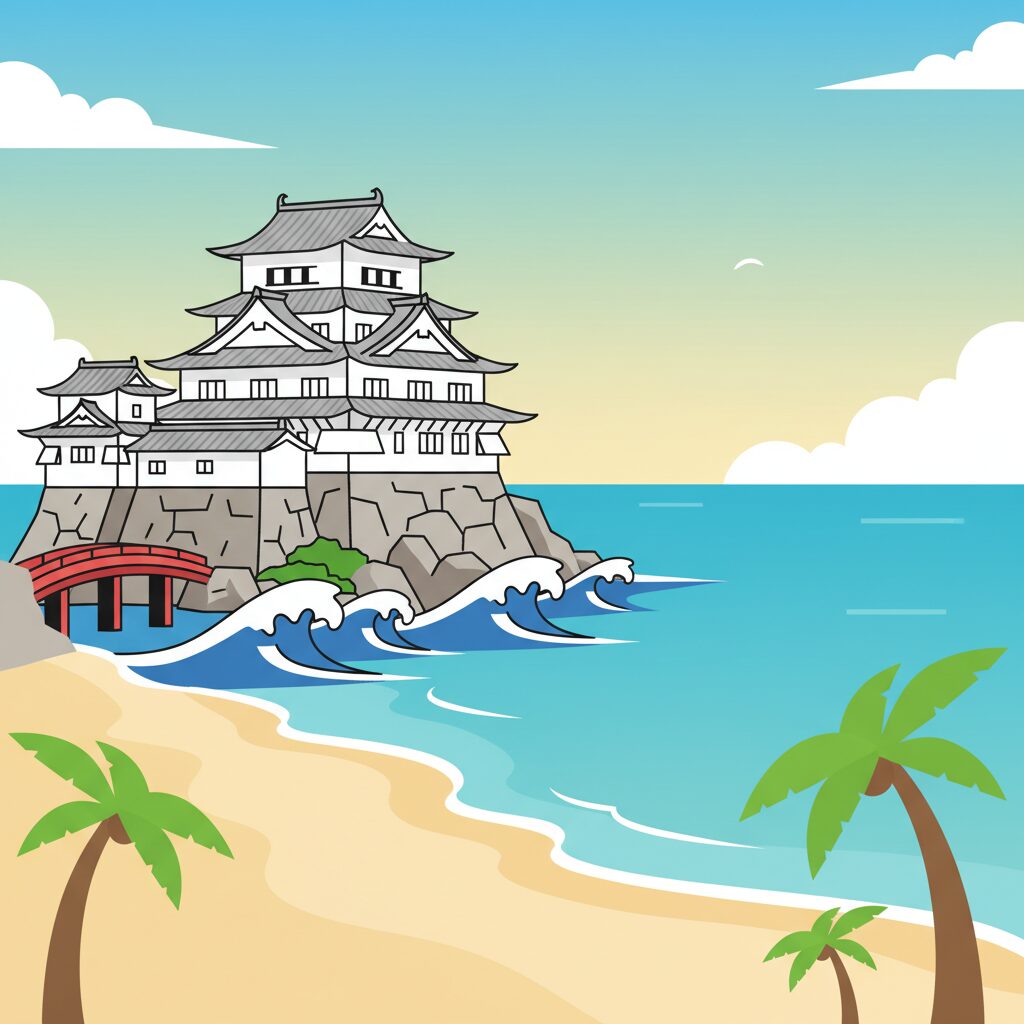
Dominating the cityscape is Kishiwada Castle. Although a reconstruction, its importance to the locals is profound. For tourists, it’s a picturesque photo spot. For Kishiwada residents, it anchors their identity. Unlike more famous castles that feel like museum artifacts, Kishiwada Castle is fully integrated into the city’s daily flow. People use the nearby park for morning jogs and evening walks. Families picnic on the lawns. It feels less like a historical site and more like the town’s communal backyard. The castle’s most renowned feature, the Hachijin no Niwa garden designed by famed modern landscape artist Mirei Shigemori, perfectly symbolizes the Kishiwada spirit. It uses stones to represent a famous strategic formation from a Chinese military epic—a modern, abstract interpretation of an ancient idea. This merging of honoring the past while embracing a bold, modern vision encapsulates Kishiwada. The people take great pride in their centuries-old Danjiri tradition but are not stuck in history. They embody a spirit of adapting and innovating without losing sight of their roots. The castle is not merely a relic; it stands as a testament to enduring strength and independent spirit.
A Different Kind of Kansai Dialect
Communicating in Kishiwada can be an experience, even for those familiar with the standard Osaka dialect. The local variant, Senshu-ben, is known for being rough, fast, and direct. The intonation is flatter, and sentences are often clipped. A common phrase like “What are you doing?” which is Nani shiteru no? in standard Japanese, might become Nani shon yen? in Senshu-ben. The bluntness can be surprising. There’s less of the softening language and polite vagueness typical of Tokyo speech. However, it’s a mistake to see this as aggression or rudeness. It’s a language of familiarity and efficiency, born from a close-knit working-class community where everyone knows each other and formalities aren’t necessary. It reflects a mindset that values honesty and clarity over polished manners. Understanding this is essential to understanding the people. Their words may be straightforward, but their actions often reveal a deep warmth and readiness to help those they consider part of their community.
Navigating the Unspoken Rules of a Close-Knit Community

For a foreigner contemplating life in Osaka, Kishiwada offers a fascinating yet intricate social environment. It provides a strong sense of belonging often lacking in the isolated anonymity of larger cities. However, this profound community connection rests on unspoken rules, shared history, and a clear division between insiders and outsiders. Navigating this world demands patience, keen observation, and a readiness to adapt to a different way of life.
The Insider/Outsider Dynamic
At first glance, Kishiwada appears to be a welcoming place. People will greet you in the street, shopkeepers will engage in conversation, and you’ll likely face many curious but well-meaning questions. This reflects the classic Osaka friendliness. Yet, it’s important to distinguish between being welcomed and truly being an insider. The city’s social fabric, woven through generations of shared Danjiri experiences, family ties, and neighborhood loyalties, is not easily breached. Becoming a genuine member of the community takes a lifetime—or perhaps even several generations. Foreign residents are likely to be treated with kindness and respect, but a subtle distance will remain. This is not out of malice but a natural result of a society founded on deep, inherited trust. Practical advice for newcomers is to adopt the role of a respectful observer and considerate neighbor. Show sincere interest in local traditions without forcing your way into them. Contribute in small ways—supporting local businesses, keeping your surroundings tidy, being a friendly presence. Your efforts will be noticed and valued. This is a stark contrast to Tokyo apartment life, where you may live for years without ever speaking to your neighbors. In Kishiwada, your presence matters, and your behavior is noticed.
“Gaman” and Grit: The Kishiwada Work Ethic
Life in this part of Osaka has long been shaped by hard, physical work—fishing, farming, and textile production. The area is renowned for the Senshu towel industry, recognized for its quality and the resilience of its workers through economic highs and lows. This legacy has fostered a strong work ethic and a cultural emphasis on gaman—endurance, perseverance, and enduring hardship without complaint. This spirit is most clearly demonstrated during the Danjiri festival, a physically demanding and inherently risky event. The determination to push through pain and exhaustion for the team and town marks the ultimate measure of character. This value system applies to daily life as well, with deep respect for skilled, honest labor regardless of social status. A master carpenter or a seasoned fisherman holds a respected place in the community, a status earned through years of dedication and expertise. This concept of success differs from the corporate world of Tokyo’s Marunouchi district, where rank and titles define status. In Kishiwada, respect is earned through real contributions and steadfast grit.
The Neighborhood Shopping Arcade: The Community’s Living Room
To experience the heart of Kishiwada’s community, one only needs to wander through the Kishiwada Station Shopping Arcade. This is not a sleek, modern mall filled with international brands. It’s a covered street, slightly worn around the edges, lined with family-run shops that have stood for decades. There’s the butcher who knows each family’s preferred cuts of meat, the fishmonger with the morning’s fresh catch, the tiny shop making custom Danjiri leg guards, and the old-fashioned café where neighborhood elders gather to gossip daily. The arcade serves less as a commercial hub and more as the community’s living room. Transactions are secondary to social interaction. A simple vegetable run can turn into a twenty-minute conversation about family, health, and festival preparations. Shopkeepers watch over local children, and bonds between merchants and customers are built on decades of mutual trust. This contrasts sharply with the impersonal efficiency of online shopping or sprawling suburban malls. It’s a living web of human connection, where the Osaka concept of jō (情)—a blend of empathy, warmth, and human feeling—is fully alive. Here, the true heartbeat of the city can be felt every day.
Is Kishiwada the “Real” Osaka? A Final Reflection
For many foreigners, the image of Osaka is strongly associated with the dazzling neon lights of Dotonbori, the endless food stalls of Kuromon, and the lively, comedic character often shown in the media. This vibrant aspect is an essential part of the city’s identity, but it represents only one chapter of a much broader story. Places like Kishiwada offer a glimpse into a different side of Osaka—one that is perhaps more deeply connected to the region’s historical roots.
Beyond the Namba Stereotype
Kishiwada encourages you to look beyond the stereotype of Osaka as merely a city of merchants and entertainers. Here, the spirit is not mainly commercial; it is communal. Loyalty lies not with a brand or corporation, but with the neighborhood block, the cho. This is the Osaka of deep roots, where families have lived on the same land for centuries, fostering a collective identity so strong it can feel almost tribal. It lacks the cosmopolitan polish of central Osaka’s Kita district and the trendy, chaotic energy of Minami. Instead, it provides a profound sense of place, a connection to history that is not just preserved in museums but lived and celebrated daily in the streets. To fully understand Osaka, one must recognize it is not a monolith. The pragmatic merchant spirit of Semba, the gritty working-class pride of the Senshu coast, and the flashy consumerism of Shinsaibashi are all genuine facets of Osaka’s identity. Kishiwada represents one of its oldest and most fiercely guarded forms.
A Place for a Different Kind of Life
So, what does this mean for a foreigner considering life in Osaka? Choosing to live in a place like Kishiwada means embracing a different rhythm of life. It suits those who value community over anonymity, and stability over constant change. It appeals to those who find comfort in the daily rituals of neighborhood life and are willing to invest the time and patience needed to build genuine, long-term relationships. It would not be an easy fit for someone seeking the fast-paced, trend-driven, and socially fluid atmosphere of a global megacity. Life here demands adaptation, respect for deeply rooted traditions, and an acceptance that you may always remain, in some small way, an outsider looking in. But the reward for that understanding is a rare and profound sense of belonging. It’s the feeling of being not just an anonymous resident in a sprawling city, but a recognized and valued member of a living, breathing community with a history stretching back centuries. The intense, unifying spirit of the Danjiri festival is the ultimate expression of Kishiwada’s soul. It serves as a dramatic annual reminder that in this part of Osaka, the welfare of the ‘we’ will always take precedence over the ambitions of the ‘me.’ Grasping this single, powerful notion is one of the most crucial steps to truly understanding the heart of the people who call Osaka home.