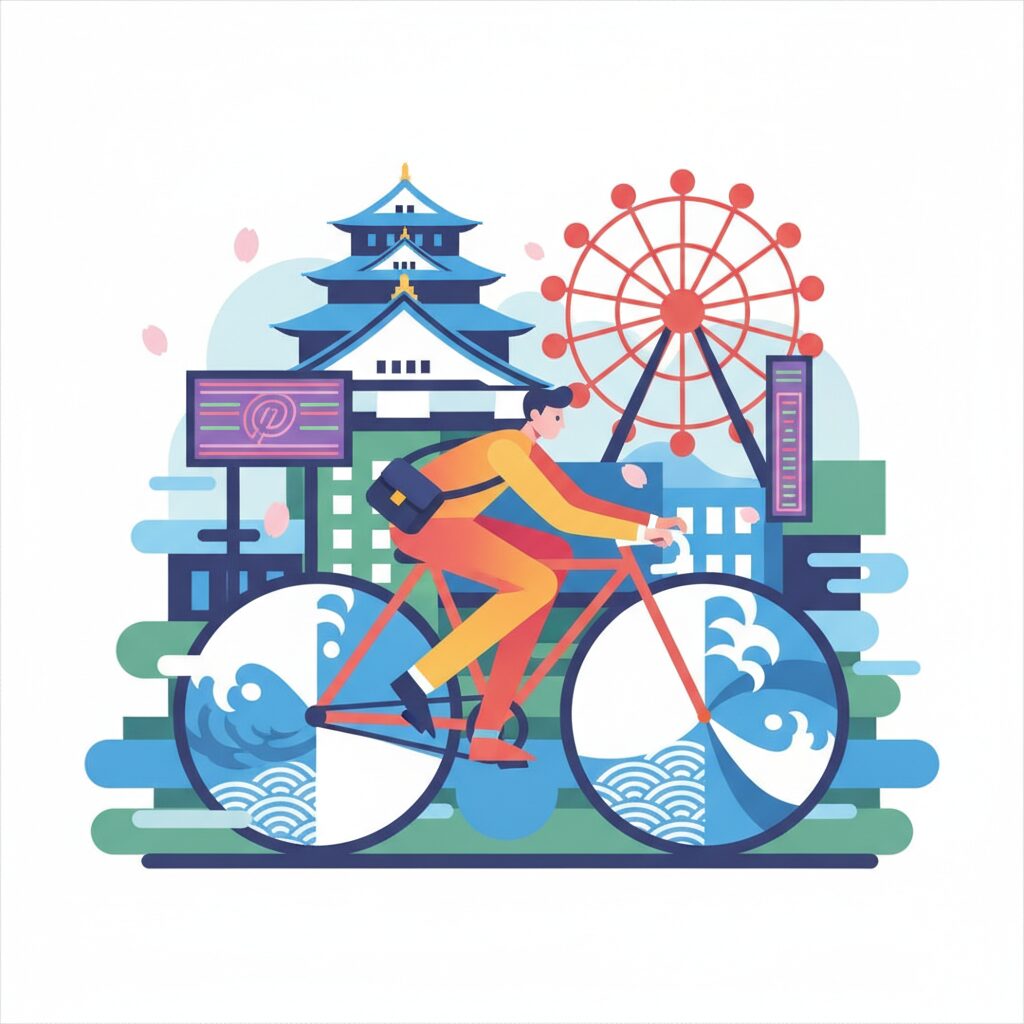
The first time you truly see the difference between Tokyo and Osaka, it might not be in the language, the food, or the fashion. It might be on a bicycle. Picture this: a quiet side street in a Tokyo neighborhood like Sangenjaya. The pedestrian light is red, but there are no cars in sight for miles. A cyclist, helmet on, phone put away, waits patiently on the sidewalk for the signal to change. They are following the rule, the absolute, undeniable, written-down rule. It’s a portrait of civic order, a quiet contract with society. Now, cut to Osaka. You’re standing at the entrance to the Tenjinbashisuji shopping arcade, a river of humanity flowing in both directions. An elderly woman—an obachan—on a squeaky, battle-scarred mamachari bicycle comes sailing through the crowd. Her front basket is overflowing with daikon radishes and leeks. Her bell isn’t ringing once or twice; it’s a constant, cheerful, insistent chirin-chirin-chirin, a sonar ping that parts the sea of people just enough for her to glide through. She doesn’t stop. She doesn’t even slow down. She weaves, she ducks, she is one with the chaos. This isn’t just a difference in traffic etiquette. This is a difference in philosophy. In Tokyo, the bicycle is a vehicle, subject to laws and regulations. In Osaka, the bicycle, the beloved chari, is an extension of the self. It’s a tool of pure, unadulterated pragmatism, a metal skeleton key that unlocks the city’s most efficient paths. It reveals the very soul of Osaka: a place where unspoken rhythms trump written rules, where individual awareness is the grease that keeps the great, clattering machine of the city moving. For anyone new here, the question burns: Is this complete anarchy, or is there a system I just can’t see? The answer, like everything in Osaka, is complicated, human, and endlessly fascinating.
In a city where each street and cycle ride tells its own story, you might also discover how local quirks extend beyond transportation by exploring Osaka’s rental lingo to see how property dealings too defy tradition.
Tokyo’s Rules vs. Osaka’s Rhythm
To grasp the freewheeling spirit of the Osaka cyclist, you first need to understand the structured world they’re rebelling against, whether consciously or not. Tokyo functions on a principle of compartmentalization. There are designated areas for cars, places for pedestrians, and increasingly, dedicated spaces for bikes. This forms the basis of its order. Osaka, in contrast, operates on a principle of beautiful, functional fusion. Spaces serve multiple purposes, their use defined not by painted lines but by the immediate needs of the people occupying them. This fundamental difference in urban philosophy marks the beginning of the major cycling divergence.
The Sidewalk is a Suggestion
In Tokyo, the sidewalk is largely inviolable. It’s pedestrian territory. While cycling on the sidewalk is technically allowed in some areas, it’s done with a sense of apology. Cyclists move slowly, yield constantly, and carry the air of guests in someone else’s space. The preferred and respected approach is to ride in designated bike lanes where available or to cycle on the left side of the road, behaving like smaller, quieter vehicles. This is the ‘correct’ method, the way prescribed by the manual. It’s a system designed to eliminate ambiguity. You know where you’re supposed to be, and you trust others do as well. It’s orderly, clear, and for many, safe.
Then you get to Osaka, and the rulebook is tossed aside. Here, the sidewalk is not a pedestrian refuge; it’s the primary thoroughfare. It serves as the default cycling highway, a shared space where a complex, unspoken dance unfolds constantly. A businessman whizzes by on a sleek cross bike, a mother with two children manages her electric-assist mamachari around a chatty group of high schoolers, and a delivery driver carrying a tower of ramen bowls balances carefully as he weaves through it all. The road, crowded with cars, trucks, and buses, is often considered the more dangerous, less efficient choice. Why risk facing a two-ton vehicle when you can flow with the organic stream of pedestrian traffic? This reasoning isn’t born from a disregard for rules but stems from the city’s very geography. Osaka is a maze of narrow side streets, covered shopping arcades (shotengai), and dense residential blocks. These spaces were designed on a human scale long before cars shaped city planning. Cycling on the road is often impractical, impossible, or simply slow. So, people adapted. The sidewalk became the solution, reflecting the Osaka mindset of seeking the most direct, practical path, even if it’s not the official one. The rule isn’t ‘stay off the sidewalk’; it’s ‘don’t cause trouble’. This is a subtle yet profound shift from following external rules to relying on internal awareness.
The Philosophy of the Bell
Nowhere is the cultural divide more audible than in the use of the bicycle bell. A simple device, yet it reveals much about communication styles. In Tokyo, ringing the bell is almost an admission of failure. It’s a last resort, used only when a pedestrian hasn’t noticed you and you need to pass. It’s often a single, gentle ching, paired with a slight bow of the head, as if to say, “Excuse my intrusion, I’m sorry to disturb your walk, but I must get by.” It’s an act of polite deference. Using it repeatedly or aggressively would be considered a serious social faux pas, signaling impatience and a lack of consideration.
In Osaka, the bell is not an apology but a communication tool. It is functional, assertive, and completely neutral. The constant chirin-chirin-chirin of the obachan in the shotengai isn’t an angry honk. It’s a friendly, continuous announcement: “Hello everyone, I’m here, moving steadily, please be aware of me as I navigate this shared space.” It’s proactive rather than reactive. It’s like the audio equivalent of a ship’s foghorn, designed to prevent collisions before they occur. It’s a key element of the city’s soundscape, blending with the calls of shopkeepers and the rumbling trains. This directness can jolt outsiders, seeming pushy or aggressive. But it’s deeply tied to the Osaka communication style. This culture often prizes honesty and efficiency over subtlety. People tend to speak openly and get straight to the point in business and in life. The bell is simply an extension of that. It’s a clear, unambiguous declaration of intent meant to make life easier and more efficient for all. It’s not rude; it’s radically practical.
The Unspoken Code of the Concrete Jungle
If you observe cyclists in Osaka long enough, you begin to realize it’s not pure chaos. There is a system, just not one that can be outlined in a government manual. It’s a living, breathing code learned through watching and participating. It consists of social contracts and shared understandings that enable this high-speed, high-density dance to operate day after day with surprisingly few collisions. Mastering this code is key to truly understanding how Osaka functions.
Reading the Flow: The Human Sonar
The most vital skill for an Osaka cyclist isn’t leg strength or balance. It’s a highly refined form of predictive social intelligence, akin to human sonar. You’re not simply looking at the space ahead; you’re actively scanning and interpreting the intentions of everyone around you. It involves reading micro-expressions and subtle body language shifts that hint at a person’s next move. You see the slight turn of a shopper’s head toward a storefront and know they’re about to make a sudden left turn. You notice the hesitation in a tourist’s steps as they check their map, prompting you to give them extra space. You sense the focused, straight-ahead gaze of a salaryman and understand he won’t veer off course, so you adjust accordingly.
This skill is developed out of necessity. In a rule-driven place like Tokyo, you rely on others to obey signals. You stop at a red light because you trust others will do the same. In Osaka’s fluid environment, you trust nothing but your own ability to predict. It’s a continuous, low-level mental calculation—anticipating trajectories, judging speeds, and making split-second adjustments. This heightened awareness reflects a broader Osaka cultural trait. The city is densely populated, with people living, working, and shopping in close-knit communities. You’re always conscious of your neighbors. This proximity fosters a special kind of social sensitivity. You learn to read the atmosphere, understanding moods and intentions without words. The sidewalk ballet is just a faster-paced version of the social awareness Osakans practice every day.
The Parking ‘System’: An Ecosystem of Convenience
The difference in approach continues when the ride ends. In Tokyo, bike parking is orderly. You find the designated, clearly marked spot, often a multi-level garage or rows of metal racks. You lock your bike there and sometimes pay a small fee. Signs warn of strict enforcement, and illegally parked bikes are regularly towed. The system prioritizes clarity, fairness, and public order. It is straightforward and unambiguous.
Osaka also has official parking lots, but these coexist with a far livelier, more anarchic, and efficient informal system. The real parking ‘system’ is an unwritten agreement—a city-wide understanding rooted in convenience and mutual tolerance. Any available sliver of public space can become temporary bike parking. Railings outside convenience stores, narrow gaps between buildings, or walls next to vending machines—if you can lean your bike without causing a serious obstruction, it’s generally fair game. This results in what appears to be a mess: chaotic rows of bikes lining every street. Yet there is a logic behind it. An unspoken hierarchy defines acceptable parking spots. You never block a building’s main entrance, wheelchair ramps, tactile paving for the visually impaired, or fire hydrants. Minor inconveniences, however, are often tolerated. It’s the give-and-take of city life. Shopkeepers might rearrange bikes neatly in front of their stores to clear a path but rarely express anger. The social contract is straightforward: I tolerate your bike here now, knowing later I’ll need a convenient spot for mine. This is the physical embodiment of Osaka’s pragmatism. Why build an expensive multi-story parking garage a block away when this perfectly good wall is right here? The goal isn’t a flawless streetscape but to carry on with life as efficiently as possible.
The Machine and Its Rider: An Osaka Story
The bicycle itself, along with the way it is ridden, reveals everything you need to understand about its owner’s priorities. In Osaka, the chari is less a piece of sporting gear or a lifestyle statement and more a reliable workhorse. It embodies the city’s relentless, practical energy. The specific style of bike, its modifications, and the rider’s posture all offer insights into the everyday life of this city.
The Almighty Mamachari
While Tokyo boasts sleek road bikes, stylish fixies, and foldable commuters, Osaka’s streets are ruled by the mamachari—the “mom’s bike.” This bicycle is the minivan of the cycling world: heavy, sturdy, and designed for carrying loads. It has a low, step-through frame for easy mounting, a wide, comfortable seat, and an upright riding posture. However, its most notable features are its carrying capacity and endless customization options. The standard model includes a large front basket, which then becomes a base for further modifications. A child seat might be added to the back, with a second, smaller child seat sometimes mounted on the handlebars. Baskets are often lined with custom-sewn fabric, elaborate plastic rain shields are installed for child protection, and extra bags are strapped to every available spot. These bikes are not slick or polished—they squeak, rattle, and often sport chipped paint. Yet they stand as monuments to resourcefulness. One mamachari serves as a family’s main vehicle for grocery shopping, school runs, and errands, carrying the full weight of daily life. Seeing a mother skillfully navigate a busy street with a child behind her, a toddler in front, and groceries piled high in the basket is a potent symbol of Osaka’s gritty, make-it-work ethos. The mamachari prioritizes function over form, making it the perfect bike for this city.
Riding Styles and What They Say
Just as the bikes vary, so do the riders. You can learn to recognize the typical Osaka sidewalk archetypes and understand their role in the urban landscape.
First is the Obachan Weave. The elderly woman on her mamachari rules this environment. Her speed may be modest, but her momentum is unstoppable. She does not swerve for you—you swerve for her. Having navigated these streets for decades, she rides with a steady confidence bordering on majestic. Her course is a straight line of purpose, and the world is expected to yield. Do not challenge her or block her path; simply admire her mastery and give way.
Next up is the Salaryman Dash. This rider is a man with a mission. Typically on a slightly sportier yet still practical cross bike, he blurs between the train station and office. His cycling style is marked by efficiency and calculated risk. Often, he rides one-handed, with the other hand carrying a briefcase or umbrella. He’s adept at last-second corrections and sharp swerves to avoid pedestrians stepping out unwittingly. His goal is to cut down his commute time by any means necessary.
Finally, there is the Student Swarm. When school ends, the streets flood with groups of students in uniform. Rarely do they ride single file; instead, they take up two, three, or even four abreast, turning the sidewalk into a moving social space. Their pace is slow and meandering, filled with laughter and chatter. They function as a single, many-headed entity, a rolling roadblock that follows its own rhythm. For them, the ride home is less about transportation and more about social connection—a reminder that despite the city’s hustle, its streets remain a stage for community and interaction.
What Foreigners Get Wrong (And How to Adapt)
The initial reaction of many non-Japanese residents to Osaka’s bicycle culture is a blend of fear and frustration. It often feels aggressive, risky, and chaotic. The constant ringing of bells, riding on sidewalks, and close calls all seem like a breakdown of civic order. The instinct is to label it as rude or inconsiderate. However, this is a fundamental misunderstanding.
It’s Not Rude, It’s Rational
What seems like disorder is actually a highly efficient, self-regulating system. It doesn’t stem from a lack of rules, but from a different kind of rule: mutual responsibility. The system functions because everyone is expected to stay highly alert. The woman ringing her bell assumes you will hear her and adjust slightly. The man rushing for the train assumes you see him and won’t make sudden moves. The entire system is founded on trust—not trust that others will follow signs, but trust that they are paying attention. An accident indicates a failure of awareness on both sides. Therefore, everyone is deeply committed to maintaining constant vigilance. The cyclist isn’t being rude by darting past you; they are acting logically within this system, assuming you are also an active, aware participant. They trust you to uphold your part of this unspoken agreement. This represents a shift from a passive system of obedience to an active system of negotiation. The goal is collective efficiency, and the cost of entry is your full attention.
How to Join the Dance
Adapting to Osaka’s cycling culture isn’t about memorizing traffic laws; it’s about syncing with the local rhythm. It requires a mindset shift. If you want to ride a chari like a local, here are the unwritten rules to follow.
First, be predictable. The system depends on anticipating others’ actions. Avoid sudden stops or turns without signaling your intention. Use your body language. A glance over your shoulder before turning is more effective than a hand signal. Move with the flow, not against it.
Second, get a bell and learn its language. Don’t be the silent, apologetic Tokyo cyclist. A bell is your voice. Use a gentle, continuous ring to announce your presence when weaving through crowds. Use a sharper, single ring to sound a more urgent warning. Think of it as your sonar.
Third, yield to the established hierarchy. The obachan on the mamachari sits at the top. Pedestrians, especially children and the elderly, come next. You, as a capable cyclist, are expected to be the most agile and adaptable participant in any interaction. Embrace this role.
Finally, and most importantly, develop your sonar. Put away your phone. Remove your headphones. Your eyes and ears are your most vital safety tools. Watch ahead, observe people’s feet, heads, and shopping bags. Anticipate, anticipate, anticipate. Don’t just look; truly see. Once you learn to read the flow, you stop struggling with the chaos and become part of the city’s vibrant, kinetic dance.
Learning to navigate Osaka’s streets by bicycle is a profound cultural lesson. It demonstrates that order can exist without strict rules, and communities can self-regulate through a complex web of mutual awareness and unspoken conventions. The chari culture perfectly mirrors the city itself: it may appear rough, chaotic, and intimidating at first, but once you understand its inner logic, you find a deeply human, practical, and surprisingly functional system. It’s a city that trusts its people to figure things out on their own, to find their path through the crowd. And there’s a unique kind of freedom in that, discovered one squeaky, freewheeling, bell-ringing revolution at a time.