
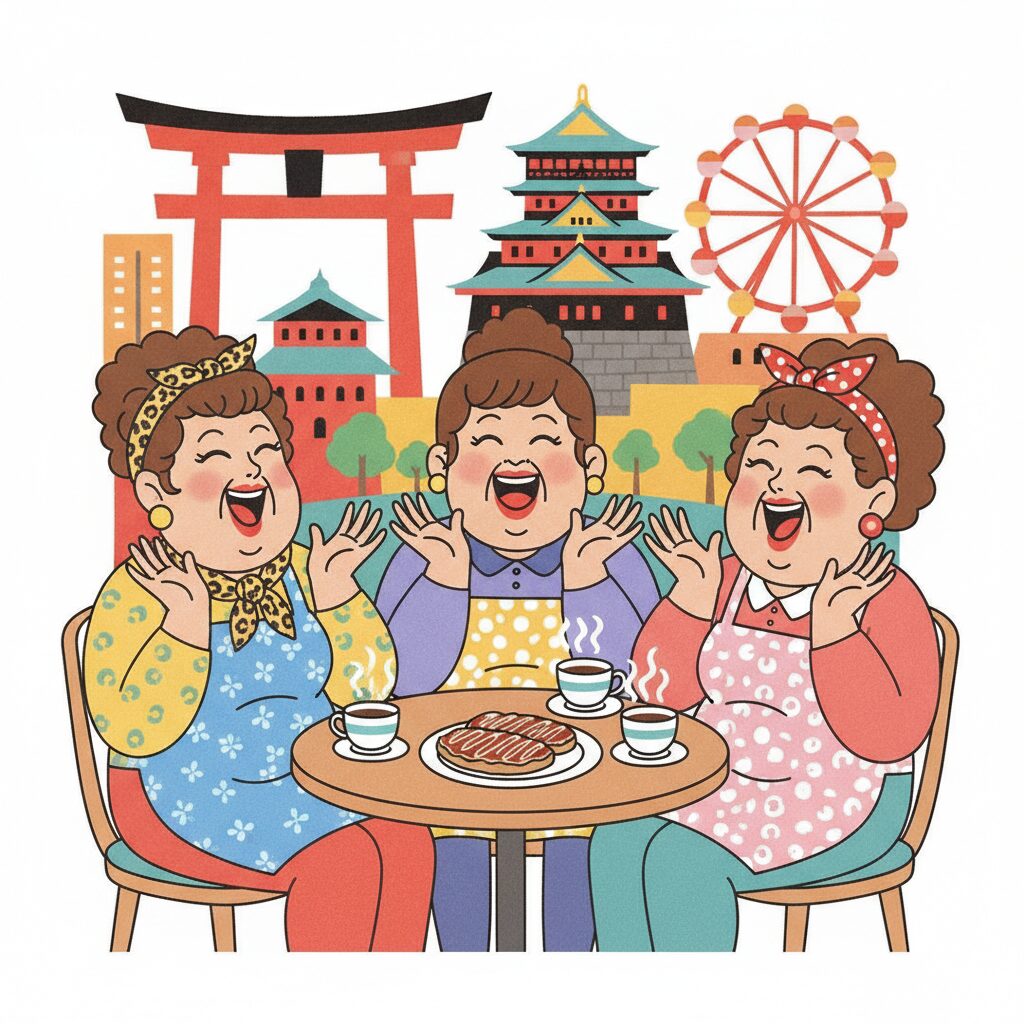
It’s a rainy Tuesday afternoon in a covered shotengai, one of Osaka’s bustling shopping arcades. The air is thick with the smell of grilled eel and damp concrete. You’re standing at a vegetable stand, trying to decide between two perfectly respectable daikon radishes when you feel a firm tap on your shoulder. You turn to find a woman in her sixties, with a tight perm and a brightly colored blouse, pointing a finger at your neck. “You’ll catch a cold dressed like that! Where’s your scarf, young man?” She isn’t asking. She is telling you. There’s no malice in her voice, just a booming, matter-of-fact certainty. For a moment, you might be confused, even a little offended. In Tokyo, a stranger addressing you with such personal advice would be unthinkable. It would be a breach of the unspoken social contract of polite, urban distance. But this isn’t Tokyo. This is your unofficial welcome to the world of the Osaka ‘Okan’. This interaction is not an insult. It’s a dialect, a form of communication that prioritizes caring over caution and connection over personal space. It’s a social fabric woven from loud conversations, unsolicited advice, and a generosity that can feel almost aggressive to the uninitiated. Understanding the Okan is fundamental to understanding the rhythm and soul of daily life in Osaka. Before we dive deeper into this cultural phenomenon, let’s ground ourselves in her natural habitat: the vibrant, chaotic, and deeply communal world of the local shopping arcade.
This unique social tapestry mirrors the broader economic shifts in the region, as seen in the emerging trends highlighted by the Kansai hotel and food expo.
Who Exactly is an ‘Okan’? Beyond the Literal Translation
More Than Just a Mom
On the surface, the word ‘Okan’ (おかん) is simply the familiar, slightly informal term for ‘mother’ in the Kansai dialect, similar to ‘mom’ or ‘ma’ in English. But within the cultural lexicon of Osaka, it means much more. The Okan is an archetype, a social role, a force of nature. She is the middle-aged or elderly woman who rules her neighborhood with an iron will and a warm heart. The stereotype often includes a practical perm that resists humidity, a fondness for bold patterns (yes, sometimes leopard print), and a mamachari—a sturdy mother’s bicycle—skillfully ridden, its front basket loaded with groceries for the evening meal. This image is more than a caricature; it’s a uniform of pragmatism for a woman who is the backbone of her family and community. She embodies a no-nonsense attitude toward life, valuing common sense over pretense and community well-being over individual privacy. The Okan is the unofficial CEO of local life, powered by a potent mix of neighborhood gossip, strong green tea, and an unshakable confidence in her own judgment.
The Gatekeepers of the Neighborhood
The Okan is the central hub of the community’s social network. She acts as a neighborhood watch, welcome committee, and arbiter of justice all in one. From her vantage point—whether her doorstep or the seat of her bicycle—she sees everything. She knows who is new to the apartment building, which children are studying for entrance exams, and which local restaurant offers the freshest fish. This omniscience isn’t born of malice or nosiness; it arises naturally from being deeply committed to the community’s welfare. She’ll be the first to tell the fruit vendor to reserve the best strawberries for you, but she’ll also give you a sharp, corrective look if you mis-sort your recycling. This isn’t about power. It’s about preserving chōwa, or harmony. To her, the neighborhood is a delicate ecosystem, and as a resident, you are part of it. Her constant vigilance is the cost of living in a place where people truly look out for each other, where your well-being is regarded as a shared concern.
Deciphering the Okan Communication Code
The Art of Unsolicited Advice
For many foreigners, one of the most surprising aspects of interacting with an Okan is her habit of giving direct, unsolicited advice on nearly every subject. It comes as a continuous flow of well-meaning yet strikingly straightforward guidance. “You bought the pre-packaged curry mix? The butcher down the street has beef on sale today; you should make it from scratch. It’s much better for you!” This is not a critique of your cooking skills; rather, it’s practical, local knowledge, shared with the assumption that you, like her, appreciate health and a good bargain. As you leave for work, you might hear a shout from the street: “Your living room light is still on! You’re wasting electricity!” It can feel intrusive, almost like an invasion of your home’s privacy. But the real intention is usually one of communal practicality and concern. She’s trying to help you save money and look out for you, applying the same household management principles she uses with her own family. The challenge lies in recognizing the supportive intent behind the blunt words and interpreting the criticism as an expression of care.
Blunt Talk as a Sign of Affection
This is arguably the biggest cultural challenge for outsiders. Typical Japanese communication, especially in Tokyo, is a subtle balance of indirectness, involving tatemae (public face) and honne (true feelings). The Okan completely bypasses this subtlety. She communicates almost exclusively from the realm of honne. A remark like, “My, you’ve put on a little weight, haven’t you?” would normally end a conversation abruptly in most social settings. From an Okan, though, it might simply be an observation, a lead-in to asking if you’re eating well, perhaps accompanied by an offer of some home-cooked vegetables. It’s a startling shortcut to a more intimate, familiar way of interacting. It signals that you’re no longer a stranger requiring the shield of polite formalities. You’ve been welcomed into a circle where such unfiltered honesty is allowed because it’s understood to come from genuine concern. It’s their way of saying, “We’re close enough now that pretense isn’t necessary.”
The Language of Bargaining and ‘Ame-chan’
Watching an Okan in her element at a local market is a lesson in social dynamics. Bargaining is less about saving a few yen and more about the social interaction itself. It’s a lively performance, a friendly exchange with the shopkeeper. “Come on, brother, this daikon looks a bit past its prime! Cut me a little break on the price!” she might declare with a dramatic sigh, often followed by shared laughter. This ritual strengthens social ties and keeps the market vibrant and personable. Then there is the nearly legendary practice of ame-chan (candy). Many Okan truly do carry a stash of hard candies in their purses. These are handed out freely to crying children, to a helpful bus driver, to the bank teller, and, unexpectedly, to you. A woman you’ve never met might press a candy into your hand on the train with a simple, “Here you go.” This small, sweet gesture is a powerful social tool. It’s a tiny act of goodwill, a spontaneous connection that briefly breaks down the anonymity of city life. It reminds you that you share the same space, the same day, and that a little sweetness can brighten everything.
The Okan vs. The Tokyo ‘Okusama’: A Tale of Two Cities
Public vs. Private Sphere
The fundamental distinction between Osaka and Tokyo can be grasped by comparing the roles of the Okan and her Tokyo equivalent, the ‘Okusama’ (a more formal term for a married woman). Life in Tokyo is defined by a rigid separation of public and private spheres. Public spaces are meant for efficient, silent movement, not for personal interaction. The Okusama excels in this setting, exuding quiet elegance and maintaining a polite, impenetrable personal boundary. Her meaningful engagements are limited to her private, carefully selected social circles. The Osaka Okan, however, follows an entirely different approach. For her, the boundaries are delightfully and chaotically blurred. The local supermarket serves as her town hall, the train carriage as her tea room, and the street corner as her salon. She brings the public world into her personal sphere of concern, treating strangers with the same familiarity she would extend to a cousin. This radical redefinition of personal and public space is exactly why Osaka feels so vibrantly interactive, full of life, and, to those unfamiliar, somewhat overwhelming.
Directness vs. Subtlety
In Tokyo, communication is an art of subtlety. Success hinges on your ability to kuki o yomu, or “read the air.” Meaning is often expressed through pauses, omissions, and what remains unspoken. For non-native speakers, this can be a frustrating and taxing code to decipher. The Okan stands as the perfect opposite. She is a clear, straightforward embodiment of “what you see is what you get.” If she disagrees with you, she will say it plainly. If she thinks your Japanese has improved, she will compliment you without hesitation. If she believes you’re paying too much for rent, she will tell you exactly who to contact for a better deal. This directness is not a lack of refinement; it represents a different cultural mindset, shaped by a mercantile tradition. Osaka was built by merchants, and in business, ambiguity leads to errors and lost profits. Clear, direct communication was, and remains, the most effective path to success.
Humor as a Social Lubricant
Laughter is the unofficial language of Osaka, and the Okan is its most fluent speaker. She uses humor—especially self-deprecating jokes and gentle teasing—as a key social tool. A checkout experience in Tokyo is typically quick, silent, and impeccably polite. In Osaka, the cashier, often an Okan-in-training, might add a running commentary on your purchases. “Oh, instant ramen and beer! A classic bachelor’s dinner, huh?” she might say with a knowing grin. The aim is not to judge but to share a small, humorous moment of human connection. They poke fun at themselves, their famously thrifty husbands, the Hanshin Tigers baseball team, and the humid weather. This steady flow of humor helps to break down barriers, foster warmth, and create a shared sense of lightheartedness. It transforms the daily routine from a series of impersonal transactions into a friendly collaboration.
How to Navigate Life with the Neighborhood Okan
Embrace the Interaction
When a stranger asks you a personal question, your first reaction might be to withdraw into your private shell. This is not the right approach with an Okan. When she comments on your life, try to view it not as an intrusion but as an opportunity, an invitation to connect. You don’t need to share your entire life story, but a simple, warm acknowledgment will help build a bridge. If she says you look tired, a reply like, “Yes, it’s been a very busy week at work!” accompanied by a small laugh is ideal. It confirms her observation, shares a small part of your life, and recognizes her effort to engage. This small change in perspective—from irritation to appreciation—is the key to cultivating a positive relationship.
The Power of a Greeting
For the Okan, consistency and recognition matter most. Make it a habit to offer a clear, cheerful greeting whenever you see the neighborhood matriarchs. A simple “Ohayo gozaimasu!” (Good morning!) or “Konnichiwa!” (Good day!) can make a big difference. When in a local shop, try a confident “Maido!” (the classic Osaka merchant greeting roughly meaning “Thanks always for your patronage!”). They will definitely notice. You will no longer be “the foreigner in apartment 3B” but become “Kim-san, the friendly young person who always says hello.” This small act is the foundation of becoming part of the community. From this simple seed of regular acknowledgment, genuine relationships can grow.
Accepting the ‘Ame-chan’ (and Other Gifts)
This is a crucial part of social etiquette. If an Okan offers you a gift—whether it’s a piece of candy, some tomatoes from her balcony garden, or a small serving of a simmered dish she made in excess—your role is to accept it with a sincere smile and a heartfelt “Arigatou gozaimasu!” (Thank you very much!). Refusing, even out of politeness or a desire not to impose, can unintentionally reject the gesture of inclusion and cause social discomfort. The gift isn’t about the item itself; it represents a bond being offered and affirmed. By accepting graciously, you complete the circle of community and signal, “Thank you for including me here.” You can and should reciprocate later with a small souvenir from a trip or a snack, further strengthening this valuable neighborhood connection.
Why the Okan Mentality Defines Osaka
A Legacy of Merchants and Community
To truly grasp the Okan, one must first understand Osaka’s history. For centuries, this city was Japan’s commercial powerhouse, known as the “nation’s kitchen,” built not by austere samurai and officials, but by pragmatic, fast-talking merchants. In the business world, the rigid formalities and subtle codes of the warrior class proved inefficient. Success required direct negotiation, a sharp mind, and the ability to quickly establish rapport and trust. The Okan is the contemporary bearer of this merchant spirit—thrifty yet generous, shrewd yet fair, and always ready for lively exchange. Moreover, the merchant and artisan communities lived in densely packed neighborhoods where collaboration was essential for survival. Your neighbor’s prosperity was linked to your own, fostering a strong sense of communal responsibility that persists to this day.
The Opposite of Cold Urban Anonymity
Living in a megacity can often be a deeply isolating experience. Though Tokyo has many marvels, it can sometimes feel like an ocean of millions, each deliberately ignoring the other. The greatest gift that Osaka offers, embodied by the Okan, is its potent remedy to this urban loneliness. It might be louder here, and it might seem noisier. Your personal space may occasionally be encroached upon by a well-meaning candy or unsolicited advice. But rarely, if ever, will you feel invisible. When an Okan scolds you for forgetting your umbrella on a cloudy day, her gruff and indirect way is really saying, “I see you. You belong to this community, and your well-being matters.” For any foreigner navigating the challenges and potential isolation of life abroad, this intrusive, loud, funny, candy-giving, and deeply caring figure is far more than just a cultural oddity; she is the very heart of Osaka.








