

Step off the Shinkansen at Tokyo Station, and you are immediately swallowed by a sea of dark suits, silent commuters, and invisible hierarchies. The air feels heavy with unspoken rules. Everything operates with a frictionless, almost mechanical perfection. Now, take that same bullet train two and a half hours west, step off at Shin-Osaka, and take a deep breath. The tempo shifts immediately. The escalators move on the opposite side. The conversations are louder, punctuated by laughter and sharp, rhythmic dialect. You have arrived in a city built not by samurai bureaucrats, but by merchants.
Historically known as the nation’s kitchen, Osaka has always been a place where pragmatism outranks prestige. In Tokyo, the first question in a business meeting is often a subtle inquiry into your corporate pedigree, your title, and your university background. In Osaka, the unspoken opening question is far simpler, far more direct, and infinitely more refreshing. They want to know what you are selling, why it matters, and how much it costs. For a foreign entrepreneur trying to break into the Japanese market, this cultural difference is not just a charming local quirk. It is a fundamental business advantage.
However, beneath this freewheeling, street-level energy lies the uncompromising reality of Japanese immigration and corporate law. The national requirements for starting a business in Japan are strictly enforced, regardless of whether you are in a boardroom in Minato Ward or a takoyaki stand in Dotonbori. You must navigate a labyrinth of capital requirements, visa regulations, and physical office mandates. As someone who frequently trades the urban hustle for the quiet, grueling endurance of the Kansai hiking trails, I have learned that the key to surviving any massive challenge is proper pacing and a clear map. This article is your map. It bridges the gap between Osaka’s vibrant entrepreneurial spirit and the rigid legal reality of establishing a company in Japan. We will decode the bureaucratic jargon, explore the true costs of doing business, and explain why setting up shop in this merchant city might be the best decision your startup ever makes.
Why Start a Business in Osaka?
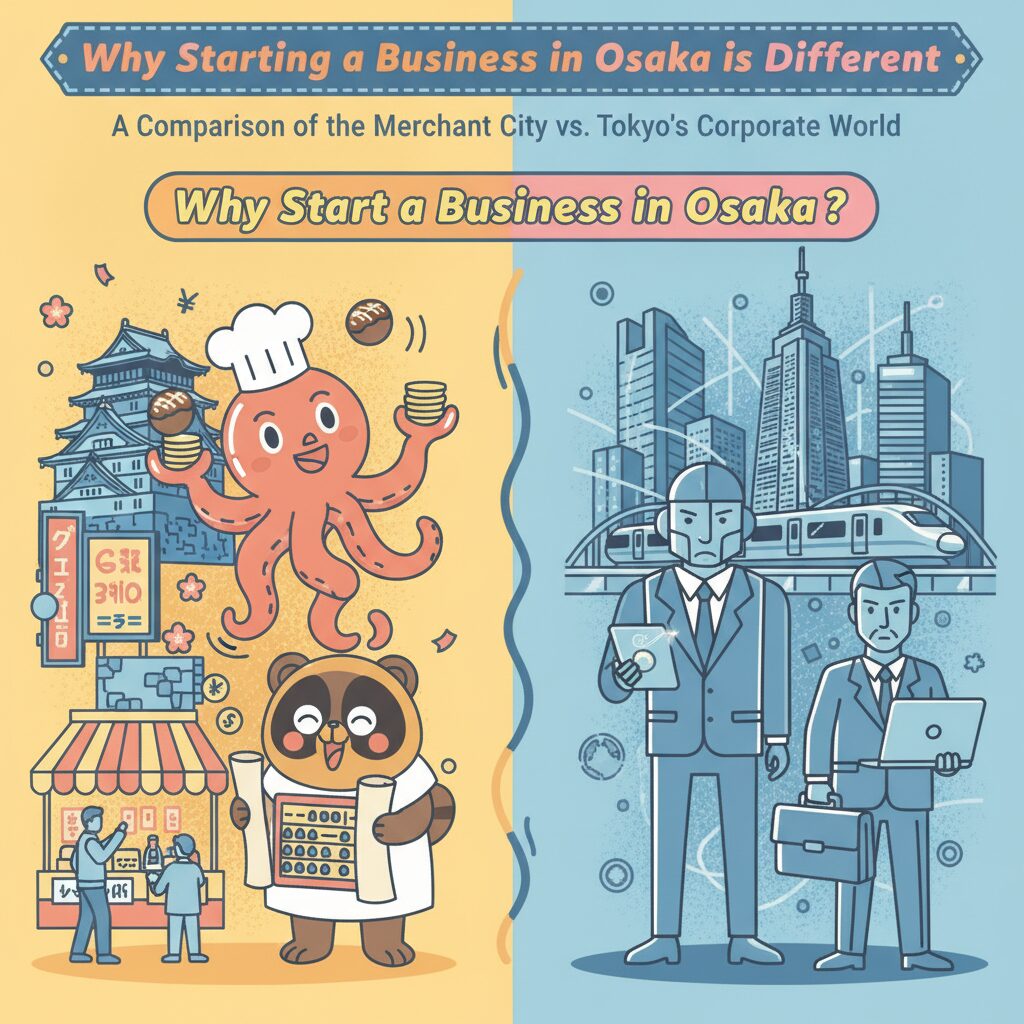
Choosing where to establish your presence in Japan is the first critical decision you will make, shaping the trajectory of your entire operational journey. Tokyo provides vast scale and access to substantial capital but requires a correspondingly high burn rate. Osaka, on the other hand, offers a different proposition. It boasts a large consumer market, strong industrial foundations, and a distinctive startup ecosystem, all at a significantly lower cost. The merchant mentality here values a good deal and relentless hustle. Small beginnings are not looked down upon—they are celebrated.
Lower Operational Costs Compared to Tokyo
The financial reality of operating a business in Kansai versus the Kanto region is striking. Commercial real estate in central Osaka, like the business districts of Honmachi or Yodoyabashi, is far more affordable than similar spaces in Shibuya or Shinjuku. This rental cost difference extends your startup’s runway, providing you precious extra months to refine your product, secure initial clients, and achieve market fit before funds run dry.
It’s not only office space that comes cheaper. Salaries for local talent, fees for tax accountants, and client entertainment expenses all fall below Tokyo’s standards. In a city where value is deeply respected, paying premium Tokyo prices for routine business services is seen as unwise. This lower cost structure enables foreign founders to take calculated risks that could bankrupt a similar venture in the capital. You can allocate more resources toward product development or marketing because you’re not burning capital just to keep your office running.
The Booming Kansai Startup Ecosystem
Osaka is not simply resting on its historic merchant reputation. The local government and business community are vigorously working to modernize the economy, driven by major international events and a strong emphasis on deep tech, biotechnology, and green energy. The manufacturing legacy of nearby areas like Higashiosaka—where small factories have made everything from toothbrushes to spacecraft components—is now blending with cutting-edge software and robotics startups.
Entities such as the Osaka Innovation Hub serve as the ecosystem’s central hub. They actively seek to attract foreign talent and disruptive ideas to challenge existing norms. Unlike Tokyo’s saturated market, where your startup might be just another player in a vast ocean, a foreign-led company in Osaka stands out. You become a big fish in a supportive, tightly-knit pond. Local business leaders are eager for international partnerships and, if you demonstrate value, they will open doors that remain closed in more traditional corporate settings.
Visas for Foreign Entrepreneurs in Japan
The biggest challenge for any foreign national wishing to establish a company in Japan is obtaining the legal right to do so. You cannot simply arrive on a tourist waiver, rent a desk, and start issuing invoices. The Japanese government tightly controls foreign business ownership to ensure new ventures deliver tangible economic benefits, create jobs, and demonstrate financial stability. Navigating this immigration framework demands absolute precision. While official legal requirements should always be confirmed with immigration lawyers or government authorities, understanding the overall process is the crucial first step.
The Osaka City Startup Visa
Recognizing that standard visa requirements are often too demanding for early-stage entrepreneurs, several municipalities, including Osaka, have introduced special startup visa programs. The Osaka City Startup Visa offers you some leeway. Instead of having all capital and office arrangements perfectly in place before arrival, this program allows you to stay in Japan for six to twelve months to prepare your business.
During this grace period, you are expected to carry out the preparatory tasks outlined in an approved business plan. You can use this time to open bank accounts, finalize commercial leases, sign initial contracts, and build your local network. This period acts as an essential bridge, acknowledging that setting up a business requires physical presence and local trust—things that cannot easily be established remotely. However, this is not a free pass. Your progress is monitored, and you must eventually switch to the standard visa to continue operations.
The Standard Business Manager Visa
The final goal for most foreign entrepreneurs is the Business Manager Visa. This is the standard, nationwide visa status that allows you to operate and manage a company in Japan. Unlike the startup visa, there is no grace period here. When applying for the Business Manager Visa, your company must be essentially ready to open on day one.
The scrutiny for this visa is intense. Immigration officers are not venture capitalists searching for the next billion-dollar unicorn; they are risk-averse government officials seeking stability, compliance, and assured tax revenue. They will scrutinize your business plan closely, looking for weaknesses in your financial projections. You must also prove that you have the managerial experience required to lead the company, meeting strict requirements regarding your physical office space and your initial investment capital.
The 5 Million Yen Investment Requirement
This requirement dashes many entrepreneurial hopes. To qualify for the Business Manager Visa, you must prove a minimum investment of five million yen in your company. This amount is roughly equivalent to thirty to forty thousand US dollars, depending on exchange rates. The funds cannot simply be a loan from a friend that you plan to repay immediately. It must be legitimate capital fully dedicated to the business.
Immigration authorities demand a thorough paper trail verifying the funds’ origin. If saved from your salary, they require years of bank statements and tax returns confirming lawful income. If gifted by a parent, notarized letters and international wire transfer receipts must be provided. Authorities are actively vigilant against money laundering and fraudulent applications.
Once the funds are cleared and deposited into the corporate account, they are not frozen. You are expected to use this five million yen to develop the business. It covers your office deposit, initial inventory, legal incorporation fees, and early operational expenses. The government wants assurance that you have a significant personal stake and sufficient financial runway to survive the challenging first year without becoming a burden on the state.
Step-by-Step Guide to Setting Up Your Company
Understanding visa requirements is one thing; executing the actual setup process is quite another. The journey from concept to a fully incorporated Japanese company is a true test of bureaucratic endurance. Much like a lengthy hike up Mount Kongo, it cannot be rushed. You must proceed one carefully measured step at a time, ensuring each step is secure before advancing.
Step 1: Drafting a Solid Business Plan
The business plan you present to immigration authorities and local banks is the cornerstone of your entire project. Avoid writing a visionary, tech-bro manifesto filled with buzzwords and aggressive, exponential growth projections. Japanese officials prioritize conservative realism above all else. They expect a detailed, month-by-month cash flow forecast for your first year of operations.
You must clearly explain how you will generate revenue, identify your target customers, and specify your fixed expenses. Include your own salary, rent, utilities, corporate taxes, and health insurance. If your plan shows that funds will run out by month eight, your visa application will be denied. You need to demonstrate a clear, feasible path to profitability or at the very least, sustainability. It’s essential to prove that your business requires your unique expertise and that a local Japanese individual could not easily perform the same role.
Step 2: Securing a Physical Office Space in Osaka
This step often surprises digital nomads. In many countries, you can register a company to a virtual office or your home address. Japan, however, is much stricter. To obtain a Business Manager Visa, you generally must have a distinct, physical office space dedicated solely to your business.
This means a residential apartment typically won’t qualify unless it has a clearly separate entrance and is explicitly zoned for commercial use by the landlord. Likewise, a hot desk in a trendy coworking space in Umeda will not meet immigration requirements. You need a space with a door, a lock, and a nameplate. A dedicated physical mailbox is also necessary.
Finding a landlord willing to lease commercial space to a newly established company owned by a foreigner can be extremely difficult. Landlords tend to be conservative and often require a Japanese guarantor. This is where the Osaka hustle comes in. You will need to search vigorously, work with specialized real estate agents familiar with foreign founders, and be prepared to put down a sizable security deposit—sometimes equivalent to six to twelve months’ rent upfront. The commercial districts of Honmachi, Yodoyabashi, and Sakaisuji-Hommachi offer older, smaller office buildings that are often more open to taking a chance on a new startup than the shiny new towers in Grand Front Osaka.
Step 3: Incorporation and Legal Registration
Once your business plan is prepared and your office lease is ready to be signed, you move on to the incorporation stage. You must draft your Articles of Incorporation, which establish the rules, objectives, and structure of your company. These documents need to be notarized by a Japanese notary public.
You will also encounter the Japanese seal system. Signing incorporation documents with just a pen is not accepted. You must create and register official corporate hanko seals. These include a representative seal, a bank seal, and a square company seal used for invoices. These small wooden or titanium stamps carry significant legal authority in Japan.
After notarization and capital preparation, you file your registration with the Legal Affairs Bureau. The filing date officially becomes your company’s establishment date. From there, you must notify the tax offices, pension office, and labor standards inspection office. It involves a mountain of paperwork. Although it may seem outdated for a modern startup to be weighed down with physical documents and wooden stamps, this thorough process forms the fundamental basis of trust in Japanese society. When you finally hold your official corporate registry certificate, you’ve proven that you can operate within the established rules.
Free Support Programs for International Startups
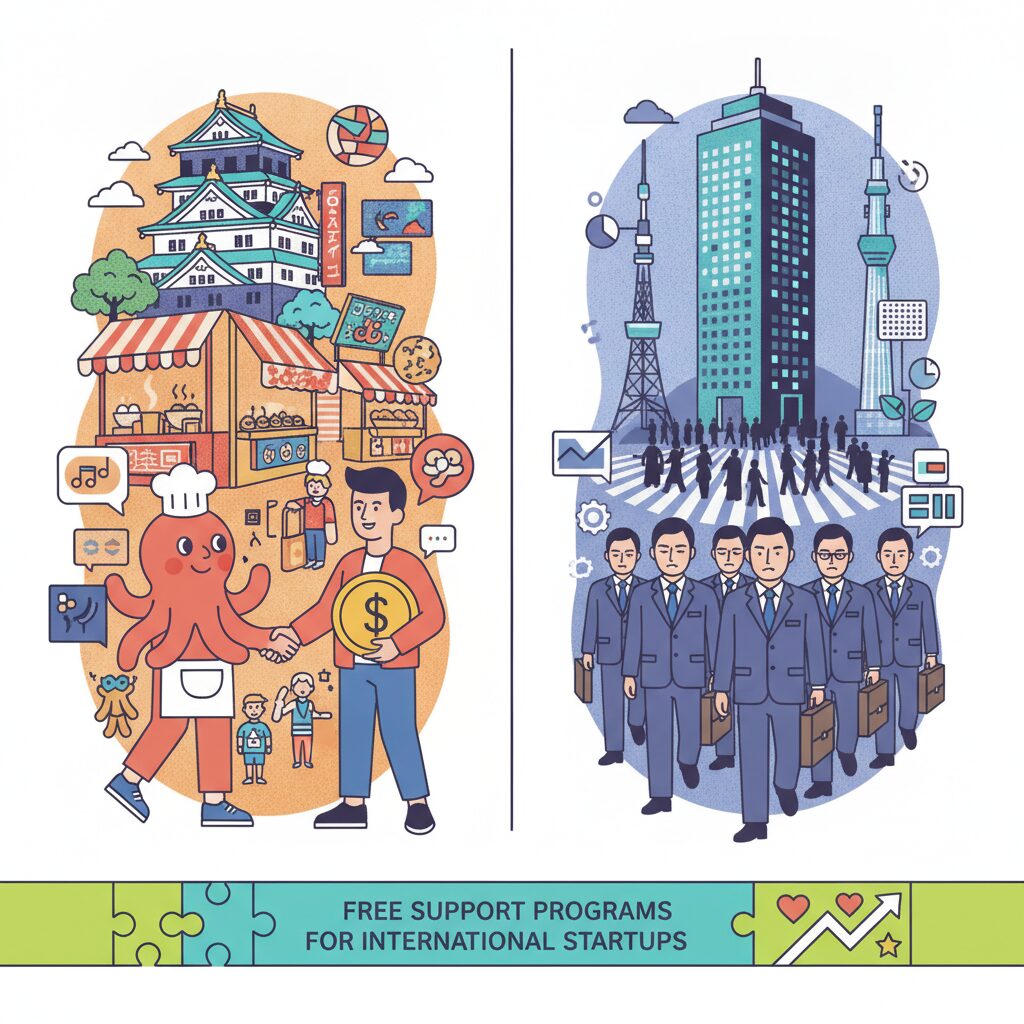
Trying to navigate this mountain of bureaucracy alone is a sure path to frustration and failure. Fortunately, both the Japanese government and local Kansai authorities are eager to infuse foreign innovation into their economy. They have established a robust support system—provided you know where to look and how to seek assistance.
Leveraging O-BIC and Osaka Springboard
While national organizations like JETRO offer a wealth of top-level information, market reports, and initial consultations for entering the Japanese market, local experts are essential for navigating the streets of Osaka. This is where organizations such as O-BIC, the Osaka Business and Investment Center, prove invaluable.
O-BIC is jointly managed by the Osaka Prefectural Government, the Osaka City Government, and the Osaka Chamber of Commerce and Industry. They act as your on-the-ground allies, providing free, tailored support for foreign companies establishing themselves in Osaka. They can connect you with bilingual tax accountants, judicial scriveners who manage incorporation paperwork, and real estate agents familiar with the specific requirements of visa-compliant office spaces. They help overcome language and cultural barriers that might otherwise impede your progress.
Similarly, programs like OSAKA SPRINGBOARD are designed specifically to accelerate the growth of startups in the region. They offer mentoring, networking events with established local corporations, and guidance on securing local government subsidies. Engaging with these organizations goes beyond receiving free advice; it signals to the local business community that you are serious, committed to integrating into their ecosystem, and respectful of their institutions. In a culture founded on relationships and trust, support from O-BIC or the Osaka Innovation Hub instantly boosts your credibility in the eyes of potential partners and landlords.
Practical Realities of Running a Business in Kansai
Beyond the legal paperwork and capital requirements, the day-to-day experience of running a business in Osaka contrasts sharply with Tokyo. The lifestyle, spending habits, and ways of building trust all reflect the unique character of the Kansai region. This city demands hard work but never at the expense of enjoying life.
Living Costs and Renting Workspace
For founders, keeping personal burn rates low is just as critical as controlling corporate expenses. Osaka stands out for offering a high quality of life at an affordable price. You can rent a spacious, modern apartment in lively neighborhoods like Fukushima, Nakatsu, or Tenma for a fraction of the cost of central Tokyo. These areas are brimming with local charm, independent coffee shops, and extensive covered shopping streets known as shotengai.
The public transportation system is comprehensive and reliable, so living far from your office doesn’t mean a difficult commute. You can easily bike from a quiet residential area to the central business district in about twenty minutes. The food scene is famously outstanding and surprisingly inexpensive. The local motto, kuidaore, which loosely means eating oneself into ruin, embodies the idea that you can entertain clients or feed your team with top-notch meals without breaking the bank.
Moreover, for those needing to escape the concrete jungle to recharge, Osaka offers unmatched access to nature. You can close your laptop in a downtown office and be hiking the rugged trails of the Ikoma mountains or Mount Rokko in under an hour. This balance is vital for enduring the marathon of entrepreneurship.
Networking with Osaka’s International Community
Business in Osaka is deeply rooted in genuine human connection. In Tokyo, networking often centers on formal exchanges of business cards, strict politeness, and the concept of tatemae, the polite facade. It can take months or years to break through and learn a potential partner’s true feelings about your proposal.
Osaka works on honne, or true feelings. Networking events here are louder, more chaotic, and far more productive. Business discussions frequently happen over the sizzling grill of an okonomiyaki restaurant or shoulder-to-shoulder in a packed tachinomi standing bar. Local business leaders will haggle with you, joke around, and ask direct questions about your profit margins and personal background.
If they don’t like your idea, they will tell you. If your service is too expensive, they’ll complain about the price openly. This bluntness might initially unsettle some foreigners, but for entrepreneurs, it is a gift. You don’t waste time deciphering subtle hints or vague promises—you know exactly where you stand. When an Osaka merchant shakes your hand and says they want to do business, they truly mean it.
Starting a business here is a tough test of endurance, especially when facing strict national immigration laws. But once you overcome these challenges, you’ll find a city that respects hard work, forgives minor failures, and strongly supports those who deliver real value. Osaka is not merely a cheaper alternative to Tokyo; it is an entirely different ecosystem—one built on pragmatic trade, honest communication, and a deep, lasting entrepreneurial spirit.








