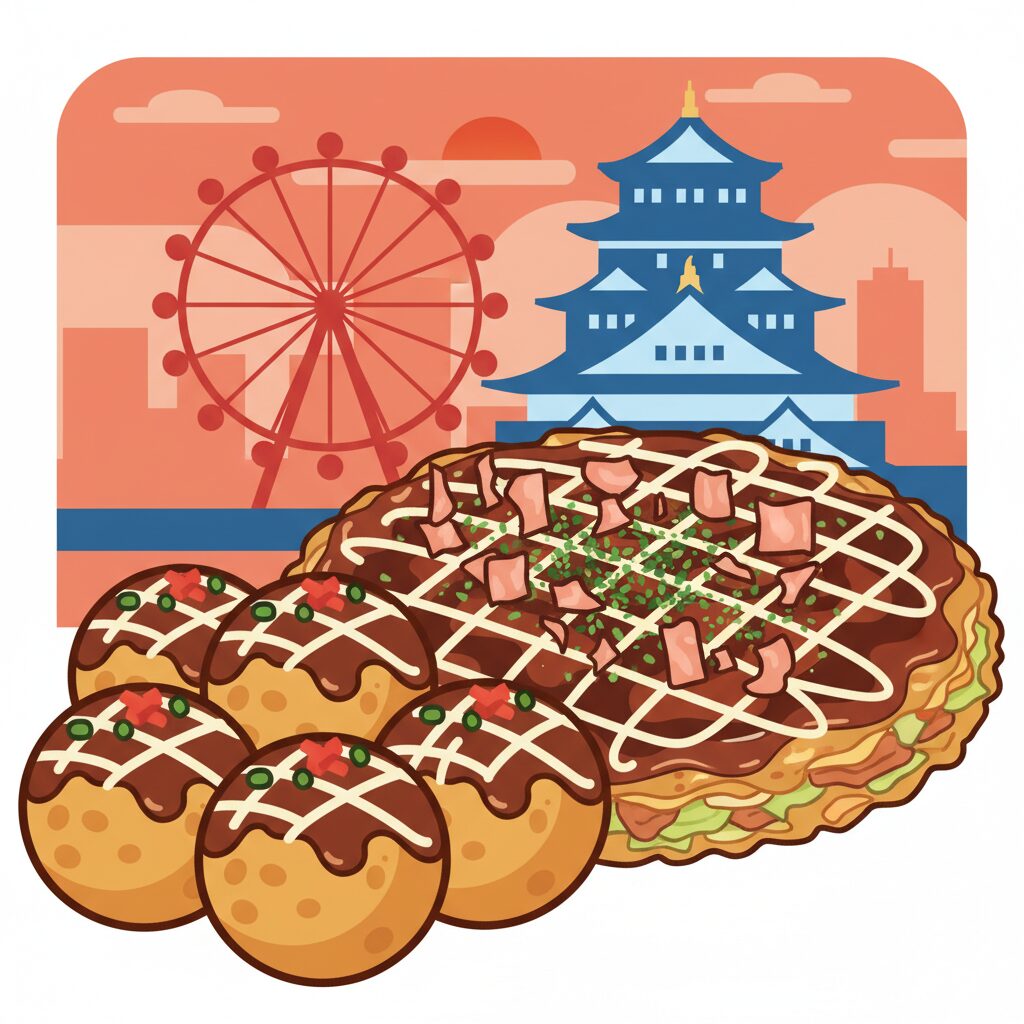
You see them everywhere. Steaming balls of batter, slick with dark sauce and dancing bonito flakes, served in a flimsy boat-shaped tray. Golden-brown octopus chunks peeking from within. This is takoyaki, and if you’ve spent more than five minutes in Osaka, you’ve probably seen it, smelled it, and eaten it. The foreign resident’s first impression is often the same: it’s a snack. A delicious, hot, and satisfying street food snack, perfect for a quick bite while exploring the neon canyons of Namba or the retro charm of Shinsekai. And right next to the takoyaki stand, you’ll find its cousin, okonomiyaki. A savory, cabbage-filled pancake-like creation, grilled on a massive teppan, then slathered in that same addictive sauce and a lattice of creamy mayonnaise. Another delicious meal, sure. But to categorize these dishes as mere street food is to fundamentally misunderstand Osaka. It’s like calling pizza a simple flatbread or a hamburger just a meat sandwich. You’re missing the entire cultural universe contained within.
In Osaka, these flour-based dishes, collectively known as konamon, aren’t just something you buy on a street corner. They are a social ritual, a domestic institution, and a direct line to the city’s soul. They are the reason a takoyaki griddle is a more common household appliance here than a dishwasher. They are the centerpiece of weekend gatherings, the foundation of countless neighborhood arguments about which local shop is best, and the edible embodiment of Osaka’s core philosophies: pragmatism, community, and a healthy disregard for culinary pretension. This isn’t Tokyo, where food can often be a delicate, reverent art form pursued in quiet, minimalist temples of gastronomy. This is Osaka. Here, food is loud, interactive, messy, and meant to be shared. It’s the glue that holds conversations, friendships, and families together. To truly understand why Osakans think and act the way they do, to grasp the subtle but profound differences that set this city apart from the rest of Japan, you have to look past the steam and the sizzle, and into the heart of its konamon culture.
This interactive, communal spirit is also perfectly captured in the art of mastering the sharp-tongued banter known as tsukkomi, another key to understanding the city’s character.
The Sacred Trinity: Konamon, Sauce, and Mayonnaise

To begin to grasp the local obsession, you first need to understand its components. It’s not just flour and octopus; it’s a carefully balanced, thoughtfully crafted ecosystem of flavor and texture that mirrors the city’s history as a merchant hub where turning humble ingredients into something delicious was the ultimate skill.
More Than Flour: The Philosophy of Konamon
Osaka has long been known as Tenka no Daidokoro, the Nation’s Kitchen. During the Edo period, it served as the central hub for rice and various goods, a city of merchants rather than samurai. This history fostered a particular mindset that endures today: a profound appreciation for value, efficiency, and shrewdness. Nothing is wasted. Every yen is maximized. Simple, affordable ingredients are transformed into something extraordinary. Flour, or kona, was the ideal medium—cheap, filling, and, with a touch of creativity, capable of becoming spectacular. Konamon culture is a direct descendant of this merchant spirit. It’s about achieving maximum satisfaction for a reasonable price. This “bang for your buck” mentality permeates every facet of life in Osaka. People here aren’t necessarily frugal but are highly value-conscious. They’ll proudly share stories of amazing deals on new shoes or surprisingly affordable yet delicious lunch sets found in hidden alleyways. There’s no shame in saving money; the shame lies in overpaying. Unlike Tokyo, where status often ties to expensive, brand-name goods, in Osaka, status means being smart with your money. Konamon perfectly fuels this mindset. It’s hearty, fulfilling, and easy on the wallet. It’s food made by the people, for the people, grounded in practicality.
The Unspoken Sauce Hierarchy
If you think the brown sauce generously spread on okonomiyaki and takoyaki is just a generic condiment, you have much to learn. That sauce is the lifeblood of the dish, and in Osaka, sauce is a serious matter. Every household, every restaurant, has its favorite, and that preference is a fierce point of pride. On supermarket shelves, you’ll find major brands. Otafuku is perhaps the most famous—a thick, sweet, and fruity sauce, a safe and popular choice, the Toyota Corolla of okonomi sauces. Then there’s Ikari, an Osaka-born brand, often spicier and tangier, appealing to more traditional tastes. But the real rabbit hole is Doro Sauce, or “mud sauce.” It’s the thick, spicy, umami-rich sediment from the bottom of the Tonkatsu sauce tank, made by the Oliver Sauce company in neighboring Kobe. Intense and complex, it’s not for the faint-hearted. Having a bottle of Doro Sauce in the kitchen is a statement: “We don’t mess around with flavor here.” Restaurants take it even further. Many local spots pride themselves on their secret, house-made sauces. They blend commercial brands, add their own fruits, vegetables, and spices, and simmer the mixture for hours. The recipe remains a closely guarded secret, passed down through generations. The sauce is their signature, the defining element that sets their okonomiyaki apart from the rest. This dedication to detail, this elevation of a simple condiment into an art form, reveals the depth of Osaka’s food culture.
Mayonnaise as a Human Right
And then there’s the mayonnaise. Not just any mayonnaise—it must be Kewpie. The iconic plastic bottle with the red cap and baby logo is an indispensable part of the konamon experience. Its distinctive flavor—richer, eggier, and tangier than Western varieties, thanks to the use of only egg yolks and rice vinegar—is the perfect creamy counterpoint to the sweet and savory sauce. The application is also an art form. The thin, crisscrossing lines of mayo squeezed from a special bottle tip aren’t just decorative—they ensure perfect flavor distribution in every bite. In Osaka, mayonnaise isn’t a request—it’s an expectation. At any self-respecting konamon shop, the question is not if you want mayonnaise, but whether you want it topped with anything else. A restaurant that dares to charge extra for mayonnaise commits a grave social faux pas, signaling they simply don’t “get it.” This generosity with condiments reflects a broader aspect of Osaka’s character. People here are direct, open, and generous. They share their food, their opinions, and their laughter freely. Complimentary mayonnaise is a small but meaningful symbol of this open-hearted hospitality. It’s a creamy, delicious declaration that says, “Welcome. We don’t skimp on the good stuff here.”
Beyond the Food Stall: The Takoyaki Party as a Social Institution
To experience konamon in its natural setting, you need to be invited into an Osaka home. This is where you’ll truly grasp the cultural importance of takoyaki—not just as food to eat, but as a shared activity. Welcome to the world of the TakoPa, the takoyaki party.
Every Home Has One: The Takoyaki Grill
Here’s a fundamental truth of life in Osaka: almost every household owns a takoyaki maker. This is no exaggeration. It’s as common as a rice cooker or an electric kettle. The model might be a simple, inexpensive electric one with a single plate of half-spherical molds, or it could be a more advanced, professional-grade gas unit with interchangeable copper plates. It’s one of the most typical housewarming gifts, a welcoming present that says, “Congratulations on your new home. Now you can fulfill your social duties.” This fact alone sets Osaka apart significantly from Tokyo. In the capital, apartments are notoriously small and home entertaining is much less frequent. Social gatherings usually take place outside the home, in restaurants or izakayas. Kitchens are practical but compact, lacking space for a single-purpose gadget. In Osaka, however, home life is different. Even a small apartment will have room made for the takoyaki grill. The focus is not on minimalist efficiency, but on creating a home capable of hosting friends and family. The presence of that little dimpled appliance quietly declares that this home is a place for community.
The ‘TakoPa’: More Than Just a Meal
A TakoPa is the epitome of Osaka socializing. It’s loud, messy, cooperative, and deeply casual. The host provides the essentials: the grill, the batter (often a fiercely guarded family recipe featuring dashi stock and sometimes grated yam for extra fluffiness), and key ingredients like boiled octopus, red pickled ginger (beni shoga), and green onions. Guests might bring drinks, snacks, or, most importantly, experimental fillings. Cheese is a modern staple. Kimchi and pork is a popular combo. Sausages, mochi, corn, avocado—there’s no limit. This is where Osaka’s playful spirit of innovation shines. The rules are few, but roles are clear. Someone preps the ingredients. Another person pours the batter, carefully filling each mold. Then comes the most crucial role: the flipper. Equipped with two sharp bamboo picks (kushi), the flipper is the star. It’s an art form. You break the crispy edges apart, gently coax the half-cooked sphere, then, with a flick of the wrist, rotate it 90 degrees, tucking the uncooked batter underneath to create a perfect ball. A skilled flipper moves with rhythmic, mesmerizing grace. A novice fumbles, making lopsided, broken takoyaki. But that’s all part of the fun. The air buzzes with sizzling batter, laughter, playful teasing about poor flipping skills, and debates about when the takoyaki are just right—crispy outside, slightly molten inside. This contrasts sharply with a polite, subdued Tokyo dinner party. It’s a hands-on, chaotic, and deeply bonding event.
Reading the Room at a TakoPa
Though a TakoPa is informal, it follows its own unspoken social rules. You don’t just sit back and wait to be served. You join in. You offer to chop green onions. You take a turn at flipping, even if you’re bad at it. You enthusiastically compliment the host’s batter. It’s a collective effort performance. The party is a microcosm of Osaka society and an excellent test of one’s nori (ノリ). Nori is a tricky word to translate directly, but it’s vital in Osaka culture. It means something like atmosphere, vibe, or the ability to sync with the group’s energy. Someone with good nori can read the room, join the banter, and add to the group’s collective spirit. Someone with poor nori is stiff, passive, or out of tune with the mood. A TakoPa is all about nori. Can you dive into the chaos, laugh at your mistakes, and enjoy the shared process? If yes, you’ll fit right in. If you hang back, waiting for a perfectly cooked takoyaki to be handed to you, you’re missing the point. The goal is not just to eat takoyaki; it’s to make takoyaki, together.
Okonomiyaki: The Soul on a Griddle

If takoyaki is the life of the party, okonomiyaki is the heart of the family dinner. It’s more filling, substantial, and carries a different yet equally strong set of cultural meanings. It symbolizes customization, hearty satisfaction, and another proud point of local identity.
It’s Not a Pancake, It’s Not a Pizza
Visitors often try to simplify by calling okonomiyaki a “Japanese savory pancake” or even a “Japanese pizza.” While these comparisons are understandable, they miss the mark completely and can even provoke a few local sensitivities. The name itself reveals the philosophy: okonomi means “what you like” or “your preference,” and yaki means “grilled” or “cooked.” By definition, it’s a dish centered on choice and personalization. The base is straightforward: a batter (often enhanced with dashi and grated yam), a large amount of shredded cabbage adding sweetness and texture, egg, and tenkasu (crispy bits of deep-fried tempura batter) for extra flavor and crunch. From there, the options are yours. Pork belly is traditional, but squid, shrimp, beef, or a mix of everything (mikkusu) are all common. This freedom to choose is quintessentially Osaka. It reflects a culture that values individuality and a certain defiance against rigid norms. There’s no one “correct” way to make okonomiyaki. The best approach is your own. This contrasts with the stricter traditions often found in other Japanese culinary arts. Naturally, this doesn’t mean rivalries don’t exist. The most famous is with Hiroshima. Hiroshima-style okonomiyaki is layered, featuring a thin crepe of batter, a heap of cabbage, noodles, and a fried egg, stacked one atop the other. Osakans, however, defend their method: mixing everything in a bowl then pouring it onto the griddle. They’ll argue, with passion and a spark in their eye, that their style is superior because it blends the flavors more harmoniously. It’s a friendlier, more democratic dish. This playful rivalry is a great source of local pride and an ongoing topic of discussion.
The Home vs. The Restaurant Experience
Like takoyaki, okonomiyaki is a home cooking staple. Families gather around a large electric hot plate (hotto pureeto) placed in the center of the dining table. It’s a weekend tradition and comfort food that everyone helps prepare. Children learn early how to mix the batter and flip the hefty pancake with two spatulas. The restaurant scene, however, offers a unique window into Osaka’s culture. Many okonomiyaki restaurants have tables with built-in teppan griddles. After ordering, you receive a bowl of raw ingredients at your table and are expected to cook it yourself. For first-timers, this can feel daunting. You pour the mixture, try to shape it into a neat circle, and face the nerve-wracking first flip. But this DIY style is central to the experience. The restaurant trusts and empowers you as the chef. It’s an interactive, engaging way to eat rarely found in more formal dining environments. Staff are always nearby to offer guidance or rescue a failed flip. Other places feature a master chef at a long counter griddle. This is dinner and a show. The rhythmic scrape and clang of metal spatulas (kote), the sizzle of the batter hitting the hot steel, the chef’s precise, almost athletic motions—it’s a polished performance refined over years. Whether you cook it yourself or watch a master, the experience is active, never passive.
The Great Modanyaki Debate
To truly understand Osaka’s food philosophy of glorious, practical indulgence, you must know modanyaki. The name is a blend of modan (modern) and yaki. It’s simply an okonomiyaki with a layer of fried yakisoba noodles inside. A carb-on-carb behemoth, born from the clever question: “Why choose between okonomiyaki and yakisoba?” In Osaka, you don’t have to. You can enjoy both in one delicious, filling package. Modanyaki perfectly embodies the city’s value-driven mindset. It’s hugely satisfying, incredibly tasty, and efficient. A complete meal in one dish. To outsiders, especially those from Tokyo’s more health-conscious and refined culinary scene, it might seem excessive. But in Osaka, it’s just common sense: if more is better and both are delicious, combining them is the logical choice. It’s a dish that captures the city’s hearty, down-to-earth, and wonderfully practical approach to food and life.
The Konamon Code: Unspoken Rules and Local Identity
Living in Osaka, you quickly discover that konamon culture carries a set of unspoken rules and beliefs. Following them signifies that you truly “get it.” These are small yet meaningful signs of cultural fluency, revealing the deep identity connected to these simple flour-based dishes.
“One Takoyaki Grill Per Household” is No Joke
Though mentioned before, it’s worth emphasizing again. The notion that every household owns a takoyaki maker is a cultural axiom, a shared truth uniting the city’s people. I had a friend move to Osaka from Tokyo, and at his housewarming, his new Osaka friends, without planning it together, each brought the same gift—he ended up with three brand-new takoyaki grills. The message was clear: you live here now, so this is part of your life. It goes beyond food; it’s a lifestyle statement. It declares home as a place for lively, joyful gatherings, implying social closeness and the openness to welcome friends in. The takoyaki grill becomes a tool for fostering community, one piping-hot, octopus-filled ball at a time.
The Cardinal Sin: Pressing Your Okonomiyaki
If you’re at a restaurant where you cook your own okonomiyaki, there is one golden rule: never, under any circumstance, press down on the okonomiyaki with your spatula while it cooks. A beginner might assume this helps it cook quicker or hold together better, but it’s a serious mistake. Pressing forces out the air pockets and steam inside the cabbage and batter, resulting in a dense, tough, rubbery pancake. The goal is a light, fluffy, and airy interior. If an older woman—whether the owner or another customer—spots you doing this, there’s a strong chance she’ll come over, take your spatulas, and scold you. This is never meant to be rude; it’s a public service and a passionate defense of the dish’s integrity. Mastering this etiquette is a rite of passage, signaling respect for the craft and showing that you’re more than a tourist. You get that fluffiness is sacred. This simple action—or restraint—is a powerful insider vs. outsider indicator.
Rice as a Side Dish? Absolutely.
Here lies a major culinary divide between Osaka and the rest of Japan. Ask someone from Tokyo if they’d eat okonomiyaki with plain white rice on the side, and you’ll likely get a horrified reaction. “Carbs with carbs? Why?” Yet in Osaka, it’s not only normal but cherished. A typical lunch is the okonomiyaki teishoku—a set meal with a full okonomiyaki, a bowl of rice, miso soup, and pickles. The logic, from an Osaka viewpoint, is undeniable: the okonomiyaki, with its rich, savory sauce, is the main dish or okazu. And what accompanies okazu in Japan? Rice. The rice acts as a neutral, fluffy backdrop for the powerful flavors of the okonomiyaki. It’s practicality over culinary dogma. Does it taste good? Is it satisfying? Yes—so it works. This perfectly captures the Osaka mindset: pragmatism bordering on stubbornness and a complete disregard for what others might label “proper.” If it makes sense to them, they’ll do it, convention be damned. This is a city that marches to its own beat, often set by the scraping of a spatula on a hot griddle.
Konamon and the Osaka Dialect: A Flavorful Pairing
The experience of konamon involves not only taste and smell but also sound. The lively, straightforward, and humorous Osaka dialect, Osaka-ben, serves as the perfect soundtrack to this food culture. The two are inseparably connected.
Words You’ll Only Hear Around the Griddle
When enjoying konamon, you’ll be immersed in the local language. Everyone in Japan knows oishii (delicious), but in Osaka, the praise is often more expressive and colorful. You might hear a robust Meccha umai! (Insanely good!) or Honma niうまいわ (This is really and truly delicious). These exclamations convey genuine, heartfelt appreciation. You’ll also pick up specific vocabulary—like the metal spatulas used for okonomiyaki called kote. Using the correct term shows you’re in the know. You might even get a playful correction if you grab the wrong bottle: “Sore shouyu chau de, soosu ya!” (“That’s not soy sauce, it’s SAUCE!”). The tone is friendly and instructive, a verbal nudge inviting you into the local community.
The Rhythm of Commerce
Pause at any takoyaki stall in a bustling shopping arcade and listen closely. The interaction between vendor and customers is a kind of street theater. The vendor, often a charismatic man or woman with a booming voice, moves swiftly—pouring batter, adding octopus, flipping dozens of takoyaki at once—while chatting continuously with customers. The ordering is a rapid-fire exchange: “Hachi-ko, soosu to mayo de!” (“Eight pieces, with sauce and mayo!”). The vendor’s reply is a classic Osaka phrase, shouted with enthusiasm: “Maido!” It literally means “every time,” but here, it’s a warm, familiar way of saying, “Thank you for your business, as always!” This is a world apart from the quiet, formal customer service typical of upscale Tokyo department stores. Here, the transaction is personal. It’s a conversation. It’s a brief moment of human connection. The konamon stall serves as a stage where the city’s direct, funny, and warm-hearted communication style is performed daily.
What Foreigners Get Wrong: It’s Not Just Cheap Food, It’s a Philosophy
Despite its widespread presence, konamon culture is often misunderstood by outsiders. These misunderstandings hinder a deeper appreciation of what the food truly signifies and, by extension, the essence of the city itself.
Mistake #1: Assuming It’s Unhealthy Junk Food
The “cheap and cheerful” reputation of takoyaki and okonomiyaki frequently causes foreigners to categorize them as junk food. While they are definitely hearty and indulgent, they are far from the nutritional emptiness typical of fast food. A well-prepared okonomiyaki is packed with cabbage—much more than you might expect. Cabbage is the main ingredient, adding sweetness, moisture, and a good amount of fiber. It also includes egg and a protein of your choice. It’s cooked on a griddle with minimal oil, not deep-fried. Although a modanyaki with extra mayonnaise is hardly diet food, a basic pork okonomiyaki can be a surprisingly balanced and fulfilling meal. To dismiss it as “junk” overlooks its role as a legitimate, everyday staple for millions.
Mistake #2: Assuming All Shops Are the Same
Tourists strolling through the vibrant, food-packed streets of Dotonbori might see multiple takoyaki stalls with long lines and assume they are all the same. This couldn’t be further from the truth. Locals in Osaka have a deeply personal and passionately defended connection to their favorite konamon shop. Usually, it’s a small, modest, family-run place hidden in their neighborhood, a spot they’ve frequented since childhood. The nuances appreciated by locals are subtle yet significant. One shop might be renowned for the crispiness of its takoyaki shell, thanks to a secret batter recipe. Another might use a higher-quality octopus. Another may have dashi broth in its batter that adds exceptional umami depth. For okonomiyaki, it could be the way they finely chop cabbage for a softer texture or their distinctive homemade sauce simmered for years. This loyalty to small, local businesses is a key part of Osaka’s community spirit. It’s about nurturing relationships over time and the comfort of a familiar face who knows your usual order. It’s a preference for authenticity over anonymous chain-store culture.
Mistake #3: Overlooking its Cultural Significance
The greatest mistake is to regard konamon as just food. It is an edible symbol of the city’s identity. When you ask an Osaka native for their favorite takoyaki spot, you get a serious, detailed, and passionate response. It often includes directions to a specific neighborhood, the shop’s history, and explanations of what sets it apart from others. These dishes represent the city’s history—flour-based cuisine was essential for survival and rebuilding in the post-war period. They reflect its practical, no-nonsense character. Most importantly, they embody its communal spirit. Konamon brings people together. In an okonomiyaki restaurant, you’ll find high school students at one table, families with young children at another, and businessmen in suits at a third— all sharing the same experience, gathered around the warmth of the griddle. Takoyaki and okonomiyaki are more than just flour and water; they are the heart of Osaka, served hot and smothered in sauce.