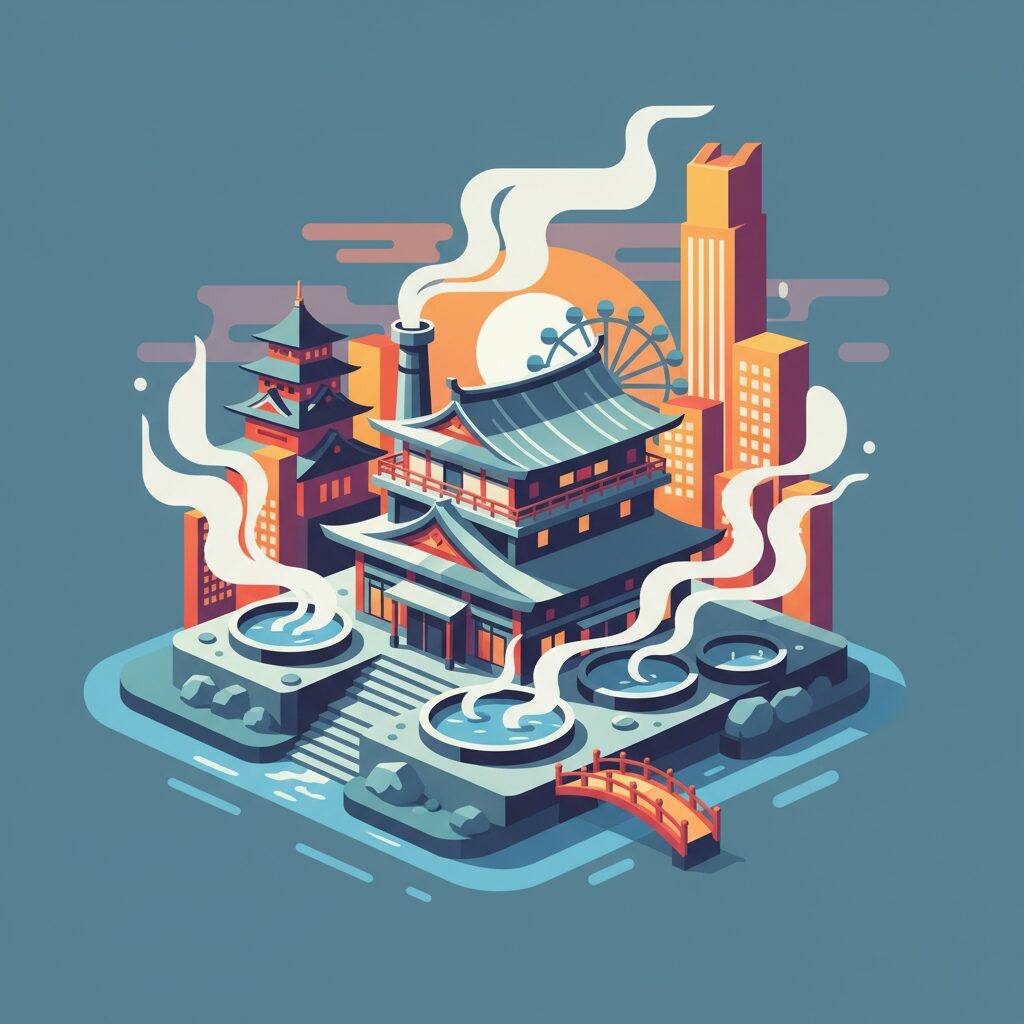
I remember the first time a colleague in Osaka asked me about my weekend plans. I was new to the city, fresh off the Shinkansen from the relentless, polished energy of Tokyo. I mumbled something about exploring a coffee shop or maybe visiting the castle. He just nodded, a slight grin playing on his lips. “That’s nice,” he said. “Me? I’m going to the sentō with the family. Gonna spend a good five hours there. Get a good soak, eat some katsudon, and take a nap in the recliner room.” Five hours? In a public bathhouse? In Tokyo, a trip to the local sentō was a quick, functional affair, a half-hour soak to wash away the day’s grime. The idea of dedicating a significant chunk of the weekend to it seemed… excessive. It felt like I was missing a piece of the puzzle. What could possibly keep a family entertained in a bathhouse for that long? It was one of my first clues that life in Osaka moves to a different rhythm, a beat that prioritizes a kind of communal, unpretentious relaxation I had never encountered before. This wasn’t about the quiet, meditative escape of a mountain onsen, a special occasion trip for tourists or Tokyoites. This was something else entirely. It was a weekly pilgrimage, a social institution hiding in plain sight, a place more central to the city’s soul than any skyscraper or famous landmark. It was the neighborhood Super Sentō, and understanding it meant understanding the real, unfiltered heart of Osaka.
To truly understand this unique rhythm of life, one should also explore the daily ritual of the Osaka morning service at a retro kissaten.
The Great Unwinding: A Ritual Beyond the Bath
By Friday night or Saturday afternoon, you can sense it—a subtle change in the city’s atmosphere. Tokyo is not defined by the frantic rush to crowded trains heading to trendy nightlife spots. Instead, there’s a more grounded movement. Cars fill expansive parking lots, families on bicycles weave through local streets, all converging on large, often modest buildings promising more than just hot water. The Super Sentō is not merely a place; it’s a destination—a self-contained realm of relaxation, a micro-resort for the working class, with an astonishingly affordable entrance fee. For the price of a movie ticket, you gain access to an entire ecosystem designed for one purpose: to fully and utterly disconnect.
This reflects a fundamental difference in weekend culture compared to other parts of Japan. In Tokyo, leisure often feels like another form of consumption, a performance. It’s about being seen at the right spot, trying the latest viral dessert, crafting an experience for social media. The Super Sentō stands in complete contrast. It’s a deeply private act carried out in a public setting. No one is there to impress anyone else. In fact, the whole point is to shed social facades along with your clothes. Multi-generational families—grandparents, parents, and children—spend the day together. Kids splash in the shallower pools while parents alternate soaking and watching over them. Groups of friends, young and old, gather to catch up, their voices echoing in the steam-filled rooms. It’s a social event without planning or reservations, based on a shared understanding that this is where you go to melt away the week’s stress.
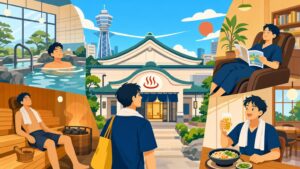
The very design of these places reflects this purpose. They are sprawling complexes. Beyond the baths, there are vast tatami rooms for lounging, full-service restaurants offering hearty, comforting dishes like ramen and tonkatsu, massage parlors providing everything from quick chair massages to full-body acupressure, and even small arcades or manga libraries. It’s a one-stop destination for unwinding. The goal isn’t just cleanliness; it’s achieving a state of suspended animation, floating for hours in a realm free of deadlines, emails, and social pressures. This all-encompassing approach to relaxation—where bathing, dining, and resting form a seamless experience—is quintessentially Osaka. It’s practical, efficient, and delivers the utmost value in both time and money—qualities the people of this city greatly cherish.
Hadaka no Tsukiai: The Great Equalizer
There’s a Japanese concept nearly impossible to translate directly into English, but one you feel deeply inside a Super Sentō: `hadaka no tsukiai`. It literally means “naked communion” or “naked relationship.” The idea is that when you remove the clothes, you also shed the uniforms, brand names, status symbols, and social hierarchies that shape life outside. In the bath, a company CEO and a construction worker are, for all intents and purposes, equals—just two people enjoying the hot water.
Nowhere is this principle more vibrant than in Osaka, a city rooted in merchant culture, where people are known for their directness, unpretentiousness, and a more relaxed attitude toward social formalities compared to Tokyo. The Super Sentō is a natural environment for this mindset. It’s a space where the sharp divide between `honne` (true feelings) and `tatemae` (the public facade) becomes wonderfully blurred. The steam seems to dissolve inhibitions, promoting a raw and honest form of communication.
I’ve seen this countless times: a group of young salarymen, still tense from work, gradually relax in a carbonated bath, their talk shifting from polite office chatter to loud, boisterous complaints about their boss, interspersed with hearty laughter. I’ve overheard elderly men, strangers to one another, strike up detailed conversations about the Hanshin Tigers baseball team, sharing analyses as passionate and intricate as any professional commentator’s. In the women’s bath, I’m told, the city’s famous `obachan` (middle-aged and elderly women) hold court, offering unsolicited yet often surprisingly wise advice on everything from cooking to romance to personal finance.
This is the social magic of the Super Sentō. It’s a level playing field. The carefully crafted personas of daily life are left behind in the locker room along with your wallet and smartphone. This atmosphere encourages a kind of vulnerability and connection that is rare in modern urban life. You might exchange a knowing glance with a stranger in the sauna as you both endure the intense heat, a silent acknowledgment of a shared challenge. You might find yourself in casual conversation with someone you otherwise wouldn’t interact with. Here, community is forged not through formal events, but through the simple, shared human experience of being vulnerable and relaxed together. It reveals much about the Osakan character—the tendency to speak honestly, the emphasis on genuine connection over superficial politeness, and the deeply held belief that at the end of the day, we are all just people trying to get by.
Anatomy of the Urban Oasis
To those unfamiliar, a Super Sentō can be an overwhelming sensory journey. It’s a blend of sounds, scents, and sensations, each carrying its own rhythm and ritual. Learning to navigate it is like acquiring a new language of relaxation, one that Osakans have mastered. Every step of the experience, from the moment you enter to when you leave, is part of a carefully choreographed unwinding dance.
The Gateway: Changing Room and Kakeyu
The journey begins in the changing room, the `datsuijo`. It’s much more than a place to undress; it’s a decompression chamber. The click of lockers shutting signals the outside world being locked away. You shed your street clothes—and with them, your public identity, whether the suit and tie of an office worker or the uniform of a student. You are distilled down to your bare self. Grabbing your small modesty towel—whose true purpose remains a delightful mystery to many foreigners, given its comical inadequacy for drying but perfect function for modesty—you head toward the baths.
Before immersing in the soothing hot water, there’s an essential, non-negotiable step: the washing area. Rows of small plastic stools face mirrors and shower stations, each stocked with soap, shampoo, and conditioner. Here, you must thoroughly scrub yourself. This ritual, called `kakeyu`, is the foundation of public bathing etiquette. It’s not just about personal cleanliness but a profound gesture of social respect. You cleanse yourself for your own sake and for everyone who will share the water. It embodies the Japanese principle of `omoiyari`, or consideration for others. Rushing or skipping this step is a major faux pas, marking you as someone unfamiliar with the communal nature of the space. In Osaka, where social conventions can sometimes feel more relaxed, this rule remains strict.
The Main Event: A Symphony of Baths
Once clean, the world of water unfolds. An Osaka Super Sentō rarely features just one large pool; it offers a curated assortment of aquatic experiences, each designed to deliver a distinct sensation or benefit. The main indoor bath (`naoyu`) is typically spacious and comfortably hot, serving as the social center where people gather. The true adventure, however, lies in exploring the surrounding baths.
You’ll almost certainly find a `tansan-sen`, a carbonated bath. Immersing yourself feels like being dipped in a glass of champagne, as thousands of tiny bubbles fizz against your skin. It’s believed to improve circulation and offers a strangely invigorating sensation. Then there’s the jacuzzi or jet bath, where powerful streams knead tension from your back and shoulders. It’s like a deep-tissue massage underwater, and it’s common to see middle-aged men patiently queueing for a spot in front of a strong jet.
Then there’s the `denki-buro`, the electric bath, a uniquely daunting feature for many. Two plates on opposite sides of a small tub emit a low-voltage electric current that causes your muscles to tingle and contract. The first time is bizarre: a prickly, vibrating shock that feels fundamentally odd. Yet devotees swear by it as the ultimate remedy for stiff shoulders and back pain. The presence of the `denki-buro` reveals something about the Osakan mindset: pragmatic and no-nonsense. It’s not elegant or particularly pleasant initially, but effective enough to earn its place. Function over form—a philosophy that defines much of the city.
The crown jewel is often the `rotenburo`, the outdoor bath. Stepping into the cool night air while your body remains submerged in steaming water is sublime. In the heart of a dense, busy city, you can sit among strategically placed rocks and bamboo, gazing at the moon or the hazy city sky. It’s a profound moment of peace, a reminder that tranquility can be found even in urban life.
The Ritual Within the Ritual: Sauna and Mizuburo
Sauna culture has surged across Japan in recent years, embraced by a new generation practicing `sa-katsu` (sauna activity). But in Osaka, the sauna has long been the realm of the `ojisan` (middle-aged man), a place of quiet endurance and unspoken rules. The sauna is not for casual chat; it’s a temple of heat, a space for silent meditation and sweating out the week’s toxins.
The true ritual lies in what follows: the `mizuburo`, or cold plunge pool. Its temperature is often shockingly cold, just above freezing. To the uninitiated, it looks like self-imposed torture. But sauna enthusiasts know this is the point. After 8-12 minutes in the intense heat of the sauna, you rinse off sweat and then deliberately, calmly submerge yourself in the icy water for a minute or two. The shock is immense, but emerging triggers a euphoric, tingling sensation that floods your body. Your mind sharpens, your senses heighten. This is `totonou`, a state of perfect balance and blissful clarity. The cycle—sauna, cold plunge, rest—is repeated several times. This disciplined quest for a specific state of relaxation, an almost scientific mastery of bliss, is a fascinating cultural aspect. It’s not just about warmth; it’s about mastering your body to achieve grace. It reflects a mindset that finds joy and meaning in process and ritual.
The Afterglow: It’s Not a Spa, It’s the Living Room
Bathing is only part of the experience. A Westerner might picture a spa as a place of quiet whispers, soothing music, and solitary reflection. An Osaka Super Sentō, however, is quite the opposite. The area after the bath is lively, joyful, and communal. It functions as the city’s living room in every sense. The serene respect of the bathhouse gives way to the vibrant buzz of social interaction.
The Post-Bath Feast
After soaking and steaming, you’re left feeling completely relaxed and ravenously hungry. Instead of changing back into your street clothes, you slip into the comfortable lounge wear provided by the facility—typically a `samue` or a `jinbei`. Now dressed for serious lounging, you make your way to the restaurant. The menu isn’t fine dining; it celebrates Japanese comfort food—hearty, satisfying dishes that feed the soul. You’ll find generous bowls of ramen, crispy tonkatsu sets, savory curry rice, and plates of gyoza. To wash it all down, nothing tastes better than an ice-cold draft beer or a bottle of fruit milk after a long soak.
The dining hall reflects Osaka itself. It’s noisy. It’s welcoming. Families share large plates of fried chicken. A group of friends clinks beer mugs, their laughter filling the air. An elderly man sits alone, methodically enjoying a bowl of soba noodles while watching TV. There’s no pretense here—only pure, unabashed contentment. The food plays a vital role in the therapeutic process, refueling the body just as the hot water has soothed the mind. This smooth transition from bathing to feasting is a core part of the Super Sentō’s charm. It recognizes that true relaxation is holistic, addressing all the senses and bodily needs.
The Zone of Utter Relaxation
Beyond the restaurant lies the true heart of the post-bath ritual: the relaxation zone, or `kyukei supēsu`. This is where the Super Sentō truly sets itself apart from other facilities. Imagine a large, dimly lit room filled with rows of plush reclining chairs. Each chair is a personal haven, equipped with its own small television and a blanket. People here are found in various states of blissful repose.
Some are sound asleep, their soft snores blending into the room’s ambient white noise. Others are absorbed in the extensive collections of manga, a hallmark of any good Super Sentō. They lie there for hours, turning page after page, completely immersed in another world. Others simply stare blankly at a variety show on their personal TV, not really watching, just allowing the noise to wash over them. This is a public space devoted to the art of doing absolutely nothing. In a society that often values productivity and constant activity, the existence of such a place is nothing short of revolutionary. It is a refuge for the weary mind.
This may be the greatest cultural divide for a foreigner to grasp. We tend to think of leisure as an activity—something you do. Here, leisure is a state of being—a state of non-doing. You are not expected to be productive, engaged, or even awake. You are simply allowed to be. This is a precious gift in a city like Osaka. It’s a collective sigh of relief, a shared permission to power down. This dedication to deep, unstructured rest feels fundamentally different from the more scheduled, performative leisure culture found in a city like Tokyo. It’s less about escaping the city and more about discovering a pocket of profound peace right in its heart.
Demystifying the Experience: What Foreigners Get Wrong
Despite all its wonders, the Super Sentō can feel daunting to someone who isn’t Japanese. There are unspoken rules, social cues to interpret, and, of course, the major aspect: the nudity. Viewing the experience solely through a Western perspective can lead to misunderstandings about its purpose and atmosphere.
The Nudity Issue
Let’s confront the obvious point. Yes, you will be naked. Yes, everyone else will be naked too. For many from cultures where public nudity is taboo, this represents the biggest challenge. People often fear it will be awkward, embarrassing, or overly sexualized. In reality, it is none of these things. Nudity in a Super Sentō is deeply, almost clinically, non-sexual. It serves a purely practical purpose. Visitors are not there to observe each other but to wash, soak, and relax. Everyone remains in their own space. After a few minutes, you notice that no one is paying attention to you, and your initial self-consciousness fades away. You quickly learn that trying to cover up with a tiny towel feels far more uncomfortable than simply walking around naturally like everyone else. The experience reveals that body awareness is largely shaped by culture. In this environment, all bodies are just bodies, and there is a quiet sense of liberation in that.
The Tattoo Taboo
Another source of confusion and concern for foreigners is the issue of tattoos. Traditionally in Japan, tattoos have been linked to the yakuza, or organized crime, leading many onsen and sentō to enforce strict “no tattoos allowed” rules. This can frustrate foreigners who view tattoos simply as a form of self-expression. However, this is where Osaka’s well-known pragmatism shines through. While the rule still applies in many places, urban Super Sentō tend to be more relaxed compared to their traditional, tourist-focused counterparts elsewhere. Some openly allow tattoos; others adopt a “don’t ask, don’t tell” stance, provided the tattoos aren’t excessively large or intimidating. Some even offer small patches to cover tattoos. This flexibility characterizes Osaka, a city less fixated on rigid rules and more focused on practical solutions that encourage harmony. The prevailing attitude is: if you’re respectful and cause no trouble, you’re welcome. It’s wise to check a facility’s policy in advance, but having tattoos doesn’t necessarily bar you from enjoying this classic Osaka experience.
The “Just a Bath” Misconception
The deepest misconception is seeing a Super Sentō as “just a bath.” This is like saying a pub is “just a place to get a drink” or a coffee shop is “just a place for caffeine.” It misses the essence entirely. The Super Sentō serves as a community center, family restaurant, health spa, and mental health refuge all in one. It is a crucial part of the city’s social fabric. Viewing it merely as a spot to clean oneself overlooks its role as the communal hearth of modern Osaka—a place where people from diverse backgrounds come to cast off their troubles, connect with others, and recharge for the week ahead. It offers insight into how the city defines well-being: not as an indulgence to be bought, but a shared right to be enjoyed regularly.
The Soul of the City in a Steamy Room
In the end, the Super Sentō perfectly encapsulates Osaka itself. It embodies the city’s most treasured values in a way that no museum or monument ever could. It demonstrates Osaka’s deeply rooted pragmatism. For a very reasonable price, you receive a full day of relaxation and entertainment. It’s the ultimate example of `kosupa` (cost performance), a concept highly valued by Osaka’s merchant spirit. Why spend a fortune on a fancy spa when you can enjoy a superior, more comprehensive experience for a fraction of the cost?
It highlights the city’s strong sense of community. Unlike Tokyo’s more individualistic and transient culture, life in Osaka is grounded in close local connections. The Super Sentō is a place where these ties are strengthened, where neighbors meet neighbors, and where the lines between family and community blur. It’s a living, breathing social network that exists offline, in the real world.
It serves as a stage for Osaka’s renowned directness and lack of pretense. The `hadaka no tsukiai` culture of the bathhouse perfectly expresses the local preference for straightforward talk and genuine connection. It’s a space where you can drop your guard, speak openly, and be your authentic self, free from the stifling pressures of social formality.
Finally, it reveals Osaka’s unique take on the good life. It’s not about flashy wealth or passing trends. It’s about finding deep joy in simple, earthy pleasures: the warmth of hot water on tired muscles, the taste of a cold beer after a sauna, the sound of laughter shared with friends, the restful calm of a nap in a quiet room. It’s a philosophy that values well-being, connection, and contentment over status and ambition.
So, when my colleague told me he was spending his Saturday at the Super Sentō, he wasn’t just sharing his plans. He was offering me a key to understanding his city. He was showing me where Osakans go not to escape life, but to fully live it, to reconnect with themselves and each other. He was pointing me to the city’s true living room—a place where, wrapped in steam and the warm embrace of community, you can discover the genuine, unfiltered soul of Osaka.