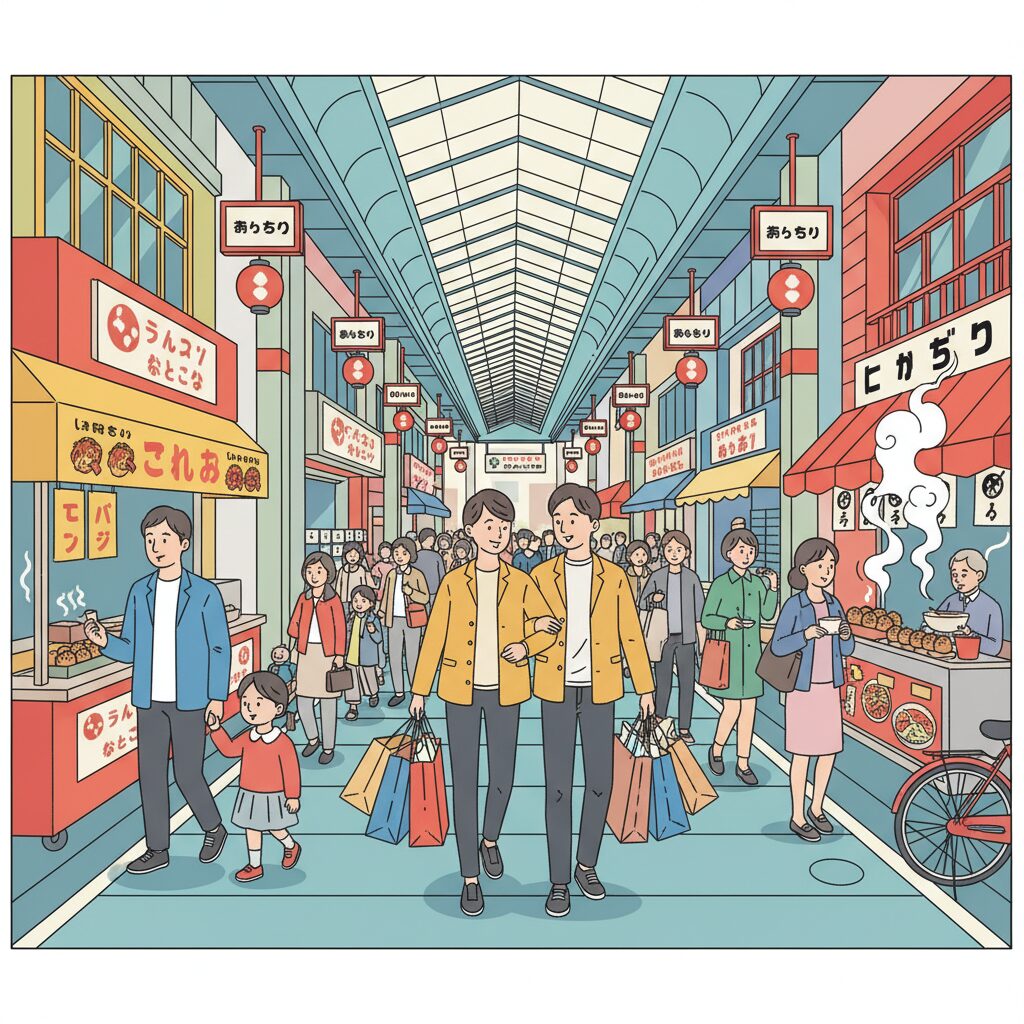
Step out of the silent, air-conditioned efficiency of a Japanese train station, turn a corner in a neighborhood like Tenma or Shinsaibashi, and you’ll find it. The transition is immediate. The air changes, growing thick with the scent of grilled eel and sweet soy sauce. The sound shifts from a polite hum to a cacophony of vendors’ calls, rumbling bicycle bells, and the shuffling feet of a thousand people on a mission. You’ve just entered a shotengai, one of Osaka’s covered shopping arcades. And if you think this is just a place to buy groceries, you’re missing the entire point. This isn’t a mall. This isn’t a supermarket. This is the city’s circulatory system, its loud, beating heart, and to live in Osaka, you have to learn its rhythm. A lot of foreigners, especially those coming from Tokyo, see this as chaos. They see the lack of orderly lines, the bicycles weaving through crowds, the shopkeepers shouting. They try to apply the rules of polite, reserved Tokyo society here, and it feels like trying to solve a math problem with a poem. The shotengai doesn’t operate on formal logic; it operates on an intuitive, unwritten social code. It’s a place built on human connection, relentless pragmatism, and a shared understanding that life is a little messy, a little loud, and a lot more fun when you’re all in it together. Forget your travel guide for a moment. This is a lesson in navigation, not of streets, but of the human currents that truly define this city. To understand the shotengai is to understand the soul of Osaka.
To truly grasp this unique rhythm, consider how a place like Kuromon Market operates on a completely different level for residents than it does for weekend visitors.
The Flow State of the Arcade
Your first walk through a bustling shotengai, such as the expansive Tenjinbashisuji, feels like being thrust into a flowing river. Your instinct might be to resist the current, cling stubbornly to one side, or stop to reorient yourself. This, however, is the Tokyo way. In Tokyo, pedestrians move with a kind of graceful, predictable order: they line up patiently for escalators, form queues without prompting, and walk in straight, purposeful lines. Applying that same approach here will only leave you bumped, jostled, and consistently frustrated. The shotengai isn’t merely a collection of individuals walking in the same direction; it’s a single, organic organism. Learning to move within it is the first unspoken rule you must master.
Reading the Human Current
There’s a move I call the “Osaka Shuffle.” It’s a fluid, almost instinctive dance through dense crowds. It’s not about waiting for a clear path; it’s about anticipating the fleeting gaps that constantly open and close. You don’t focus on the person immediately ahead; you watch three, four, five people in front of you, reading the crowd’s collective body language. A slight dip of a shoulder from an elderly man to your left signals that a space is about to appear. A family slowing to admire a display creates a temporary block you must flow around, not collide with. People stop suddenly, greet friends, or get distracted by a sizzling tempura stand. No one apologizes because this is simply expected—it’s woven into the fabric of the experience. The key is to stay relaxed, stay alert, and never plant your feet stubbornly like a rock in the river. You must become water. This is a fundamental mindset difference: Tokyo values collective order and minimizing disruption, while Osaka values individual momentum within chaotic flow. The goal isn’t a flawless procession but for everyone to reach their destination with minimal fuss, even if it appears to be a beautiful mess from the outside.
The Bicycle’s Reign
Then there are the bicycles. In most cities, a bike in a crowded pedestrian area is a hazard. But in an Osaka shotengai, it’s just another fish in the school. You’ll see elderly women, their baskets brimming with daikon radishes and leeks, pedaling slowly and weaving through the thickest crowds with serene ease. Delivery riders on electric bikes zip by, balancing stacks of ramen bowls precariously. The bell—the “chirin-chirin”—is not a harsh demand to clear the way but a gentle sonar ping, a simple signal of presence: “I’m here, part of this flow with you.” Pedestrians part smoothly like the Red Sea, almost instinctively, and then the space closes up again. There is a deep, unspoken trust: cyclists trust pedestrians to make small adjustments, and pedestrians trust cyclists not to be reckless. The rule is simple: the bicycle is not an intruder. It has just as much right to be there as you do. Don’t be startled. Don’t leap aside aggressively. Make a subtle shift, a slight lean, and let it pass. Parking is another matter. Bikes are often left unlocked, leaning against shop walls. The rule centers on obstruction: parking against a closed shutter is acceptable, but blocking the entrance to the fishmonger is a cardinal sin. It’s about practical consideration, not rigid rules.
The Symphony of Commerce
The soundscape of a shotengai can be overwhelming at first. It isn’t the usual, calming pop music found in department stores. Instead, it’s a rich, layered symphony of human activity where every sound carries meaning. The vendors’ calls, the sizzle of frying oil, the rumble of steel shutters, and neighbors’ chatter—all serve as valuable information. They indicate what’s fresh, what’s on sale, and where the action is. Compared to the relative quiet of other Japanese cities, this can seem intense. In Osaka, silence in a commercial space signals trouble—it means business is slow. The noise, by contrast, signifies health, vitality, and life.
“Maido!” — More Than Just a Greeting
Above all other sounds, one word echoes through the arcade: “Maido!” A greengrocer shouts it as you pass by without even looking directly at you. The woman at the pickle stand offers it with a warm smile as she hands back your change. The butcher yells it as you walk away. Literally, it’s a formal phrase meaning something like, “Thank you for your continued patronage.” But in Osaka, it has been worn smooth by frequent use and transformed into the city’s social and commercial lubricant. “Maido!” can mean “Hello,” “Welcome,” “Thanks,” “Come again,” or simply, “I see you.” It’s a verbal nod acknowledging your presence within the community of the shotengai. It’s not a demand to buy something; rather, it’s the underlying rhythm, the constant hum that says, “We’re all here, participating together.” Responding isn’t mandatory, but a slight nod or a quiet “doumo” marks you as someone who understands. It’s the first word you should learn in the local dialect—not just for its meaning, but for the sentiment it conveys.
The Art of the Pitch
Shopkeepers in the shotengai are not passive attendants waiting for shoppers to decide. They are performers on a stage, with their storefronts as their sets and customers as their audience. They call out daily specials in melodic, rhythmic chants: “Hoi, o-niisan, kono maguro oishii de!” (“Hey, mister, this tuna is delicious!”); “Kyabetsu, hyaku-en, dou ya!” (“Cabbage, 100 yen, how about it!”). For those accustomed to the quiet politeness of retail staff elsewhere in Japan, this can seem pushy. But it isn’t—it’s a form of information broadcasting. In a place filled with hundreds of visual and sensory stimuli, the human voice is the most effective way to cut through the noise and highlight value. It’s also a kind of entertainment. The best vendors are masters of their craft, using humor, wit, and deep product knowledge to attract customers. Engaging with them is part of the experience. Asking a question—“Is this fish good for grilling?”—invites them to perform, to share expertise, and to build a connection beyond a simple sale. They take pride in their offerings, and their loud pitches express that pride.
The Negotiation of Value, Not Price
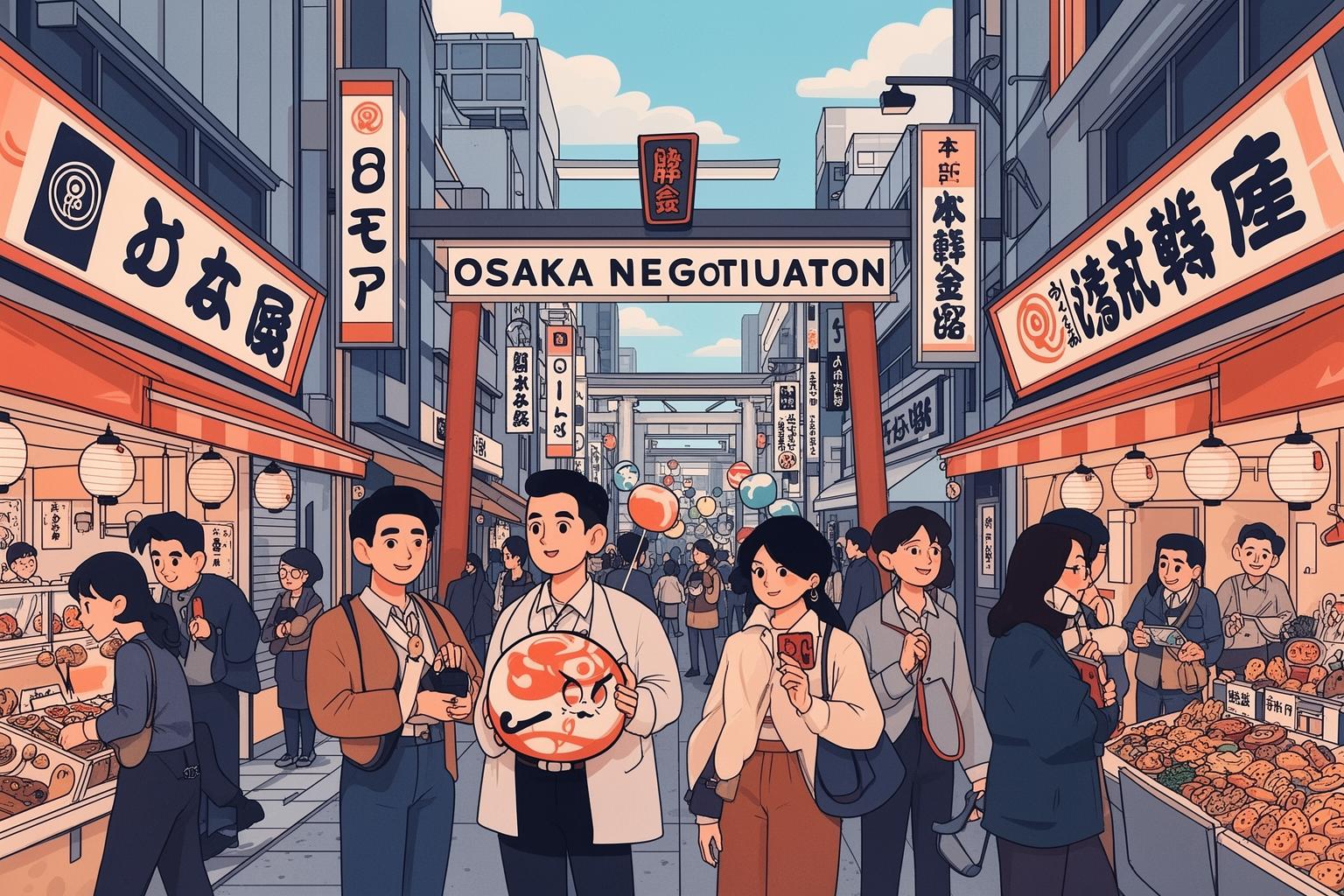
Here’s one of the biggest misconceptions for newcomers: the concept of haggling. You might observe the lively exchange between a shopkeeper and a customer and assume they are negotiating the price. However, ninety-nine percent of the time, they are not. Direct, aggressive bargaining over a marked price is considered impolite and won’t get you anywhere. The price on the sign is the price. Yet, a different, more subtle negotiation is always underway: the negotiation of value and relationship. This is a game regular customers play, and it’s one you can learn as well.
It’s Not Haggling, It’s a Relationship
The true currency in the shotengai is not yen; it’s recognition. When you become a familiar face at a certain stall—the fruit stand where you regularly buy your mikan oranges, the tofu shop you visit every few days—the nature of the transaction changes. The shopkeeper knows you. They know your preferences. The conversation deepens. You’re not just a customer; you become part of their daily routine. And this is when the magic begins. This is when you receive the `omake`. `Omake` is a small gift, a little extra item given for free. You buy five tomatoes, and the owner adds a sixth. You purchase a block of tofu, and she includes a small piece of `atsuage` (fried tofu). This is not a discount. It is a gesture of goodwill, a thank-you for your loyalty. It physically represents the relationship you’ve built. Asking for an `omake` is highly rude. Receiving one is a sign you’ve moved from being an anonymous shopper to a neighborhood regular. This system is fundamentally different from supermarket loyalty cards based on points. It’s analog, human, and wholly based on personal connection. It emphasizes that commerce here is not just about exchanging goods; it’s about nurturing community ties.
The Language of the Transaction
Let’s explore a typical interaction at a fishmonger. You don’t simply point at a piece of fish and say “kore kudasai” (this one, please). That’s how it works at supermarkets. Here, you start a conversation. “O-chan, kyou no osusume wa?” (“Mister, what’s your recommendation today?”). He’ll respond passionately. “This aji (horse mackerel) just arrived this morning! Look at the clear eyes! Perfect for grilling with a little salt.” You examine the fish. You ask another question. “Could you prepare it for me as sashimi?” He might agree, or he might say, “No, no, for sashimi, this tai (sea bream) is much better. A bit pricier, but the texture is incredible.” You are not simply purchasing a product; you’re buying his expertise. The final exchange might include some friendly banter about the weather or the Hanshin Tigers baseball team. As he wraps your fish, he might share a cooking tip. This entire process, which may take five minutes instead of thirty seconds, is the real point. It’s a moment of human connection that makes buying dinner more meaningful. It transforms a chore into an enjoyable social ritual. This is what people truly pay for, a value no supermarket can provide.
Decoding the Sensory Data Stream
A shotengai is an overwhelming flood of sensory information. The visuals are cluttered, the aromas intense, and the sounds unrelenting. For an outsider, it might feel disorienting—a chaotic mess. But to a local, this isn’t noise; it’s a dense, rich stream of data. Learning to interpret this information is essential for navigating the shotengai skillfully and grasping its hidden language. Every faded sign and lingering scent tells a story.
Reading the Signs, Both Written and Unwritten
Forget sleek, minimalist corporate branding. The shotengai’s aesthetic is unapologetically handmade, wonderfully cluttered, and steeped in history. A shop’s sign reflects its personality. A finely carved wooden sign indicates a business that has stood for generations, a true master of their craft. A fluorescent-lit sign with peeling plastic letters might denote a bargain-focused store emphasizing low prices above all else. The best signs are often hand-painted, with thick black ink on cardboard, announcing the day’s specials. The dripping ink and imperfect characters don’t look unprofessional; they convey immediacy—they signal that the deal was made fresh this morning, based on today’s market arrivals. The clutter itself is a sign. A storefront piled high with boxes and goods spilling into the walkway isn’t a sign of disorder; it’s evidence of rapid turnover, meaning the products are fresh and in demand. You learn to read these visual cues instinctively. You distinguish the slightly worn vegetable stand catering to a shrinking elderly clientele from the vibrant, bustling fishmonger serving local restaurants. The plastic food models, often sun-faded over decades, aren’t just kitsch; they serve as a visual menu for a community that, generation after generation, valued seeing exactly what they would receive.
The Aroma Map
Close your eyes in a shotengai, and you can navigate by smell alone. Each section has a distinct olfactory signature. There’s the savory, sweet, slightly smoky haze surrounding the `yakitori` (grilled chicken skewer) stall. A few steps away, that scent gives way to the sharp, tangy, earthy aroma of a `tsukemono` (pickles) shop, with its vast barrels of radishes, cucumbers, and cabbage fermenting in brine and rice bran. Near the entrance, the sweet, batter-rich fragrance of a `taiyaki` (fish-shaped cake) maker often wafts through the air. Deeper inside, the clean, oceanic, slightly metallic scent of a fresh fish market dominates—a smell locals associate with quality and freshness. These aromas aren’t mere background ambiance; they are invitations, drawing you in. They also serve as landmarks. If you’re meeting a friend, saying “Let’s meet by the croquette shop” is less clear than “Let’s meet where the smell of fried potatoes begins.” It’s a more primal, effective way to navigate a place that can sometimes resemble a labyrinth.
The Shotengai as the Neighborhood’s Living Room
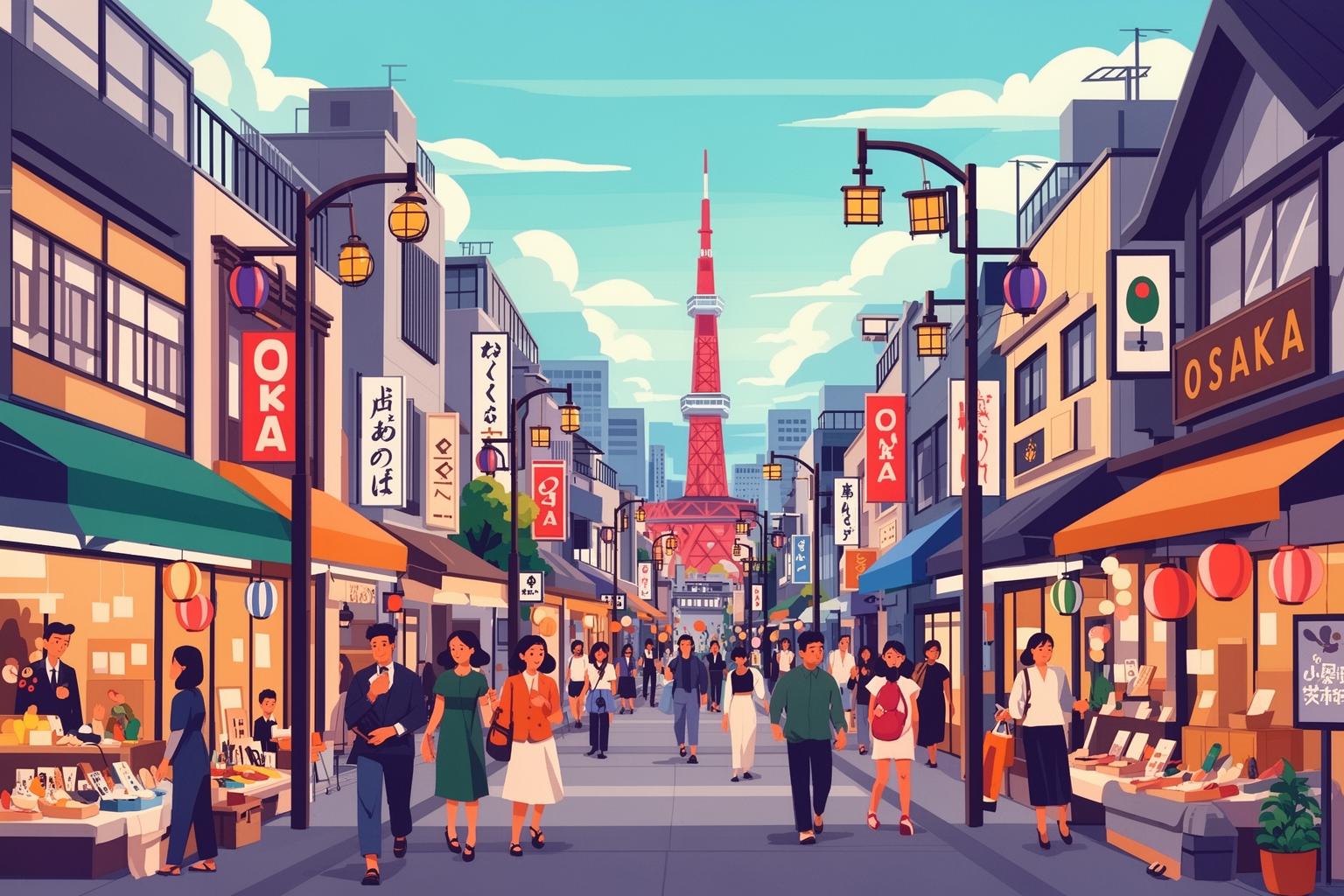
The fundamental mistake is to see the shotengai as merely a commercial area. It is much more than that. It serves as the community’s heart, a semi-public space functioning as the neighborhood’s informal living room. Commerce provides the pretext, but community is the true purpose. This is where the neighborhood’s social life unfolds openly for everyone to witness. Connections are sustained here, gossip is shared, and the collective identity of the area is shaped day after day.
Beyond Shopping
Spend ten minutes in one spot and observe. You’ll notice children in school uniforms, bags over their shoulders, stopping to buy a 100-yen croquette for a snack after school. You’ll see two elderly women who unexpectedly meet, halting mid-walkway to chat for a solid fifteen minutes, causing the crowd to weave around them. Nobody becomes upset; this is precisely what the space is meant for. A shop owner might be sweeping the pavement outside his store while chatting with the owner across the way. Benches aren’t just for weary shoppers—they’re for residents to sit, watch the world, and be seen. Local festivals, seasonal decorations, and community events all revolve around this area. The shotengai is the stage for daily life’s ongoing drama. This explains why these arcades have withstood the rise of massive, impersonal malls and online shopping. They offer something money can’t buy: a sense of belonging. This sets them apart from many other cities. Whereas a high street abroad might be purely transactional, the shotengai’s essence is social first and commercial second.
The Unspoken Rules of Social Space
As a shared living room, it follows social norms. Though lively, it’s not lawless. People usually avoid speaking loudly on their phones while walking, as it creates a private, disruptive bubble. A brief, necessary call is acceptable, but lengthy personal conversations are reserved for quieter spots. Personal space here is flexible. The crowd’s density means you’ll be closer to strangers than elsewhere, but there’s mutual understanding. An accidental bump prompts a quick, almost reflexive “Sumimasen” or the Osakan “Sんません” (Sunmasen), and it’s over. No one takes offense. Eye contact is brief; you don’t stare but acknowledge others with a glance. It’s about sharing space without intrusion. Most importantly, practical consideration is key. Don’t block the walkway with your friends, and be mindful of those behind when you pause to look at something. These aren’t formal etiquette rules but necessary guidelines for tens of thousands to coexist peacefully in a confined space. It’s a brilliant example of collective social intelligence.
Navigating the shotengai is like learning Osaka’s language. This language is spoken not just in words like “Maido” and “Nambo” (How much?), but in a slight shoulder dip, the gift of an extra onion, or the patient pause as a bicycle passes. It resists the cold efficiency of modern life, insisting that buying fish or vegetables remains a human exchange, not a sterile barcode scan. It can be overwhelming, noisy, and chaotic. But once you stop trying to control it and instead learn to read its signals and move with its unique, powerful rhythm, you’ll uncover the city’s most authentic, vibrant, and profoundly human side. You haven’t truly experienced Osaka until the shotengai’s chaos begins to feel like home.