Someone always asks the question. It usually comes up after they’ve lived in Osaka for a few months, once the initial shine of Dotonbori’s neon glare has settled into a familiar, friendly glow. They’ll be sipping a highball in some back-alley tachinomi in Namba, shoulder-to-shoulder with a salaryman who’s just offered them a piece of his grilled squid, and they’ll turn to me and say, “So, Tokyo’s nightlife… is it just like this, but bigger?”
And I always have to laugh. Because it’s not just bigger. It’s a completely different operating system. Comparing the nightlife of Osaka’s Minami district—that sprawling, electric labyrinth of Namba, Shinsaibashi, and Dotonbori—to Tokyo’s mega-hubs like Shinjuku and Shibuya is like comparing a dense, chaotic, open-world video game to a level-based platformer. In Osaka, you’re dropped into the heart of the action with every weapon and power-up within a few steps. In Tokyo, you have to clear one world completely before taking a high-speed transit system to the next.
This isn’t about which city is “better.” This is about a fundamental difference in urban philosophy that seeps into every interaction, every yen spent, and every decision you make after the sun goes down. It dictates whether your night is a spontaneous adventure or a carefully scheduled mission. It defines whether you feel like a participant on a city-wide stage or an anonymous audience member in a very cool, very large theater. For anyone living here, or thinking about it, understanding this difference is key to understanding the very soul of Osaka. It’s not just about where you drink; it’s about how you live.
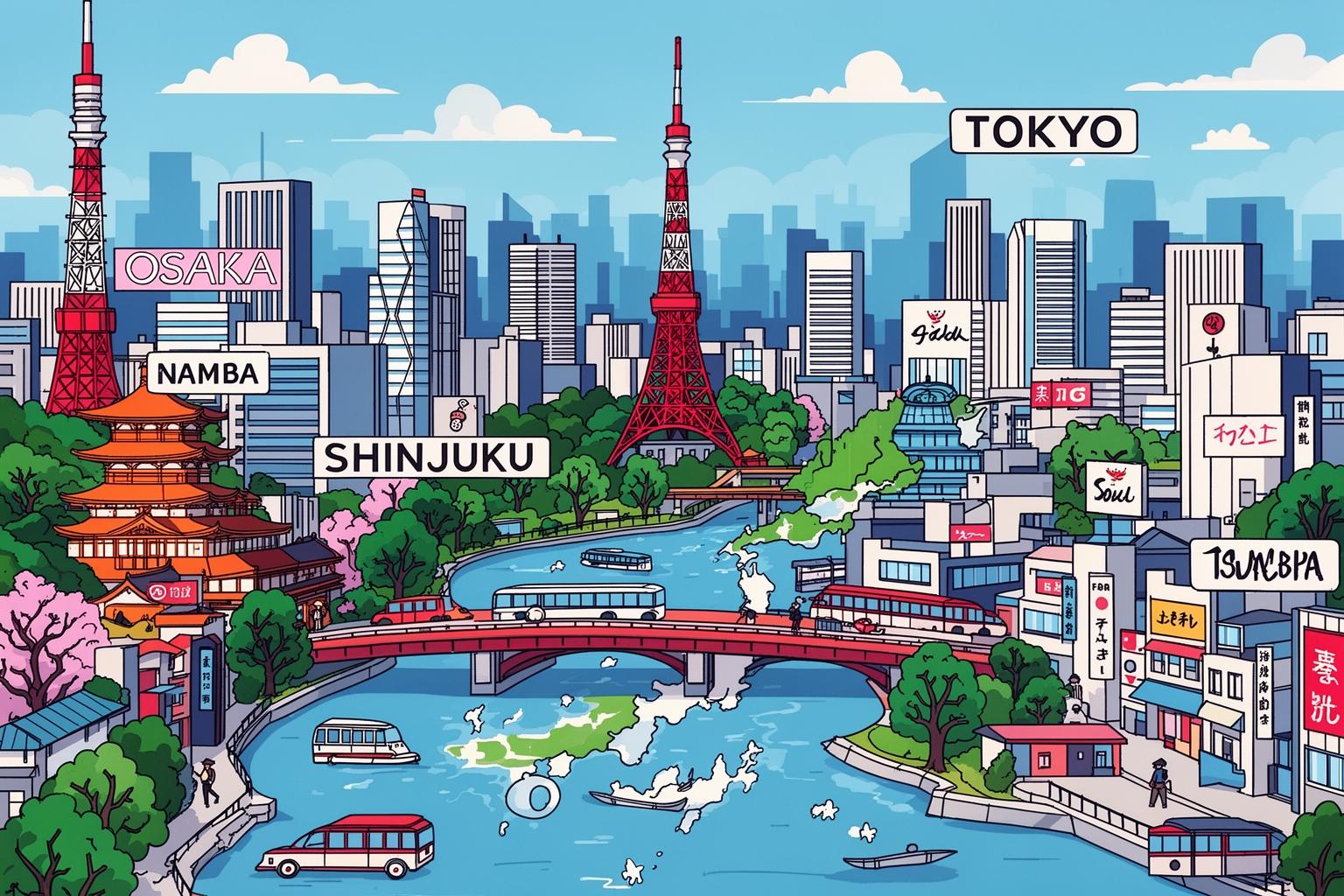
To get a sense of the sheer, walkable density we’re talking about, just look at a map of Osaka’s core nightlife zone. Everything is right here.
To truly understand this walkable, community-focused urban philosophy, you need to experience the rhythm of Osaka’s shotengai.
The Geographic Soul of the Night: Concentrated vs. Dispersed
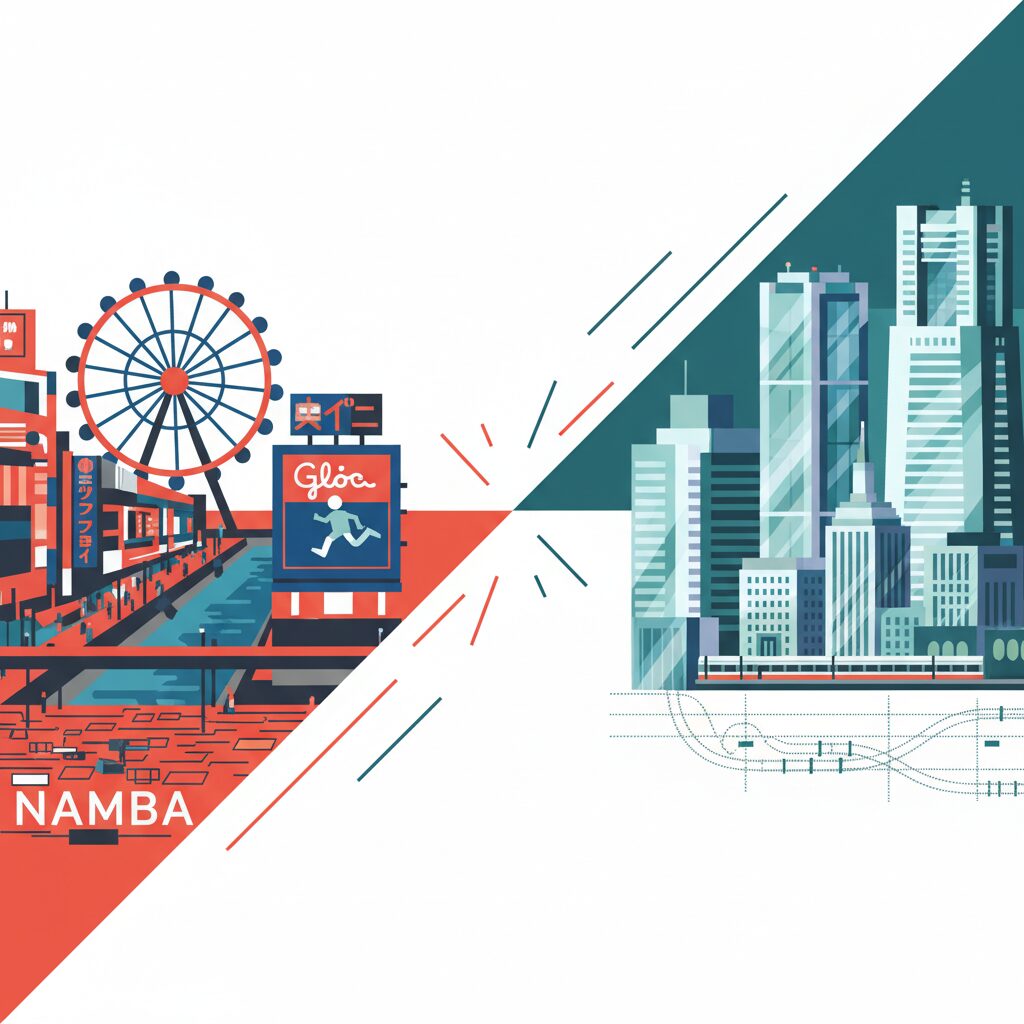
Everything begins with the map. The physical layout of a city shapes the rhythm of its social life, and this is most evident during the after-dark hours in Japan’s two largest metropolitan centers. Osaka and Tokyo have developed their entertainment districts based on fundamentally opposing concepts, and this simple difference has a cascading impact on everything else.
Osaka’s “Minami” Core: A Human-Scale Maze
When an Osakan says, “Let’s go out,” they almost always mean “Minami.” This southern downtown area is a broad term encompassing the interconnected districts of Namba, Shinsaibashi, Dotonbori, and adjacent streets like Ura-Namba and Amemura. The key word is interconnected. Rather than a collection of separate neighborhoods, it’s one vast, living entertainment organism. Traveling from the high-fashion boutiques of Shinsaibashi to the smoky yakitori spots of Namba isn’t done by train—you walk, and it takes just five minutes.
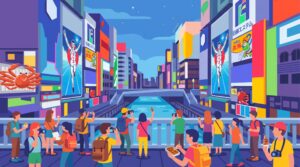
This walkability is the secret ingredient. It fosters a sense of endless possibility. A night in Minami is a string of spontaneous choices. You might begin with dinner at a proper izakaya near Namba station, then feel like having cocktails. A short stroll across the Dotonbori canal takes you to Shinsaibashi, where dozens of sleek bars hide on the upper floors of unassuming buildings. Next, you might catch the faint beat of a bassline and follow it to a tiny basement club in Amemura (American Village). Hungry again? The takoyaki and ramen stalls along Dotonbori blaze into the early hours. Craving karaoke? There’s a venue for that on literally every corner. There’s no friction.
The whole experience is crafted on a human scale. The streets form a chaotic maze—a mix of broad, neon-lit boulevards and narrow alleys that seem to dead-end but open into courtyards filled with hidden bars. This layout encourages exploration and happy accidents. Few have rigid plans because the environment itself constantly tempts with something new just around the bend. The energy pulses like a current, a steady flow of people moving from one experience to the next by foot. You’re immersed in a river of options, and changing course requires only the slightest whim.
Tokyo’s Mega-Hubs: A Game of Subway Roulette
Tokyo plays by a very different set of rules. A night out here means committing to a specific neighborhood, a carefully made choice before you even leave home. The question isn’t just “Where are we going?” but “Which major urban hub will define our evening?” Each hub is a self-contained universe, separated by significant and costly train rides.
Consider this: Shinjuku and Shibuya, Tokyo’s nightlife giants, might as well be in different cities. Attempting to hop from a bar in Shinjuku’s Golden Gai to a club in Shibuya mid-evening isn’t a casual move; it’s a dedicated undertaking. It requires navigating the world’s busiest train station, paying a fare, and spending 10-15 minutes in transit. By the time you exit Shibuya’s Hachiko gate, the momentum of your night has reset. Consequently, people rarely do it. You pick your hub and stick there.
This results in a more fragmented and deliberate nightlife rhythm. A “Shibuya night” has a distinct vibe: youthful, trendy, filled with mega-clubs and influencer-approved cafés. A “Shinjuku night” presents a different menu: from the sprawling red-light district of Kabukicho to quiet, upscale bars near the Park Hyatt, to tiny, historic drinking dens in Omoide Yokocho. Then there’s Ginza for upscale dining and cocktails, Roppongi for its notorious international club scene, and Shimokitazawa for its bohemian, indie atmosphere. Each is a destination, requiring conscious choice and travel.
The outcome is a less fluid, more structured evening. The night unfolds within the invisible boundaries of your chosen district. Although each Tokyo hub is vast—Shinjuku alone feels larger than all of Minami—it lacks Osaka’s seamless, boundary-blurring flow. The city’s immense scale, a defining strength in many respects, becomes a limitation on the spontaneity of its nightlife.
The Economic Pulse: How Cost Shapes Culture
Beyond geography, the single most influential factor shaping the atmosphere of a city’s nightlife is money—not just the cost of things, but the underlying attitude towards spending. In this regard, Osaka and Tokyo are poles apart. Osakans possess an inherent, almost spiritual dedication to the concept of “cospa,” which governs the entire social economy after dark.
Osaka’s “Cospa” Kingdom: More Bang for Your Yen
“Cospa,” a Japanese blend of “cost” and “performance,” is elevated to a near-religion in Osaka. It embodies the art of maximizing value for your money. This isn’t about being cheap; it’s about being savvy. An Osakan will eagerly share tales of fantastic all-you-can-drink deals or standing bars where large draft beers cost less than 300 yen. Paying a high price for something mediocre is seen as a personal failure.
This mindset makes Osaka’s nightlife remarkably accessible, with an astonishingly low barrier to a fun night out. The culture of `senbero`—literally “getting tipsy for 1000 yen” (around $7-8 USD)—thrives here. You can stroll into numerous `tachinomi` (standing bars) near Namba Station, order a beer and two small dishes, and still have change left from a 1000-yen bill. This isn’t a limited-time offer; it’s the standard business approach.
Such affordability fosters a culture of casual, frequent socializing. Going out isn’t a major, planned occasion requiring a budget—it’s the go-to response to boredom. It’s what you do on a Tuesday night when you don’t feel like cooking. The economic model favors frequency over high margins. Bar owners prefer you to visit three times a week, each time spending 1500 yen, rather than once a month for a 5000-yen splurge. This philosophy traces back to Osaka’s merchant roots, where success relied on volume, repeat customers, and offering deals so compelling that patrons wouldn’t dream of going elsewhere.
`Nomihodai` (all-you-can-drink) plans are also central to this scene. While Tokyo’s versions can sometimes feel like a rip-off, featuring watered-down drinks and limited menus, Osaka takes pride in offering solid `nomihodai` deals. Drinks are potent, selections broad, and prices fair. It’s an unspoken social contract: businesses provide incredible value, and customers keep coming back.
Tokyo’s Price Tiers: Paying for the Prestige
Tokyo, naturally, has cheap drinking spots, but the city’s baseline is noticeably pricier with a different pricing structure. In Tokyo, you aren’t just paying for the drink in your hand; you’re paying for location, brand, interior design, and the prestige of the address. A simple gin and tonic’s price can vary dramatically depending on whether you’re in a Koenji backstreet bar or a stylish Shibuya lounge with a view.
Table charges, or `otoshidai`, are more prevalent and often higher in Tokyo. Although they exist in Osaka, there they typically feel like a straightforward transaction for a small appetizer. In Tokyo, these charges can feel like an unspoken “seat rental fee,” especially in upscale or trendy venues. This adds a layer of calculation to the night—you’re less likely to just drop by for a single drink knowing there’s a mandatory cover charge.
This results in a more event-driven nightlife culture. Since a night out can represent a significant financial commitment, it’s often a planned, special occasion. You save up for that cocktail bar you saw on Instagram or a restaurant in Ginza. It’s less about casual drop-ins and more about carefully curated experiences. The economic structure promotes quality over quantity, favoring memorable singular nights over a string of cheap, cheerful outings.
This isn’t a critique of Tokyo’s model. The city offers some of the world’s most refined dining and drinking experiences. But that polish comes at a cost, subtly influencing social behavior and making spontaneity a luxury—whereas in Osaka, spontaneity is simply the norm.
The Social Fabric: Spontaneity vs. Scheduling
The physical and economic structures of these cities shape two distinct social rhythms. How people plan—or choose not to plan—their evenings reveals much about their underlying mindset. Osaka’s nightlife thrives on the charm of last-minute invitations, while Tokyo’s depends on the precision of a shared Google Calendar.
“Aiteru?” – The Osaka Invitation
In Osaka, a typical night out often begins with a simple two-word text from a friend around 6 PM: “今日、空いてる?” (Kyou, aiteru?) – “Are you free tonight?” There’s no introduction, no advance arrangement. It’s spontaneous. And because the city is so compact and affordable, the response is frequently “Yes.”
This low-friction ease is the driving force behind Osaka’s social life. Imagine you live in Tennoji and your friend works in Umeda. Meeting halfway at Namba takes just a 10-minute train ride for both of you, with minimal cost. The price of that first beer is inexpensive too. The total time and monetary investment required to initiate socializing is minimal. This low barrier encourages people to readily accept spontaneous invitations.
The result is a delightfully fluid social scene. You meet one friend, and as you head to a second bar, you encounter their colleague, who joins you. At the next spot, a tiny standing bar, you strike up a conversation with the group next to you because you’re practically pressed together. Suddenly, your duo grows into a shifting, informal group of six. The night takes on a life of its own.
This captures classic Osakan behavior—direct, unpretentious, and valuing immediate shared experiences over detailed planning. The city’s compact layout supports this lifestyle. You don’t need a strict itinerary when a hundred other options lie within a 100-meter radius. You simply follow the vibe. This mirrors the Osakan communication style—less focused on formal politeness and more on getting straight to the point and enjoying the moment.
“Yotei Awasemashou” – The Tokyo Coordination
In Tokyo, the go-to phrase is different: “今度、予定合わせましょう” (Kondo, yotei awasemashou) – “Let’s coordinate our schedules for next time.” The invitation is for the future, not tonight. Spontaneity is difficult when friends are spread out across a vast city with long, grueling commutes.
Planning a night out with a group in Tokyo can feel like a logistical challenge. It often requires Doodle polls, group chats to pick a neighborhood that’s reasonably accessible for all, and booking tables weeks ahead, especially at popular venues. The effort involved means that when you do go out, you stick strictly to the plan. You meet at the scheduled time and place, dine at the reserved restaurant, and all leave promptly to catch your respective last trains.
This isn’t because Tokyoites are less fun or sociable. It’s a rational adaptation to their environment. When your commute can take an hour and a half each way, and taxis home are expensive, spontaneity is a luxury you can’t afford. Time and money are precious resources that demand careful management. Social life evolves to fit these infrastructural constraints.
Social interactions themselves tend to be more contained. You usually stay with the group you arrived with. The layout of many Tokyo bars and restaurants—with private booths and tables—supports this. There’s less of the chaotic, free-flowing mingling that characterizes an Osaka tachinomi. A successful night in Tokyo means executing the plan smoothly. In Osaka, success means throwing out the plan altogether in favor of something more interesting that just happens to come along.
The People on the Street: Performers vs. Pedestrians
The atmosphere of a city at night is ultimately shaped by the people who walk its streets. Here, the cultural differences between Osaka and Tokyo become strikingly clear. Osaka’s streets resemble a stage where everyone is invited to perform, while Tokyo’s streets feel like a runway, aiming to perfect a look of curated, effortless cool.
Osaka’s “Me Dachitai” Spirit: Everyone’s on Stage
A key cultural concept in Osaka is `me dachitai`, which roughly means “the desire to stand out.” This contrasts with the well-known Japanese proverb, “The nail that sticks out gets hammered down.” In Osaka, the nail that sticks out earns applause. This spirit fills the nightlife with a theatrical, participatory energy.
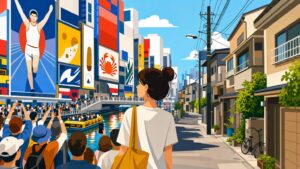
Stroll through Dotonbori. The iconic Glico Running Man sign isn’t just a tourist photo backdrop; it’s part of the urban stage that locals embrace. The fashion in Amemura is more than clothing—it’s a costume. Bold, loud, and meant to be noticed. The restaurant staff yelling `irasshaimase!` (welcome!) aren’t just greeting customers; they’re performing, competing with neighboring restaurants to be the loudest and most enthusiastic.
Interactions here are performative as well. Bartenders engage in witty banter, sometimes gently teasing their patrons. Strangers at the bar freely share opinions, ask where you’re from, and draw you into their conversations. The “fourth wall” is constantly broken. You’re not a passive observer of the city’s nightlife but an active participant, whether you planned to be or not. This can feel overwhelming to some but fosters a communal energy and shared experience unique to Osaka. The aim is to entertain and be entertained, to laugh and connect, even if only briefly.
Tokyo’s Curated Cool: The Art of Anonymity
Tokyo boasts an undeniable world-class cool, but of a different kind. It’s less about loud performance and more about refined self-expression. The streets of Shibuya and Harajuku are famous for fashion tribes, but the goal often centers on signaling membership within a subculture and perfecting a particular aesthetic. It’s a quieter, more introspective form of expression. The focus is on looking the part rather than playing a role for others.
Public spaces in Tokyo function on a stronger principle of civil inattention and anonymity. People generally keep to themselves. The energy is one of collective movement but not collective interaction. Surrounded by millions, you can still feel completely alone, which can be both freeing and isolating. Striking up a random conversation with a stranger in a crowded Tokyo bar is rare and might be seen as an intrusion on their private time.
This doesn’t mean Tokyo is cold or unfriendly; it’s simply more reserved. Social connections tend to be structured, occurring within established groups of friends or colleagues. The city serves as a stunning, immaculate backdrop to your night rather than a chaotic stage thrust upon you. The performance lies in the careful curation of your outfit, choice of venue, and Instagram story. It’s a more controlled, polished, and ultimately modern form of urban expression. In Osaka, you shout to be heard over the noise; in Tokyo, you cultivate a vibe that speaks for itself.
Navigating the After-Hours: The Last Train Dilemma
Nothing dictates the pace of a Japanese night out quite like the dreaded last train, the `shuuden`. It’s the midnight curfew that transforms princes into pumpkins and scatters revelers. How each city’s inhabitants handle this nightly deadline reveals much about their distinct nightlife philosophies.
The Osaka “Walk of Shame” is Simply a Walk Home
To be clear: Osakans rely on their train system just as much as anyone else. But missing the `shuuden` in Osaka is often not the disaster it is in Tokyo. The city’s compact layout offers an essential safety net. Because Minami, the core nightlife district, is close to many residential neighborhoods, staying out too late carries far fewer consequences.
If you live inside the Osaka Loop Line, taking a taxi from Namba won’t force you to remortgage your apartment. For many younger residents of central wards, a long walk or a determined bike ride home is a viable, if somewhat tiring, backup plan. This creates a powerful psychological effect: the night doesn’t have a strict cutoff. The fear of being stranded is considerably lower.
This absence of “last train anxiety” plays a major role in Osaka’s relaxed, spontaneous atmosphere. It’s why “just one more drink” is a common refrain. People are less likely to glance at their watches every few minutes after 11:30 PM. The evening can unfold more naturally, ending when the fun does, not when the train timetable demands. This freedom fosters serendipitous encounters and late-night adventures that are much harder to find when you’re always racing the clock.
Tokyo’s “Shuuden” Dash: Cinderella’s Curse
In Tokyo, the `shuuden` isn’t a mere suggestion; it’s an ironclad rule. It’s the most powerful force shaping the city’s nightlife. The entire social structure revolves around it. Missing the last train in Tokyo means facing harsh choices: an expensively astronomical taxi ride (a 30-minute trip can easily cost over 10,000 yen), a night spent in the neon-lit limbo of a karaoke box, or booking a capsule hotel or manga café.
This reality influences every decision. From about 11 PM onward, the evening becomes a countdown. Conversations are cut short with hurried goodbyes like, “Sorry, I have to catch the Chuo Line!” Groups break up in a frantic, synchronized rush toward station entrances. Watching the mass exodus from Shinjuku or Shibuya Station just after midnight is a spectacle itself—a human tidal wave driven by sheer logistical panic.
This inflexible deadline inevitably stifles spontaneity. It’s impossible to fully lose yourself in the moment when part of your mind is constantly running transit calculations. The night’s structure is rigid. There’s a clear endpoint, and everything must conclude before it arrives. While this efficiency keeps Tokyo running smoothly during the day, at night it stands as a formidable obstacle to genuine, carefree celebration.
What Foreigners Often Misunderstand
When outsiders compare the nightlife of these two cities, they often rely on easy clichés and stereotypes. They describe Osaka’s grit as “rough” or assume Tokyo’s vastness means it’s uniformly sophisticated. In reality, things are much more nuanced and intriguing.
Myth: Osaka is “Rough” and Tokyo is “Safe”
A common stereotype is that Osaka, especially the Minami area, feels a bit sketchy or dangerous, while Tokyo is seen as a model of polished safety. This view fundamentally misinterprets the cultural landscape. Osaka’s “roughness” reflects a lack of pretension, not a lack of safety. It’s loud, chaotic, and people are refreshingly direct. The streets might not be as immaculate as Tokyo’s Marunouchi, but the atmosphere is overwhelmingly welcoming.
The perceived grittiness is a feature, not a flaw. It stems from a city that values function over form, and having a good time over perfect aesthetics. You might find yourself in a grimy building down a dark alley in a bar that hasn’t been updated since the 1970s, yet have the best night surrounded by some of the friendliest locals.
On the other hand, while Tokyo is generally very safe, certain nightlife districts can pose challenges, especially for foreigners. Touts in Shinjuku’s Kabukicho or parts of Roppongi can be aggressive and predatory in ways Osaka rarely sees. Their approach often involves luring tourists and expats into bars with promises of cheap drinks, only to hit them with absurdly inflated bills. The “danger” in Tokyo tends to be more targeted and financial—a polished scam rather than a messy, good-natured brawl.
Myth: Osaka is Just for Laughs and Takoyaki
Another widespread misconception is that Osaka’s nightlife is unsophisticated—a one-note mix of cheap beer, fried food, and loud jokes. While the city embraces its reputation as the capital of `kuidaore` (eating oneself into bankruptcy) and comedy, this cliché overlooks the remarkable depth and diversity of its scene.
Osaka’s charm lies in offering everything, often on the same street. You’ll find world-class, quiet cocktail bars run by master mixologists just steps away from standing-room-only spots serving 200-yen beers. There are elegant vinyl bars where DJs spin rare groove, chic wine bars, and a vibrant underground music scene that is much less commercialized than Tokyo’s. The key difference is that these varied venues are not confined to separate districts. The highbrow and the lowbrow, the refined and the raucous, all coexist within the same lively, democratic ecosystem. You don’t need to visit a “fancy neighborhood” for a classy drink—just walk down a different alley. In Osaka, you can have it all at once, without ever needing a train pass.