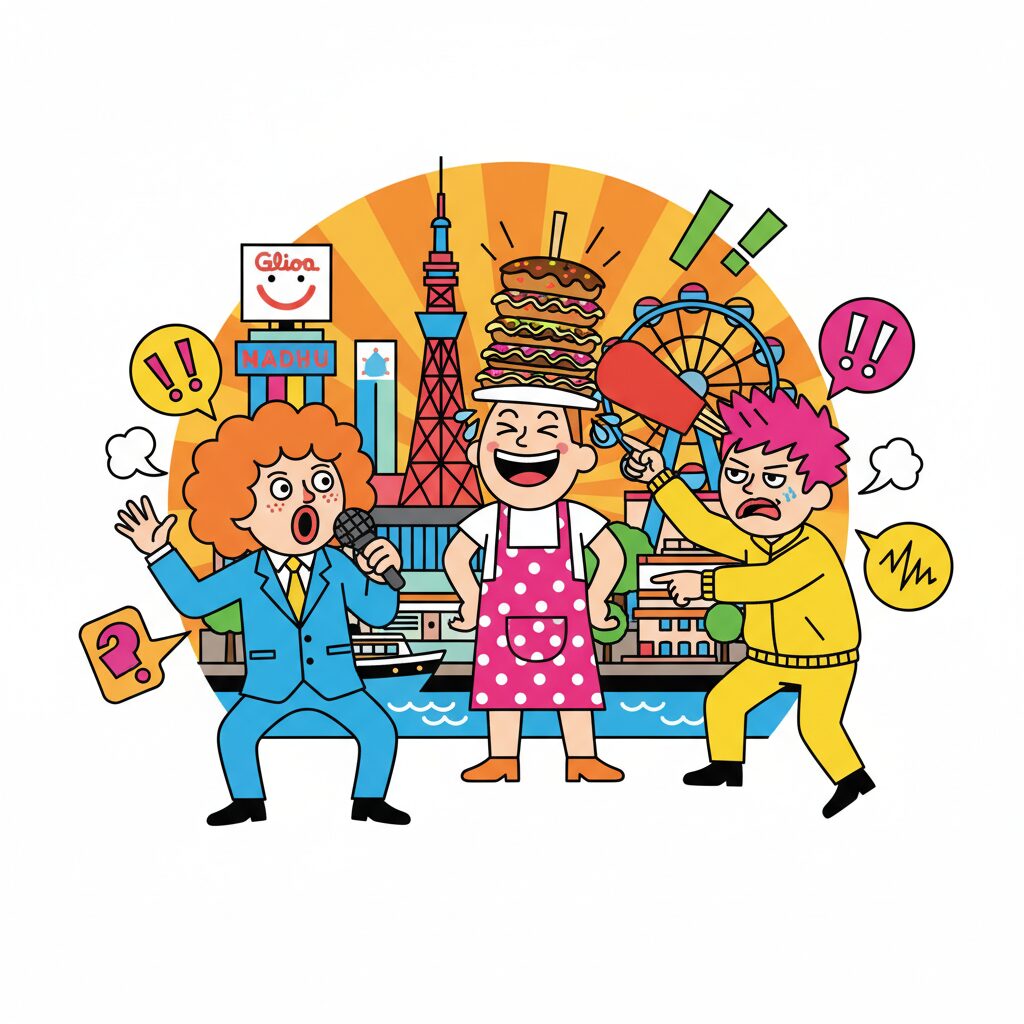
I remember my first week in Osaka. I was standing in front of a tiny, steaming takoyaki stand tucked into a corner of the Tenjinbashisuji Shotengai, the longest covered shopping arcade in Japan. The air was thick with the savory smell of grilled octopus and dashi, the clatter of the takoyaki picks, and a wall of sound I couldn’t yet decipher. The owner, a man with a weathered face and a mischievous glint in his eye, expertly flipped the spheres of batter. I pointed, held up one finger, and said my best, most practiced “Hitotsu, kudasai.” One, please.
He stopped, looked at my very obviously foreign face, then at the single takoyaki boat, and said in a deadpan voice, “Hyaku man en.” One million yen. I froze. My brain short-circuited. Did I mishear? Was this some kind of tourist trap? Was I about to be scammed over a ball of fried octopus? I just stared, mouth agape, a cocktail of confusion and panic bubbling in my chest. After a beat of perfect comedic timing, his face cracked into a huge grin, the woman next to me erupted in a hearty laugh, and he handed me the takoyaki, saying the actual price, a few hundred yen. He then winked and said, “O-ni-san, kao, makka ya de.” “Your face is bright red, big brother.”
That was my baptism by fire into the world of Osaka communication. It wasn’t rude. It wasn’t a scam. It was an invitation. An invitation to play, to engage, to not take life so seriously. This city, I quickly learned, doesn’t just run on trains and electricity; it runs on banter. It’s a place where conversation is a contact sport played with a smile, where humor is the local currency, and where the line between a stranger and a friend is as thin as a sheet of nori. For anyone coming from the polite, reserved, and often silent social landscape of Tokyo, or indeed from many Western cultures, Osaka can feel like landing on another planet. It’s a place where the unwritten rules of Japanese social interaction are not just bent, but gleefully snapped in half and tossed into the Dotonbori canal. This isn’t your textbook Japan. This is Osaka, and learning to talk here is about learning to dance.
This unique communication style, rooted in Osaka’s distinctive waarai culture, even influences modern professional environments like remote work.
Beyond ‘Konnichiwa’: The Unspoken Rules of Osaka Chatter
Your initial experiences in Osaka may leave you questioning whether you’ve completely misunderstood everything you believed about Japanese culture. The carefully maintained walls of politeness, deference, and hesitation seem to dissolve here. In their place emerges a lively, direct, and remarkably warm style of interaction that can feel overwhelming until you learn its unspoken rules.
The Foundation: It’s a Performance, Not a Confrontation
The most crucial thing to understand about communication in Osaka is that it is performative. Every exchange, whether buying groceries or ordering a beer, can turn into a brief, improvised scene. The teasing, playful barbs, and exaggerated complaints aren’t expressions of hostility. Quite the contrary—they indicate that the other person sees you, acknowledges you, and seeks to connect with you on a human level, even if only for thirty seconds.
This way of interacting is deeply embedded in Osaka’s history as the nation’s kitchen and main commercial center. For centuries, it was a city of trade, where deals weren’t made in silent, formal boardrooms but in lively marketplaces. Success demanded sharp wit, charm, and the ability to build rapport instantly. People had to size each other up, elicit laughter, and earn trust within minutes. That spirit endures; it has simply shifted from the rice markets to store counters and izakaya bars. Sharing a laugh has always been, and still is, the quickest way to forge a connection. When the takoyaki vendor joked with me, he wasn’t trying to intimidate. He was testing—seeing if I could take a joke and was open to the local rhythm. Laughing or even offering a clumsy witty reply signals that you get it—you’re willing to join the performance.
The Currency of Laughter
In Tokyo, social currency often comes from politeness, proper etiquette, and recognizing social hierarchies. In Osaka, laughter is the main currency. The goal of many conversations isn’t merely exchanging information but eliciting a chuckle, a grin, or a hearty laugh. A successful interaction leaves both sides smiling. That’s why conversations can suddenly veer into the absurd and then whip back with dizzying speed.
Once, while waiting at a local clinic, an elderly man nearby was loudly complaining, but with a theatrical flair, about his bad knee. He wasn’t simply saying it hurt—he was announcing to the whole waiting room that his knee intended to secede and form its own tiny, painful nation. The receptionist, without missing a beat, called back from behind her desk, “Well, if it does, make sure it pays its health insurance premiums!” The room erupted in laughter, and the usual tension of the clinic waiting room lifted. The man’s pain was real, but the way he expressed it—and the receptionist’s quick reply—turned a moment of personal misery into one of shared humor and community. That is Osaka in a nutshell. Humor isn’t just for jokes; it’s a living tool—a way to transform the mundane into entertaining and the difficult into bearable. To miss this is to miss the true essence of the city.
Deconstructing the Duet: ‘Boke’ and ‘Tsukkomi’ in the Wild
If you’ve ever watched Japanese comedy, you’ve probably come across the concept of ‘manzai’, a traditional stand-up style featuring two performers. One is the ‘boke’, the funny character who says or does something foolish, absurd, or out of place. The other is the ‘tsukkomi’, the straight man who responds with a sharp, witty, and often physical retort, highlighting the absurdity. It’s important to know that in Osaka, ‘manzai’ isn’t just a stage act. It takes place all day, every day, on every street corner. The ‘boke’ and ‘tsukkomi’ dynamic forms the fundamental rhythm of conversation.
What exactly are ‘Boke’ and ‘Tsukkomi’?
Let’s break it down. The ‘boke’ (from the verb ‘bokeru’, meaning to be senile or air-headed) is the one who creates comedic tension. They are the agent of chaos. They might pretend to be ignorant, make a ridiculous pun, or exaggerate wildly. Their role is to throw a verbal curveball, disrupting the normal flow of conversation with absurdity. The takoyaki vendor claiming his product cost a million yen was a perfect ‘boke’ moment, creating a surreal, nonsensical tension.
The ‘tsukkomi’ (from the verb ‘tsukkomu’, meaning to thrust or poke into) is the one who resolves that tension. They act as the voice of reason, the audience’s surrogate, calling out the ‘boke’s foolishness. Their retort is the punchline. It validates the joke and brings the conversation back to reality, even if only briefly. The classic ‘tsukkomi’ phrase you’ll hear countless times a day in Osaka is “Nande ya nen!”, which roughly means “Why?!” or “What the heck?!” or “No way!” It’s the verbal slap that completes the comedic exchange.
This dynamic is a continuous give-and-take. It’s a cooperative effort to create shared humor. One person sets up the joke (‘boke’), and the other knocks it down (‘tsukkomi’).
Spotting the ‘Boke’ in Everyday Life
Once you know what to watch for, you’ll notice ‘boke’ moments everywhere. They’re a constant part of the city’s soundscape. Here are some classic examples you’re almost certain to encounter:
- The Price Gag: Like my takoyaki experience, this one’s common. You ask the price, and the shopkeeper quotes an astronomical or ridiculously low amount with a completely straight face. The goal is to see your reaction.
- The Deliberate Misunderstanding: You might ask for directions to the station, and someone points to a tiny police box and says, “There it is. The trains are very small today.” They’re playing with you, waiting for you to catch on.
- The Absurd Exaggeration: If it’s a little hot outside, an Osakan might say they’re melting into a puddle and will need to be mopped up and sent home. If they have a tiny papercut, they might claim they’re bravely fighting for their life.
- The Feigned Ignorance: You could be wearing a bright red shirt, and a friend or colleague might look closely and ask, “Are you feeling okay? You look a bit blue today.”
These aren’t meant to deceive or confuse maliciously. They’re playful provocations, conversational hooks designed to draw you into the game. The ‘boke’ is offering you a chance to play the ‘tsukkomi’.
Your Role as the ‘Tsukkomi’ (or How to Keep Up)
So, how do you respond when a ‘boke’ is thrown at you? This is where many foreigners falter. The instinct, shaped by Western conversational norms, might be to politely correct them, get flustered, or simply fall silent in confusion. These reactions, while understandable, effectively kill the joke and halt the performance.
Your role is to be the ‘tsukkomi’. You need to fire back a retort. This doesn’t mean you have to have the lightning-fast wit of a pro comedian. The beauty of the system is that even a simple, predictable ‘tsukkomi’ is appreciated. It shows you’re playing along.
When the shopkeeper says, “One million yen,” you shouldn’t just stand there. You respond:
- “Meccha takai yan!” (That’s way too expensive!)
- “Honma ka?!” (Really?! Are you serious?!)
- The classic: “Nande ya nen!” (No way!)
- Even a simple laugh and “You’re crazy!” in English works fine.
The key is energy. A ‘tsukkomi’ should be delivered with some force and mock outrage. It’s a sharp, percussive beat following the ‘boke’s setup. A flat, quiet response feels anticlimactic. Think of it less as a sentence and more as a sound effect signaling “I get the joke!”
Don’t hesitate to use your hands. A light, open-palmed chop in the air while speaking is classic ‘tsukkomi’ body language. You’re not expected to be a natural. Just trying, showing that you understand the rhythm, earns instant respect and affection. It signals that you’re not just a tourist passing through but someone making an effort to grasp the local culture on its own terms.
The Masters of the Craft: Conversations with the Osaka ‘Obachan’
If the ‘boke’ and ‘tsukkomi’ interplay is the grammar of Osaka conversation, then the ‘obachan’ (a familiar term for a middle-aged or older woman) stands as its greatest living poet. The Osaka obachan is a cultural institution, a force of nature who embodies the city’s spirit of directness, pragmatism, and irrepressible warmth. Encounters with them are an essential part of daily life here, and understanding them is crucial to understanding the city.
The Queen of the ‘Shotengai’
Imagine this: a woman, likely in her 60s or 70s, sporting a tight perm in a hue not found in nature, perhaps purple or a soft orange. She’s probably dressed in something with a bold animal print, most likely leopard. She rides a bicycle with a basket up front, weaving through the crowded shopping arcades (‘shotengai’) with the terrifying precision of a fighter pilot. She speaks loudly, laughs even louder, and carries herself with complete and utter lack of inhibition. This is the Osaka obachan in her natural environment.
She is both the guardian of local knowledge and enforcer of social norms, all while being the first to break them with a bawdy joke. A conversation with an obachan is rarely a simple exchange; it’s an event. She will approach you without hesitation, especially if you look lost or foreign. The questions come quickly and directly: “Where are you from?” “What are you doing here?” “Are you eating properly?” “You’re too skinny!” “Are you married yet?”
For outsiders, this can feel intensely intrusive. In many cultures, asking such personal questions of a stranger would be considered highly rude. But here, you need to shift your perspective. It’s not nosiness; it’s inclusion. In her eyes, you are in her neighborhood, her city. Therefore, you are, to some extent, her responsibility. Her questions are her way of assessing your situation and figuring out if you need help. In her own unique way, she is welcoming you into the community. The questions serve as a shortcut to familiarity.
The ‘Ame-chan’ Protocol
One of the most endearing and defining traits of the Osaka obachan is her relationship with ‘ame-chan’ (a cute term for ‘ame’, or hard candy). It’s an unwritten rule that every obachan carries a stash of candy in her purse at all times. This candy isn’t just for herself. It’s a social tool, a universal peace offering, a small act of kindness shared with anyone and everyone.
You’ll receive candy from an obachan at the fruit stand, the woman sitting next to you on the bus, or the neighbor you’ve just met. It often follows a short conversation, a small thank you for a minor favor, or sometimes for no reason at all. It’s a tangible expression of the city’s desire to connect.
The protocol is simple: you must accept it—graciously. Refusing the ‘ame-chan’ is like refusing a handshake. You smile, say “Arigato gozaimasu,” and take the candy. It’s a token of goodwill. This small gesture is a microcosm of Osaka’s social philosophy: life is better when we share, when we look out for one another, even in the smallest ways. That tiny piece of candy is a reminder that you belong to a community, not just blend into the crowd as an anonymous face.
Decoding Obachan-speak: Directness as a Form of Care
The obachan’s directness can be the toughest aspect for foreigners to interpret. A comment like, “That shirt is very… colorful. Are you going to a festival?” or “You look tired today, you should get more rest,” may feel like sharp criticism. But more often than not, these remarks come from a place of genuine, if unfiltered, concern.
Think of it as the communication style of a pragmatic, no-nonsense grandmother. She doesn’t have time for the subtle, indirect pleasantries you might find in Kyoto or Tokyo. She sees a problem and states it plainly. In her mind, she’s helping you. Noticing that you look tired is her way of telling you to take better care of yourself. Commenting on your flamboyant shirt is her way of engaging with you and your choices. This is a world apart from the Tokyo ideal of ‘tatemae’ (the public facade), where one would rarely make such a direct personal comment. In Osaka, this bluntness is a form of ‘honne’ (one’s true feelings), offered as a sign of intimacy. She’s not treating you like a fragile stranger; she’s treating you like family, someone you can say anything to. The key is to hear the warmth underlying the words, not just the seemingly critical surface.
From the Supermarket to the Izakaya: Where Banter Happens
This distinctive style of communication isn’t limited to special events or close friends; it permeates every aspect of everyday life. The boundary between a commercial transaction and a social interaction is delightfully, chaotically blurred. You’re expected to engage as a participant, not just act as a consumer.
The Cash Register Comedy Club
Shopping at a local supermarket in Osaka offers a vastly different experience compared to Tokyo. In Tokyo, the cashier embodies quiet efficiency: the transaction is fast, silent, and anonymous. You might hear a whispered “arigato gozaimashita” at the end, but that’s typically all.
In Osaka, the checkout line transforms into a stage. The cashier, often someone who’s worked there for decades and knows everyone, plays the master of ceremonies. They’ll comment on your purchases: “Ooh, nabe tonight? It’s getting chilly, isn’t it?” “Wow, plenty of beer! Throwing a party?” “Ah, you picked the good beef. Celebrating something special?” They’ll notice if you’re fumbling with your coins and say, “Take your time, take your time! The money won’t run away!” They might make a joke with the person behind you about how long you’re taking. It’s never mean-spirited; it’s inclusive. For that moment, the three of you become a small community, sharing a laugh over the minor hassle of counting yen.
At first, this can feel uncomfortable. You might worry about being judged or feeling spotlighted. But soon you realize it’s quite the opposite. It’s a gesture of recognition. You aren’t just another customer; you’re a person buying food for a party, and they’re acknowledging and sharing in that little moment of your life. The expected response is to join in. “Yes, a party for one!” or “Gotta stay warm somehow!” A simple smile and nod are also perfectly fine.
The ‘Izakaya’ Counter: The Ultimate Proving Ground
For a true taste of Osaka’s communication heart, find a small, counter-style ‘izakaya’ (a Japanese-style pub) in areas like Tenma or Kyobashi. This is the advanced level. Here, the ‘taisho’ (the owner/chef) acts as the conductor, and the customers at the counter form the orchestra. The moment you take a seat, you become part of the ensemble.
The taisho will almost certainly start a conversation, asking where you’re from and what you do. The regulars next to you will lean over to join in. Soon, conversations flow up and down the counter. Jokes are made at the taisho’s expense, which he returns with mock grumpiness. Customers recommend dishes to one another, creating a communal dining atmosphere.
This is where the concept of ‘nori’ (ノリ) becomes essential. ‘Nori’ is a tricky word to translate directly, but it essentially means the vibe, the mood, or the flow of a social situation. To have good ‘nori’ (‘nori ga ii’) is to be able to sense the atmosphere and add positively to it. If the mood is light and playful, you should be light and playful. If the taisho cracks a self-deprecating joke, you laugh along. If the customer beside you offers a taste of their dish, you accept enthusiastically. Having bad ‘nori’ means being oblivious or insensitive to the shared mood—staying quiet and dour when everyone else is laughing or being loud and obnoxious when the mood calls for subtlety. In an Osaka izakaya, good ‘nori’ is everything. It’s about being present, open, and willing to join the communal experience. It’s the final ingredient that transforms an ordinary meal into an unforgettable night of connection and laughter.
The Osaka vs. Tokyo Communication Divide
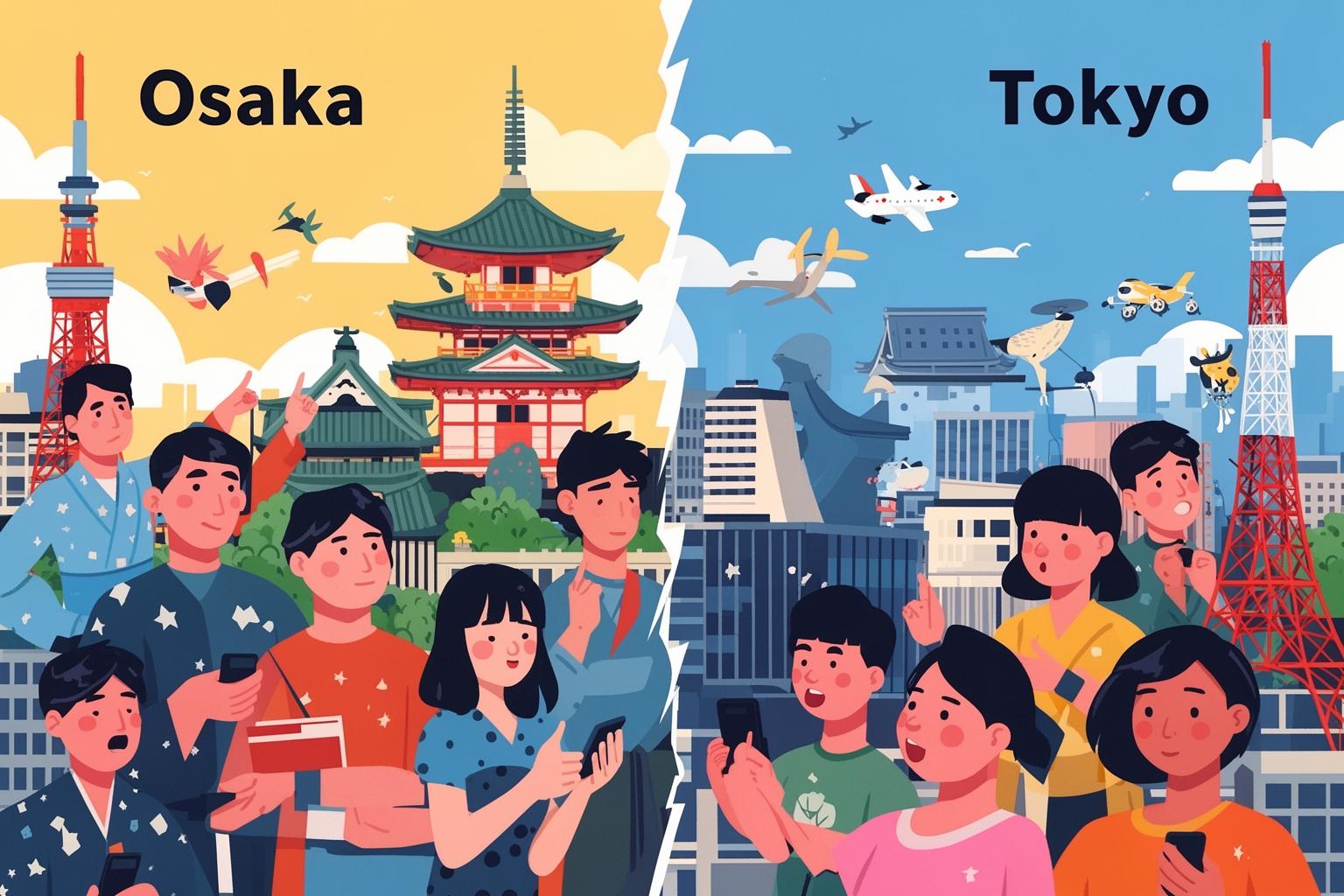
To truly grasp the distinctive flavor of Osaka’s social life, it helps to have a point of reference. And in Japan, the ultimate point of comparison is always Tokyo. These two cities embody opposite ends of the Japanese social spectrum, and this contrast is most evident in the way people communicate with one another.
Direct Hits vs. Reading the Air
Tokyo’s communication culture centers on the concept of ‘kuuki wo yomu’, which literally means “to read the air.” It is the skill of understanding what is left unsaid. It involves sensing the atmosphere, noticing subtle signals, and speaking in a manner that maintains group harmony (‘wa’). Conversations tend to be indirect, filled with politeness and ambiguity. The most crucial points are often left unstated, conveyed through context and nuance. To communicate effectively in Tokyo is to be adept at reading between the lines.
Osaka discards this entire approach. Here, communication is direct and straightforward. People usually say exactly what they think, though often with a humorous twist. The focus is not on what remains unsaid, but on the lively and energetic exchange of words. An Osakan might view Tokyo’s style as cold, distant, and frustratingly vague. Conversely, a Tokyoite may perceive Osaka’s style as loud, blunt, and somewhat lacking in subtlety. They represent two different languages spoken within the umbrella of “Japanese.”
In Tokyo, if you make a small mistake at work, your boss might say, “Perhaps we could consider a different approach next time.” It’s gentle, indirect, and helps save face. In Osaka, however, your boss is more likely to give you a hearty slap on the back and say, “You really messed that up, didn’t you! Don’t do it again! Now, let’s go for a drink.” Though the intention behind both responses is the same—to correct the error—their delivery worlds apart. The Osaka style uses humor and directness to quickly clear the air and move forward, while also strengthening personal bonds.
“Why Are You Laughing?” – The Misunderstanding
This fundamental difference leads to many misunderstandings, especially among foreigners. In numerous cultures, direct teasing signals aggression or bullying. Laughter can be used to mock or exclude. Therefore, when a stranger in Osaka begins playfully teasing you, your instinct might be to become defensive. Why is this person laughing at me? Why are they pointing out my flaws?
You must consciously flip your perspective. In Osaka, being teased means being included. It shows that the other person feels comfortable enough to break down formal barriers. They see you not as a fragile outsider, but as a sturdy insider capable of handling some friendly banter. The laughter is not directed at you; it is an invitation to laugh with them. A silent, unresponsive attitude is seen as a refusal of this invitation, creating awkwardness that the original joke was meant to prevent.
The silence of a Tokyo train reflects respectful consideration for others. The lively chatter and laughter on an Osaka train signal a community in motion. Neither is better; they are simply profoundly different. Your enjoyment of life in Osaka depends on your willingness to embrace the latter.
A Tale of Two Taxis
Picture this final scene. Imagine taking a taxi in Tokyo. The driver’s seat is wrapped in plastic. The driver, wearing white gloves, politely confirms your destination. The ride is quiet, apart from the hum of the engine and the occasional voice of the GPS. The transaction at the end is efficient and formal. It’s a seamless, functional, and completely impersonal experience.
Now, take a taxi in Osaka. The driver, often a talkative man in his late sixties, will likely strike up a conversation before you’ve even closed the door. “Where are you headed? Oh, Namba! Going for a wild night out, huh? Where are you from? The UK! Ah, the Beatles! I love the Beatles!” He’ll inquire about your job, your family, your thoughts on the Hanshin Tigers baseball team. He might even offer you a piece of his ever-present ‘ame-chan’ candy. By the end of the fifteen-minute ride, you will know his life story, and he will know quite a bit about yours. The ride becomes more than just a service; it’s an interaction and an opportunity for human connection, however brief. That, right there, is the difference.
How to Navigate and Thrive in Osaka’s Social Sea
So, you’ve chosen to live in this chaotic, warm, and wonderfully quirky city. How do you transition from being a bewildered onlooker to an engaged participant? How do you navigate this sea of banter without feeling overwhelmed? The good news is, the entry bar is surprisingly low.
You Don’t Have to Be a Comedian
Let’s be clear: no one expects you to suddenly master the comedic timing of a ‘manzai’ star. You don’t need to be fluent in the Kansai dialect or possess a repertoire of clever comebacks. The most important trait isn’t wit, but willingness. A willingness to be open. A willingness to be playful. A willingness to laugh, both with others and at yourself.
When the ‘boke’ comes your way, your ‘tsukkomi’ doesn’t have to be flawless. A simple smile and a shake of the head will do. A laugh and a casual “No way!” in English is perfectly understood. It’s the effort that matters. Showing that you’re aware of the game being played is 90% of the challenge. Your participation, however awkward, is a compliment. It signals to the other person that you see them, you hear them, and you appreciate their way of connecting.
The Golden Rule: Assume Good Intentions
If I could offer just one piece of advice for navigating life in Osaka, it would be this: always, always assume good intentions. When someone is blunt, assume they mean to be clear and helpful, not rude. When someone teases you, assume they’re being friendly, not hurtful. When someone asks personal questions, assume they want to connect, not pry. When someone laughs, assume it’s an invitation to share their joy, not to make you the butt of a joke.
This mindset is the key to unlocking the city. If you approach every interaction defensively, you’ll be constantly confused and offended. But if you meet every encounter with an open heart and the assumption of kindness, you’ll find that kindness returned a thousandfold. You’ll discover a city that isn’t just superficially friendly, but genuinely invested in the human connections that shape daily life.
Embracing the ‘Nori’
Ultimately, living in Osaka means embracing the ‘nori’—learning to go with the flow. Don’t overthink every exchange. Don’t stress about saying the perfect thing. Just be present. Listen. Laugh. Join in when you can. When the fruit vendor spins a tall tale about watermelons raised listening to classical music, just smile and ask if they prefer Mozart or Beethoven. Play along. The interaction itself is what matters.
This city rewards participation. It invites you to step out from behind the wall of polite reserve and engage with the world around you. It can be exhausting, it can be confusing, but it’s never, ever boring. By learning the rhythm of its conversations—the playful ‘boke’, the sharp ‘tsukkomi’, the warm directness, the shared laughter—you don’t just learn the language of Osaka. You learn the language of its heart.