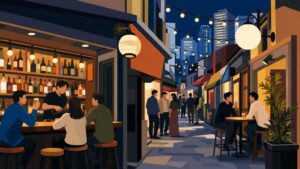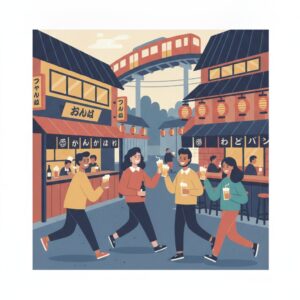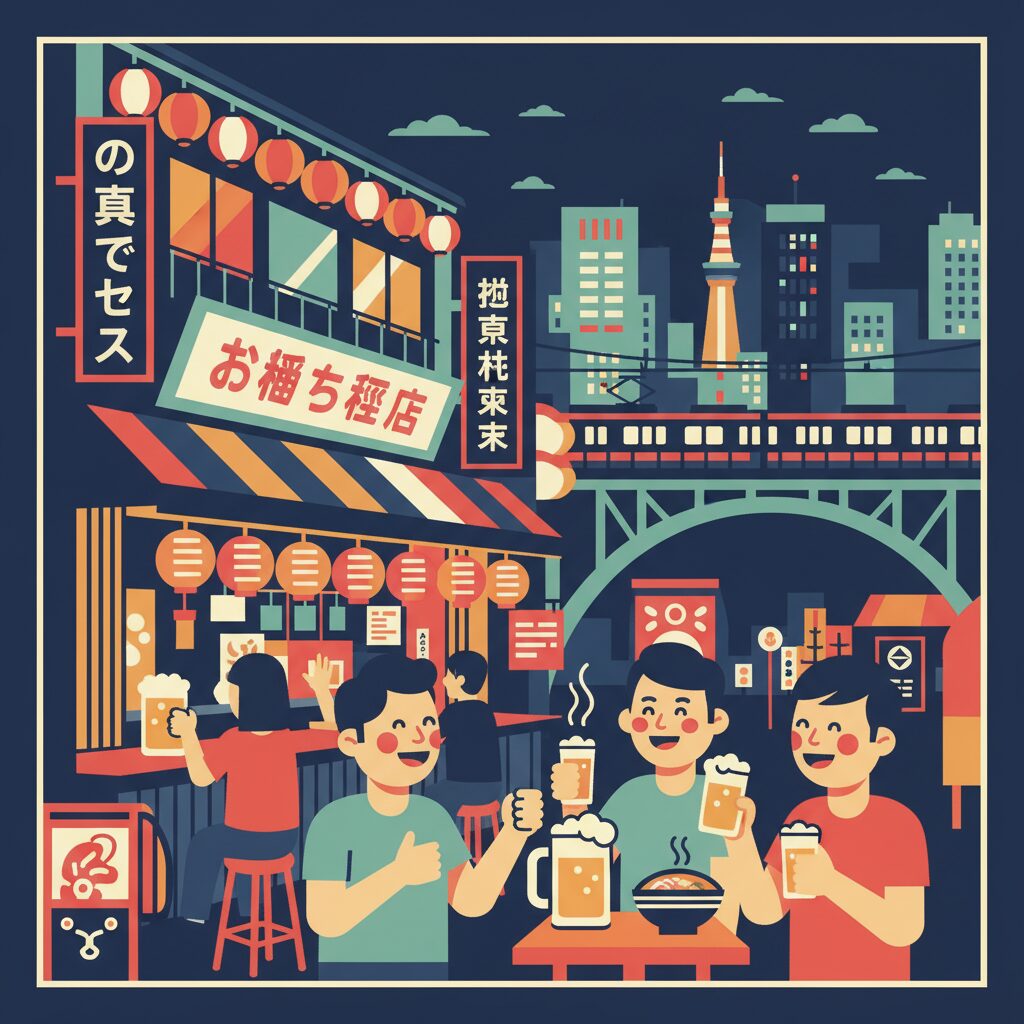
You hear the noise before you see it. A low, rolling thunder of chatter, clanking plates, and laughter that spills out from under the train tracks and into the night. This isn’t the curated, neon-slick nightlife of Namba or the polished corporate corridors of Umeda. This is Tenma. A sprawling, chaotic maze of tiny bars, standing-only counters, and street-side tables clustered around one of Osaka’s oldest markets. For the uninitiated, it can feel like sensory overload, a bewildering jumble of red lanterns, handwritten menus, and smoke wafting from a hundred different grills. The question that hangs in the air, thick as the smell of yakitori, is simple: why here? Why do Osakans, from salarymen in crisp suits to young couples on a date, cram themselves into these tiny, sometimes grimy, always loud establishments? The answer isn’t just about cheap beer. To understand the rhythm of a night out in Tenma is to pull back the curtain on the operating system of the Osaka psyche. It’s a lesson in the city’s economics, its social contracts, and its deep-seated belief that a good time shouldn’t come with a high price tag or a long list of rules. This isn’t a guide to the best bars. This is a field guide to the people who fill them, an exploration of how a night of bar-hopping—or hashigo-zake, as it’s known—reveals the raw, unfiltered, and beautifully complex character of daily life in Osaka.
If you need a quieter, more focused atmosphere during the day, you can explore the best work-friendly cafes in Tenma.
The Unspoken Rules of the Hashigo-Zake Gauntlet
Stroll through Tenma on a Tuesday night and you’ll notice it—the constant movement. People aren’t settling down for the night; they’re drifting from one brightly lit doorway to another. This fluid, nomadic drinking style is called hashigo-zake, which literally means “ladder drinking,” hopping from one bar to the next as if climbing rungs. It’s more than just a fun pastime; it’s a core social philosophy here, guided by unwritten rules that distinguish locals from tourists. Learning this rhythm is the key to truly understanding Osaka’s social scene, a world apart from the planned, reservation-heavy culture typical in other parts of Japan.
Rule One: Commitment is a Curse
In Tokyo, a night out often starts with a reservation. You choose a place, book it for a specific time, and commit. The group arrives, settles in, and often stays for hours, gradually working through the menu. This is known as ippon-shōbu—a one-shot deal. Tenma operates on the exact opposite principle. Here, sticking to one venue all evening is viewed as a rookie error, a lack of imagination. Why confine yourself to a single kitchen when a dozen others, each specializing in something different, are just a few steps away?
The flow is sacred. You slip into a tiny sushi bar, with maybe six stools crammed around a counter. You order a beer and a few pieces of whatever the chef recommends, signaling freshness. You eat, drink, pay. The whole visit might last just twenty minutes. Then, you step back onto the street, eyes searching for the next spot—maybe a tempura stall with impossibly light batter, or grilled oysters plucked straight from the tank. The goal isn’t to find one perfect place, but to weave together a series of good-enough moments into a memorable night. This reflects a core Osaka trait: a restless pursuit of value and variety. It’s an almost obsessive need to explore options, ensuring the best possible experience for your time and money. It’s not about being flaky; it’s about being an engaged, discerning consumer of the night. You’re a curator, not just a customer.
Rule Two: Space is Social, Not Personal
Your first impression of a classic Tenma tachinomi (standing bar) may be one of intense discomfort if you’re used to Western ideas of personal space. These places are small. Extremely small. You stand shoulder to shoulder with strangers, elbows almost touching, your conversation audible to everyone within five feet. No cozy booths, no private tables—only the counter, the crowd, and a shared, palpable energy. What a foreigner might see as a flaw, an uncomfortable design, is actually a defining feature.
The lack of space acts as a social lubricant. It breaks down the barriers usually present between strangers. In a spacious, quiet bar, starting a conversation with the person next to you can feel awkward or intrusive. In Tenma, it’s nearly inevitable and entirely expected. This close proximity creates a temporary, unspoken bond. You’re all part of this crowded, noisy, lively mess together. This is why Osaka is famously “friendly.” It’s not just a vague, feel-good idea—it’s practical, situational friendliness born from shared circumstances. The old man beside you might gruffly point to a dish and mutter, “Try that. It’s good today.” The woman on your other side might laugh at a joke you share with your friend. You’re not just standing next to each other; you’re sharing an experience. This forced intimacy fuels Tenma’s social life, a stark contrast to Tokyo’s more reserved, group-focused izakayas, where invisible walls between tables can feel miles high.
The Economics of a Tenma Night Out: More Than Just Cheap Drinks
It’s impossible to discuss Tenma without mentioning money. The neighborhood is renowned for being incredibly affordable—a place where a memorable night out won’t drain your wallet. However, to simply label it as a “cheap” area misses the point entirely. Tenma’s financial culture exemplifies the Osakan passion for kosupa, or cost performance. It’s not about spending as little as possible; it’s about maximizing quality, fun, and satisfaction with every single yen spent.
The Gospel of “Senbero”
Signs advertising Senbero are scribbled on cardboard or chalkboards outside many bars. The term combines sen en (1,000 yen) with berobero (drunk or tipsy). The offer is straightforward: for about the price of a movie ticket, you can get delightfully buzzed. A typical senbero set might include a draft beer and two side dishes, or perhaps three drinks chosen from a limited menu. While it serves as a clever marketing tactic, it also represents a philosophy, a challenge set by the bar and eagerly embraced by its customers.
For an Osakan, ordering a senbero set isn’t just about saving money—it’s a game. Does this place live up to its promise? Is the beer cold? Are the skewers cooked properly? Is the portion size fair? It’s an ongoing, subconscious assessment of value. This mindset stems directly from Osaka’s history as Japan’s merchant capital. For centuries, traders, shopkeepers, and artisans thrived on their skill to negotiate, evaluate quality, and spot a great deal. That commercial spirit runs deep. A Tenma local doesn’t view a 1,000 yen set as a mere cheap thrill but as a savvy transaction. They admire the efficiency, transparency, and straightforward value. It’s a rejection of the frills and inflated prices common in trendier districts. In Tenma, you pay for the food and drinks—not the ambience or brand.
Why Cash is Still King in the Alleyways
While much of Japan gradually adopts digital payments, Tenma’s narrow alleys remain firmly anchored in the tangible world of cash. Many of the smallest and most compelling spots accept only cash. This isn’t due to resistance to technology; rather, cash complements the hashigo-zake style perfectly. The process is simple and immediate: order, receive your food, place your money on the tray, and collect your change. The transaction is done—no waiting for card machines, no awkward splitting of the bill.
This cash-based, pay-as-you-go system is what keeps Tenma’s nightlife flowing smoothly. Leaving a bar is as seamless as entering it. When you’re ready to move on, you’re not held back by an open tab. You can finish your drink, pay your small bill, and vanish into the night. This straightforwardness is quintessentially Osaka—practical, efficient, and free of unnecessary ceremony. The clink of coins on a plastic tray marks the end of one brief chapter of the evening and clears the way for the next. It emphasizes the transient, moment-to-moment nature of the experience, maintaining high energy and constant movement.
Reading the Room: The Language and Logic of a Tenma Bar
Approaching a busy counter in Tenma for the first time can feel intimidating. There’s a flow to the service—a shared language of gestures and brief phrases that keeps everything moving swiftly. There’s no hand-holding here. The staff are often juggling a dozen orders simultaneously, expecting a certain level of awareness from their customers. Grasping this unspoken system is essential to feeling like a participant rather than just an onlooker.
The Art of the Quick Order
Menus in Tenma often appear as strips of paper pasted to the wall, written in hurried calligraphy. Sometimes, there’s no menu at all. The real selection is what’s displayed in the glass case before you or what you see the person next to you eating. Being able to read the atmosphere and place a quick, decisive order is a prized skill. This is not the place for an extended Q&A with the chef about every ingredient. You look, point, and order: “Kore to, nama bīru hitotsu” (“This and one draft beer”). It’s a system that rewards keen observation and decisiveness.
Hesitation slows everything down. The entire operation depends on speed and flow. Regulars know this instinctively—they walk in, catch the owner’s eye, and shout out their order before fully settling at the counter. It’s a sign of familiarity and efficiency. For newcomers, the best approach is to observe for a moment. Notice what’s popular and what the chef is skillfully preparing. This learning-by-watching reflects how many social skills are acquired in Japan—not through direct instruction, but through careful observation and gradual involvement. The staff’s direct, sometimes blunt, communication isn’t meant to be rude; it suits the environment. In a space this loud and busy, clarity and brevity are crucial. They’re not being curt; they’re trying to get your beer to you as quickly as possible.
“Maikai Arigato”: The Currency of Regulars
While Tenma can feel anonymous and chaotic, it’s also a neighborhood built on relationships. These aren’t the overly formal, customer-is-always-right relationships found in department stores. Here, the currency is recognition. After several visits, the owner might give you a slight nod as you enter. They may start pouring your usual drink without prompting. When you leave, they’ll say “maido” or “maikai arigato”—an Osaka phrase meaning something like “thanks, as always.”
This is a different kind of customer service from the polished, scripted omotenashi Japan is known for. It’s more personal, more earned. It’s a quiet acknowledgment that you’re part of the place’s fabric, however small. This recognition may appear subtly—you might get a slightly more generous pour of sake, or the chef might slide a small off-menu dish your way with a “sābisu” (on the house). These aren’t grand gestures but small, human moments that foster a sense of community and belonging. It’s a relationship built on mutual respect and familiarity, not just a commercial transaction. Being a regular in Tenma doesn’t mean visiting every night; it means you understand the rhythm, respect the space, and appreciate the craft of those behind the counter. You’ve demonstrated that you “get it.”
Tenma vs. The World: How Osaka’s Drinking Culture Stands Apart
Every city has its own drinking districts, but Tenma stands apart. It’s not just about the concentration of bars or the cost of drinks. It’s about the underlying philosophy, the very reason it exists. Tenma is a tangible expression of Osaka’s unique cultural identity, a distinction that becomes especially evident when compared to other cities, particularly its long-time rival, Tokyo.
The Tokyo Comparison: Planned vs. Spontaneous
If a night out in a fashionable Tokyo neighborhood feels like a carefully curated playlist, a night in Tenma is more like tuning into a radio scanner. In Tokyo, especially in business or upscale areas, evenings often follow a clear narrative: the main venue, the nijikai (second round), and sometimes the sanjikai (third round), usually planned ahead. Social interactions tend to be more structured and confined to the group you came with.
Tenma is the opposite. It celebrates spontaneity. You don’t visit Tenma with a detailed plan; you go there with an open mind. Your group might split up and come back together. You might strike up a conversation with strangers and end up sharing a bottle of sake. The night unfolds through improvisation, constantly responding to the chances that arise. This mirrors Osaka’s broader character—a city less focused on hierarchy and formality, and more on pragmatism and genuine human connection. The vibe suggests that you don’t need an invitation or reservation to enjoy yourself. You just need to show up and be ready to jump in.
Beyond the “Friendly” Stereotype: A Culture of Mutual Interference
Let’s reconsider the “friendly” stereotype. What outsiders often interpret as friendliness in Osaka is actually a culture of casual interference. It’s both a willingness and an expectation to cross the subtle social boundaries that are carefully observed elsewhere in Japan. In a Tokyo bar, the salaryman beside you would likely never comment on the food you’re eating. In Tenma, he’ll lean over without hesitation and say, “You should add some shichimi pepper; it tastes better that way.”
This can be surprising if you’re not accustomed to it and might feel intrusive. But it arises from a fundamentally different view of public social space. The unwritten rule in much of Japan is to avoid bothering others (meiwaku o kakenai). In Osaka, the rule is more like, “We’re all here, so why not interact?” This “mutual interference” acts as social glue. It’s the woman running the oden stand asking if you’re cold. It’s the group at the next table offering you takoyaki because they ordered too much. It’s a constant, gentle buzz of human interaction that makes you feel part of a living, breathing community. To truly enjoy Tenma, you have to embrace this. You must see a stranger’s comment not as an intrusion, but as an invitation. It’s the city’s way of saying, “We see you. You’re one of us tonight.”
A Practical Guide for the Uninitiated
Understanding the philosophy is one thing; putting it into practice is another. For those ready to dive in, exploring Tenma for the first time calls for a bit of strategy—not a strict plan, but a general approach to help you catch the neighborhood’s unique rhythm and avoid being overwhelmed by the sheer number of choices.
Beginning Your Exploration
Tenma has no single “main street”; instead, it’s a network of interconnected alleys and covered arcades. A smart way to start is near JR Tenma Station. The area directly beneath and around the train tracks is filled with classic tachinomi and grill spots—the bustling core of the scene. Alternatively, you can begin from the Ogimachi side and head north, or stroll through the Tenjinbashisuji Shopping Street and then drift into the smaller lanes branching off it. Timing is key. Although some venues stay open all day, the true energy picks up around 5 PM as workers finish their shifts. Weeknights tend to be a more local experience, perfect for observing daily rituals. Weekends, especially Friday and Saturday nights, turn into a full-on festival, with massive crowds, electric energy, and an intense atmosphere. For first-timers, a weeknight might provide a gentler introduction.
What to Eat, What to Drink, and How to Behave
Tenma’s culinary scene is all about specialization. Instead of one bar that does a little bit of everything, you visit several places, each excelling at one thing. Seek out focused spots: a sushi bar with exceptional fish and little else; a yakitori shop featuring every imaginable part of the chicken on skewers; a kushikatsu joint dedicated to deep-fried delights. Follow the crowds and trust your nose—if a place is packed with locals and smells amazing, it’s likely a safe bet. Don’t hesitate to try dishes you don’t recognize; pointing works universally. For drinks, start with a nama bīru (draft beer)—the standard opener. From there, explore sake, shochu highballs, or whatever the bar specializes in. When it comes to behavior, be a considerate neighbor. Don’t take up a large stretch of counter space if you’re alone. Be aware of how long you linger, especially if there’s a line outside. The spirit here is communal—you have your moment, enjoy it, then make room for the next person. It’s a cycle you help keep flowing.
Tenma is more than just a collection of bars; it’s a living museum of Osaka’s soul. It’s where the city’s commercial history, love of value, impatience with pretense, and deeply communal nature converge in a chaotic, joyful symphony. A night spent hopping from one tiny counter to another is a lesson in the local language of human connection. It shows you that in Osaka, community isn’t cultivated in quiet, reserved spaces—it’s forged in the heart of the crowd, built on a shared love for good food, fair prices, and the simple but profound joy of sharing a drink with the person beside you. Coming to Tenma just for a cheap meal misses the point entirely. Come to listen, to observe, and to join in. Come to realize that life in Osaka isn’t meant to be lived at a distance. It’s meant to be lived up close, shoulder-to-shoulder, in a way that’s loud, a bit messy, and unapologetically human.