The first time it happened, I was utterly baffled. I was standing in a tiny, cluttered shop in the labyrinthine Tenjinbashisuji Shotengai, trying to buy a kitschy, colorful pair of socks. The shop owner, a woman with a magnificent perm and a voice that could cut through steel, looked at my selection, then looked at me, and declared in booming Osaka-ben, “Are you sure? Your face is pretty, but those socks might be too much for you!” I froze. My Japanese was decent, but was this an insult? A fashion critique? A sales tactic? A wave of hot confusion washed over me. Before I could stammer a reply, she let out a hearty cackle, slapped the counter, and said, “Just kidding! They’ll look great! That’ll be 500 yen, sweetie.” And just like that, the tension vanished, replaced by a strange sense of warmth. I hadn’t just bought socks; I had participated in a micro-performance. I had been initiated, just a tiny bit, into the communication culture of Osaka. This city, I quickly learned, doesn’t just run on trains and electricity; it runs on a constant, flowing current of humor, a verbal dance of playful jabs and witty comebacks. It’s a language all its own, spoken in supermarkets, on train platforms, and in government offices. To live in Osaka is to learn the rhythm of this banter, to understand the affectionate sting of a well-timed tsukkomi, and to realize that in this city, a shared laugh is worth more than a thousand polite bows. It’s a world away from the reserved elegance of Kyoto or the polished efficiency of Tokyo, and it’s a place where conversation is a contact sport, played with a wink and a smile.
To truly understand this unique communication style, one must explore the daily rhythms of its commercial heart, as detailed in this article on navigating work and life in Osaka’s Semba district.
The Art of the Comeback: Understanding Tsukkomi
To begin understanding daily life in Osaka, you first need to grasp the concept of tsukkomi. Translating it simply as a “retort” or “comeback” is like calling a symphony “some sounds.” While technically accurate, this description misses the entire essence of the performance. A tsukkomi is a sharp, witty, and often hilariously critical response to someone’s foolish or absurd statement or action, known as the boke. It acts as a verbal slap that brings the conversation back to reality—but it’s a slap delivered with affection. It serves as the essential punctuation mark in the grammar of Osaka comedy, omnipresent and constant, composing the city’s background music.
More Than Just a Retort
A genuine tsukkomi is a nuanced form of social interaction. It’s not an insult, although it might sound like one to those unfamiliar with it. The true purpose of a tsukkomi isn’t to criticize but to connect. When someone delivers a tsukkomi, they’re effectively saying, “I see you. I’m paying attention to you. I’m engaged enough to play along with you.” It’s a sign of closeness and affection—a way to break down the walls of formality that often characterize interactions in other parts of Japan. While the content may sharply point out a flaw, mistake, or silly moment, the context is always one of warmth.
Often, there’s a physical element that can surprise foreigners. The classic tsukkomi might be accompanied by a light, open-palmed tap on the arm, shoulder, or even the back of the head. This pantomime, completely lacking real force, is meant to emphasize the joke. The first time a kindly grandmother at a bus stop taps your arm and says, “Young lady, your bag is open! Are you donating your wallet to the city?” it may seem harsh. But look at her smile; she’s not reprimanding you, but inviting you into a shared moment of humor. It’s an act of communal intimacy, a gesture saying we’re all in this slightly absurd life together.
Consider some examples. Imagine you’re with a friend from Osaka and say, “Wow, it’s so hot today!” In many places, you might get a simple agreement. In Osaka, you’re more likely to hear a tsukkomi: “Of course it’s hot—it’s August! Were you expecting snow?” with a playful eye roll. Or if you arrive a minute late to a meeting, a Tokyo colleague might stay silent to avoid confrontation, but an Osaka colleague might joke, “Ah, the celebrity has arrived! We were just about to roll out the red carpet.” They don’t truly think you’re arrogant; instead, they’re defusing the awkwardness with humor, clearing the air and moving on. This humor has a practical social purpose: it smooths out the small frictions of daily life, turning potential negativity into shared laughter.
The Unspoken Rules of Engagement
Like any art form, tsukkomi follows unspoken rules. Mastering them is a lifelong pursuit for locals, but grasping the basics can enrich your experience as a resident. First and foremost is timing. A tsukkomi must be instantaneous—a reflex. When someone says something foolish (the boke), the retort must come within a split second. A delayed tsukkomi falls flat—the moment is lost, and the remark can feel awkward or mean-spirited. This rapid exchange gives Osaka conversations their distinctive, lively rhythm.
Tone is absolutely key. A tsukkomi is delivered with energetic, feigned exasperation, never genuine anger. It’s a performance—you play the “straight man,” the voice of reason amid absurdity. Underlying this is amusement, the sound of someone enjoying the other’s silliness. This is the crucial difference foreigners often overlook: the words may sound critical, but the tone is warm and affectionate.
Importantly, tsukkomi is collaborative; it can’t exist without the boke who sets it up. People in Osaka often, sometimes unconsciously, set each other up for these exchanges. One might intentionally say something silly or exaggerated, allowing the other the pleasure of delivering the perfect tsukkomi. It’s a give-and-take—a verbal game of catch. This contrasts sharply with Tokyo’s conversational style, which often prioritizes maintaining a smooth, frictionless harmony (wa). In the capital, conversations tend toward indirectness, subtlety, and avoiding direct contradiction. A sharp or personal joke—even in fun—might be seen as disruptive or rude. In Osaka, by contrast, harmony is achieved through direct engagement, teasing, and shared laughter. It’s a more robust, resilient form of wa, built on active, playful connection rather than avoidance.
Everyone Plays a Part: The Boke and the Straight Man
The entire communication system in Osaka revolves around a dynamic duo, a comedic pairing that appears in nearly every interaction: the boke and the tsukkomi. The boke is the funny one, the airhead, the person who says or does something silly, out of place, or simply wrong. The tsukkomi is the straight man, the one who highlights the foolishness with a sharp comeback. While these roles are famously performed by professional manzai comedians on TV, in Osaka, they are fluid roles that ordinary people assume throughout the day. A mother and son, a shopkeeper and customer, two coworkers at their desks—all these pairs form and dissolve in an ongoing, city-wide improvisational comedy show.
The Boke: Taking on the Foolish Role for Fun
Being the boke doesn’t mean actually being unintelligent. In fact, playing the boke well requires keen social intelligence. It’s about willingly and knowingly making yourself the target of the joke to foster the conversation. It’s a generous act. You create an opportunity for laughter and connection. The boke is the one who serves the volleyball, setting it up perfectly for the tsukkomi to spike it down. Without the boke, the tsukkomi has no reason to exist. It’s a symbiotic relationship.
You’ll see it everywhere. Imagine two elderly men sitting on a park bench. One looks up at a pigeon and says with a deadpan expression, “Look at that eagle. So majestic.” This is a deliberate, expertly crafted boke. He knows it’s a pigeon, and his friend knows he knows. But the statement lingers in the air, a beautifully absurd offering. His friend is now socially obliged to respond with a tsukkomi: “That’s a pigeon, you idiot! Have your eyes finally given up?” They both share a chuckle. The exchange served no purpose other than to create a brief moment of shared joy. It was a conversational gift.
For foreigners, adopting the boke role is often the easiest and safest choice. Your very presence can unintentionally cast you as the boke. When you misuse a Japanese word or show surprise at something ordinary, you create a perfect opening for a friendly local to jump in with a warm, corrective tsukkomi. But you can also do it on purpose. If you’re at an okonomiyaki restaurant, famous for its savory pancakes, you might point to the sizzling grill and ask, “So, when does the dessert course come out?” This is sure to delight the staff, who will eagerly play along, explaining okonomiyaki to you with feigned seriousness and plenty of laughter.
The Instant Duo: Discovering Your Comedy Partner Everywhere
The magic of Osaka is how this dynamic unfolds constantly between complete strangers. The roles of boke and tsukkomi are assigned in an instant, turning even the most mundane transaction into a moment of human connection. The city is one vast stage, and everyone is a potential scene partner.
Walk into a bakery and stare at the bread for a moment too long. The person behind the counter might lean forward and say, “Don’t worry, they don’t bite! Take your time, we’re not charging by the minute.” You, the hesitant customer, have been cast as the boke. Their playful remark is the tsukkomi. At the supermarket, the cashier might scan your single onion and small pack of tofu and comment, “Wow, such a feast tonight! Try not to eat it all at once!” In that moment, your modest purchase serves as the boke, and their comment is the tsukkomi. They aren’t judging your dinner; they’re turning a mechanical, impersonal task into a shared joke.
This culture of spontaneous comedy is a customer service style unique to Osaka. It’s a way of making people feel welcome and comfortable. In Tokyo, excellent service is often characterized by seamless, unobtrusive, and formal perfection. In Osaka, excellent service frequently involves a personal touch, a bit of teasing, and a shared laugh. A taxi driver might see your large suitcase and say, “Where are you moving—to Hokkaido? That thing’s bigger than my car!” He’s not complaining; he’s starting a conversation, making the ride more memorable and enjoyable. This is what people mean when they say Osaka is “friendly.” It’s not just about smiles and politeness; it’s about the willingness to momentarily lower the barrier between strangers and share a small, silly, human moment together.
Why Osaka? The Historical and Cultural Roots of Humor
This deeply rooted communication style didn’t arise by chance. It didn’t simply emerge out of nowhere. The city’s distinctive fondness for banter and its boke/tsukkomi culture stem directly from its unique history, economy, and geography. Osaka’s character was shaped in the fires of commerce, rather than the formal courts of aristocrats or the strict barracks of samurai. To truly understand why people speak the way they do here, you need to look back at how the city itself developed.
A Merchant City’s Practicality
For centuries, while Tokyo (then Edo) was the center of military and political power, Osaka stood as the unrivaled commercial hub of Japan, known as the “nation’s kitchen” (tenka no daidokoro). It was a city of merchants, artisans, and traders. In a world driven by commerce, different skills mattered. Success depended not on pedigree or strict protocol, but on one’s ability to build relationships, negotiate, and think quickly. Humor was, and remains, an incredibly effective business tool.
A quick, witty joke can ease a tense negotiation. A shared laugh builds rapport and trust much faster than a stiff, formal bow. The back-and-forth of bargaining—haggling over prices and goods—mirrors the rhythm of the boke and tsukkomi. It’s a verbal dance, a contest of wit. This commercial spirit nurtured a culture of directness, practicality, and a certain irreverence toward stuffy authority. Osakans take great pride in securing a good deal (neuchi), and the playful banter of the marketplace has permeated every aspect of life. You can still sense it today in the city’s vast shotengai (covered shopping arcades), where shopkeepers call out to passersby, teasing and drawing them into conversation. This is a direct reflection of the city’s merchant heart.
This history sharply contrasts with Tokyo. The capital’s culture was shaped heavily by the samurai class, which valued order, hierarchy, and a formal, prescribed code of conduct. Open or emotional expression was often viewed as unrefined. This legacy remains evident in the city’s more reserved and formal social atmosphere. In Osaka, the heroes were not stoic warriors but clever merchants who could seal a deal with sharp wit and a quick joke.
The Impact of Manzai
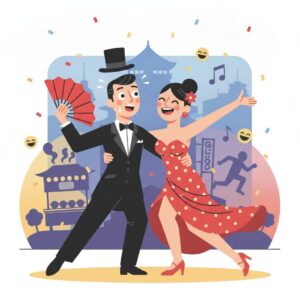
You can’t discuss Osaka humor without mentioning manzai. This traditional style of Japanese stand-up comedy, usually performed by a two-person team, has become a national obsession, with Osaka as its undeniable epicenter. The entire structure of manzai relies on the boke/tsukkomi dynamic: one comedian utters increasingly absurd statements, while the other responds with quick, escalating retorts, often punctuated by a theatrical tap with a paper fan.
Osaka is home to Yoshimoto Kogyo, the entertainment powerhouse dominating Japanese comedy for over a century. In Namba district, the company’s headquarters and flagship theater are well-known landmarks. TVs in homes and restaurants throughout the city are frequently tuned to comedy programs featuring Yoshimoto talent. Children in Osaka grow up idolizing comedians much like children elsewhere admire athletes or musicians. They absorb the rhythms of manzai from an early age, and it becomes the default communication style, a natural way to shape conversations. People quickly recognize a boke and instinctively know how to deliver the tsukkomi. It is a shared cultural language that everyone speaks fluently—a constant backdrop to life that reinforces and perpetuates this distinctive conversational style.
The Dialect: Osaka-ben
Finally, the local dialect, Osaka-ben, fits perfectly with this comedic culture. Compared to the relatively flat, standard Japanese spoken in Tokyo, Osaka-ben is famously melodic, rhythmic, and highly expressive. It carries a song-like quality that conveys a wide range of emotional nuance. The same sentence can sound entirely different depending on the intonation.
Osaka-ben is also rich with words and phrases tailor-made for banter. The most iconic example is “Nandeyanen!” which roughly means “Why the heck?!” or “You’ve gotta be kidding me!” It is the quintessential tsukkomi phrase—a verbal tool deployable in countless situations. Other phrases like “Akan” (No good / Impossible) or “Honma ka?” (Really?) are delivered with a punchiness that standard Japanese often lacks. This direct, earthy, and colorful dialect perfectly carries the lively, straightforward, and humorous spirit of the Osakan people. It’s the city’s soundtrack, with every conversation a fresh composition.
Navigating the Banter as a Foreigner
For someone new to Osaka, the constant flow of jokes, teases, and comebacks can feel overwhelming and at times downright confusing. It’s easy to mistake a friendly poke for a serious insult or to feel pressured to be humorous within a language and culture that isn’t your own. Yet, learning how to navigate—and even join in—this world of banter is essential to truly connecting with the city and its people. It’s about recognizing the affection behind what seems like boldness.
What Foreigners Often Misinterpret
The biggest challenge for newcomers is the question, “Are they making fun of me?” When a shopkeeper comments on your flashy clothes, or a stranger on the train points out that you’re holding your umbrella awkwardly, your first reaction might be self-consciousness or offense. It’s important to realize that in 99.9% of cases, the answer is a definite “no.” In Osaka’s culture, being teased means you are acknowledged. It indicates that someone feels comfortable enough to drop formalities. Silence or overly polite, distant conversation often signals indifference. A playful tsukkomi means engagement. They’re inviting you into their social circle, not trying to exclude you.
Another common feeling is being put on the spot. An Osakan might ask you a direct question like, “Why did you buy that? It’s so weird!” and then wait with a grin for your response. This can feel like a test you weren’t prepared for. The key is to understand that you’re not expected to deliver a perfect, witty comeback. The interaction isn’t about judging your humor. A simple, good-natured response is enough. A laugh, a smile, or a mock-pouty face works perfectly. It shows you understand the spirit of the game, even if you don’t know all the rules yet.
Finally, there’s the risk of taking things too literally. Language depends on context. If an elderly man at a noodle shop sees you, a foreigner, using chopsticks and loudly exclaims, “Wow, you’re better than a Japanese person!” he’s not conducting a serious, scientific evaluation of your skill. He’s using a common, exaggerated phrase to express surprise and approval. He’s creating a bond. Responding with a dry, “Well, I have been practicing for several years,” misses the point entirely. The right response is to play along, perhaps with a proud puff of your chest and a joking, “Of course, I’m a pro!” This shared lighthearted exaggeration is exactly the purpose of the exchange.
Your Survival Guide to Osaka Conversations
So, how do you jump in? It’s easier than you might think. You don’t have to become a professional comedian immediately. You just need a few simple tools to help you join the fun.
Step 1: Relax and Smile. This is the golden rule. Your reaction matters more than your words. When someone gives you a tsukkomi, your first instinct should be to smile or laugh. This instantly shows you get it—that you understand the playful intent. A warm smile breaks any awkwardness and signals you’re willing to participate. It shows friendliness and approachability, almost always returned with an even warmer smile.
Step 2: The Simple Comeback. You don’t need a perfect punchline. A few basic playful phrases make you sound like an experienced player. Saying “Nandeyanen!” (Why the heck?!) with a laugh will earn you friends everywhere. It’s the universal key to Osaka conversations. Another good one is “Mou, yamete ya~” (Oh, stop it~), drawn out teasingly. It’s a gentle way to throw back the joke. Even a simple “Hidoi!” (How mean!), delivered with a big grin, shows you’re in on the fun.
Step 3: Play the Boke. As mentioned, this is often the easiest role for outsiders. Embrace your status as a foreigner. Do something a little silly on purpose. At a bar, when the waiter brings otoshi (a small appetizer), look at it wide-eyed and ask, “Is this a special gift for me?” This is a perfect boke moment. It invites the staff and customers to engage, explain the custom, and share a laugh. Deliberately misstating a sign or pretending to be overwhelmed by the flashing lights of Dotonbori are great ways to offer locals a conversational softball they’ll be happy to hit.
Step 4: Don’t Force It. While joining in is fun, remember you don’t have to perform. If you’re tired, not in the mood, or simply confused, that’s completely fine. A polite nod and a simple smile are universally understood and end the interaction smoothly. Nobody in Osaka intends to make you uncomfortable. The culture aims to create fun and ease. Don’t stress if you don’t feel ready. But keeping an open mind and being prepared for these spontaneous moments of comedy will greatly enrich your everyday life in the city.
Real-Life Scenarios and How to Handle Them
- Scenario 1: At the Supermarket. You’re buying a single, sad-looking banana. The cheerful cashier scans it and says, “Just one? Are you dieting, or just lonely?”
- Misunderstanding: She’s nosy and judgmental about your eating habits.
- Osaka-style Reaction: Laugh and reply, “It’s for my friend!” while patting your stomach. Or look at the banana with mock sadness and say, “Yeah, it’s a lonely dinner tonight.” This turns a simple purchase into a mini soap opera, and the cashier will enjoy it.
- Scenario 2: With Your Landlord. Your landlord, Mr. Tanaka, sees you leaving the apartment wearing a hat. He says, “Nice hat! Trying to hide your messy hair today?”
- Misunderstanding: He’s criticizing your appearance and thinks you’re lazy.
- Osaka-style Reaction: Take off the hat, run your hands through your hair dramatically, and say, “You caught me, Tanaka-san!” with a big grin. This acknowledges his joke and creates a friendlier, more familiar bond than a formal greeting ever could.
- Scenario 3: In the Office. You bring homemade cookies to share. A coworker tries one and exclaims, “Whoa, this is so sweet! Did you dump the whole bag of sugar in here?”
- Misunderstanding: They genuinely dislike your cookies and think your baking is bad.
- Osaka-style Reaction: Put your hand on your hip, feign indignation, and say, “That’s the secret ingredient! It’s what makes them so good!” Or lean in conspiratorially and whisper, “Don’t tell the boss, it’s to keep us energized!” This shows you can take a joke and helps create a relaxed, enjoyable workplace atmosphere.
The Deeper Meaning: Why This Culture Matters
It might be tempting to dismiss this entire communication style as frivolous or merely a regional oddity. However, doing so overlooks the significant social role it plays. Humor in Osaka goes beyond just eliciting laughter; it is the city’s fundamental way of building community, fostering resilience, and creating a strong sense of shared identity. It is the lifeblood of the city, the unseen thread connecting millions of people.
More Than Just Jokes, It’s Connection
At its heart, the ongoing exchange of boke and tsukkomi serves as a powerful means of breaking down social barriers. In a society that can often seem rigid and hierarchical, Osaka’s humor acts as a great equalizer. A witty shopkeeper might tease a wealthy customer, and a junior employee can playfully poke fun at their boss in ways that would be nearly unimaginable elsewhere. This shared language of laughter forms brief moments of equality, where social rank and background matter less than the ability to enjoy a playful exchange.
This instantly creates a feeling of connection, even among strangers. Sharing a laugh quietly declares, “We’re on the same team. We understand each other.” It transforms impersonal, transactional spaces—a convenience store, a train car, a post office queue—into potential sites for human interaction. This is why living in Osaka feels distinct from other large cities. There is an unspoken assumption that everyone is approachable, that a conversation is always just one silly comment away. This provides a powerful remedy to the urban loneliness common in modern city life. It’s hard to feel truly isolated when the person selling you fried chicken treats you like their long-lost, slightly goofy cousin.
Moreover, humor is a renowned coping mechanism. Osaka has a long tradition of weathering hardships, from natural disasters to economic recessions. The ability to find humor in daily life, to laugh at oneself and life’s absurdities, reflects remarkable resilience. It helps maintain perspective and resists being weighed down by solemnity. This practical, life-affirming attitude is among the city’s most admirable traits. They take their work and food seriously, but never themselves—and that makes all the difference.
Living in Osaka vs. Tokyo: The Vibe
In the end, this culture of communication defines the daily experience in Osaka and sharply contrasts with Tokyo. Life in Tokyo can feel like being inside a beautifully designed, perfectly functioning machine. It’s clean, efficient, and convenient. People are exceptionally polite, and public spaces follow a quiet, unspoken order. Interactions are smooth and professional but often lack warmth. You can spend years there having little more than superficial exchanges with those around you.
Conversely, living in Osaka feels like being at an ongoing, chaotic, and vibrant family reunion. It’s louder, messier, and a bit more unpredictable, but bursting with life and energy. The lines between public and private, stranger and friend, blur delightfully. Daily errands become a series of small performances and improvisations. The supermarket cashier knows about your cat, the ramen shop owner asks about your job, and the neighbor offers unsolicited yet kindly advice on everything from gardening to relationships. For some, this level of engagement can be overwhelming; for those who embrace it, it’s the city’s greatest appeal. Osaka is a place where you’re not just an anonymous resident but a character in a vast, humorous, and deeply human story—and to play your part, all you need is to be ready for a laugh.