
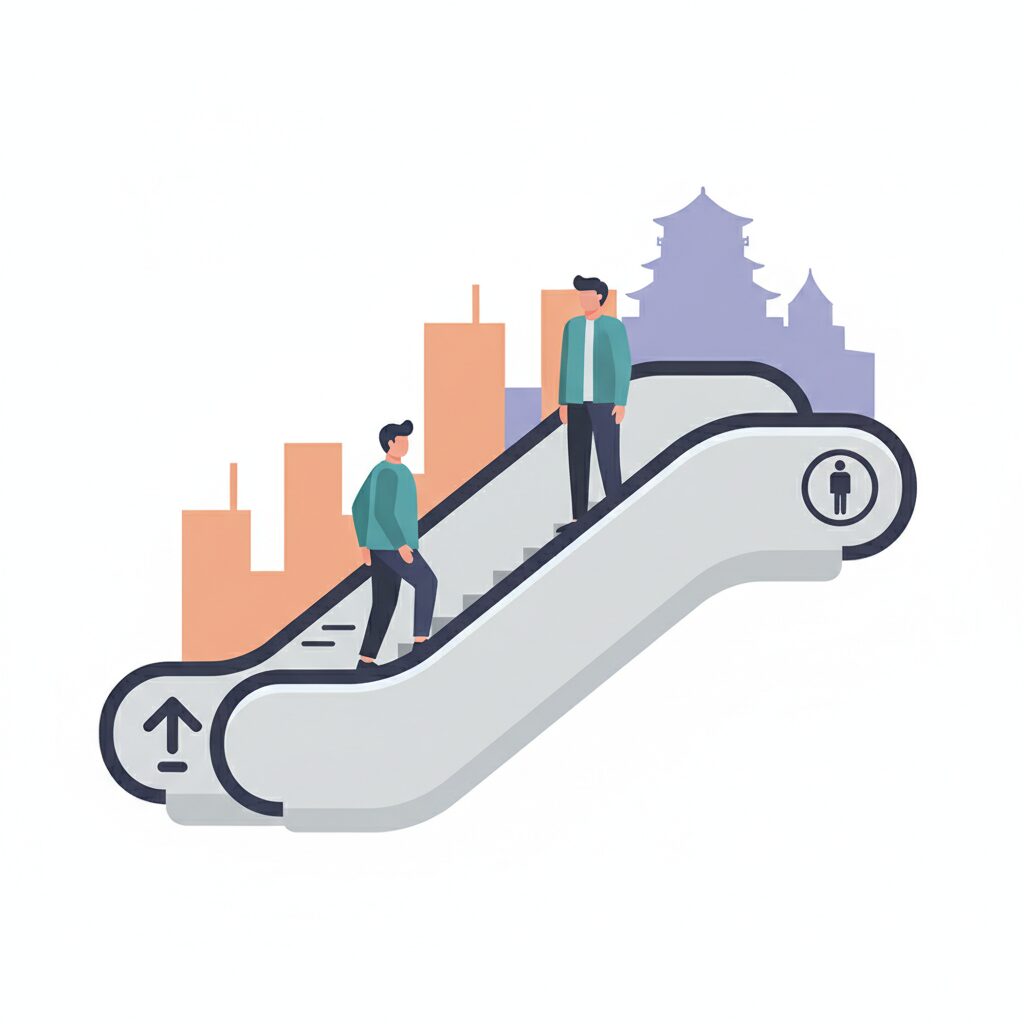
Step off the train at Umeda Station for the first time, and you’re not just in a station; you’re inside a living organism. It’s a concrete and steel circulatory system, pulsing with a relentless flow of people. You’re carried along by the current, a torrent of office workers, shoppers, and students, all moving with a purpose that you haven’t quite deciphered yet. You see an escalator rising towards the department stores, a ribbon of metal climbing into a canyon of commerce. You step on, moving to the left side out of habit, the way you’ve done in a hundred other cities, including Tokyo. And then you feel it. A slight pressure from behind. A polite cough. A steady stream of people gliding past you on your left, their footsteps a quiet, insistent beat. You’ve just made your first, classic, non-Osaka mistake. You’ve broken the golden rule. Here, in this city, everyone stands on the right.
This isn’t just a quirky local custom, a piece of trivia for a travel guide. This simple act of choosing which side of an escalator to stand on is the key to everything. It’s a breadcrumb that leads you down a path to understanding the fundamental operating system of Osaka. It’s the first question you should ask if you want to know what it’s really like to live here, to navigate its streets, to understand its people. Why the right side? Why does Osaka march to a different beat than Tokyo, than the rest of Japan? The answer isn’t about escalators at all. It’s about history, commerce, and a deeply ingrained pragmatism that defines the city’s very soul. Forget the tourist maps for a moment. The real map to understanding this place is written in the unspoken rules of its human traffic, starting with this one, simple choice. This is your entry point into the city’s flow, a rhythm that feels chaotic at first, but soon reveals its own powerful, efficient logic.
To truly grasp this pragmatic rhythm, one must also understand the city’s deep-seated food obsession, known as kuidaore, which fuels its everyday life and commerce.
The Great Escalator Divide: Right Side Story
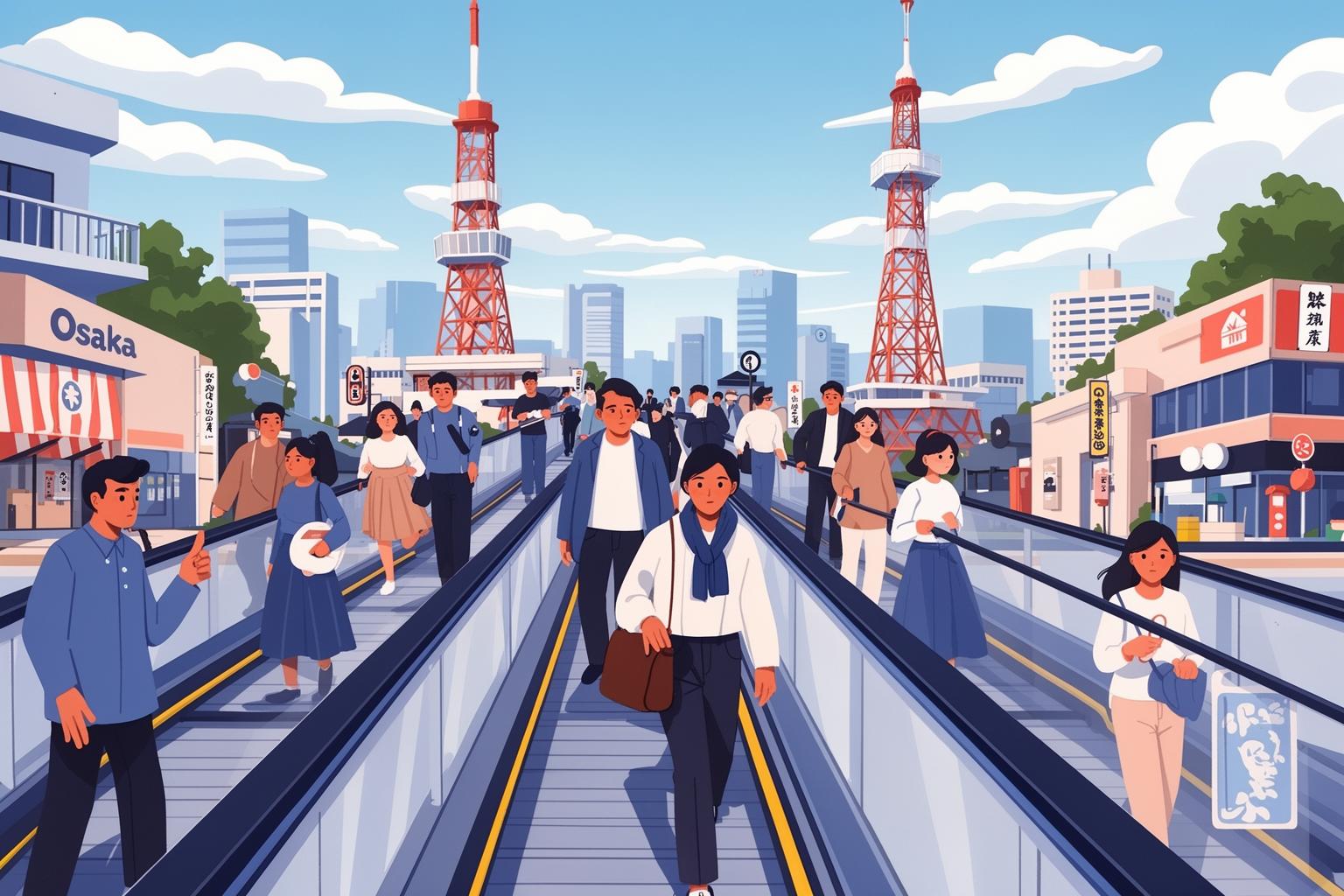
The rule is absolute. In Osaka, and broadly across most of the Kansai region, you stand on the right side of the escalator to allow others to pass on the left. For locals, this is muscle memory—an unconscious action repeated thousands of times daily. For outsiders, it serves as a subtle, constant reminder that you are not in Tokyo. In the capital, the opposite applies: stand on the left, walk on the right. This isn’t a mere suggestion; it’s a fundamental law of urban dynamics. Ignoring it in Tokyo feels like swimming against the current—an unmistakable social breach. Ignoring it in Osaka carries a similar weight, but the correction arrives sooner and more directly—a swift “sumimasen” (excuse me) that functions less as a question and more as a polite command to move.
Imagine the main escalator at Namba Station, linking the Nankai line to the subway—a huge, surging artery of human traffic. During rush hour, the right side becomes a steady wall of people, patiently riding along. The left lane blurs with motion, a fast track for those moving with a bit more urgency. There’s a beautiful, unspoken coordination to it all. No one manages it. No signs enforce it. It just exists. It’s a shared cultural understanding, an unspoken software everyone operates on instinctively. For a newcomer, this is the first lesson in blending in. Mastering the escalator is the initial step toward feeling less like a visitor and more like part of the city’s daily rhythm. It’s the moment you stop thinking about where to stand and instinctively drift right. It’s the moment you begin to sense the city’s unique pulse.
A Tale of Two Capitals: Why the Split?
The question of why this divide exists is a popular topic of discussion among Japanese people themselves. There is no single, universally accepted explanation, but the prevailing theories offer fascinating insights. They reveal a story not about escalators, but about the historical identities of two rival cities—one built on military power, the other on economic strength. In a way, these explanations serve as origin stories that Kansai and Kanto residents tell about themselves.
Echoes of the Samurai City
The most common explanation for Tokyo’s “stand left” practice lies in the city’s history as Edo, the seat of the Tokugawa shogunate. This was a samurai city, governed by the codes and practicality of the warrior class. Samurai wore their katana, the long sword, on their left hip, allowing a smooth draw with the right hand. When walking on a narrow path or passing someone in a corridor, keeping left minimized the risk of scabbards clashing. Such a clash was a serious sign of disrespect and could spark a deadly duel. Therefore, the custom of moving on the left was a deeply ingrained way to avoid conflict—maintaining order, preserving harmony, and respecting the personal and lethal space of others. This samurai logic, the theory suggests, has been passed down through centuries into the unspoken etiquette of modern Tokyo commuters: stand left, keep your sword arm free, and avoid unnecessary friction.
The Merchant’s Hustle
Osaka’s story is quite different. It was never a city of samurai lords but rather the “nation’s kitchen” (tenka no daidokoro), the economic powerhouse of Japan. It was home to merchants, artisans, and financiers. Here, the logic was not about avoiding duels, but about closing deals. The prevailing theory behind the “stand right” rule is commercial. Since most people are right-handed, a merchant carrying an abacus, money pouch, or valuable goods in their dominant hand would stand on the right side of a busy street or staircase to keep their valuables protected between their body and the wall, shielding them from pickpockets and accidental bumps. The left side was reserved for moving quickly to the next destination. This is the logic of commerce, not combat. It reflects Osaka as a city where practicality and the flow of money, rather than swords, dictated the etiquette.
From Expo ’70 to Urban Legend
A more recent theory points to the 1970 Osaka World Exposition, a massive international event that introduced global standards to the city. The argument goes that with many visitors from countries with right-side road traffic, the city’s infrastructure, including escalators, adopted a “keep right” convention to align with international norms. Hankyu Railway, a major Kansai-based private railway company, is often credited with promoting the “stand right” rule around this time. While these historical details are difficult to verify conclusively, they all lead to the same conclusion: Osaka’s culture has always been more outward-looking, shaped by trade and international contact, and fundamentally more pragmatic than the tradition-bound capital in the east. Whether it’s the merchant protecting his goods or the city welcoming the world, the core principle remains practical, efficient movement.
Beyond the Escalator: The Rhythm of the Rails
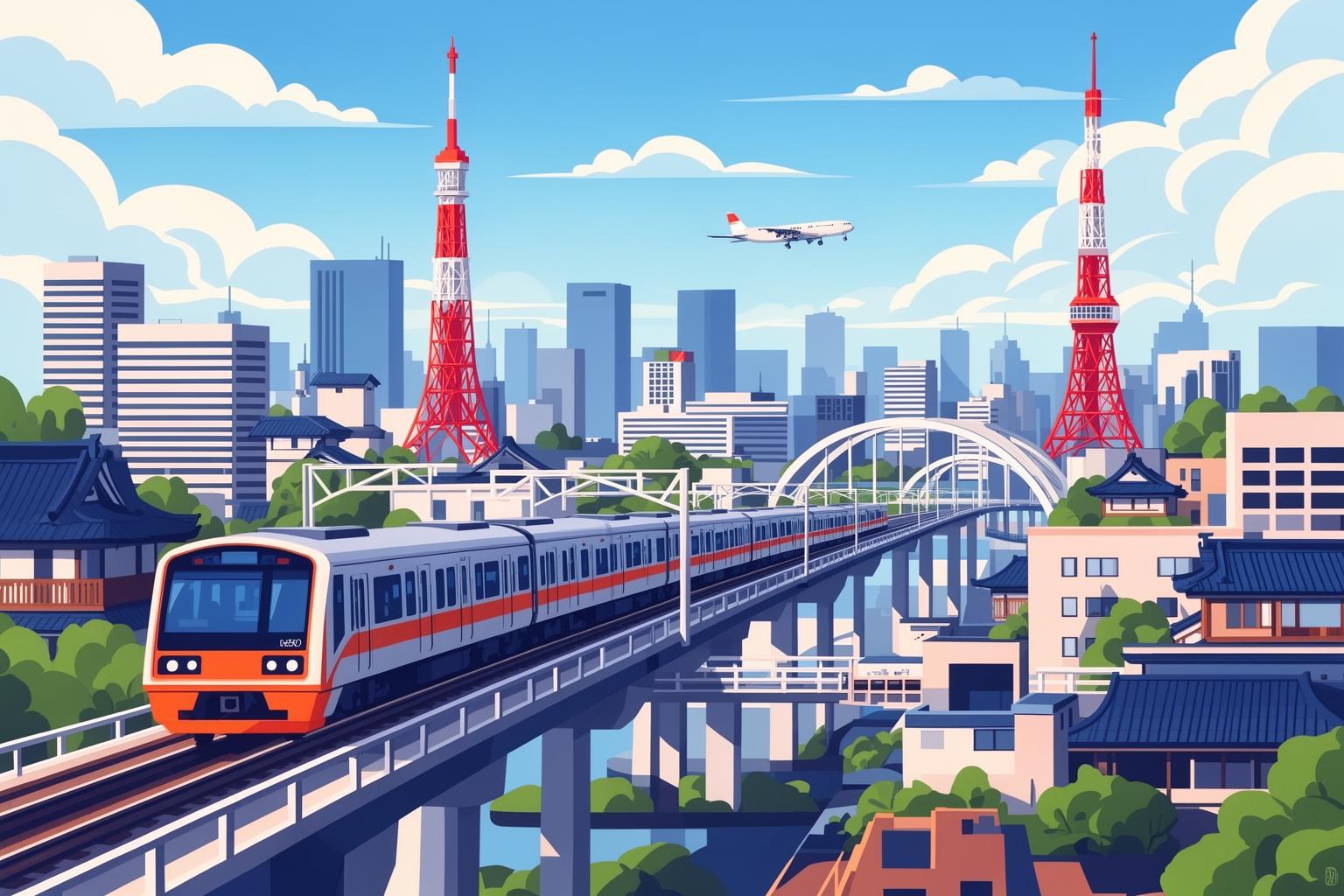
The escalator serves merely as the gateway. This distinctive Osakan spirit—a mix of efficiency, straightforwardness, and a slightly more chaotic energy—infuses the entire public transportation experience. Boarding a train in Osaka offers a fundamentally different sensory experience compared to Tokyo. It’s a journey deep into the city’s character.
The Midosuji Squeeze and the Art of the Lean
Riding the Midosuji subway line, the city’s main north-south artery, during the morning rush is a rite of passage. It’s packed, intensely so. But the crowd differs from that on Tokyo’s Yamanote Line. The Tokyo crush tends to be a silent, almost stoic event. People squeeze themselves into impossibly tight spots with a shared, grim determination, eyes closed or glued to their phones, collectively agreeing to pretend no one else is there. The Osaka squeeze is more… organic. People lean into the space, shift, and adjust. There’s an unspoken negotiation for every inch—a physical dialogue less about silent endurance and more about actively making it work. Personal space is fluid, shaped not by a fixed bubble but by the immediate needs of the group. You learn to brace yourself, find a foothold, and become part of the human Tetris puzzle that moves everyone along.
A Symphony of Sounds: The Conversational Commute
The most noticeable difference is the sound. Tokyo trains are famously quiet. Conversations are hushed, phone calls are taboo, and the dominant noises are the rhythmic clatter of the tracks and the digitized station announcements. Osaka trains, however, are a different story. People talk. Friends heading to Shinsaibashi laugh out loud. Elderly women, or “obachan,” chat animatedly about their day. It’s not chaotic, but the ambient volume is noticeably higher. Tokyo’s strict public silence gives way to a more permissive, communal vibe. This isn’t because Osakans are rude; rather, the boundary between public and private space is drawn differently. The train is seen as an extension of the city’s social fabric, not a sterile transport pod. Life doesn’t pause when you board; it simply goes on.
The Unspoken Rules of Seating
Even the process of finding a seat reveals local character. In Tokyo, queuing for trains is often an exercise in linear precision. People form neat, orderly lines at designated platform spots. In Osaka, lines are more… suggestive. It’s more of a general gathering in the right area. When the doors open, there’s a subtle but evident shuffle. It’s not a mad rush, but a strategic, fluid movement toward any open space. Once onboard, another Osakan trait appears: directness. If there’s a small, not-quite-person-sized gap on a bench, a Tokyo commuter might accept standing. An Osaka commuter, especially an obachan, is more likely to make eye contact with the person next to the gap and say, “Chotto tsumete,” or “Scooch over a bit.” It’s not aggressive. It’s efficient. Why stand when a simple, direct request can create a seat? It’s real-time problem-solving.
De-Coding the Osaka Mindset: It’s Not Rude, It’s Rational
All of these behaviors—standing on the right, forming conversational lines, and directly asking others to make space—can easily be misunderstood by outsiders. Compared to the more reserved customs of other Japanese cities, these actions might seem loud, pushy, or impatient. However, interpreting them as rudeness misses the point entirely. It’s not a lack of manners; rather, it’s a different system of conduct rooted in rationality and efficiency.
Efficiency is King
The spirit of the Osaka merchant remains strong. Time is money, and wasting it is considered a serious offense. The escalator rule perfectly illustrates this mindset. Why should someone in a hurry have to wait behind someone who is not? The system creates two lanes: one for standing, one for moving. It’s a straightforward, logical arrangement that maximizes flow. This reasoning applies everywhere. Directly asking someone to “scooch over” is quicker and more effective than politely waiting for them to notice the space. The somewhat more chaotic boarding process is a collective, unspoken effort to fill the train as swiftly as possible. Every action aims at one goal: keeping things moving.
Public vs. Private: A Different Boundary
In much of Japan, especially Tokyo, a clear distinction exists between one’s true feelings (`honne`) and the public persona one shows (`tatemae`). The public realm is a stage where harmony (`wa`) must be carefully maintained and performed. This explains why trains are quiet and interactions tend to be indirect. In Osaka, this boundary is more fluid. People are more likely to express their `honne` openly in public. This is not a performance; it is simply who they are. The city’s energy reflects the sum of its individuals, expressed without reservation. This is often what people mean when they say “Osaka people are friendly.” It’s not that they are inherently more welcoming than others in Japan; rather, they are more expressive and direct. Their friendliness is active, not passive.
Understanding “Friendly” vs. “Polite”
This distinction can confuse outsiders. A Tokyoite might demonstrate politeness by not disturbing you, giving you space, or maintaining respectful silence. An Osaka local might show friendliness by chatting with you at a bus stop, warning you that you’re about to miss your train, or offering unsolicited but helpful directions when you appear lost. One shows politeness through non-interference; the other shows friendliness through active engagement. The latter may feel intrusive if you’re unaccustomed to it, but it stems from genuine, practical helpfulness. They identify a problem (you’re lost) and provide the most efficient solution (telling you where to go). It’s the merchant’s mindset applied to social interaction.
Your Survival Guide to Osaka’s Urban Flow
Living in Osaka or even just spending an extended time there means learning to adapt to its distinctive urban rhythm. It’s less about memorizing strict rules and more about tuning yourself to a different vibe. However, a few practical tips can help ease the initial adjustment.
Rule #1: When Unsure, Stay to the Right
This is the simplest and most essential guideline. Whether on an escalator, moving walkway, or staircase, stand on the right if you’re not walking. Watch what the locals do. The flow is strong, and it’s always easier to move with it than against it. Don’t worry if you forget—at worst, you might hear a polite “excuse me.” No one will be genuinely upset; they just want to reach their destination.
Go with the Flow
Don’t expect strict order everywhere. Lines can be a bit disorderly, and boarding trains might feel like a gentle rush. The key is to stay alert and adaptable. Look for openings, anticipate the crowd’s movements, and become part of the stream of people. Fighting it will only lead to frustration. Learning to move with it is the secret to navigating the city smoothly and confidently.
Listen More Than You Look
Osaka’s soundscape is rich with meaning. Pay attention to the local Kansai dialect. Its intonation is more melodic and expressive than standard Japanese. Listen to conversations on the train. The background noise is part of the city’s personality, telling the story of a place vibrant, alive, and unapologetically itself. Tuning in helps you grasp the city’s emotional pulse.
Don’t Confuse Directness with Rudeness
This is important. If someone speaks abruptly or very directly, remember it’s about efficiency. It’s rarely meant to be rude; rather, it’s the quickest way to communicate, solve a problem, or offer assistance. Appreciate the honesty and straightforwardness—it’s a form of respect for both your time and theirs.
Ultimately, stepping onto the right side of an escalator is a small daily rite of passage into Osaka’s culture. It’s a minor physical shift that mirrors a bigger mental one. You’re syncing with a different logic—a mindset shaped by commerce and honed through centuries of pragmatism. The city values common sense over strict formality, efficiency over elaborate politeness, and a direct approach over a convoluted one. At first, its rhythm may seem strange, its volume a bit overwhelming. But once you stop resisting and learn to feel the beat, you’ll discover a city that’s not only efficient but also deeply human, dynamic, and full of life. You’ll find your rhythm, keep to the right, and let the city carry you forward.








