Coming from Tokyo, my life was a neatly organized collection of corporate logos. My groceries came from a sprawling, brightly lit Aeon supermarket. My coffee was from a familiar green-and-white mermaid. My errands were a series of efficient, predictable transactions in clinically clean environments. Life was a well-oiled machine, smooth and impersonal. When I first moved to Osaka, I felt a strange sense of dislocation. I kept asking myself, “Where do people actually buy things?” I couldn’t find the giant, all-in-one superstores that defined my Tokyo existence. The answer, I soon discovered, wasn’t in one place. It was everywhere, woven into the very fabric of the city, hiding in plain sight under the long, covered roofs of the local shotengai, the neighborhood shopping arcades. These are not nostalgic relics or tourist traps. They are the humming, chaotic, and profoundly practical engines of daily life in Osaka. They are the reason this city feels so different, so grounded, and so surprisingly affordable. Forget what you think you know about shopping in Japan; the shotengai is a different economic universe, and understanding it is the key to understanding Osaka itself.
This vibrant, community-focused economy extends beyond shopping, as seen in the unique cafe culture of Shinsaibashi and Amerikamura.
More Than Just Groceries: The Shotengai as a One-Stop Life Hub
In Tokyo, my life felt compartmentalized. I’d take a train to a shopping district for clothes, visit a medical building for a check-up, and head to a massive supermarket on the town’s outskirts for my weekly groceries. In Osaka, I realized these separate trips all merge into one vibrant ecosystem. The shotengai isn’t merely a place to shop; it’s a place to live. It’s a comprehensive support system for the community, a form of urban planning that feels both timeless and strikingly efficient.
The Anatomy of a Neighborhood Arcade
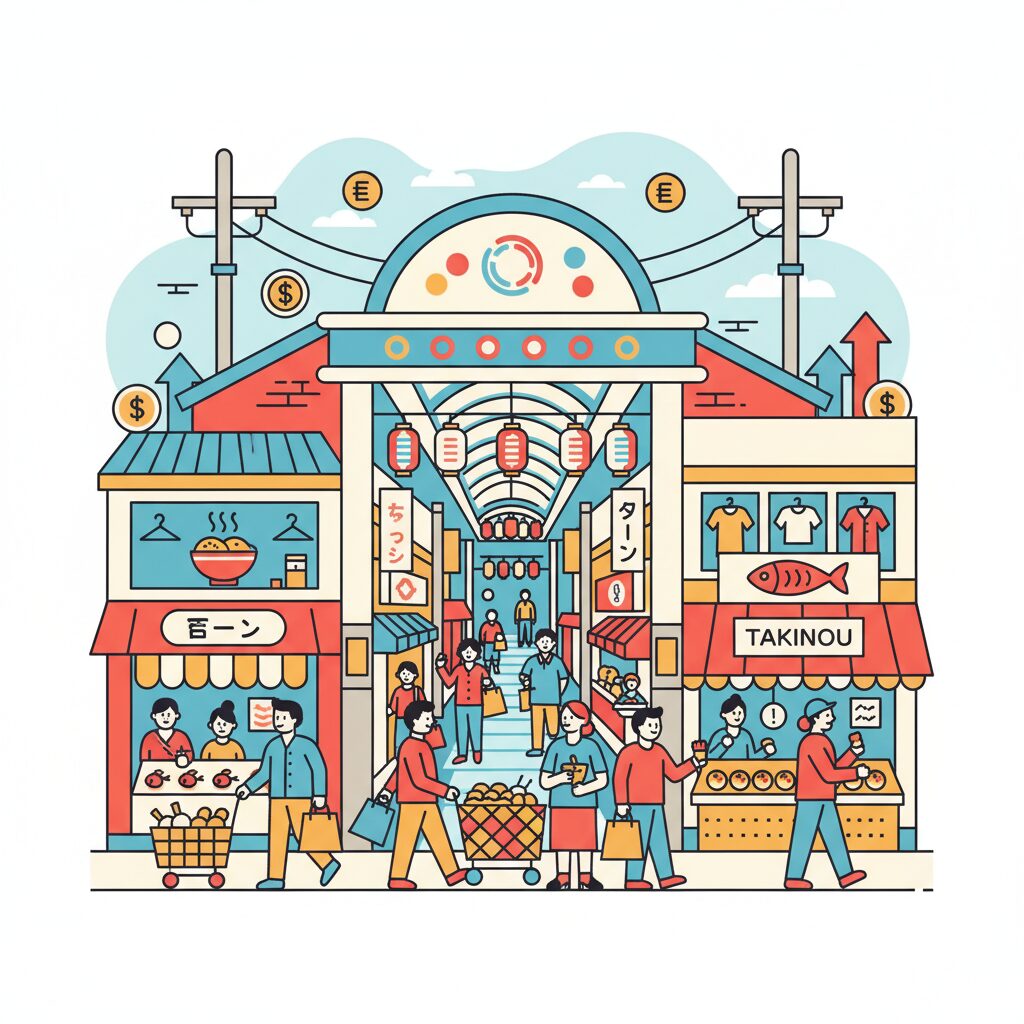
Step into any neighborhood shotengai, away from popular tourist spots like Kuromon Ichiba, and you’ll notice a familiar rhythm. It’s an organized chaos, a harmony of small, specialized shops that have thrived for generations. Instead of a generic “produce section,” you find the yao-ya, the fruit and vegetable expert, with pyramids of gleaming tomatoes and boxes of seasonal greens spilling onto the walkway. The owner, often a third-generation vendor, can tell you exactly which prefecture those melons came from and when they’ll reach peak ripeness. Next door stands the niku-ya, the butcher, with the scent of fresh meat in the air and the rhythmic chopping of a cleaver on a wooden block. They don’t just sell pre-packaged trays; they ask what you’re cooking—sukiyaki, nikujaga, tonkatsu—and offer you the perfect cut, often slicing it to your desired thickness right then and there. Then there’s the sakana-ya, the fishmonger, with shimmering whole fish laid on beds of ice, showcasing Osaka’s closeness to the sea. They’ll scale, gut, and fillet your purchase with skillful knife work. You’ll find the tofu-ya, where tofu is freshly made daily and stored in clean water baths, and the okome-ya, the rice specialist, who can blend various rice types tailored to your taste. This high degree of specialization is the shotengai’s economic secret. These independent shops operate with low overhead, maintain direct supplier relationships, and possess deep expertise in their goods. This model challenges the monolithic supermarket approach, where everything is available but nothing stands out. Beyond food, the arcade spreads into a full map of everyday essentials. A small private dental clinic might be nestled between a futon shop and a bakery. An internal medicine doctor’s waiting room is filled with familiar neighborhood faces. You can get a haircut at a classic, no-frills barbershop or a chic new salon. Pharmacies, stationery stores catering to local students, and small hardware shops that can fix nearly anything also line the arcade. It’s a self-contained world where you can cash a check, buy dinner, see a doctor, and get a key cut, all within a five-minute walk under a sheltering roof, protected from summer heat or winter rain. This is the ultimate walkable city, a concept many urban planners aim for, perfected here through decades of organic, community-driven growth.
The Price is Right: Deconstructing Osaka’s Affordability
One of the first things that struck me about Osaka was how far my money went, especially on daily necessities. This comes from the unique economic culture of the shotengai. Osaka residents have a reputation for being kechi, or stingy, but that’s a misconception. They aren’t cheap; rather, they are masters of value. Discerning consumers who demand quality for their money, the shotengai is their battleground. Pricing here is dynamic, not fixed. In a Tokyo supermarket, a slightly bruised apple is often discarded as a liability. In an Osaka shotengai, it’s an opportunity. The vendor bags it with others and sells it for a fraction of the price, shouting, “Perfect for juice!” Waste is taboo. This practical mindset is everywhere. As the afternoon progresses, the atmosphere shifts. This is when the famed nebiki, or price-cutting, kicks in. Shopkeepers don’t want to keep inventory overnight. The fishmonger bundles remaining sashimi, the baker bags unsold pastries, and the croquette shop launches a “time service” sale. For savvy shoppers, 4 PM in the shotengai feels like a gold rush. This sharply contrasts with the rigid, centrally-managed pricing of chain stores. Here, prices are a dialogue between the vendor’s need to sell and the customer’s hunger for a deal. It’s a fluid, responsive market adapting in real time. This value-driven culture goes beyond simple discounts. Portions are often more generous. The butcher might throw in extra minced meat for a regular customer. The tempura lady might add one more piece of fried pumpkin with a wink. This isn’t charity; it’s smart business. It fosters relationships and ensures repeat visits. The whole system depends on volume and loyalty rather than high profit margins per item. By cutting away excessive packaging, corporate marketing, and managerial layers, the shotengai achieves a directness and affordability that large corporations simply can’t match. It’s an economic model built for the people who rely on it every day.
The Human Factor: Where Commerce and Community Collide
The economic efficiency of the shotengai tells only part of the story. What truly distinguishes it from the sterile aisles of a supermarket is the powerful blend of commerce and community. In Tokyo, I was just an anonymous customer, a mere data point in a sales report. In my Osaka shotengai, I am seen as a person. This is not a quaint or sentimental remark; it is a fundamental aspect of how the local economy operates.
Your Face is Your Loyalty Card
In modern retail, companies pour billions into intricate loyalty programs, apps, and point cards to monitor customer behavior and encourage repeat visits. In the shotengai, the system is far more sophisticated and costs nothing: it is the human face. The shopkeepers are not temporary employees; they are the owners. They stand in the same place day after day, year after year. They remember you. They recall what you buy. This is the heart of the shotengai’s strength. After several visits to the same vegetable stand, the obaa-chan running it began greeting me with a nod. Soon, she was offering advice: “These cucumbers are especially good today, perfect for sunomono.” She wasn’t merely trying to upsell me; she was sharing her expert knowledge. She was building trust. This is something an algorithm can never replicate. This relationship is your greatest advantage as a shopper. The fishmonger knows you prefer leaner cuts of tuna. The tofu maker recognizes you come on Wednesdays for fresh yuba. They become curators of your daily meals, your personal shoppers. They will steer you away from less-than-fresh items and guide you toward the best offerings of the day. This level of personalized service is the ultimate form of customer loyalty. You don’t return just because prices are low. You return because you’re part of a reciprocal relationship. You are not simply exchanging money for goods; you are engaging in a community ritual. This is the well-known Osaka “friendliness” people mention, but it’s more than a personality trait. It’s a deeply rooted business strategy. In a dense network of small, competing shops, reputation and relationships are everything. Your face is your credit, your history, and your pass to the best products and warmest service.
The Unspoken Social Safety Net
Beyond the commercial exchanges, the shotengai serves an essential civic role. It acts as the neighborhood’s central nervous system, an informal information hub and a subtle social safety net. The daily, ongoing interactions weave a web of weak ties that hold the community together. Shopkeepers are the unofficial guardians of the neighborhood. They know the daily rhythms. They notice when an elderly regular skips their daily daikon radish and might check in. They see which kids are skipping school. They are the eyes and ears on the street, providing a layer of security that is organic and deeply effective. For residents, especially those living alone, the shotengai is a vital point of human contact. The simple acts of buying a newspaper or a liter of milk become brief, friendly exchanges that help stave off the loneliness and isolation common in modern cities. It’s also a practical network. If your air conditioner breaks in the middle of Osaka’s brutal summer, the local electronics shop owner will know a trustworthy repairman. Looking for a part-time job? The woman at the bento shop might have heard that the nearby clinic is hiring. This flow of information is invaluable. It is a decentralized, trust-based system for addressing the small challenges of daily life. This social infrastructure is mostly invisible and certainly doesn’t show up on any city budget, but its worth is enormous. It cultivates a sense of belonging and mutual responsibility. The shotengai reminds you that you’re not merely living among buildings, but in a community of people who, in small yet meaningful ways, look out for one another. This is a striking contrast to the anonymity of life in a sprawling metropolis like Tokyo, where neighbors often remain strangers.
The Osaka Mindset vs. The Tokyo Model
The persistence of the shotengai in Osaka is no coincidence. It is a tangible expression of a distinctly different urban philosophy and consumer mindset compared to Tokyo. It embodies a set of values that prioritize pragmatism over polish, and community resilience over corporate convenience. To truly grasp the essence of Osaka, one must understand the shotengai.
Pragmatism Over Polish
Stroll through a shopping district in Tokyo, such as Omotesando or Ginza, and you will be surrounded by an aesthetic of perfection. Storefronts are minimalist masterpieces, products displayed like museum artifacts, with lighting designed to perfection. The focus here is on presentation, branding, and crafting an aspirational experience. In contrast, walk through a traditional Osaka shotengai, and you encounter an aesthetic of vibrant, glorious chaos. Signs are often hand-written, sometimes faded, loudly advertising deals. Produce bins are piled high, overflowing to convey abundance. Lighting tends to be functional, often harsh fluorescent, and floors may show wear. From a Tokyo viewpoint, it might seem messy or somewhat rundown, but this misses the point entirely. Osaka culture, fundamentally, is deeply pragmatic. The shotengai isn’t intended to be an art gallery; it is designed to sell goods efficiently and affordably. The overflowing bins aren’t signs of neglect; they speak volumes: “We have so much stock, we can afford to sell it cheap!” The loud, rhythmic vendor calls aren’t noise; they’re direct and effective advertising. This substance-over-style approach defines the Osaka mindset. Customers care less about brand names and more about the quality and price of what they buy. This pragmatism fosters an environment where small, independent businesses flourish without needing the large capital investments required for the polished presentation seen in Tokyo. It is an economy based on the product itself, not the marketing that surrounds it.
Resisting the Corporate Tide
Across many parts of Japan, including Tokyo, traditional shotengai have struggled to compete with giant shopping malls, national supermarket chains, and ubiquitous convenience stores. Many have become “shutter streets,” rows of closed, empty shops. Yet in Osaka, they remain vibrantly alive. This endurance isn’t just nostalgic; it is because their economic model remains fiercely competitive and relevant. The shotengai embodies economic localism, keeping money circulating within the community. When you purchase vegetables from a family-run stall, your money doesn’t flow to a corporate headquarters in Tokyo. It pays the vendor’s rent to a local landlord, who, in turn, buys lunch from the noodle shop next door. This cycle creates a resilient, self-sustaining local economy. Additionally, the shotengai excel at adaptation. While core businesses persist, you’ll often find younger entrepreneurs opening specialty coffee shops, craft beer bars, or boutique clothing stores within the arcade. They are attracted by lower rents and steady foot traffic. This enables the shotengai to evolve and serve both long-time residents and a new generation. This stands in sharp contrast to the top-down corporate model, where decisions are made in distant boardrooms and local stores look identical regardless of location. The shotengai operates as a bottom-up system, shaped directly by the neighborhood’s needs and tastes. It is a powerful form of resistance against urban homogenization and a testament to Osaka’s independent, entrepreneurial spirit.
A Foreigner’s Guide to Thriving in the Shotengai
For a newcomer, the shotengai can appear overwhelming. The noise, the crowds, and the rapid-fire Kansai dialect may feel worlds apart from the quiet, orderly aisles of a chain supermarket. Yet diving in is not only simple but also one of the most rewarding experiences you can have while living in Osaka. It is the quickest way to start feeling like a local.
Breaking the Language Barrier with a Smile
Many foreigners worry that their Japanese isn’t good enough to navigate the shotengai. This fear is unnecessary. The language of the shotengai is universal: pointing, smiling, and holding up fingers. Begin with simple, low-pressure interactions. Buy a single piece of fruit or a freshly fried croquette from a takeaway window. The vendor is experienced and can usually guess what you want. Hold out a handful of coins and let them take the correct amount. These business owners want to make a sale and are almost always patient and helpful with newcomers. The key is to become a familiar face. Visit the same vendors regularly, even if it’s just for one or two items. A simple “Konnichiwa” and “Arigatou” go a long way. Over time, your confidence will grow, and the vendors will start to recognize you. This small act of repetition transforms you from a stranger into a customer, and eventually, into a member of the neighborhood. Don’t wait until your Japanese is perfect. The shotengai is the city’s best language school, and the lessons are delicious.
Reading the Rhythms of the Arcade
To truly master the shotengai, you need to grasp its daily rhythm. It is not a static place; it is a living organism with its own distinct flow. Early morning belongs to professionals and dedicated home cooks who come for the freshest fish and produce, just arrived from the market. The air is calm and focused. By mid-morning, the pace quickens as housewives and retirees begin their daily shopping. This is a social time, with people stopping to chat in the aisles. Midday is often a quiet lull, ideal for browsing if you prefer to avoid crowds. The real action starts in the late afternoon, around 4 PM, when people shop for dinner and the famous evening sales begin. Vendors become more vocal, the energy intensifies, and the best bargains can be found. As evening falls, the arcade transforms again. The shutters of butchers and fishmongers close, and the lights of small izakayas, tachinomi (standing bars), and restaurants flicker on. The shotengai shifts from a place of commerce to one of community leisure. Understanding this daily cycle allows you to use the shotengai strategically: go early for the best quality, go late for the best prices. And remember to bring cash. Although more shops are adopting cashless payments, many small, family-run stalls still operate on cash-only. It’s faster, simpler, and part of the direct, unvarnished economic culture of the arcade.
To my friends in Tokyo, living in Osaka seems like a compromise. But when they visit, they are amazed by the vibrancy and affordability of my daily life. They can’t understand how I eat so well on a budget. The secret isn’t a special app or discount supermarket chain—it’s the shotengai. It is far more than a collection of shops; it is the economic and social heart of the city. It’s a system that values people over profits, community over corporate efficiency, and value over vanity. For anyone wanting to truly understand what makes Osaka tick, my advice is simple: skip the tourist sites and spend an afternoon exploring your local shopping arcade. Buy your dinner there. Talk to the vendors. Feel the energy. That is where you’ll find the real, unapologetic, and brilliantly practical soul of Osaka.