So you’ve moved to Osaka. You’ve got your apartment, you’ve figured out the Midosuji subway line, and you’ve mastered the art of dodging bicycles on the sidewalk. You feel like you’re getting the hang of it. Then the weekend rolls around. You pull up Google Maps, ready to explore the Kansai region, thinking, “Okay, time to use that JR Pass knowledge I crammed for my first tourist trip.” You suggest a quick jaunt to a temple in Nara to a new colleague. They pause, scrunch their face a little, and say, “Ah, Nara, huh? That’s a bit of a trek for me.” You’re confused. A trek? It’s less than an hour away. The next weekend, you suggest Kobe for lunch. A different friend, who lives just a few stations from you, eagerly agrees. “Great idea! My line goes straight there.” My line? You thought everyone just took the JR train. Welcome to the invisible force that shapes daily life and weekend plans in Osaka, a concept completely alien to the JR-centric world of Tokyo and the tourist trail. The dirty little secret of living in Osaka is this: the Japan Rail Pass is for visitors. Real life, and your entire social geography, is dictated by a fierce, century-old rivalry between five private railway empires. Your choice of where to live doesn’t just determine your daily commute; it pre-selects your weekend getaways, your favorite department store, and even your sense of regional identity. This isn’t just about transportation; it’s about tribalism on steel rails. Understanding this system is the key to understanding the city’s rhythm and the mindset of its people. Forget the nationwide JR map for a moment; to truly get Osaka, you need to learn the five separate kingdoms that carve up the Kansai plain.
To truly understand the city’s rhythm, consider exploring Osaka’s last village in Chihayaakasaka, where rice paddies reveal a different facet of the region’s identity.
The Great Railway Divide: Why Osaka Isn’t a JR Town
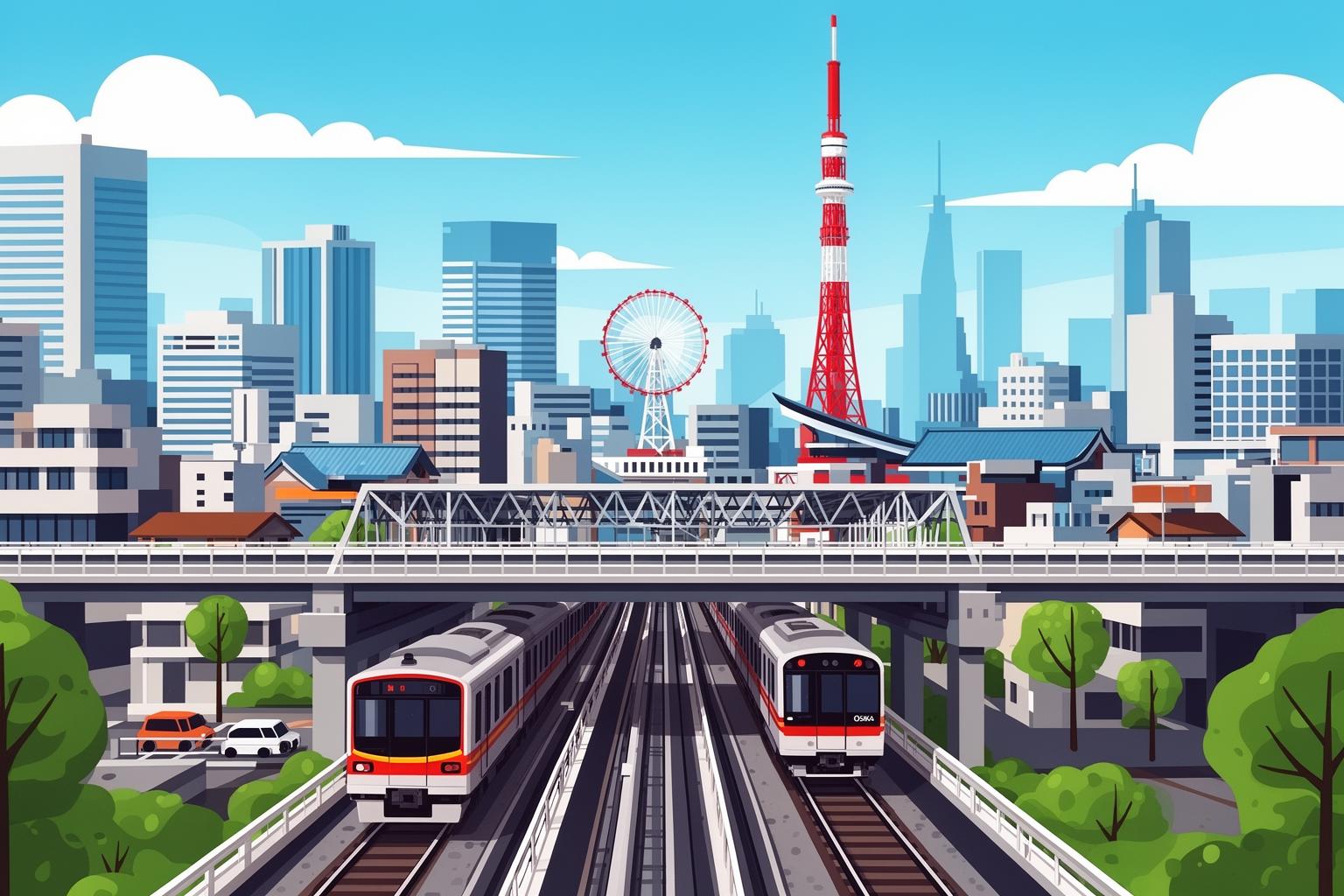
First things first, let’s reset your mental map of Japanese trains. If you’ve spent any time in Tokyo, you’ve been conditioned to view the world through the lens of the JR Yamanote Line. It’s the emerald green loop that defines the city— the central circuit from which all other lines, public and private, seem to radiate. The private lines in Tokyo feel like tributaries feeding the mighty JR river that flows through Shinjuku, Shibuya, and Tokyo Station. Life revolves around that central JR nervous system. Osaka has a loop line as well. The JR Osaka Loop Line is functional and even essential for navigating the city center, connecting major hubs like Umeda, Tennoji, and Kyobashi. But for an Osakan, it’s not the alpha and omega—it’s just one piece of the puzzle. The real power, the lines that inspire loyalty and shape lifestyles, are the private ones. These are not merely commuter rails; they are sprawling empires built on a business model perfected here in Kansai over a century ago. They are the reason your social life feels geographically partitioned.
A Tale of Two Terminals: Umeda vs. Namba
To understand the Osaka mindset, you have to recognize that the city has two hearts, not one. There’s Kita (North), centered around the vast Umeda-Osaka Station complex, and Minami (South), anchored by the vibrant, chaotic energy of Namba. Unlike Tokyo, where major hubs feel like different nodes on the same JR network, Umeda and Namba feel like the capitals of competing federations. Umeda is the stronghold of the Hankyu and Hanshin railway companies. Their grand terminal stations and flagship department stores sit right beside JR Osaka Station, forming a tripartite powerhouse of commerce and transit. This is the gateway to the west and north: Kobe and Kyoto. Namba, by contrast, is the domain of the Nankai and Kintetsu railways. Their terminals serve as launchpads to the south and east: Wakayama, Mount Koya, Nara, and the Ise-Shima peninsula. The Keihan Railway carves out its own territory, linking the business districts of Yodoyabashi and Kyobashi to Kyoto. The city isn’t a circle; it’s a series of strong vectors pointing outward from various starting points. An Osaka native doesn’t simply think, “How do I get to Kyoto?” They consider, “Am I taking the Hankyu from Umeda, the Keihan from Yodoyabashi, or the JR from Osaka Station?” The answer almost always depends on which line they live along.
The Five Kingdoms: Meet the Players
Let us formally introduce the dynasties that rule the rails and, by extension, your weekend plans. These five companies are far from interchangeable transportation providers. Each boasts a distinct history, corporate culture, color scheme, and sphere of influence.
Hankyu Railway: The aristocrat. Known for its classic maroon trains, polished wood-grain interiors, and green velvet seats, it connects Osaka-Umeda with the cultural hubs of Kobe-Sannomiya and Kyoto-Kawaramachi. Its routes pass through some of the most desirable residential neighborhoods in Kansai. Hankyu is more than a train; it’s a brand associated with a refined lifestyle, complete with its own upscale department store and the all-female Takarazuka Revue.
Hanshin Electric Railway: The populist. Its main line roughly parallels Hankyu’s, also linking Umeda and Kobe, but with a very different vibe. Hanshin is the railway of the people, deeply connected to the beloved, perpetually underdog Hanshin Tigers baseball team. Its Umeda terminal features a department store famed for its epic basement food hall and a legendary standing-room-only squid-yaki stall. It feels more energetic, more downtown, more salt-of-the-earth compared to its maroon rival.
Keihan Electric Railway: The Kyoto specialist. While Hankyu and JR also serve Kyoto, Keihan’s entire identity is built around this connection. Its trains, often equipped with double-decker cars for sightseeing, follow the Yodo River, linking Osaka’s business districts directly to Kyoto’s cultural heart—places like Gion, Fushimi Inari, and Kiyomizu-dera. For those on the Keihan line, Kyoto isn’t a day trip; it’s part of their extended neighborhood.
Kintetsu Railway: The behemoth. This is Japan’s largest private railway network—a sprawling giant dominating territories east and southeast of Osaka. From its dual terminals in Namba and Tennoji, its lines extend to Nara, Yoshino’s cherry blossoms, the sacred Ise Grand Shrine, and even Nagoya. Kintetsu is the key to Japan’s ancient heartland. Its express trains feature comfortable seating, making longer journeys a pleasure.
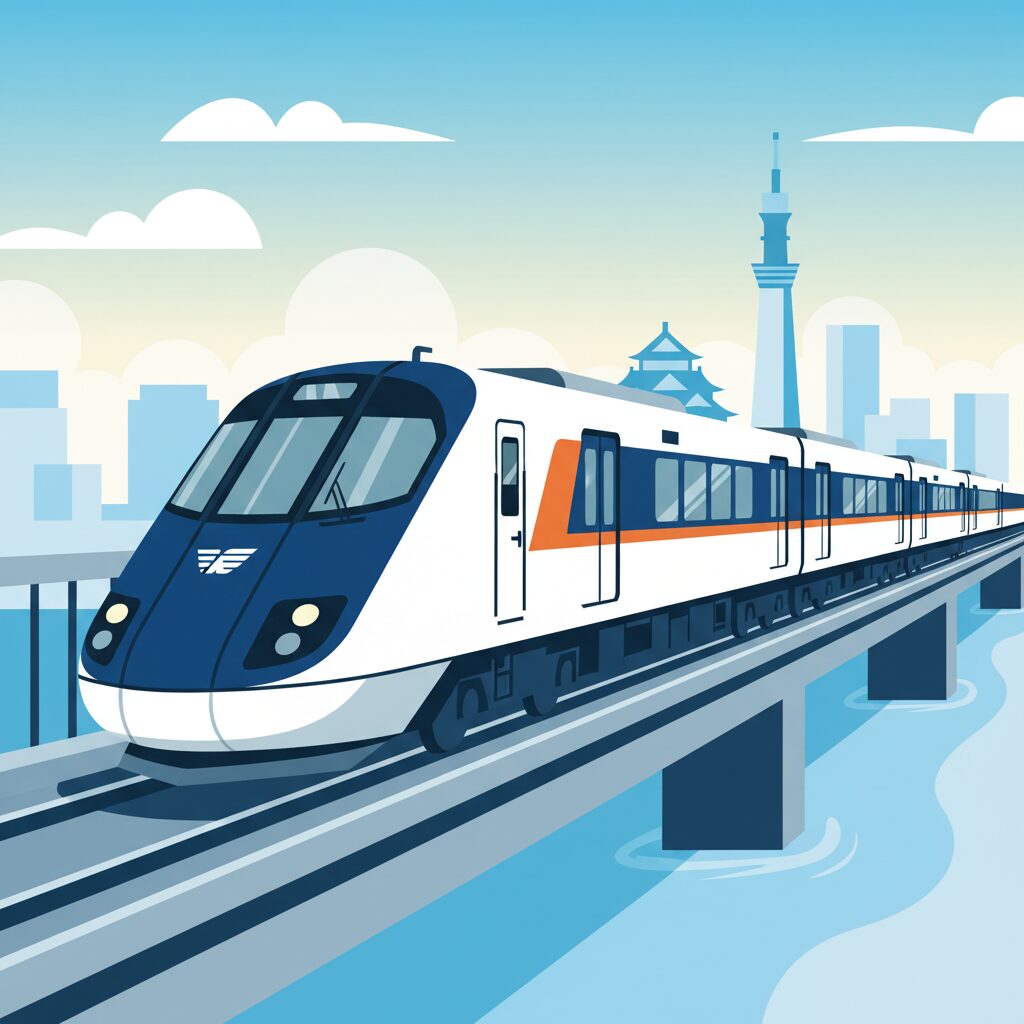
Nankai Electric Railway: The southern gateway. Nankai governs routes south of its Namba terminal and serves as the primary link to Wakayama Prefecture, the serene temple-mountain of Koya-san, and, crucially for modern travelers, Kansai International Airport (KIX). Its most famous train, the Rapi:t limited express, is a sleek, retro-futuristic blue machine that looks like something out of a sci-fi anime.
These five kingdoms are constantly and often subtly competing—on price, speed, comfort, and the allure of their destinations. The line you live on becomes your home team.
How Your Apartment Choice Secretly Chooses Your Weekends
When you were searching for an apartment, you probably paid close attention to the distance from your office or the nearest subway station. Looking at a map of Osaka with its intersecting lines, you likely thought, “Great, plenty of options.” What you probably didn’t realize is that by choosing to live in a place like Toyonaka, you weren’t just picking a neighborhood; you were implicitly pledging loyalty to the Hankyu realm. In doing so, you were also setting the default destination for your future weekend outings. This is no coincidence—it’s the product of a deliberate, century-old business strategy that shaped modern Osaka.
The Railway-Real Estate Connection: A Hankyu Story
This model was pioneered by Ichizo Kobayashi, the visionary founder of Hankyu. In the early 20th century, his goal wasn’t merely to build a railway connecting Osaka and Kobe. He wanted to create demand for it. So, he acquired large swaths of inexpensive, undeveloped land along the planned route. After constructing the railway, he developed attractive residential communities equipped with modern amenities nearby. To encourage salaried workers to leave the congested city and move to his new suburbs, he offered housing loans. But he didn’t stop there. To give these residents a destination, he built the Hankyu Department Store at the Umeda terminal—a palace of commerce and culture. At the far end of a branch line, he established the Takarazuka Revue, a unique all-female musical theater troupe. Kobayashi built a fully integrated ecosystem: live along our line, use our loans to buy a house we developed, commute on our train, and spend your leisure time and money in our department store and theater. This revolutionary concept proved wildly successful. Other private railways soon followed, developing their own residential communities and commercial centers. This explains why neighborhoods along specific lines often have a distinct, cohesive character. You’re not simply living near a railroad; you’re living within a carefully curated corporate lifestyle.
“I’m a Hankyu Person”: The Subtle Social Geography
Because of this history, a subtle yet powerful social identity has formed around the railway lines, affecting more than just your travel habits; it shapes how you see the entire Kansai region. Your line becomes your default route, your path of least resistance.
If you live along a Hankyu line, your world orients to the refined enclaves of northwest Kansai. A spontaneous afternoon trip to a trendy cafe in Kobe’s Kitano district or a stroll along the Philosopher’s Path in Kyoto is effortless. You board a maroon train, and you’re there—no transfers, no hassle. The Hankyu Umeda terminal, with its three parallel tracks and simultaneous departures, feels like a grand stage sending you off to elegant destinations. Your mental map of “easy places to go” is filled with spots like Arashiyama, Nishinomiya, and Kawaramachi.
For Hanshin residents, the compass also points west to Kobe, but the journey feels distinct. Stops come more frequently, and the atmosphere is livelier. Koshien Stadium serves as your cathedral, and the roar of the Tigers’ crowd is your anthem. A typical weekend might involve catching a ballgame or exploring the lively, down-to-earth Motomachi shopping arcade in Kobe. Traveling to Nara seems foreign—not due to distance, but because it requires going to Namba and crossing into another railway’s turf.
Living along the Keihan line, in a place like Hirakata, makes Kyoto feel like an extension of your home. You measure distance in Keihan stops. A friend suggests meeting in Gion? No problem—you’ll be at Gion-Shijo station in under an hour. You know the best times to ride the double-decker car for a scenic view of the Yodo River. To you, Kyoto isn’t just a world-famous tourist destination; it’s where you shop and dine. Traveling to Wakayama, however, is a complex cross-city journey that feels like a major expedition.
If you settle in Higashiosaka, you’re at the heart of the Kintetsu empire. Your weekend world expands eastward. Nara Park, with its bowing deer and giant Buddha, is just a simple, direct ride away. You don’t hesitate to hop on a Kintetsu Limited Express for a longer trip to the beaches and shrines of Ise-Shima. You’ve probably visited Kashihara Shrine or hiked the mountains of Yoshino. But ask you to go to Kobe, and you’ll cringe inwardly at the thought of the Umeda-to-Namba transfer shuffle.
And if your home is in Sakai, south of the city center, you belong to the Nankai republic. Your escape route leads south. The beaches of Wakayama, the spiritual calm of Mount Koya, and outlet malls near the airport are your frequent destinations. The sleek blue Rapi:t train is your chariot. When people mention Kyoto, it feels impossibly distant—a northern land requiring a multi-stage pilgrimage to reach.
The Weekend Negotiation: A Practical Guide to Osaka Socializing
This railway tribalism has tangible effects on your social life. It forms the unspoken rules behind weekend plans. When you propose an outing to a group of friends from Osaka, you’re not just suggesting a place; you’re initiating a complex geopolitical negotiation. Whether your plan succeeds or fails often depends on one key factor: the hassle of the transfer.
The Mental Burden of Crossing Railway Territories
To a newcomer, a transfer is simply changing trains—you get off one, walk a little, then board the next. But for an Osakan accustomed to the railway kingdoms, it’s far more complicated. Moving from one private railway’s domain to another comes with a mental cost. It often means navigating a huge, confusing station like Umeda or Namba, shifting between platforms belonging to different companies, enduring lengthy walks, multiple levels, and purchasing a separate ticket. Consider this common example: you, a new resident on the Hankyu line in Ikeda, want to meet a friend who lives on the Kintetsu line in Fuse. You suggest meeting halfway. But where exactly is halfway? Geographically, it might be somewhere downtown. But railway-wise, no simple midpoint exists. To get to Nara, you must take the Hankyu train to its final stop at Umeda, navigate the underground maze to the Midosuji subway, ride south to Namba, then find the Kintetsu platforms to board the train to Nara—three separate rides from three companies. Meanwhile, your friend has a single, direct train to Nara. Your reasonable-sounding proposal has just created a major inconvenience for you. This explains why the simple “Let’s go to Nara!” might be met with a thoughtful pause and then a suggestion like, “How about Kobe instead?”—a counteroffer based on railway convenience.
Understanding “It’s a Bit of a Pain” (ちょっと面倒くさい – Chotto Mendokusai)
The phrase chotto mendokusai is a polite, catch-all Japanese way to say “that sounds like a hassle.” In Osaka, when talking about day trips, it frequently means “That’s not on my line.” It’s not about laziness or lack of interest. Rather, it reflects a deeply rooted pragmatism characteristic of the Osaka mindset. Osakans are famously efficient and budget-conscious. Why spend an extra 40 minutes and 500 yen on transfers to reach a destination that’s practically the same as one on your own line? Why endure the Umeda-Namba transfer ordeal to get to Nara when Kyoto is a straightforward ride? This mental calculation is always running in the background. Knowing this helps you plan outings more smoothly. Instead of fixed destinations, suggest a neutral meeting point on a line you both share, like the Midosuji subway, then decide from there. Even better, learn their home line and propose a spot convenient for them. “Hey, I know you’re on the Nankai line. Want to check out that café in Wakayama City this weekend?” This shows you understand their world and geography. It shows you truly get it.
Beyond Convenience: A Mindset Shaped by Steel Rails
This deep-rooted loyalty to a private railway line goes beyond mere convenience. It is a core element of the city’s identity, reflecting Osaka’s history as a merchant city founded on competition and private enterprise. The steel rails that transport millions each day have also etched deep grooves into the collective consciousness of the city, influencing how people travel, shop, socialize, and perceive their place within the broader Kansai region.
The Gravitational Pull of the Terminus
The influence of each railway domain centers on its grand terminal stations. These are far more than simple boarding points; they are self-contained worlds. The terminals of Hankyu, Hanshin, Kintetsu, and Nankai are crowned by enormous, multi-story department stores owned by the railway companies. These stores are cultural landmarks. Families have shopped for generations at the Hankyu Umeda Main Store or the Kintetsu Department Store in Abeno Harukas. Your “home” department store—the one at the end of your line—becomes your go-to spot for everything from gifts and groceries to meeting friends for lunch. This creates a strong gravitational pull that continually deepens your bond with your chosen railway. Even if you live closer to Kobe, your commercial and social life often remains grounded in the Umeda terminal. The terminal acts as your anchor, your gateway to the city, and your launching point for adventures. This intense loyalty to a particular department store, and thus a railway line, is a quintessential Osaka trait that often confounds visitors.
What This Means for You, the Foreign Resident
So, what’s the takeaway? If you plan to live in Osaka, think beyond the subway map. When considering an apartment, pay attention to which private railway line it is on. Ask yourself: what kind of lifestyle do I want? If you envision weekends spent exploring Kyoto’s temples and gardens, then living along the Hankyu or Keihan lines is a strategic dream. If you’re a history enthusiast who wants proximity to the ancient capitals of Nara and Asuka, then the Kintetsu domain is ideal. For beach lovers or hiking fans drawn to the mountains and coastline of Wakayama, the Nankai line is your southern route to paradise. Choosing your railway allegiance thoughtfully can greatly enhance your quality of life and make discovering Kansai’s attractions feel effortless and natural. More importantly, understanding this system offers deep insight into the local mentality. You’ll understand why your colleagues’ travel stories revolve around specific areas and grasp the unspoken logistics behind social invitations. You’ll recognize that Osaka is not a single, uniform city but a dynamic federation of distinct territories, each with its own character, culture, and iron road home. This is the true Osaka—a city shaped not by a centralized plan but by competing private empires that laid tracks and, in doing so, forged the spirit of a region.