The first time it happens, you’ll probably miss it. You’re standing at a takoyaki stall in Namba, steam rising into the humid air, and the vendor slides your boat of octopus balls across the counter. “Careful now,” he says with a perfectly straight face. “That’s the most beautiful takoyaki I’ve made all day. If you drop it, you’ll make the whole street cry.” You pause, confused. Is he serious? Is this a warning? You offer a hesitant, awkward thank you and walk away, cradling the food like a sacred artifact. It’s only later, after you see him deliver the exact same line to the next three customers, that you realize you weren’t being warned. You were being initiated. You just had your first taste of Osaka’s most vital social currency: comedic banter. This isn’t just a city of comedians; it’s a city where comedy is the default operating system for human interaction. It’s the code that unlocks relationships, defuses tension, and turns a mundane transaction into a memorable micro-performance. Forget the polite, measured distance you might find in Tokyo. In Osaka, the distance between strangers is often bridged with a playful jab, a gentle roast, or a shared, knowing laugh. It’s a language that can feel jarring to outsiders, but once you learn to hear the rhythm behind the punchlines, you start to understand the very soul of this city. It’s a place built not on polite deference, but on the resilient, joyful, and deeply human act of finding the humor in everyday life.
Osaka’s vibrant social exchanges carry over into its culinary innovations, as seen in its gluten-free konamon challenge, where tradition meets playful reinvention in the heart of the city.
The Unspoken Rules of Manzai in Everyday Life
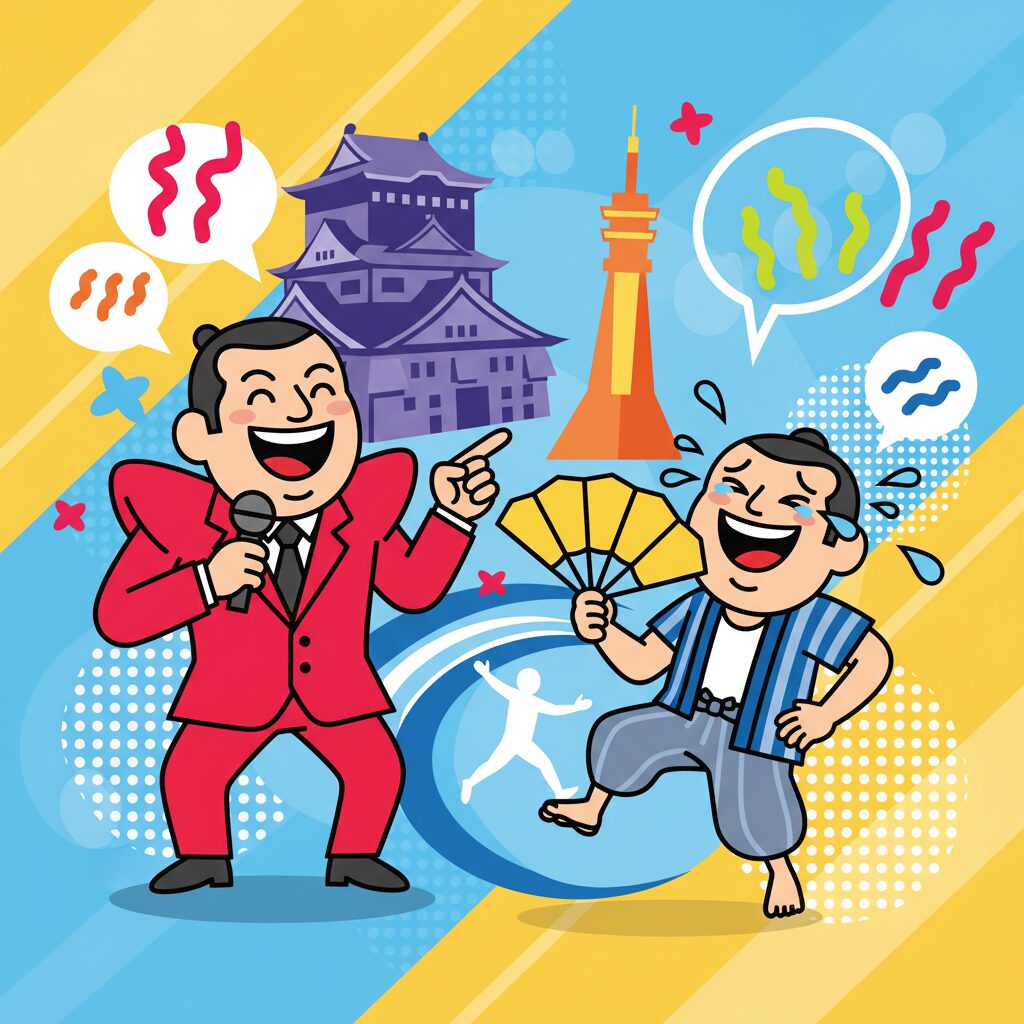
To grasp conversation in Osaka, you first need to understand the basic framework of manzai, the traditional Japanese stand-up comedy style that defines this city as much as deep-dish pizza defines Chicago. At its heart, manzai is a fast-paced exchange between two performers: the boke and the tsukkomi. The boke plays the fool—the airhead who utters something silly, nonsensical, or plainly wrong. The tsukkomi is the straight man who responds with sharp, often exaggerated, criticism, correcting the boke and grounding the situation, usually accompanied by a light slap or a pointed retort. This isn’t just a comedic act seen on television at the Namba Grand Kagetsu theater. It’s the essential template for nearly every casual conversation you’ll have in Osaka. People naturally assume these roles. It’s a conversational dance where one person deliberately throws out a ridiculous idea (boke), inviting the other to swiftly bring it back down to earth (tsukkomi). It’s a performance of connection—a back-and-forth that says, “I see you, I hear your absurdity, and I’m here to engage.”
Discovering Your Role: Are You the Boke or the Tsukkomi?
In any interaction, these roles shift fluidly and are assigned in a heartbeat. Watch two friends chatting at a cafe. One might say, “I studied so hard for that test, I think my brain has turned to tofu.” That’s the boke: an exaggeration, an invitation. The friend doesn’t reply with a worried, “You should get some rest.” That would stall the conversation. Instead, they deliver the tsukkomi: “Tofu? Don’t flatter yourself. It was mush from the start.” The joke lands. The bond is strengthened. Being the boke isn’t a sign of weakness or ignorance; it’s an act of generosity. You willingly make yourself the fool to create a chance for your partner to shine. It’s a demonstration of vulnerability and trust. You’re setting them up to score points, and together, you both win. A true Osakan can switch roles effortlessly, knowing when to serve and when to smash. The game itself is the goal, and joining in is essential for anyone aiming to move beyond mere small talk.
The Skill of the Comeback: Why the Response Counts More Than the Joke
The heart of Osaka banter lies not in the initial joke but in the response. The tsukkomi powers the conversation. A weak boke can be redeemed by a sharp tsukkomi, but even the best boke fails if met with silence or, worse, a literal reply. It’s like leaving someone hanging after a high-five attempt. For example, if you struggle to open a jar and say, “This thing must be sealed with super glue,” a typical Tokyo response might be a polite, helpful suggestion. The Osaka comeback is, “Stop making excuses for your weak noodle arms and hand it over.” The first solves the problem; the second builds a relationship. It’s a playful insult laced with affection. The tsukkomi acknowledges the boke’s absurdity and actively engages with it. It closes the social loop and sparks shared energy and humor. Mastering this rhythm is crucial to understanding how Osakans connect so swiftly and informally.
Banter as a Social Barometer
In Osaka, the style and intensity of banter directly mirror the closeness between two people. It serves as a finely tuned measure of social distance. The way you joke with a stranger is entirely different from how you tease your closest friend, and being able to interpret these signals is vital for navigating the local social scene. The presence of banter itself signals that the relationship is shifting from purely transactional to more personal. It’s the city’s way of saying, “We’re good. We can drop the formalities now.” This progression—from light, observational humor to deeply personal roasting—maps the entire course of a friendship in Osaka, from the initial greeting to a lifelong bond.
The Stranger’s Test: The Opening Salvo
Your first interactions with this system will probably be with shopkeepers, bartenders, or the ever-chatty elderly women known as Osaka no obachan. Their banter is an opening move, a test to see if you’re on their wavelength. When the woman at the vegetable stand looks at your purchase and says, “Just one carrot? Are you planning to feed a hamster?” she’s not criticizing your shopping choices. She’s casting out a feeler. A nervous laugh and a quick exit mean you’ve failed the test. The exchange remains purely commercial. But if you play along, you pass with flying colors. Replies like, “He’s a very hungry hamster!” or “It’s for my diet, don’t judge me!” will earn a hearty laugh. Suddenly, you’re no longer just a customer; you’re a person, a fellow participant in the grand game of daily life. This initial teasing is how Osakans probe for warmth and a shared sense of humor, quickly sorting people into two groups: those who get it, and those who don’t.
Leveling Up: Banter Among Friends and Colleagues
As relationships deepen, the banter grows as well. Among friends, jokes become more personal, sharper, and paradoxically, more affectionate. Teasing one another about past mistakes, questionable fashion choices, or quirky habits forms the lifeblood of friendship here. It constantly reaffirms the strength of the bond; the unspoken message is always, “I know you well enough to joke about this, and you understand I’m not being mean.” This dynamic often carries over into the workplace in ways that may surprise those used to more formal corporate cultures. In a Tokyo office, a manager might deliver feedback with layers of polite, indirect language. In an Osaka office, that same manager might walk by your desk, glance at your screen, and loudly ask, “Are you working or just making it look like you’re working? I can’t tell the difference!” This isn’t a threat—it’s camaraderie. It breaks down the barrier between boss and employee, fostering a sense of being a team battling together.
Reading the Room: When Not to Joke
Importantly, this culture of humor is not a license for endless sarcasm or insensitivity. The true skill in Osaka communication lies in knowing when to stop. There’s a time and place for banter, and a socially adept Osakan senses this instinctively. During serious apologies, heartfelt talks about personal struggles, or formal business negotiations with high stakes, the jokes vanish. The tone becomes sincere and straightforward. The ability to switch between these modes distinguishes a charming local from an annoying fool. Humor is a tool for connection, not a means of avoidance. If someone tries to use a joke to dodge a serious subject, they’ll be called out immediately. Banter is the default setting, but Osakans can flip the switch to “serious” whenever the situation requires it. Understanding this boundary is as crucial as understanding the jokes themselves.
Deconstructing Osaka’s Comedic Lexicon
Osaka’s distinctive sense of humor is driven by its unique dialect, Osaka-ben. The words, intonation, and rhythm of this local language perfectly suit the quick back-and-forth exchange between the boke and tsukkomi. Certain expressions are so embedded in the culture that they serve as conversational shortcuts, instantly setting a playful, informal mood. These aren’t merely words; they are culturally charged tools, each forming a fundamental part of Osaka’s banter. Learning to recognize—and perhaps even use—a few of these key phrases will greatly enhance your grasp of everyday interactions in the city.
“Nande ya nen!”: The Definitive Comeback
If you had to capture the entire essence of the tsukkomi in a single phrase, it would be “Nande ya nen!” Literally translated, it means something like “Why?!” or “What the heck?!” but its true meaning is much richer. It’s a theatrical, almost musical expression of disbelief at a boke. It’s the verbal equivalent of a playful smack on the back of the head. When someone says, “I’m thinking of taking a boat to work to avoid the crowded trains,” the only fitting response is a quick “Nande ya nen!” It’s not a genuine question expecting an answer; it’s a performance. It’s a way of saying, “What you just said is so absurd that I have to call it out with enthusiasm.” It’s rarely uttered with real anger. Rather, it’s a shared punctuation mark signaling the successful completion of a comedic exchange. Hearing it bounce back and forth across a bar or on a street corner is like hearing the city’s heartbeat.
The Impact of “Akan” and “Meccha”
The local dialect is sprinkled with words that bring a unique punch and character to everyday speech. Akan is Osaka’s version of “no good” or “impossible,” but it’s delivered with a finality and rhythm that make it more dramatic and funnier than its standard Japanese counterpart, dame. A mother telling her child they can’t have a snack might say, “Akan!” in a sing-song tone that’s both firm and playful. Likewise, meccha is the preferred intensifier for “very” or “super.” In Osaka, things aren’t just good, they’re “meccha ii”; not just funny, but “meccha omoroi.” This word adds enthusiasm and energy to every description, turning a simple statement into a lively declaration. These words are the seasoning in the stew of Osaka conversation, giving it a flavor you won’t find elsewhere.
Self-Deprecation as a Tool of Charm
One of the strongest weapons in Osaka’s comedic toolkit is self-deprecation. People here excel at making fun of themselves first, serving a clever social purpose. By highlighting their own flaws—their reputed stinginess (kechi), loudness, or occasional clumsiness—they defuse potential criticism and become instantly more relatable and approachable. A common example is joking about bargaining for the best deal. Someone might proudly say, “I haggled with the shop owner for ten minutes and got this for 50 yen off!” This isn’t a shameful admission of poverty; it’s a boke. It invites the listener to respond with a tsukkomi like, “Only 50 yen? I would have gotten it for free!” This turns a potentially sensitive topic like money into shared amusement. It signals, “I don’t take myself too seriously, so you don’t have to either.”
The Tokyo-Osaka Divide: A Tale of Two Communication Styles
The cultural differences between Osaka and Tokyo spark ongoing fascination and rivalry across Japan, with communication styles showcasing this divide most clearly. It’s a classic contrast of directness versus indirectness, entertainment versus efficiency. Grasping this difference is key to understanding why Osaka feels so distinct from the rest of Japan. It’s not merely about a different accent; it reflects a fundamentally different philosophy about the purpose of conversation. For many foreigners, their first encounter with Japan is Tokyo, and arriving in Osaka can feel like switching from a formal documentary to a lively sitcom.
Efficiency vs. Entertainment: The Purpose of Conversation
In Tokyo, social interactions often prioritize smoothness and avoiding conflict. There is a strong emphasis on tatemae, the public persona of politeness and conformity. Conversations, especially with strangers or business contacts, often serve as a means to exchange information, complete transactions, or maintain social harmony. The focus is on efficiency and predictability. In Osaka, however, conversation is often valued as an end in itself. Transactions serve merely as an excuse for interaction. The aim is to create a shared moment, to entertain and be entertained. A convenience store cashier in Tokyo will perform their duties with quiet, almost robotic precision, whereas in Osaka, the same cashier might comment on your drink choice, ask about your day, or joke about the weather—all while continuing to scan items seamlessly. To an Osakan, a silent, strictly functional transaction can feel cold and impersonal; to a Tokyoite, an overly chatty interaction may seem inefficient and somewhat intrusive.
Directness Perceived as Rudeness
This core philosophical difference often causes misunderstandings. Osaka’s directness, fondness for teasing, and tendency to ask personal questions can be perceived by outsiders, including Tokyoites, as rude or aggressive. What an Osakan considers a warm, playful jab may feel like an unprovoked attack to those unfamiliar with the culture. Conversely, Osakans often view the Kanto region’s politeness and indirectness as cold, distant, or even insincere. The use of multiple layers of honorifics and vague language meant to show politeness in Tokyo can be interpreted in Osaka as concealing true feelings. In Osaka, being straightforward, even if somewhat messy, is taken as an expression of honesty. The belief is that frank, humorous conversation is a quicker route to genuine understanding than navigating a labyrinth of unspoken social rules.
How to Navigate Osaka’s Comedic Culture as a Foreigner
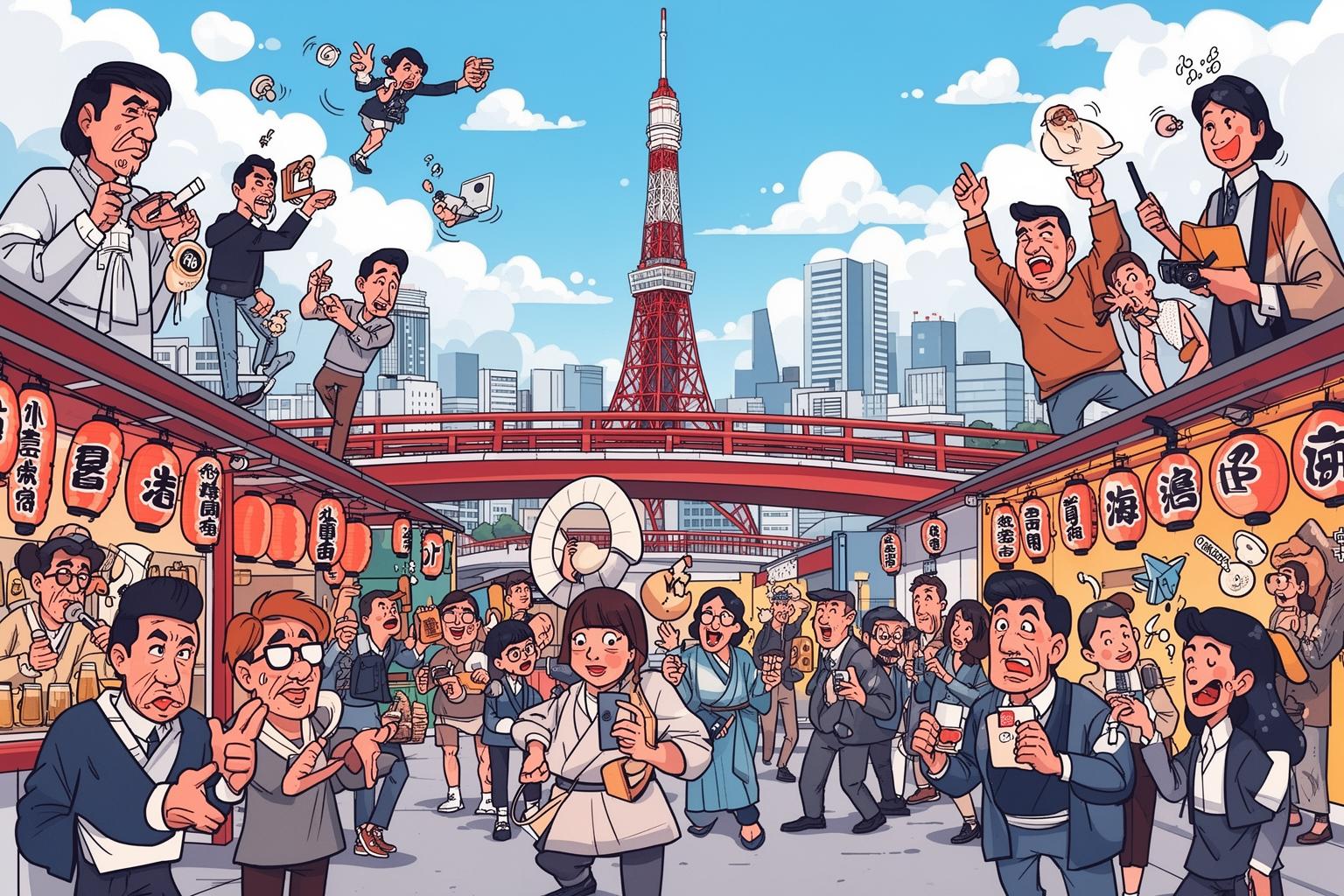
So, how do you, as a non-native, fit into this fast-paced world of banter? It can feel intimidating, especially when you’re also dealing with a language barrier. But the good news is that Osakans are generally forgiving and appreciative of any effort to join in. You don’t need to be a comedy genius to thrive here. You simply need to be willing to let your guard down, embrace a bit of absurdity, and learn to recognize a joke when you hear one. Taking part in the local culture of banter is one of the fastest ways to feel less like a tourist and more like a resident.
Don’t Be Afraid to Be the Boke
As a foreigner, you have a secret advantage: you are a natural boke. Your language mistakes, cultural misunderstandings, and confusion about which side of the escalator to stand on—all of these make perfect setups for comedic moments. Instead of feeling embarrassed by your errors, lean into them. Treat them as opportunities for shared laughter. When you accidentally ask for a “beer” instead of a “building” (biru vs biru), and the person you’re speaking with starts laughing, don’t shrink away. Laugh along with them. You’ve just created a memorable, human connection. By willingly playing the fool, you become incredibly approachable. You show that your ego isn’t fragile and that you’re open to connection—exactly what people in Osaka are looking for.
Your Go-To Tsukkomi: The Simple Nod and Laugh
You don’t need lightning-fast wit or an extensive Osaka-ben vocabulary to be an effective tsukkomi. When a shopkeeper teases you, the simplest and most effective response is often just a big smile and a hearty laugh. This is a universal signal that you caught the intention, even if you didn’t understand every word. You’ve received their boke and closed the loop. If you want to take it up a notch, a simple phrase like “Honma ya!” (You’re right!) or “Omoroi!” (That’s funny!) works wonders. The goal isn’t to out-joke the local; it’s to show appreciation for the effort and to be happy to join the performance. Acknowledging the game is all it takes to be seen as a good player.
Embrace the Chaos of the Conversation
Finally, release any expectations about how a conversation should go. Interactions in Osaka rarely follow a straight line. They can wander, get sidetracked by jokes, and involve multiple people jumping in and out. The topic might change three times in a single minute. Don’t try to steer it back to a logical path. Just hang on and enjoy the ride. The main purpose of many of these conversations isn’t to reach a conclusion, but to enjoy the act of talking. It’s in this shared, joyful, and often chaotic space that the strongest social bonds in Osaka are formed. When you stop worrying about the destination and start savoring the witty, winding journey, you’ll have truly begun to grasp what it means to communicate in this remarkable city.