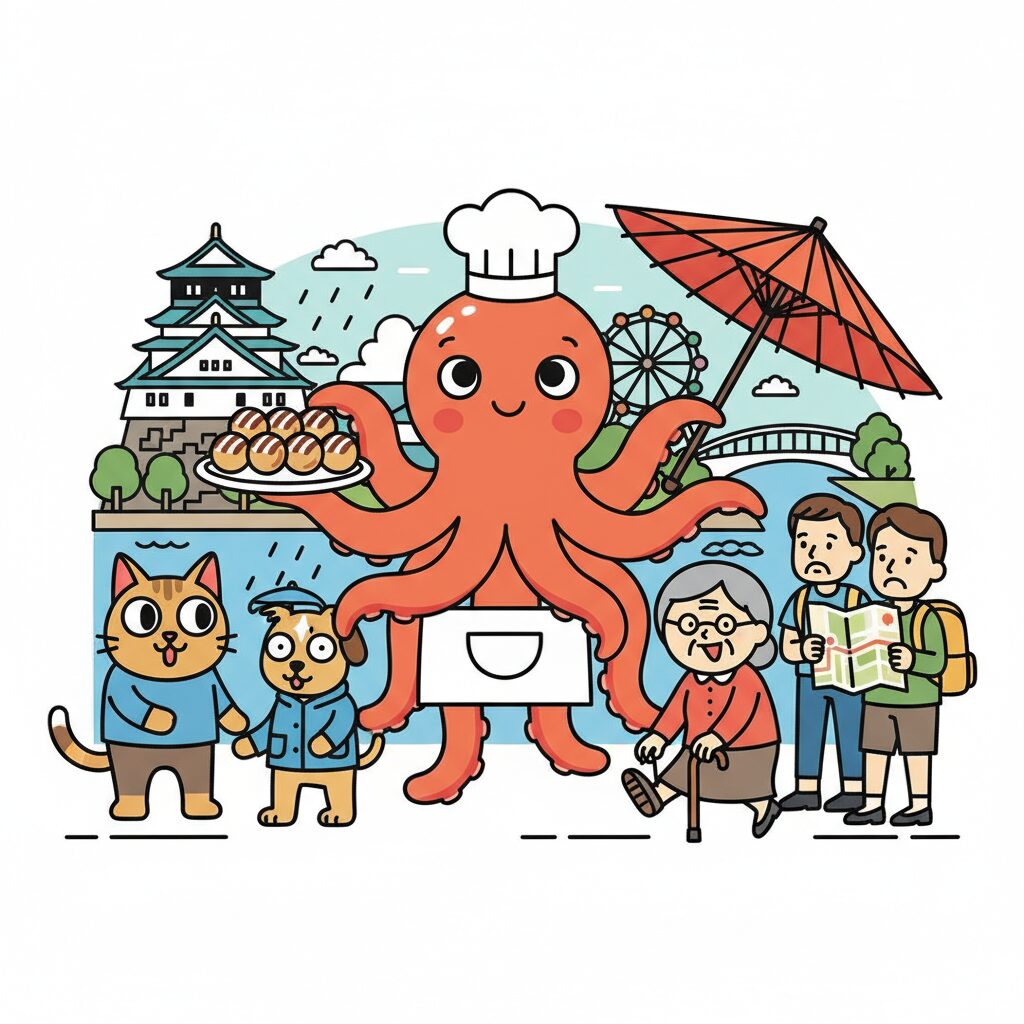
It’s a Tuesday afternoon in the belly of Umeda Station, a labyrinth designed to test the human spirit. I’m staring at a transit map that looks like a bowl of multi-colored spaghetti, trying to decipher the kanji for a local line I’ve never used. My brow is furrowed. I’m projecting an aura of pure, unadulterated confusion. In Tokyo, this is a private moment. A silent, solitary struggle where you and Google Maps become one. But this isn’t Tokyo. This is Osaka. Suddenly, a hand taps my shoulder. Not a gentle, hesitant tap, but a firm, insistent one. I turn to face a woman, maybe in her late sixties, with a cloud of perfectly permed hair and a leopard-print blouse that radiates confidence. She doesn’t ask if I need help. That would be inefficient. Instead, she points a determined finger at my ticket. “Akan!” she declares, a wonderfully concise Osaka-ben expression for “That’s no good!” Before I can respond, she’s snatched the ticket, marched me over to a different machine, jabbed a sequence of buttons with terrifying speed, and fed my coins into the slot. A new ticket pops out. She shoves it into my hand, points me toward the correct platform, gives me a thumbs-up, and then, as a parting gift, presses a small, strawberry-flavored candy into my palm. Then she vanishes back into the crowd. I was never in distress. I would have figured it out. But in her world, watching me struggle for even thirty seconds was simply unacceptable. That, right there, is the soul of ‘Osekkai.’
Osekkai (お節介) is a word that defies simple translation. Dictionaries might offer “meddlesome,” “officious,” or “nosy,” all of which carry a negative charge. And sometimes, they’re right. But in Osaka, Osekkai is a far more complex and essential part of the city’s cultural DNA. It’s an unsolicited, often overwhelming, and deeply ingrained form of proactive helpfulness. It’s the act of inserting yourself into someone else’s business, not out of malice, but from a genuine, if sometimes misguided, belief that you can and should fix their problem. For a foreign resident, navigating Osaka’s Osekkai culture is a daily tightrope walk between feeling genuinely cared for and feeling like your personal space is being invaded by a squadron of well-meaning but incredibly direct strangers. It’s the invisible force that defines life here, making it feel worlds away from the polite, beautiful, but often impenetrable bubble of Tokyo. Understanding Osekkai isn’t just a fun cultural quirk; it’s the key to understanding what daily life in Osaka is actually like.
This distinctive local dynamism resonates even in professional life, as seen through Shimatsu strategies that emphasize efficient work practices alongside community care.
The Anatomy of Osekkai: More Than Just Being Nosy
To truly understand what Osekkai is all about, you need to look beyond the surface of its loud, straightforward interactions. This behavior isn’t random; it’s a cultural pattern shaped by the city’s unique history and social fabric. It’s the result of commerce, community, and a dialect that values getting straight to the point rather than using polite, indirect pleasantries.
The Merchant Roots of a Helpful City
Osaka has always been a city of merchants. For centuries, it was known as ‘tenka no daidokoro’—the nation’s kitchen. It served as Japan’s commercial hub, where rice, sake, and countless goods were traded. Unlike Tokyo (then Edo), which was founded on the strict hierarchy of samurai and bureaucrats, Osaka was built on business. And good business depends on good relationships. In the busy markets and packed shotengai (shopping arcades), your reputation was your currency. You couldn’t afford to be distant or aloof.
This merchant heritage nurtured a strong sense of community. The success of one shopkeeper was tied to the prosperity of the entire street. If a neighbor’s business faltered, it reflected badly on everyone and damaged the local economy. This cultivated a mindset where everyone’s affairs were, to some degree, everyone else’s business. There was a shared, vested interest in the collective well-being. People looked out for one another because it made practical sense. This wasn’t abstract kindness; it was a survival tactic.
Fast forward to today, and that mentality remains. The modern Osakan may no longer be a rice merchant, but they’ve inherited that sense of communal responsibility. When they see you, a foreigner, appearing lost or confused, you become a temporary disruption to the smooth flow of their community. Helping you isn’t just a kindness; it’s a way to restore order and efficiency. It’s about addressing a problem that exists right here, right now, in their shared space. The Tokyo mindset, shaped by a more formal and hierarchical society, emphasizes respecting personal boundaries above all. Intervening without being asked is seen as intrusive. In Osaka, letting someone struggle when you could easily assist is the real social faux pas.
The Language of Intervention: How Osekkai Sounds
Part of what makes Osekkai so startling to newcomers is the manner in which it’s expressed. Osaka-ben, the local dialect, is famously direct, quick, and expressive. It cuts through the indirectness of standard Japanese often taught in textbooks. Where a Tokyo native might politely ask, “Ano, sumimasen, o-komari desu ka?” (Um, excuse me, are you having trouble?), an Osakan is more apt to say, “Chotto, soko chigau de!” (Hey, that’s wrong!).
This bluntness can easily be misinterpreted as rudeness. But it isn’t about aggression; it’s about efficiency. The aim is to convey the necessary information as quickly as possible. This straightforward style of speech is the vehicle for Osekkai. You’ll hear it everywhere.
From the owner of your local ramen shop: “Chanto tabeteru n ka? Yaseru sugiru de!” (Are you eating properly? You’re too skinny!). This isn’t a judgment on your eating habits; it’s their way of showing concern for your well-being, much like a family member would.
From a stranger at the bus stop on a chilly November day: “Nani sonna usugi de! Kaze hiku de, honma!” (What are you doing wearing such thin clothes! You’ll catch a cold, seriously!). They’re not criticizing your fashion sense; they’re genuinely worried about your health.
Grasping this is essential. The words may sound commanding or critical, but the underlying tone is one of care. It’s a pragmatic, straightforward form of affection. They treat you not as a fragile outsider to be handled with polite formalities, but as a temporary member of the local community who needs a bit of looking after.
Osekkai in the Wild: A Foreigner’s Field Guide
Once you know what to watch for, you’ll notice Osekkai everywhere. It’s an ambient aspect of the Osaka environment, much like the sound of cicadas in summer or the aroma of takoyaki near Namba station. Here are some of the most common places where you’ll come across this distinctive cultural phenomenon.
The Supermarket Saviors and Shopping Street Supervisors
The shotengai is the quintessential battleground for Osekkai. These covered shopping arcades, such as the marathon-length Tenjinbashisuji, are the vibrant heart of local life. Imagine standing in front of a greengrocer’s stall, staring at a heap of strange, unfamiliar vegetables. You’re trying to recall whether you need gobo or nagaimo for that recipe you found online. You hesitate for more than five seconds.
That’s the cue. An ‘obachan’ (a familiar term for an older woman) will appear at your side. She isn’t an employee; she’s just doing her own shopping. Sensing your hesitation, she correctly identifies it as ‘foreigner confusion’ and acts immediately. She may grab a giant daikon radish, toss it into your basket, and launch into a rapid-fire, unsolicited explanation of how it’s ideal for oden, complete with cooking tips and gestures. Don’t want a daikon? Too late. You now have one. Declining would mean rejecting the gesture, a much greater social faux pas than accepting an unwanted vegetable.
Another classic example is the ‘amechan’ (candy) custom. Osaka obachan are well known for carrying purses full of sweets. If you engage with them, if they help you, or even if you just look a bit down, chances are you’ll be offered a piece of candy. It’s a small, sweet exchange that seals a brief human connection. It says, “We’re good. We’ve interacted. Here’s a little something.”
Navigating Public Transport with Unofficial Guides
As my experience in Umeda revealed, Osaka’s train stations are hotspots for Osekkai. The city’s transit system is a complex web, and locals know it well. They spot tourists or newcomers staring at a map, and their internal ‘must-help’ alert goes off. Their assistance is frequently quite hands-on.
They won’t just point you in the right direction—that would be too passive. They’re more likely to take you by the arm and physically escort you to the correct platform, chatting all the way. They’ll explain which car is best for your transfer at the next station and when the express train departs. It doesn’t matter if you can’t catch a word of their rapid-fire Osaka-ben. Their mission is to get you from Point A to Point B, and they’ll see it through.
This is a world apart from the Tokyo experience. In Tokyo’s stations, people rely heavily on the system’s clarity. The signs are clear; officials are available if requested. Everyone is expected to navigate their own journey. To intervene would imply incompetence. In Osaka, the assumption is that the system is confusing and people are human, so naturally, they need help. It’s a fundamental contrast in the philosophy of public space: Tokyo’s is built on respectful distance; Osaka’s on collective responsibility.
The Neighborhood Watch You Didn’t Sign Up For
Living in Osaka, especially in a traditional neighborhood, means Osekkai comes home with you. Your neighbors will know your routine. They’ll be aware of when you leave for work, when you return, and most importantly, they’ll understand the garbage rules better than you.
Putting out burnable trash on a plastics day is a major offense in Japan. In Tokyo, you might receive a polite, anonymous note taped to your bag. In Osaka, you’re more likely to get a knock at your door. It’ll be your neighbor, Mrs. Tanaka, holding your misplaced garbage bag and patiently but firmly explaining the entire recycling system from scratch. She might even offer to re-sort it for you. It feels humiliating and intrusive—like you’ve broken a sacred law.
But there’s a valuable flip side to this neighborhood vigilance. The same Mrs. Tanaka who corrected your garbage etiquette will also be the first to notice if your lights haven’t been on for a couple of days. She’ll check if you’re unwell, and if you are, she might bring a pot of okayu (rice porridge). This isn’t just neighborliness; it’s the Osekkai system operating as a low-tech social safety net. In the anonymity of a big city, it’s a strange comfort to know someone would notice if you disappeared.
The Fine Line: When Osekkai Crosses Over
Despite its heartwarming, community-building appeal, let’s be honest: Osekkai can be incredibly, frustratingly annoying. The same urge that compels someone to help you with your train ticket can also prompt them to comment on your life choices with the subtlety of a sledgehammer. Knowing when and how to push back is an essential survival skill for foreign residents.
Unsolicited Advice and Personal Questions
The boundary between helpful intervention and intrusive meddling is often crossed when the conversation moves from practical concerns to personal matters. As a foreigner, you become an object of curiosity, and some Osakans feel obligated to offer guidance on your life decisions.
Prepare yourself for questions and remarks that would be considered wildly inappropriate in many Western cultures. A casual chat with a local shopkeeper can quickly turn into an inquisition about your private life.
“You’re not married yet? You’re not getting any younger! I have a nephew…” “Oh, you’ve put on a bit of weight, haven’t you? Must be all that ramen!” “You’re a photographer? Can you really make a living from that? You should get a more stable job.”
This isn’t meant to be malicious. From their perspective, they are offering valuable life advice based on experience and care. They notice a potential issue—you’re single, you’ve gained weight, your job seems unstable—and their Osekkai instinct kicks in to try and fix it. To them, these topics are not taboo; they are part of the normal conversation in a caring community. But for a foreigner accustomed to strict personal boundaries, it can feel like an overwhelming judgment.
Responding to Osekkai: A Survival Guide
How you respond to Osekkai will shape your experience living in Osaka. Having a few tactics ready can make all the difference. The key is to gauge the intent and respond appropriately.
Scenario 1: Genuinely Helpful Osekkai
This is the classic train station rescue or the supermarket vegetable lesson. The intention is pure, and the outcome positive. Resisting this kind of help is often more trouble than it’s worth and can come off as ungrateful. The best response is a bright smile and a heartfelt “Okini!”—the warm, delightful Osaka-ben word for “Thank you.” Embrace the moment. Let them help. You’ll brighten their day and get where you need to go faster.
Scenario 2: Annoying but Harmless Osekkai
This includes unsolicited advice on your job, love life, or clothing. Engaging in argument is pointless. You won’t win a debate with an Osaka obachan. The best approach is polite deflection: a simple smile, a slight nod, and a neutral phrase like “So desu ne…” (Is that so…) or “Benkyo ni narimasu” (That’s very educational/I’ll learn from that). You acknowledge their input without agreeing. You validate their Osekkai impulse while maintaining your boundaries. Then, steer the conversation elsewhere.
Scenario 3: Truly Intrusive Osekkai
This is rare but it does happen. Someone is being too pushy, too personal, or genuinely making you uncomfortable. You have the right to set limits. The key is to be firm yet polite. A straightforward “Kekko desu” or “Daijoubu desu” (No, thank you / I’m fine) delivered with a serious expression and less smiling sends a clear message. You’re not being rude, but you are ending the interaction. Since causing a scene carries a high social cost in Japan, most people will back off if you show discomfort clearly without hostility.
Osekkai as a Superpower: Why It Makes Osaka Livable
It’s easy to focus on the awkward and intrusive aspects of Osekkai, but after living here for a while, your perspective begins to change. In a world where urban centers are growing increasingly anonymous and isolating, Osaka’s Osekkai culture stands out as a bold expression of enforced community. It’s truly the city’s unique strength.
Building Community in a Concrete Jungle
Osekkai directly opposes anonymity. It compels you to interact with those around you. You can’t simply be a faceless commuter traveling between your apartment and office. The woman at the bakery will comment on your new haircut. The elderly man running the tobacco stand will ask about your weekend. You will be noticed. You will be spoken to. Whether you want to or not, you will become part of the local network of relationships.
At first, this can feel draining, especially if you’re an introvert. However, over time, it fosters a sense of belonging that is difficult to find in other large cities like Tokyo. In Tokyo, you might live for years without learning your neighbors’ names. The city thrives on polite indifference. In contrast, in Osaka, your neighbors will know your name within a week—and probably recall what you had for dinner last night. This constant, low-level social interaction gradually dissolves the loneliness of urban life, leaving you with a genuine, if sometimes noisy, feeling of belonging.
A Safety Net of Strangers
Ultimately, Osekkai acts as a safety net crafted from the goodwill of strangers. It is a collective promise that if something goes wrong, someone will step in. If you drop your groceries, three people will hurry to help you gather them. If your child falls and scrapes a knee in the park, another parent will be there with a bandage and kind words before you can even respond. If you fall ill, someone will notice.
I learned this lesson most vividly one rainy evening. I had accidentally left my apartment keys on my desk inside my locked apartment. My phone battery was low, my Japanese still shaky, and I was unsure what to do. Standing helplessly in the hallway, my neighbor—a woman I had only exchanged brief greetings with—opened her door to take out the trash. She saw the expression on my face and immediately understood. For the next hour, she took charge. She called a 24-hour locksmith, explained the situation in fluent, rapid Japanese, and even negotiated a lower price for me. She stayed with me until they arrived, making small talk to distract me from feeling foolish. She didn’t have to do any of this. But in the Osekkai culture of Osaka, leaving me stranded was not an option. In that moment, her meddling was the kindest, most comforting thing in the world. It reminded me that in this city, you are never truly alone. For better or worse, someone is always looking out for you.