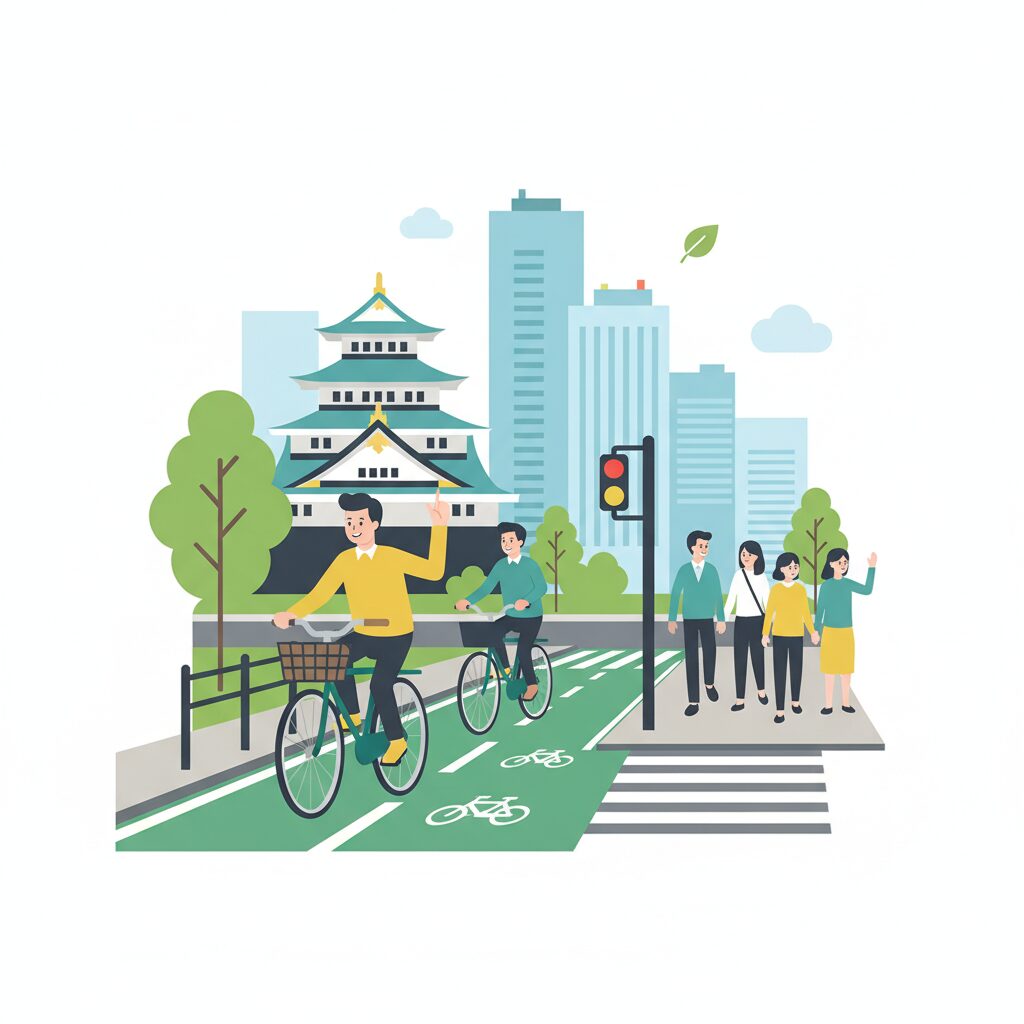
Your first few weeks in Osaka are a sensory overload, a whirlwind of neon, sizzling street food, and a dialect that sings and snaps. But beneath the obvious charms lies a subtler, more chaotic rhythm. It’s the sound of whirring chains and the gentle chime of a thousand tiny bells. It’s the sight of a river of steel and rubber flowing through streets, sidewalks, and shopping arcades with a logic that defies all conventional traffic laws. This is the world of Osaka bicycle culture, and your first encounter will likely leave you standing on a street corner, utterly bewildered. You’ll see a mother, two children loaded onto her sturdy mamachari, glide past a businessman holding an umbrella in one hand and a smartphone in the other, while a pack of high school students weaves through them all without a word, like a school of fish executing a flawless, un-choreographed maneuver. It’s not aggressive. It’s not angry. It just is. And the question that burns in your mind isn’t just “Is this legal?” but “How does this even work?”
Forget what you learned in driver’s education. Forget the neat, orderly bike lanes of other world-class cities. In Osaka, the bicycle is not just a mode of transport; it’s a prosthetic limb, an essential extension of the body for nearly every man, woman, and child. The rules they follow aren’t written in any legal code. They are learned through osmosis, practiced from childhood, and embedded deep in the city’s pragmatic, efficient, and fiercely independent soul. This isn’t just about getting from Point A to Point B. It’s a daily, city-wide performance of negotiated space, a testament to a collective understanding that runs deeper than painted lines on asphalt. To understand the heart of Osaka, you must first understand the way it rides. Before we dive into the unwritten rules of this beautiful chaos, let’s get our bearings on the city itself.
As you continue to uncover the nuances of Osaka’s buzzing streets, exploring the city’s distinctive merchant mindset provides fresh insights into the forces that drive its dynamic cultural rhythm.
The Mamachari: Osaka’s Armored Heart
To begin understanding the cycling scene, you must first acknowledge its undisputed queen: the mamachari, or “mom’s bike.” This is not the sleek, lightweight racing bicycle seen in the Tour de France. The mamachari is the urban equivalent of a pickup truck or family minivan. It’s a beast of burden, a utilitarian marvel built for durability rather than speed. Constructed from heavy steel, it’s meant to endure the daily demands of city life, from rattling over cobblestones to resting against a concrete wall for hours on end. It exemplifies Osaka’s fundamental philosophy of pragmatism over aesthetics. No one aims to impress with their mamachari; they simply use it to get through their day.
Anatomy of a Workhorse
Take a closer look at these ever-present machines. They are feats of practical engineering. The frame often has a low, step-through design, making mounting and dismounting easy—even while wearing a skirt or carrying a child. The handlebars curve back toward the rider, encouraging an upright, relaxed posture ideal for surveying the bustling environment ahead. At the front, a deep, sturdy basket serves not as a quaint accessory but as an indispensable cargo area. This is where groceries go, where school bags are tossed, and where sometimes a small dog peeks out, enjoying the ride. The real changes come with the family: a plastic child seat is securely bolted above the rear wheel, often featuring high sides and a secure harness. For families with two small children, another seat is frequently attached to the handlebars, placing the smaller child snugly between the parent’s arms. The mamachari is a family’s primary and most essential vehicle, the means for school runs, grocery trips, and weekend park outings. It’s fitted with a heavy-duty double kickstand that stabilizes it during loading and unloading. A built-in wheel lock snaps shut with a satisfying click. The light is often powered by a dynamo connected to the front tire, so there’s no need to worry about batteries, a small but brilliant touch of self-reliance. This is more than a bike; it’s a mobile command center for the Osaka family.
The Rider Archetypes
Watching mamachari riders is like seeing a cross-section of Osaka society in motion. There’s the young mother, a picture of focused determination, steering through a crowded sidewalk with a child on the back, a toddler in front, and a precarious pile of grocery bags threatening to spill from her basket. She doesn’t wobble; her movements are economical and precise. Her face is a mask of concentration as she calculates both the path of a wandering pedestrian and the opening of a shop door in a single fluid motion. Then there’s the elderly gentleman, perhaps in his eighties, riding at a slow and steady pace. His mamachari may be old and a bit rusty, but it connects him to his community, taking him to the local shogi club or his favorite coffee shop. He rides with quiet confidence, having navigated these same streets for decades. High school students pedal in groups, their youthful energy barely contained. They laugh and chat, often riding side by side, their mamacharis serving as social tools as much as transportation. And, of course, there’s the quintessential Osaka obachan (a familiar term for an older woman), often sporting a formidable full-face sun visor resembling a welding mask. She pedals with relentless, powerful rhythm, a force of nature on two wheels, parting crowds with her sheer, undeniable presence. Each rider tells a story of the city’s pulse—a daily narrative of errands, commutes, and connections.
A Symbol of Pragmatism
The mamachari perfectly symbolizes the Osaka mindset, shaped by the city’s long history as a merchant capital. In business, results matter more than appearance, and efficiency is key. The mamachari embodies this principle. It is neither sleek, fast, nor fashionable. But it works. It carries the weight of a family, endures the elements, and costs only a fraction of a car’s ownership and operating expenses. It allows a parent to drop off a child at daycare, pick up groceries, and return home—all in one efficient trip. It is a tool designed to solve urban logistical challenges as directly as possible. This rejection of frivolity in favor of function is quintessentially Osaka. It’s a city that has always valued a good deal, clever solutions, and a no-nonsense approach to getting things done. The mamachari isn’t just a bike; it’s a rolling declaration of the city’s values.
The Choreography of Chaos: Reading the Streets
Now that you are familiar with the vehicle, it’s time to learn about the environment. One of the biggest surprises for many newcomers, particularly those from Western countries where sidewalks are strictly pedestrian-only zones, is the sheer amount of bicycle traffic on the pavement. The question of “Why?” has a complex explanation rooted in history, infrastructure, and a deeply embedded social contract. Many of Osaka’s streets, especially the smaller ones weaving through its dense neighborhoods, are narrow and congested with car traffic, leaving little space for dedicated bike lanes. For decades, cyclists have used the sidewalks for self-preservation. Over time, this necessity transformed into a norm, creating a unique, shared space governed by unspoken rules.
Sidewalks as Shared Living Rooms
To grasp why this system functions smoothly without constant collisions or conflict, you need to shift your perspective. In Osaka, the sidewalk is not a sterile transit corridor; it resembles a shared public living room—an extension of the community’s social space. It’s where shopkeepers place their signs, neighbors stop to chat, and children play. Bicycles are simply one element in this lively environment. The guiding principle is not strict adherence to “lanes,” but a flexible system based on awareness and mutual respect. There is a hierarchy, but it is gentle. The elderly and people with disabilities have top priority, and cyclists are expected to give them plenty of space. Mothers with strollers are also accommodated. Essentially, everyone remains constantly aware of others, adjusting speed and path accordingly. This system is built entirely on collective, non-verbal communication.
The Eye Contact Rule
This is likely the single most important unwritten rule of navigating Osaka. Before crossing someone’s path or merging into pedestrian traffic, you make eye contact. It’s a brief glance, a quick nod, a subtle dip of the head. This is the silent agreement. It conveys, “I see you. You see me. I will proceed, trusting you to adjust your path slightly to make way, just as I will do for you.” This continuous, subconscious exchange of acknowledgments keeps the entire system functioning. It often replaces the need for stop signs and traffic lights in many low-speed situations. When a cyclist approaches a pedestrian from behind, they don’t just rush through; they slow down, wait for the acknowledgment glance over the shoulder, then proceed. Learning this silent language is essential to moving from a fearful observer to a confident participant.
The Art of the Weave
This choreography is most evident in a shotengai, a covered shopping arcade. These pedestrian-only passages are often crowded with shoppers, yet bicycles continuously glide through them. Watching a skilled Osaka cyclist navigate a shotengai is like watching a master weaver at a loom. They rely not on speed but momentum, maintaining a slow, steady pace while rarely stopping completely. Instead of moving in straight lines, they follow gentle, serpentine paths, seeking natural gaps in the crowd. Their focus extends thirty feet ahead, predicting where shoppers will move next or when a child might dart out from a storefront. It’s a mesmerizing display of spatial awareness. They flow like water around rocks—not forcing their way but always finding the path of least resistance. To outsiders, it may appear as a series of near-misses. To Osaka locals, it is simply the efficient, normal way to navigate the market.
Intersections: The Great Negotiation
Major intersections with full traffic light systems are generally respected by all. However, at countless smaller, four-way intersections scattered throughout the city’s neighborhoods, a different set of rules applies. Here, right-of-way is not an absolute dictated by signs but something actively negotiated in real-time. A car may inch forward, signaling its intent. A cyclist, seeing the car’s slow approach, will dart across. A pedestrian, noticing a gap between the bike and the next car, will move forward. This multi-party negotiation resolves within seconds, often without honking or words. It depends on everyone sharing the goal: to keep moving without collisions. This can be intimidating at first, as your instinct might be to wait for a clear, unambiguous signal. But in Osaka, waiting for the perfect opening means waiting forever. You must learn to interpret others’ intentions, express your own through confident yet cautious movement, and become part of the flow.
The Meaning of the Bell
In many cultures, a bicycle bell is an alarm, a warning, or a demanding “get out of the way!” In Osaka, the chirin-chirin bell serves a very different purpose. It is a polite announcement, a gentle heads-up—more like clearing one’s throat. Used when approaching a pedestrian from behind, it does not startle but informs them of your presence so they won’t be surprised when you pass by. Timing and frequency matter greatly. Repeated frantic ringing is seen as rude and impatient. The proper technique is a single, clear chirin from a safe distance, allowing the person ahead time to acknowledge you and, if desired, shift slightly aside. It is not a command but a courteous piece of information. Using the bell correctly signals your understanding of local etiquette, showing that you see yourself not as a vehicle demanding right-of-way but as a guest sharing the space.
Advanced Techniques and Feats of Daring
Once you’ve mastered the basics, you’ll start to recognize the virtuosos—the cyclists who have transformed riding into an art form. These are the individuals performing daily feats of balance and multitasking that seem to challenge the laws of physics. These advanced skills aren’t taught but developed through years of dedication and a profound commitment to convenience and efficiency. They represent the pinnacle of Osaka’s bicycle culture, inspiring both admiration and a hint of apprehension among newcomers.
The One-Handed Trinity: Umbrella, Phone, and Briefcase
Rain does not halt Osaka. The city does not suddenly switch en masse to trains or remote work with every downpour. Life goes on, and so must the bicycles. This necessity has given birth to one of the most iconic and impressive abilities: riding with a one-handed umbrella. The cyclist holds a full-sized umbrella overhead with one hand to shield themselves from the rain, while steering, balancing, and occasionally braking with the other. This is no wobbly, casual act. Experienced riders possess an almost supernatural sense of balance, adjusting their stance to counter the wind’s force on the umbrella. They have perfected the art of the one-handed stop—a gentle squeeze of the rear brake to prevent pitching forward. It’s a practical ballet, a graceful response to a common challenge.
The smartphone scroll is another familiar, albeit officially frowned upon, skill. With one hand lightly on the handlebars to steer, the other maneuvers a smartphone, the thumb deftly flicking through emails, news feeds, or maps. This demonstrates how deeply the bicycle is woven into daily life. The commute isn’t idle time; it’s an extension of work or social activities. It’s a tribute to the rider’s confidence, juggling two streams of information simultaneously: the digital world in their hand and the complex physical environment speeding past.
Finally, there is the salaryman clutching his briefcase. Rather than stowing it in a basket, which may be too small or considered unprofessional, he often wedges it between his torso and arm, securing it firmly while steering with both hands. This frees up the basket for a convenience store bag. It’s a simple, elegant solution that keeps professional belongings close and secure.
Tandem Riding and Its Variations
The practice of futari-nori, or two people riding on one bicycle, is technically illegal but widely tolerated under certain circumstances. It’s most common among young people. You’ll see high school couples, the boy pedaling while the girl sits gracefully on the rear cargo rack, arms wrapped around his waist. It’s a portrait of youthful romance, a shared moment of freedom and intimacy. You might also spot a mother giving her older child, who’s outgrown the child seat, a short ride home from the station. This is not regarded as reckless endangerment but as a practical solution for short trips. Authorities tend to look the other way, recognizing it as part of social custom—a minor violation born of convenience rather than harm.
Cargo Cult: The Masters of Logistics
The carrying capacity of an Osaka cyclist is truly remarkable. You’ll witness logistical feats that would leave professional couriers envious. There’s pride in making just one trip. This leads to some astonishing scenes: a student riding with a cello strapped to their back; a restaurant worker balancing stacks of steaming ramen bowls on a special tray mounted on the rear rack; a handyman distributing pipes, tools, and a bag of cement mix between his basket and bungee cords. I once saw a man transporting a small washing machine in his front basket, steering with a grim look of determination. This is the merchant spirit in full force: maximize efficiency, make the most of every resource, and never make a second trip if it can be avoided.
The Provincial Divide: How Osaka’s Flow Baffles Tokyo
The distinctiveness of Osaka’s cycling culture becomes most evident when compared to Tokyo. Cycling in Tokyo means experiencing order, predictability, and a quiet, intense social pressure to conform. In contrast, cycling in Osaka means experiencing freedom, chaos, and a shared understanding that the destination matters more than the method. These two cities embody a fundamental philosophical divide in the Japanese mindset, which plays out daily on their streets.
Tokyo’s Code: Rules Must Be Followed
In Tokyo, rules exist and are adhered to strictly. If there is a designated bike lane, you use it. You ride single file. You stop at every red light, even on a deserted street at 3 AM. You give pedestrians a wide, apologetic berth. Cycling on a crowded sidewalk is a major social no-no, sure to draw disapproving looks and tuts. The entire system is based on the belief that following the rules ensures a safe and efficient environment for everyone. There is a feeling of being a small, responsible part of a vast, well-oiled machine. Breaking the rules disrupts the harmony and must be avoided at all costs. The pressure to conform is intense but unspoken. Tokyo prioritizes order and predictability above all else.
Osaka’s Logic: The Destination Comes First
Osaka follows a different logic. The priority is to reach your destination efficiently and safely. Rules are treated as guidelines to support that aim, not as inviolable laws. If a rule impedes efficiency without significantly compromising safety, it’s often seen as a suggestion. Why wait at a red light if no cars are coming? Why ride on a narrow road when a wide, empty sidewalk is right beside it? This approach isn’t driven by a desire for disorder but by deep pragmatism. Osaka cyclists constantly assess risks and rewards. The unwritten social contract allows this flexibility, with the understanding that everyone must stay aware and avoid causing problems for others. It’s a system based on individual responsibility within a community rather than strict obedience to top-down rules.
When Worlds Collide
The contrast becomes humorously clear when cyclists from one city navigate the other. A Tokyo native cycling in Osaka is often stuck in indecision, waiting for clear signals and gaps that rarely appear, creating a line of impatient but good-natured Osaka locals weaving around them. Conversely, an Osaka cyclist in Tokyo is like a bull in a china shop. Their fluid, opportunistic riding is deemed reckless and rude. Their cheerful use of the bell is mistaken for aggression. Their casual sidewalk riding provokes silent, cold fury. This starkly illustrates the cultural divide: Tokyo’s focus on social harmony through collective restraint versus Osaka’s emphasis on individual energy and practical efficiency.
The Parking Puzzle and the Impound Gambit
For every action, there is an equal and opposite reaction. The freedom and convenience of cycling through Osaka come at the Sisyphean cost of parking your bike. With millions of bicycles on the streets, designated parking spots are scarce, resulting in another intriguing example of organic, rule-bending urban life. This is the ultimate unspoken social contract: where and how you leave your bike when you’re not riding it.
The Tetris of Bicycle Racks
Official bicycle parking areas, often found near train stations or large department stores, are quite a sight. They range from simple outdoor racks to futuristic, multi-level automated garages where machines whisk your bike into an underground vault. The outdoor lots resemble a daily game of Tetris. The spaces are incredibly tight, and fitting your bike in without tangling handlebars with your neighbor’s requires skill. It demands a specific technique of lifting, adjusting, and sometimes apologizing to the bike next to yours. The automated garages showcase Japanese engineering marvels but can intimidate newcomers and quickly fill up during peak hours.
Guerilla Parking and its Etiquette
Due to the scarcity of official spots, most bicycle parking in Osaka is unofficial, or “guerilla,” parking. Bikes are lined up against any solid surface available: guardrails, fences, building walls, and signposts. It may seem chaotic, but a subtle etiquette governs this practice. Rule one: never block a pathway. You must leave enough space for pedestrians, wheelchairs, and strollers to pass comfortably. Rule two: never block an entrance. Parking in front of a shop or apartment’s main door is a cardinal sin, both disrespectful and harmful to business. Rule three: respect designated no-parking zones, usually marked with conspicuous red signs. These areas are frequently patrolled, leading to the ultimate rite of passage for any Osaka cyclist.
The Silver Sticker of Shame
One day, you’ll come back to where you parked your bike, only to find it gone. In its place, stuck to the pavement or railing, is a sticker or laminated notice informing you that the city has removed your bicycle. This is the impound notice—the silver sticker of shame. Your heart sinks. At first, you might think it’s been stolen, but the official notice reveals a different, bureaucratic reality. Following its instructions, you embark on a quest to a municipal impound lot, often located in a remote, inconvenient part of the city. You pay a fine, show proof of ownership, and enter a bicycle graveyard—an enormous lot filled with hundreds, if not thousands, of confiscated mamacharis. After a long search, you find your bike, reclaim it, and begin the slow, sheepish ride home. Every cyclist in Osaka experiences this at least once. It’s the city’s way of periodically culling the herd and reminding everyone that although the rules are flexible, they are not entirely imaginary.
Your Guide to Joining the Flow
Reading about this complex, chaotic, and beautiful system is one thing; actively participating in it is quite another. It can be intimidating, but with the right mindset, not only is it achievable, it’s also incredibly rewarding. Riding a bike is undoubtedly the best way to explore the hidden corners and true character of Osaka. To help you move from a scared pedestrian to a confident cyclist, here are a few guiding principles.
The First Rule is to Pay Attention
The unspoken rules of the system rest on mutual awareness. This isn’t the time for podcasts or loud music through headphones. You need to engage all your senses. Keep your eyes constantly scanning—forward, sideways, and with quick checks behind you. Your ears should tune in for the jingle of other bike bells, the hum of approaching electric cars, and the footsteps of pedestrians. You’re not just operating a vehicle; you’re an active participant in a dynamic, ever-shifting environment. Your safety, as well as that of others, depends on your ability to remain alert and aware.
Be Predictable, Not Right
In a system governed by flexible rules, predictability is key. Your aim should be to avoid surprising anyone. This means making smooth, deliberate movements. If you plan to turn, signal your intention with a glance or subtle body language well ahead of time. Avoid sudden stops or quick swerves. Remember, being technically “right” according to traffic laws offers little comfort if you cause a collision by making an unexpected move. Flow is king. Your role is to merge seamlessly, telegraphing your intentions so others can anticipate and react to you just as you do to them.
Master the Slow Roll
Newcomers often make the mistake of operating in extremes: either full speed or a complete stop. Watch seasoned Osaka cyclists, and you’ll see they seldom come to a full halt unless absolutely necessary. Instead, they excel at the slow roll—a low-speed, highly balanced crawl that lets them keep momentum while maneuvering tight spaces or waiting for a small gap in traffic. This is far more efficient than constant stopping and starting. Practice in a quiet park or street. Find your bike’s tipping point and learn to control it at a walking pace. This skill alone will greatly enhance your ability to navigate the city’s crowded arteries.
A Final Word of Encouragement
Osaka’s bicycle culture might seem like an impenetrable wall of chaos at first. It challenges everything you thought you knew about traffic, rules, and public spaces. But don’t be discouraged. Embrace the learning process. Start slow. Watch, listen, and absorb. Rent a bike for a day and simply try to keep up with the flow in a quiet neighborhood. You will make mistakes. You’ll probably hear a few gentle bell chimes aimed your way. But you will learn. And once you do—once you feel that moment of synchronization with the city’s unique rhythm—it’s pure liberation. You’re no longer just an observer of Osaka life; you become part of its pulse. Moving through its veins, uncovering its secrets, and participating in the beautiful, unspoken dance that makes this city maddening, efficient, and wonderfully alive.