
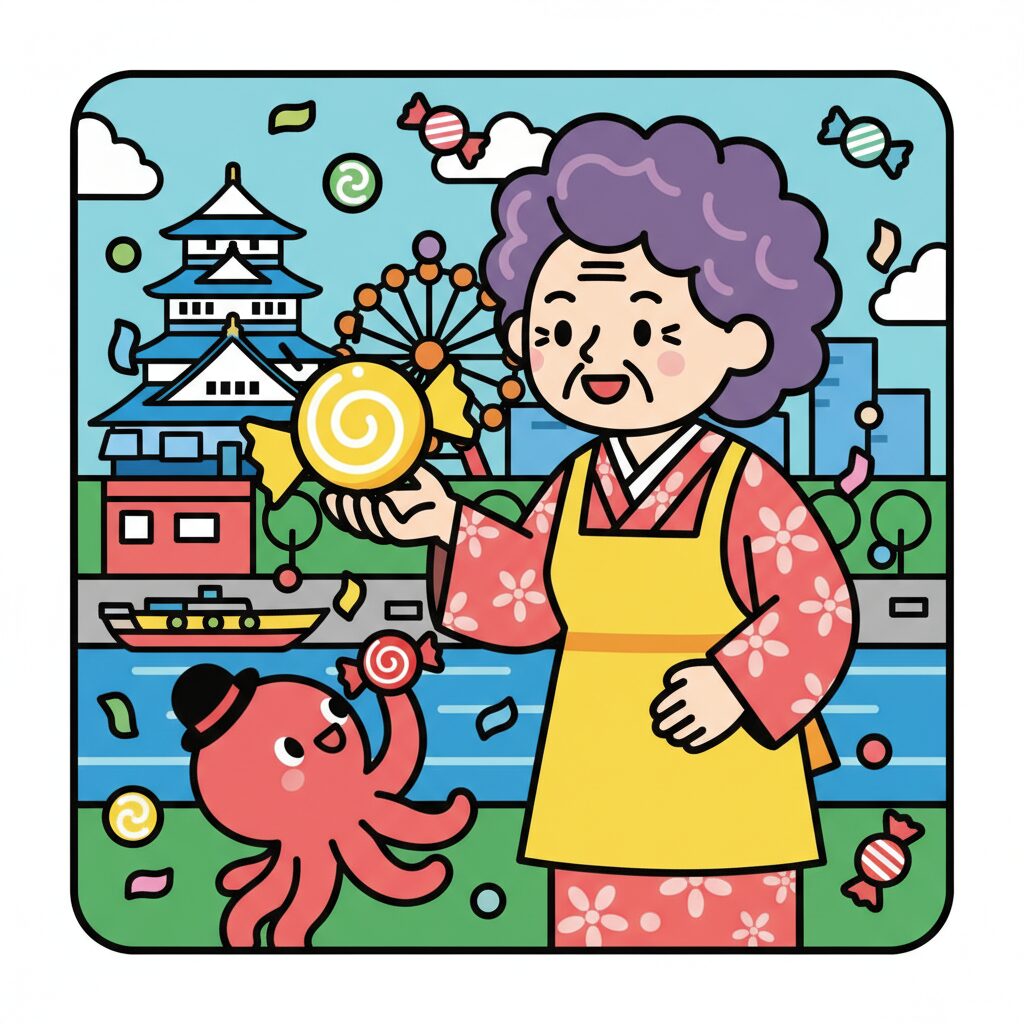
The first time it happened, I was completely baffled. I was on the Sakaisuji Line, heading toward Tenjinbashisuji 6-chome, a classic Osaka afternoon unfolding outside the window. The train car was a gentle hum of quiet conversations and the rhythmic clatter of the tracks. A few seats away, a toddler, previously content, decided his patience had expired. The protest started small, a whimper that quickly escalated into a full-blown, ear-splitting wail. The young mother, her face a mask of frantic apology, tried every trick in the book to soothe him. Nothing worked. The air in the car grew thick with a collective, unspoken tension. Then, magic happened. From across the aisle, a woman who looked to be in her late sixties, sporting a spectacular lavender-tinted perm and a vibrant, tiger-striped blouse, leaned forward. She didn’t say a word at first. Instead, she began a determined rummage through a cavernous leather handbag. A moment later, she produced a small, brightly wrapped candy. With a practiced flick of the wrist, she caught the mother’s eye, smiled a wide, reassuring grin, and offered the candy with a knowing nod. “Boku, kore taberu?” she cooed at the child. “Want this, little guy?” The mother bowed repeatedly, a flurry of “Sumimasen, sumimasen,” the child, distracted by the shiny object, instantly quieted. The tension in the train car evaporated. It was as if a spell had been broken. My Japanese was decent, but my cultural fluency was still in its infancy. I had just witnessed my first ‘Ame-chan’ exchange. I saw a piece of candy, but what I’d really seen was the heart of Osaka in action. It was a gesture that seemed so small, yet it explained more about this city’s soul than any travel guide ever could. For anyone trying to understand what makes Osaka tick, what makes its daily life so profoundly different from the reserved elegance of Tokyo, the answer starts here, with a simple piece of hard candy and the formidable women who wield it.
This small but significant act is a window into the vibrant Osaka amen-chan culture that energizes the city’s everyday interactions.
What Exactly is ‘Ame-chan’? More Than Just Candy
First, let’s analyze the language. In Japanese, ‘ame’ (飴) means candy. The suffix ‘-chan’ (ちゃん) is a diminutive term of endearment, commonly used for children, pets, or close friends. Thus, ‘Ame-chan’ isn’t just ‘candy’; it conveys ‘dear little candy’ or ‘cute candy.’ This linguistic nuance is your initial hint. It presents the item not merely as a sweet but as something familiar, gentle, and friendly. This isn’t about giving expensive Godiva chocolates or artisanal caramels. The traditional Ame-chan is simple and humble. We’re referring to timeless, individually wrapped hard candies that have been staples in Japan for generations. Consider ‘Kuro-ame‘ (black sugar candy) with its rich, molasses-like flavor. Or perhaps ‘Mikan-ame’ (mandarin orange candy), evoking a nostalgic winter citrus taste. There are also milky hard candies like ‘Ichigo Miruku’ (strawberry milk) or the straightforward, refreshing ‘Hakka-ame’ (mint candy). The essential point is that these candies are shelf-stable, portable, and universally pleasant. They are the workhorses of the candy world. Offering an Ame-chan is a ritual, a piece of social choreography performed thousands of times daily throughout the city. It’s a transaction where the currency is not yen, but kindness. It serves as a tool for social engineering, smoothing over awkward moments, building brief connections between strangers, and adding a small dose of sweetness to the often impersonal rhythm of urban life. It’s a social lubricant, an icebreaker, and a tiny peace treaty all wrapped in a crinkly piece of plastic. Understanding Ame-chan means understanding that in Osaka, small gestures carry great significance. They form the foundation of the city’s famously warm and welcoming atmosphere.
The Guardian of the Candy: Meet the Osaka Obachan
At the center of the Ame-chan universe stands its undisputed queen: the Osaka ‘Obachan‘ (auntie/middle-aged woman). It’s easy to fall into stereotypes here—the loud, boisterous woman clad head-to-toe in leopard print with a booming laugh. While you will certainly encounter her, and she is magnificent, the truth is far more complex and powerful. The Osaka Obachan is the matriarch of the public realm. She is a force of nature, a wellspring of communal wisdom, and the self-appointed guardian of neighborhood harmony. Where a Tokyo resident might show social responsibility through quiet conformity and unobtrusive behavior, the Osaka Obachan embodies it through active, vocal, and direct involvement. She’s the one who will tell you your shoelace is untied, comment on how cute your dog is, or offer unsolicited yet surprisingly useful advice on removing a stubborn stain from your shirt. Her confidence is her trademark accessory. The famed love of animal prints isn’t merely a fashion statement; it declares, “I am here, I am visible, and I refuse to be dull.” Her handbag is far more than just a bag; it’s a mobile command center, an urban survival kit. Inside, you’ll find tissues, a foldable fan, a small sewing kit, perhaps a coupon for the local supermarket, and nestled in a special pocket or pouch, an apparently endless supply of Ame-chan. These candies are her principal tool of diplomacy. She distributes them with the authority of an experienced ambassador. She drives the Ame-chan economy. The gesture extends her role as a community caretaker. By offering candy to a fussy child, she’s not only helping the parent but restoring tranquility to the entire train car. She preserves the ‘wa’ (harmony), but in a distinctively Osaka manner—not through silent passivity, but through proactive intervention. She is the city’s social glue, and Ame-chan is her favored adhesive.
The Unspoken Rules of the Ame-chan Exchange
For a foreigner, experiencing or receiving an Ame-chan offering can be a moment of charming confusion. There are unspoken rules and a subtle etiquette that shape the entire interaction. Learning to read the situation is essential to navigating this sweet aspect of Osakan life.
The Context is Everything
The Ame-chan doesn’t materialize out of nowhere. It’s almost always triggered by a specific circumstance. As noted, a crying child is the most classic example. It’s a practical solution to a mutual problem. But it can also arise during quiet moments of connection. You might be standing in a long line at the ward office, sharing a sigh of collective boredom with the woman beside you. That shared sigh might be enough to earn you an Ame-chan. Or perhaps you help an elderly person pick up something they’ve dropped. The verbal “thank you” will almost certainly be accompanied by the offering of a candy. It’s a tangible token of gratitude, a way to make the thanks more concrete. It can also be a simple reward for cuteness—babies, toddlers, and sometimes even well-behaved pets are prime recipients.
The Art of Accepting
So, an Obachan extends her hand, a small, wrapped candy resting in her palm. What should you do? Your foreign instinct might be to politely refuse, not wanting to impose. In Osaka, this can be misunderstood. Declining the candy can feel like rejecting the connection. The best approach is to accept it graciously. The proper verbal response is an important part of the ritual. You’ll hear Japanese people say, “Sumimasen, arigatou gozaimasu.” To a learner, this might seem odd. “I’m sorry, thank you very much.” Why apologize? The ‘sumimasen’ here isn’t an expression of guilt. It’s a softener, an acknowledgment of the other person’s effort. It means, “I’m sorry for the trouble you’ve gone to,” or “Thank you for taking the trouble.” It’s a beautiful piece of Japanese linguistic nuance that honors the giver’s kindness. Pair this with a smile and a slight bow or nod. You don’t need to eat the candy immediately. Simply accept it, tuck it in your pocket or bag, and the social exchange is complete. You’ve successfully fulfilled the ritual.
Giving and Receiving
While Obachan are the primary givers, the act isn’t exclusive to them. ‘Ochan’ (uncles/middle-aged men) may also offer candies, though often with less flourish. And it’s not only for children. As a young adult, I’ve received Ame-chan many times—after a brief chat about the weather, or simply for appearing a bit tired on the train. It’s a gesture of gentle encouragement, a quiet “chin up.” It transcends generational and social boundaries with ease, delivering a universally understood message of goodwill.
Ame-chan as a Communication Starter
This is where the sharp contrast with Tokyo becomes unmistakably clear. A typical train car in Tokyo feels like a bubble of private worlds. Everyone is absorbed in their phone, a book, or a deliberately blank gaze into the distance. Unsolicited conversation with a stranger is a significant breach of social protocol—it simply doesn’t happen. The silence reflects a mutual respect for personal space. In Osaka, that personal space is somewhat more permeable. The Ame-chan often acts as the key that opens the door to conversation. Offering the candy is Act One. Act Two is the follow-up question, such as “Kawaii desu ne. Nan-sai?” (“So cute. How old is he/she?”) directed at the mother of the now-pacified child. For a foreigner, the classic might be, “Doko kara kimashita ka?” (“Where are you from?”). The candy functions as a conversational passport, granting permission to engage further. It transforms a group of anonymous commuters into a temporary micro-community. I’ve witnessed entire sections of a train car become involved in lighthearted chatter, all sparked by a single piece of black sugar candy. This is essential to understanding daily life in Osaka. The city operates on a different social system—one that values connection over privacy, interaction over anonymity. People talk to each other—in the street, in shops, in parks. The Ame-chan is both a cause and a reflection of this talkative, communal culture. It fuels the cycle of communication by continuously creating small opportunities for it to happen. It keeps the city’s social muscles flexible.
Beyond the Candy: What Ame-chan Really Represents
If you still believe this is merely about candy, you’re overlooking a much larger meaning. The Ame-chan ritual offers a glimpse into the fundamental values of Osaka. It serves as a tangible expression of the city’s character, embodying a way of life you can literally hold in your hand.
Kindness as a Practical Tool
Osakans are known for their pragmatism. This city was built by merchants who prioritized practical solutions and concrete results over abstract ideas. The Ame-chan represents the ultimate practical act of kindness. Facing a problem—a noisy child, a drop in blood sugar, or a lull in conversation—here is a simple, inexpensive, and effective response. It’s not about making a grand philosophical statement of compassion; it’s about solving a small issue immediately with whatever is at hand. This approach permeates life in Osaka, where people are direct, results-driven, and committed to helping others in tangible ways.
A Defense Against Urban Anonymity
Living in a sprawling metropolis can often feel isolating. It’s easy to become just another face lost in a sea of millions. The Ame-chan is a subtle act of resistance against that anonymity. When an Obachan offers you candy, she’s saying, “I see you. You’re not just a stranger on this train; you’re a fellow human sharing this moment with me.” These small, repeated acts of acknowledgment create a social safety net, forging weak connections between strangers and fostering a sense of shared identity and mutual responsibility—qualities noticeably weaker in other large Japanese cities. It’s the city’s way of preserving its humanity.
The Legacy of a Merchant City
Historically, Osaka was Japan’s commercial hub, known as the ‘nation’s kitchen.’ Business thrived on relationships, trust, and continual give-and-take. Merchants understood that cultivating ‘shin’yo’ (trust/credibility) was crucial, achieved through dependable interaction and small acts of goodwill. While the connection may not be direct, the spirit of this merchant ethos lives on in the Ame-chan exchange. It acts as a means of keeping positive social accounts, depositing small acts of kindness into a communal bank of goodwill. This philosophy of investing in the community through small gestures ultimately helps create a more pleasant, connected, and supportive environment.
A Foreigner’s Guide to Navigating the Sweet Side of Osaka
So, how do you, as a non-Japanese resident, fit into this sweet ecosystem? The first step is simply to be open to it. When it occurs, don’t overthink it. Don’t worry about hidden meanings or obligations. See it for what it is: a simple, warm gesture of welcome.
Embrace the moment. Smile. Accept the candy with a ‘Sumimasen, arigatou gozaimasu,’ and you’ll have made a genuine connection. The Obachan will likely be delighted. For many, sharing this piece of their culture with a foreigner is a source of pride. You’re not just receiving candy; you’re being invited, even if only briefly, to be an insider. Now, if you want to advance to the next level of Osaka cultural fluency, there’s an advanced move: carry your own Ame-chan. It’s not expected at all, but if you find yourself able to offer one—perhaps to a fussy child nearby—the reaction will be remarkable. It’s a powerful signal that you’re not merely a tourist or temporary resident. It shows you’ve been paying attention, that you understand local customs, and that you wish to participate, not just observe. Offering an Ame-chan as a foreigner is like learning a secret handshake. It will open doors to conversations and connections you never imagined. It will earn you instant respect, especially from the Obachan cohort, the true guardians of local culture.
Picture the scene: you’re at a local park in Nagai. A young family is nearby, and their toddler takes a tumble. After the parents comfort him, you lean over with a smile and offer a small candy. The parents’ surprise quickly turns to delighted appreciation. You’ve just spoken a sentence in the deepest, most authentic dialect of Osaka—the language of practical kindness.
The Final Takeaway: Why a Piece of Candy Explains Osaka
Ultimately, Ame-chan is much more than just a sugary treat. It serves as a symbol—a social tool and a tiny, edible piece of Osaka’s spirit. It perfectly captures the city’s character: straightforward, warm-hearted, practical, and deeply communal. It reflects the fundamental difference in social philosophy between Osaka and Tokyo. Tokyo’s harmony arises from elegant restraint and carefully maintained distance, while Osaka’s harmony is shaped by active engagement, lively conversation, and shared candy. For anyone deciding where to live in Japan, this small cultural ritual offers a revealing litmus test. Do you prefer the quiet, orderly anonymity of a city that prioritizes your personal space above all else? Or do you flourish through spontaneous connection, finding comfort in the idea that a stranger might offer you candy just to brighten your day? If the latter resonates with you, if the image of a city held together by countless small acts of generosity brings a smile, then the vibrant, noisy, and delightfully sweet chaos of Osaka may be the perfect place to call home. Just make sure to leave some room in your bag for Ame-chan—you’re going to need it.








