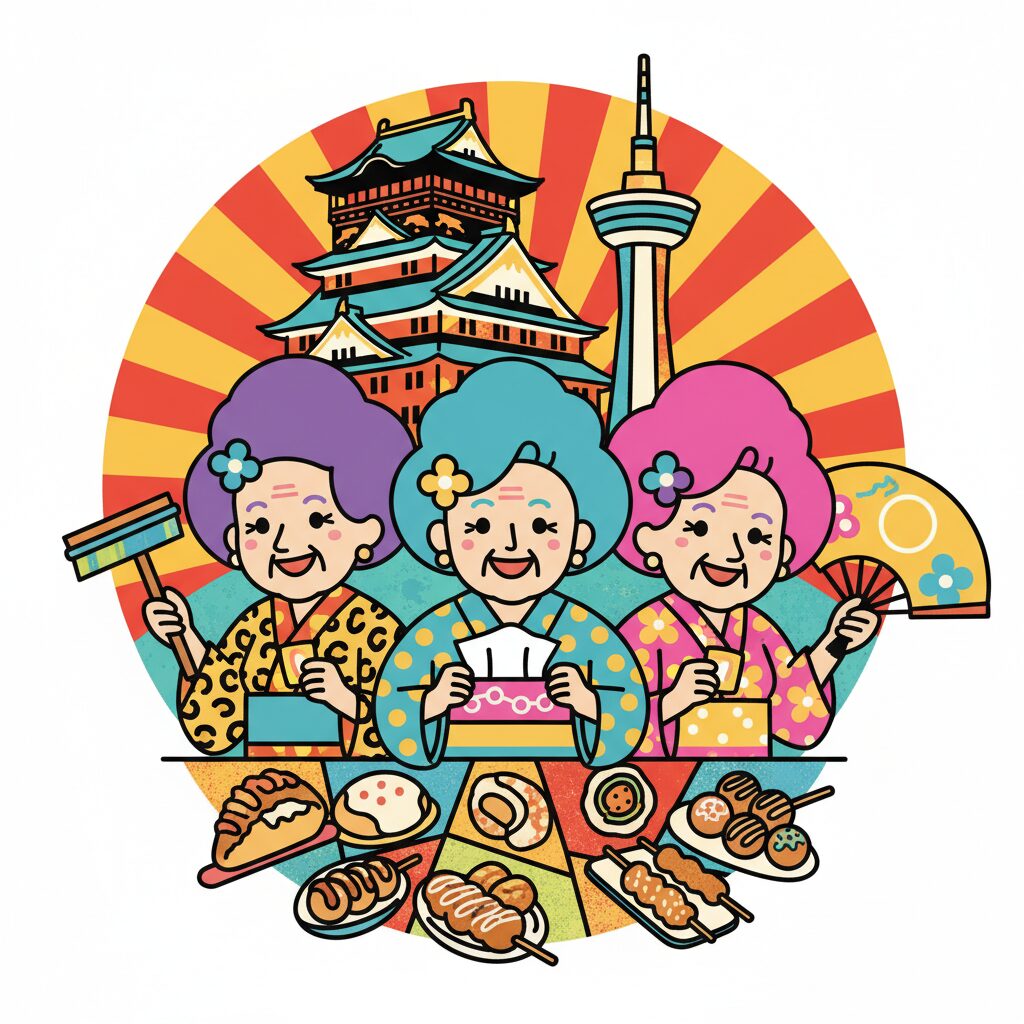
You see them everywhere, from the bustling shotengai of Tenjinbashisuji to the quiet residential lanes of Kitabatake. They move with a purpose that defies their age, a flash of gold lamé catching the sun, the unmistakable pattern of a big cat on a blouse or a handbag. This is the Osaka obachan, a figure as iconic to the city as takoyaki or the Glico Running Man. For many newcomers, particularly those arriving from the polished, whisper-quiet corridors of Tokyo, she is a cultural phenomenon, a walking, talking embodiment of everything that makes Osaka so bewilderingly different. The stereotype is potent: loud, pushy, dressed in animal prints, and armed with a seemingly endless supply of hard candies, or ame-chan, ready to be dispensed at a moment’s notice. But to dismiss her as a mere caricature is to fundamentally misunderstand the engine that powers this city’s social life. The Osaka obachan is not just a middle-aged or elderly woman; she is a social institution, a community hub, and the unofficial guardian of the city’s unwritten rules. To truly grasp what it means to live in Osaka, you must look beyond the leopard print and learn to read the complex, powerful language of its matriarchs. They are the key to unlocking the city’s vibrant, chaotic, and deeply human heart.
Moreover, the maze-like dynamics of Osaka life invite a closer look at how the rental guarantor system intertwine with the city’s multifaceted blend of tradition and modernity.
The Anatomy of an Osaka Obachan: More Than Just Fashion
Before grasping their role, you need to deconstruct the image. Every detail of the classic obachan persona, from her clothing to her candy, serves as a carefully selected tool for navigating and shaping her surroundings. It’s a performance of identity grounded in decades of Osakan culture, where pragmatism, confidence, and connection are the highest virtues.
The Leopard Print Uniform: A Badge of Honor, Not a Cliché
Throughout most of Japan, fashion tends to emphasize elegant subtlety and seamless blending. The aim is not to stand out but to belong, conveying quiet competence. The obachan’s wardrobe boldly rejects this entire mindset. The leopard print, vivid purples, and sparkling accessories are not fashion missteps. They are a statement of presence. In a city shaped by merchants, visibility equals strength. Being memorable, even a bit audacious, is a valuable asset.
This aesthetic choice clearly signals: “I am not invisible. I am confident, approachable, and unafraid to occupy space.” It serves as a visual icebreaker. In Tokyo, striking up a conversation with a stranger on the train is rare and often awkward. In Osaka, an obachan’s vibrant blouse almost acts as an invitation. It expresses a personality open to interaction. From a safety standpoint, this confidence also acts as armor. A woman projecting such unapologetic self-assurance is less likely to be perceived as an easy target. The fashion is functional; it establishes her persona before she utters a word. It’s a uniform signifying her status as a seasoned, influential community member.
“Ame-chan”: The Currency of Connection
Never underestimate the influence of the ame-chan. That small, crinkling piece of hard candy, produced from a roomy handbag, is one of the obachan’s most vital tools for social navigation. It’s much more than just a treat; it’s a versatile social device. Offering an ame-chan is a micro-transaction of goodwill, instantly creating a moment of shared humanity.
Watch it in action. An obachan might offer one to a cranky child on the subway, earning a grateful nod from the overwhelmed parent and diffusing a tense public moment. She might give one to a young cashier after a brief friendly exchange, turning a routine transaction into a personal connection. For a foreigner who looks lost or confused, receiving an ame-chan is a gentle, disarming welcome. It says, “It’s okay, relax, you’re among friends here.” It costs next to nothing, yet it can soothe nerves, spark conversations, express gratitude, and forge brief but meaningful bonds. It functions as the city’s unofficial currency of kindness, with the obachan acting as skilled bankers managing its distribution.
The Voice That Carries: Communication as a Community Service
The volume of conversations in Osaka can be startling to outsiders. What may seem like shouting is, locally, simply efficient communication. Osaka is a city of bustling markets, crowded shopping arcades, and busy train stations, where ambient noise is high. To be heard, one must speak loudly. The obachan’s strong voice is a practical response to this environment.
Yet, it also reflects a deeper cultural preference for directness. In Tokyo, conversations are often layered with politeness and ambiguity (honne and tatemae), requiring people to read between the lines. The Osaka obachan has little patience for such nuance. She speaks plainly and clearly. This isn’t rudeness; it’s honesty. It cuts through misunderstandings and addresses matters head-on. When an obachan tells a shopkeeper the daikon radishes aren’t fresh today, it’s not an insult. It’s a straightforward observation, part of a longstanding relationship based on trust and frankness. This direct style of communication is the community’s lifeblood, and the obachan are its most fluent speakers.
The Obachan as Neighborhood Infrastructure
While each obachan’s personality is strong, their true strength comes from their collective role. They are not isolated individuals but form an invisible, highly effective network that acts as the backbone of neighborhood life. They serve as analog social media, hyperlocal news sources, and unofficial emergency response systems, all in one.
The Unofficial Neighborhood Watch
Long before security cameras and digital surveillance existed, there was the obachan. Whether perched on a stool in front of her shop, standing on her balcony watering plants, or taking her daily walk to the supermarket, she observes everything. Her gaze is a continuous, sweeping patrol of her territory. She understands the daily rhythms of the street with an intimacy no technology can match.
She knows which children should be walking home from school by 3:15 PM. She is aware that elderly Mr. Tanaka in the corner house always picks up his newspaper by 7 AM. She notices when an unfamiliar van has been parked on the street for two days in a row. This is not idle curiosity but a form of passive, persistent vigilance. If a child doesn’t come home on time or if Mr. Tanaka’s newspapers begin to accumulate, she is often the first to notice and take action. She might make a call, knock on a door, or alert other neighbors. In a country with an aging population, this informal safety net is incredibly important. The obachan network provides a layer of security and care deeply woven into daily life, offering peace of mind that no formal system can fully replicate.
The Keepers of Local Knowledge
Forget Google Maps or Yelp. The ultimate source of practical, high-quality local information is the neighborhood obachan. She is a living database, a human search engine for the community. Her knowledge is not abstract but gained through decades of hands-on experience living and shopping in the area.
Want to know where to find the freshest fish, the cheapest vegetables, or a tailor skilled at mending a torn jacket? Ask an obachan. She can tell you which local clinic has the most patient doctor, which park is safest for children to play in, and the best time to visit the post office to avoid queues. This information is invaluable for anyone, especially newcomers trying to navigate a new environment. Building a friendly rapport with the local obachan is like being given a key to the city. They are the gatekeepers of the essential, unwritten guide to living well in their part of Osaka. Their advice is freely shared, born of a genuine desire to be helpful and to maintain a well-functioning community.
The Art of the Bargain: More Than Just Saving Money
Watching an obachan haggle at a market in a shotengai is like observing a master at work. It’s a performance filled with drama, humor, and skill. But the goal isn’t simply to save a few yen. Bargaining is a crucial social ritual that reaffirms the relationship between customer and shopkeeper.
The exchange begins with a friendly greeting, followed by comments on the weather or local news. Next comes the evaluation of the goods, mixing compliments with gentle critiques. The negotiation itself is a playful back-and-forth, a verbal dance. “A little extra for me, since I’m such a good customer?” she might say with a wink. The shopkeeper might sigh dramatically before tossing an extra onion into her bag. This interaction strengthens social bonds. It turns a simple purchase into a shared experience, reinforcing that they are not anonymous participants in a transaction but neighbors in a community. An obachan’s skill in navigating this ritual marks her social integration and influence.
Navigating the Obachan Social Code: A Guide for Newcomers
For foreigners, interacting with an Osaka obachan can initially feel intimidating. Their straightforwardness may be mistaken for aggression, and their familiarity might come across as intrusive. However, grasping the underlying intentions is essential to fostering positive relationships and integrating into local life.
The “Atsukamashii” Misunderstanding: Boldness vs. Rudeness
There is a Japanese term, atsukamashii, which can be translated as shameless, impudent, or pushy. In many parts of Japan, it carries a strong negative connotation. In Osaka, however, the meaning is softened. Here, a certain degree of atsukamashii behavior is not only tolerated but often valued as a sign of honesty and straightforwardness.
An obachan might see you on a chilly day and say, “You’re not wearing enough layers! You’ll catch a cold!” In Tokyo, such unsolicited personal advice from a stranger would be quite rare. In Osaka, it reflects genuine concern. She might ask direct questions about your job, family, or hometown soon after meeting you. This is not a breach of privacy; it’s a quick way to establish a connection. The best response is not to withdraw defensively but to engage openly. Thank her for her concern, answer her questions with a smile, and you will likely gain a valuable neighborhood ally. View her boldness not as rudeness but as a straightforward form of kindness.
Breaking the Ice: How to Engage
The good news is that the social barrier to engaging with an obachan is very low. They are often eager to interact, especially with foreigners who show interest in their community. The key is to take a small first step.
A simple, cheerful “Konnichiwa!” as you pass by on the street can be enough to spark a conversation. Complimenting her perfectly pruned bonsai or her charmingly dressed dog is another great way to start. At the supermarket, you might ask how she plans to cook a vegetable you’re unfamiliar with. This small gesture of seeking her advice is usually met with an enthusiastic and detailed explanation. Unlike in more reserved cities where people may hesitate to engage, the Osaka obachan often assumes that a stranger is simply a friend she hasn’t met yet. Show a bit of warmth and curiosity, and you will be warmly welcomed.
The Difference Between Public and Private Space
One of the biggest cultural adjustments for those from Tokyo or Western countries is Osaka’s fluid sense of personal space. The invisible bubble people usually maintain around themselves is much smaller and more penetrable here. This is especially noticeable in interactions with obachan.
She might reach out to fix the tag on your shirt, brush lint from your shoulder, or guide you by the arm if you seem lost. A conversation beginning at a butcher’s counter can easily spill onto the street and last several minutes. Your personal affairs can quickly become a matter of public interest in the friendliest way. If you’re buying a lot of instant noodles, an obachan behind you might cheerfully suggest you eat more vegetables. This blurring of public and private boundaries reflects Osaka’s community-first mindset. The neighborhood is viewed as an extension of the home, and its residents as an extended family. For the obachan, looking out for you, even in small ways, is simply part of her role as a senior member of that family.
Why the Obachan is Osaka’s Superpower
In the larger story of Japan, Osaka is often portrayed as the loud, rough-around-the-edges cousin to the refined, sophisticated Tokyo. However, viewing it this way overlooks the city’s distinctive strength. This strength is embodied by the obachan, who exemplify a powerful model of community, resilience, and genuine humanity.
Resilience and Post-War Spirit
The identity of the Osaka obachan was shaped by history. Osaka has long been a city of merchants and artisans—practical, hardworking people who depended on their ingenuity and social networks to survive and thrive. The city was heavily damaged during World War II and had to be rebuilt from ruins. This background fostered a spirit of remarkable resilience, pragmatism, and a strong faith in the power of human connection.
The obachan are the direct bearers of this spirit. They are women who prioritize common sense over abstract formality, believing that a tight-knit community is the best safeguard during difficult times. Their focus on haggling, straightforwardness, and dedication to maintaining social bonds are not mere personality traits; they are survival tactics passed down through generations. These women have been the matriarchs holding families and neighborhoods together when official systems faltered.
The Antidote to Urban Alienation
Life in big cities today can often feel isolating. People live close to one another yet remain strangers, connected online but disconnected in person. Tokyo, despite its efficiency and politeness, can feel deeply impersonal. Osaka, however, offers a compelling remedy to this urban loneliness, with the obachan serving as its primary custodians.
It’s nearly impossible to go unnoticed in a neighborhood watched over by obachan. They will strike up a conversation, learn your name, and notice your absence. Their constant, subtle social interactions—the shared candy, unsolicited advice, and loud hellos—work tirelessly against loneliness. With warmth and insistence, they draw you into the community’s fold. For a foreigner struggling to find their place, this can be an extraordinary gift. The obachan network creates an immediate, analog social safety net that makes the sprawling city feel more like a close-knit village.
A Living Culture, Not a Museum Piece
It’s easy to see the Osaka obachan as a relic of the past, a colorful figure whose ways are slowly disappearing. But this perception is mistaken. Though fashions may change—swapping out leopard print for another bold design—her essential role in the community remains vital.
She is the living heart of Osaka’s culture. She preserves its stories, upholds its social expectations, and generates its unstoppable energy. She ensures Osaka stays a place defined by human connections, not just concrete and steel. To truly understand this city, you don’t need to ascend a skyscraper or tour a historic castle. You simply need to visit a local market, buy some fruit, and have a genuine conversation with the woman in the bright blouse who offers you a piece of candy. In that one simple moment, you’ll discover the true, living spirit of Osaka.