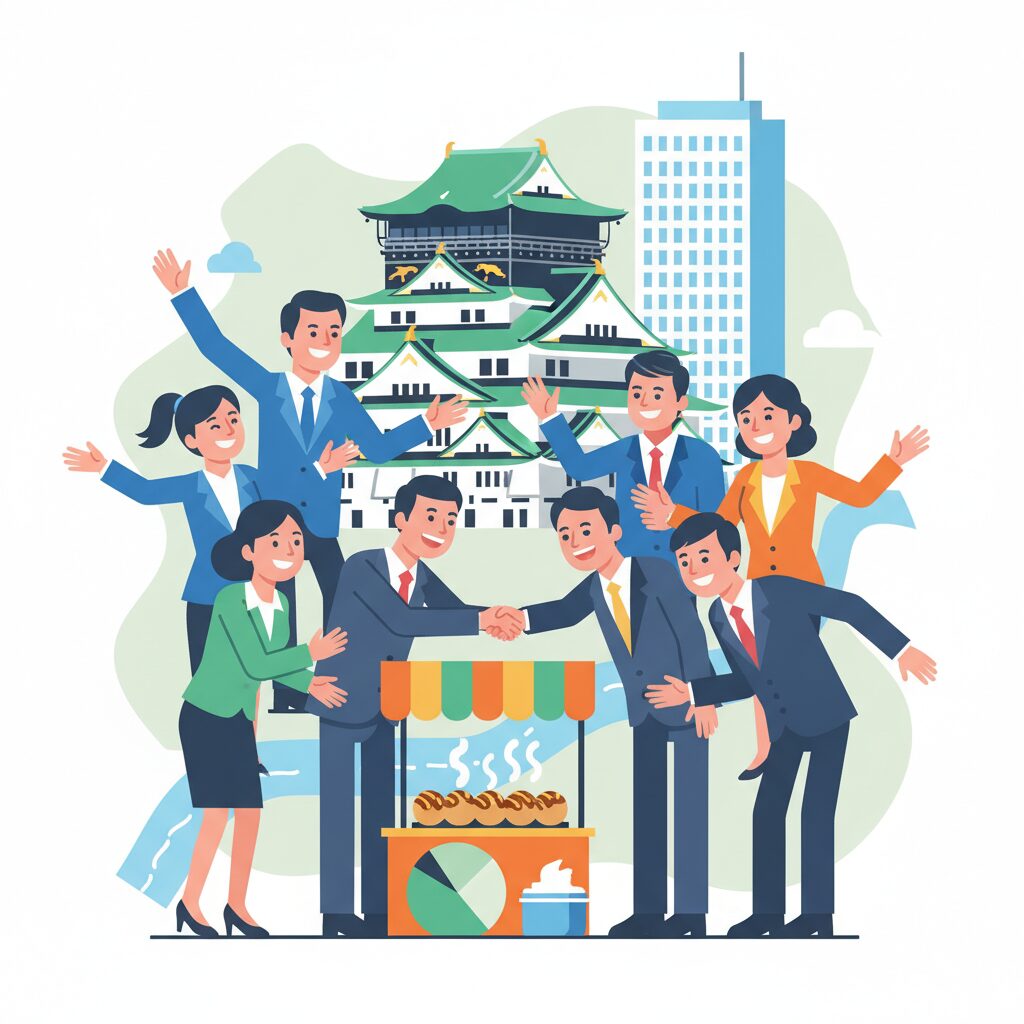
You’ve probably heard the jokes. Osaka, the city of comedians, takoyaki, and people who talk a little louder, a little faster. You might have seen the TV shows where the Osaka character is always the funny, money-obsessed sidekick. It’s a fun image, but if you’re planning to live and work here, you need to look past the neon signs of Dotonbori and understand the engine that truly powers this city: the ‘Akindo’ (商人) spirit. This isn’t some dusty concept from a history book. It’s the invisible software running on every laptop in every Umeda skyscraper, the unspoken language in every deal made in a Shinsaibashi boutique, and the rhythm of daily life for millions. Forget the stereotypes for a moment. Working in Osaka isn’t about being a comedian; it’s about understanding the serious, pragmatic, and deeply human art of business that was perfected here over centuries. This merchant’s soul shapes everything from how you negotiate a contract to how you talk to your boss, making the business culture here feel worlds away from the buttoned-up formality of Tokyo. We’re about to decode the unwritten rules, the peculiar phrases, and the underlying mindset so you can navigate your professional life here not just as a foreigner, but as someone who truly gets it.
Understanding that Osaka’s pragmatic merchant spirit often coexists with a relaxed conversational style, you might also explore the subtleties of non-commitment in Osaka conversations to further appreciate the city’s unique business culture dynamics.
The Soul of the Akindo: More Than Just Making a Sale
At the very center of Osaka’s identity lies the concept of the ‘Akindo,’ the merchant. For centuries, while Tokyo (then Edo) was the hub of samurai and political power, Osaka served as the nation’s kitchen and commercial core. Rice, sake, and goods from across Japan passed through here. This wasn’t a place of strict hierarchies and stoic warriors; it was a land of vibrant markets, clever negotiations, and people who relied on their wit, relationships, and ability to create value for survival. This legacy shaped a mindset that values practicality, mutual benefit, and a groundedness still palpable today. The spirit of the Akindo goes beyond mere selling; it’s a comprehensive philosophy on building sustainable success through human connection, resourcefulness, and a realistic outlook. Grasping this essence is the crucial first step to understanding why business in Osaka operates as it does.
Shobai: Business as a Relationship
In most places, the word ‘business’ is common. In Osaka, however, you’ll frequently hear ‘shobai’ (商売). Although they might seem synonymous, the nuance makes all the difference. ‘Business’ can feel cold and transactional, focusing on numbers in a spreadsheet. ‘Shobai,’ conversely, is warm, dynamic, and deeply personal. It suggests an ongoing relationship—a dance between buyer and seller—where the aim is not just a single successful deal but a long-term partnership benefiting all parties. A Tokyo-based company might be impressed by a flawless presentation and thorough, process-driven proposal. An Osaka-based company focuses more on the presenter. Do they trust you? Do they like you? Do they feel you’re in it together? In Osaka, a salesperson might spend the first half-hour of a meeting discussing your weekend, their children, or the Hanshin Tigers‘ latest game. A foreigner might see this as unprofessional time-wasting. In reality, it’s the most important part of the meeting—the process of building a human foundation on which the ‘shobai’ stands. The contract is merely a piece of paper; the real agreement lies in the handshake and mutual understanding to look out for one another. That’s why deals can sometimes be sealed verbally here, with paperwork to follow. Trust is the true contract.
“Mou kari makka?”: The Real Meaning of “Making a Profit?”
Stroll through any of Osaka’s covered shopping streets, the ‘shotengai,’ and you might hear merchants greet each other with a cheerful, “Mou kari makka?” (儲かりまっか?). Literally, this means, “Are you making a profit?” To outsiders, especially Westerners, this can sound intrusive and rude. Discussing one’s financial situation is taboo in many cultures. But here, taking it literally misses the point entirely. This phrase isn’t an inquiry into finances; it’s a greeting rooted in community. It’s the business equivalent of “How are you?” The real meaning is closer to, “Is life treating you well? Is business flowing? Are we all prospering together?” It’s a check-in on the health of the commercial ecosystem. The traditional response is equally important: “Bochi bochi denna” (ぼちぼちでんな), meaning something like, “So-so, can’t complain,” or “Getting by.” Even if business is thriving, no one would reply, “It’s fantastic! I’m making a fortune!” That would come off as arrogant and lacking humility. ‘Bochi bochi’ is the perfect Akindo reply, showing groundedness, modesty, and an understanding that fortunes can change. It reflects the pragmatic, cautiously optimistic, and community-minded spirit of Osaka ‘shobai.’
Kechi vs. Shimatsu: The Art of Frugality
Now comes the biggest stereotype: people from Osaka are ‘kechi’ (ケチ), or stingy. They’re seen as obsessed with discounts, hating waste, and counting every last yen. While there’s some truth in this, ‘kechi’ is the wrong word and carries a negative, selfish connotation. The term Osaka people use to describe themselves is ‘shimatsu’ (始末). This is a far deeper and more respected concept. ‘Shimatsu’ isn’t about cheapness; it’s about being resourceful and wise with money. It’s the philosophy of maximizing value and eliminating waste—whether of time, materials, or money. Someone practicing ‘shimatsu’ doesn’t just buy the cheapest item; they consider total cost of ownership, long-term value, and efficiency. They’ll invest more in a quality tool that lasts twenty years rather than a cheap one that breaks in two. In business, this means intense negotiations. An Osaka client will examine every line item in a quote, question costs, and suggest alternative, more efficient approaches. This isn’t obstinacy; it’s ensuring the partnership rests on real value. They respect counterparts who justify costs and engage in detailed talks about efficiency. To the Akindo, waste is the greatest sin. ‘Shimatsu’ is the virtue of respecting resources and a mark of sharp business acumen.
The Osaka Office: Where Speed and Pragmatism Reign
Step into an office in Osaka, and the atmosphere feels distinctly different from its Tokyo counterpart. Although both are undeniably Japanese, the underlying operating systems differ. Tokyo offices often carry an air thick with process, formality, and a quiet, deliberate pace. In contrast, Osaka’s energy is more dynamic. You’ll hear more laughter, more straightforward conversations, and a heightened sense of urgency. The core values of the Akindo—speed, efficiency, and a focus on results—directly influence daily workflows and communication styles. Formality exists but typically takes a backseat to getting things done. This work culture is designed for a marketplace, not a bureaucracy.
“Hayai mon Gachi”: Speed is Victory
The phrase ‘hayai mon gachi’ (早いもん勝ち) means “the person who is fast wins,” or more casually, “first come, first served.” This idea is deeply embedded in Osaka’s business culture. Quick decision-making and decisive action are highly valued. While Tokyo’s corporate world is well known for ‘nemawashi’ (根回し)—the slow, careful process of building consensus behind the scenes before formal meetings—Osaka often takes the opposite approach. Meetings are for making decisions, not for slowly approving choices already made in private. Employees with good ideas are encouraged to present them directly and passionately, and managers are expected to assess these ideas promptly and respond with a clear ‘yes’ or ‘no.’ This creates a dynamic, sometimes challenging but often exhilarating environment. There is little tolerance for endless deliberation or analysis paralysis. The market moves quickly, and the Akindo understands that missing a good opportunity is worse than making a minor mistake by moving fast. This environment can be empowering for foreign employees from cultures that value initiative and directness, as their ideas may be heard and acted upon much more quickly here than in other parts of Japan.
Honne and Tatemae: A Different Dialect
Anyone who has worked in Japan knows the concepts of ‘honne’ (本音), one’s true feelings, and ‘tatemae’ (建前), the public façade or official stance. Throughout Japan, communication delicately balances these two. However, this balance is very different in Osaka. Tokyo business communication tends to operate largely in ‘tatemae.’ Feedback is indirect, refusals are expressed vaguely, and maintaining surface harmony is critical. In Osaka, the balance shifts much closer to ‘honne.’ People are far more likely to say what they truly think. This directness is not meant to be rude; rather, it signals efficiency and respect. The logic is straightforward: why waste everyone’s time with polite fictions when there is business to be done? If a price is too high, an Osaka client won’t say, “We will take this back for internal review.” They’ll say, “This is too expensive. We can’t afford this. What’s your best price?” If a part of your proposal seems weak, they’ll point it out directly. For foreigners, this can be both a blessing and a challenge. It’s refreshingly clear, eliminating much of the ambiguity typical of Japanese business communication. Yet, if unprepared, the directness can feel blunt or even aggressive. The key is understanding the intention: it’s about clarity and moving forward together, not personal criticism.
Communication Style in Practice
This preference for ‘honne’ and speed appears in various ways. Meetings in Osaka tend to be livelier and less formal. Although an agenda exists, conversations flow more freely, and passionate debates are common. Participants might interrupt or speak over each other, not out of disrespect but as a sign of engagement and a collective desire to solve the problem. It can feel like organized chaos, yet it’s often highly productive. Humor is also essential in Osaka’s business culture. A well-timed joke can ease tension during tough negotiations or build a bridge between parties. Laughter reflects a healthy relationship. A serious, stone-faced demeanor can be seen as secretive or difficult to work with. The ability to laugh, especially at oneself, shows confidence and fosters camaraderie. The overall communication style is goal-focused. The purpose of talking is to achieve an outcome, and any means—whether direct feedback, passionate debate, or a good joke—that aids that outcome is welcomed.
Navigating Business Etiquette: The Unspoken Rules
While Osaka’s business culture is more relaxed and direct compared to Tokyo’s, it is by no means chaotic. Deep-rooted etiquette rules remain, but they are interpreted through the pragmatic perspective of the Akindo. The emphasis is less on strict, performative rituals and more on actions that foster trust, demonstrate competence, and show respect for the ‘shobai’ itself. Mastering these unspoken customs is crucial for cultivating the strong personal relationships that form the foundation of success here. It’s about learning the local rhythm of negotiation, presentation, and social interaction.
The Art of the Negotiation (Négiri)
In many Western cultures, and especially in formal Tokyo business environments, haggling over price may be considered inappropriate or even offensive, as it can suggest distrust of the seller’s price. In Osaka, however, the opposite applies. Negotiation, or ‘négiri’ (値切り), is not only accepted but fully expected. It’s a fundamental part of the ‘shobai’ ritual. Accepting the first price offered without discussion can be seen as naïve or, worse, indifferent. A good-natured negotiation signifies that you are a serious businessperson who understands value and is invested in the process. It’s a conversation, not a confrontation. The aim is to reach a ‘nattoku no iku nedan’—a price agreeable to both parties. It’s not about extracting every last yen from your partner but engaging in a respectful exchange that shows mutual commitment to finding the most efficient, value-based solution. When participating in ‘négiri,’ approach it as a search for mutual benefit. Instead of saying “Your price is too high,” say something like, “We have a budget of X. Is there any way we can work together to meet that? Perhaps by adjusting volume or delivery timing?” This demonstrates that you’re a partner seeking solutions, not an adversary seeking to win. The dance of ‘négiri’ builds respect, and the final price is earned by both sides.
Business Attire: Practicality Over Formality
Stroll through the business districts of Umeda or Yodoyabashi, and you’ll see many suits, much like in Tokyo’s Marunouchi. But on closer inspection, subtle differences emerge. Osaka emphasizes looking professional, clean, and respectable, but with less obsession over brand names or conforming to a strict corporate dress code. Practicality guides the Akindo’s wardrobe choices. A suit is a tool for work, not a status symbol. During Osaka’s famously hot and humid summers, the government’s “Cool Biz” campaign (which encourages businesspeople to dress down to save on air conditioning) is embraced enthusiastically. From May to October, you’ll see far more open collars and fewer ties in Osaka than in Tokyo, where formality often trumps comfort. The unspoken rule is to dress suitably for your client and the occasion, but the baseline is somewhat more relaxed. Your performance and ability to cultivate relationships matter far more than the label on your jacket.
After-Hours: Nomi-nication with a Purpose
The Japanese custom of ‘nomi-nication’ (a combination of ‘nomu’ – to drink, and ‘communication’) is an essential part of business culture throughout Japan, but it plays a slightly different role in Osaka. In Tokyo, drinking parties with colleagues or clients can sometimes feel like a formal extension of the workplace, with hierarchies rigidly observed and conversations remaining cautiously professional. In Osaka, however, ‘nomi-nication’ is where genuine relationship-building occurs. It offers a chance to let your guard down, transition from ‘tatemae’ (public face) to ‘honne’ (true feelings), and connect as individuals. These gatherings tend to be louder, more lively, and less hierarchical. It’s common to see junior employees engaging in friendly banter with their department heads. The goal is not to close deals over drinks—that would be considered poor etiquette—but to build the personal trust and rapport that make closing deals back at the office easier and more natural. It’s your opportunity to reveal who you are as a person, not just a professional. Sharing laughs, pouring drinks for one another, and discussing life outside work are the activities that cement the ‘shobai’ partnership.
Common Misunderstandings for Foreign Residents
For a foreigner entering the Osaka business scene, cultural differences can feel like navigating a minefield of potential misunderstandings. Actions and words that are considered entirely normal here may be easily misinterpreted through a different cultural perspective. Being mindful of these common pitfalls can save you a lot of confusion and help you understand your colleagues’ and clients’ behavior as intended. It’s about adjusting your expectations and learning to accurately interpret the local cues.
Misinterpreting Directness as Rudeness
This is likely the most frequent challenge. A foreign professional used to the indirect, harmony-oriented communication style of Tokyo or the polite euphemisms common in Western business culture might be taken aback by the straightforwardness of an Osaka counterpart. Hearing blunt remarks like “We don’t like that idea,” or “Your numbers don’t make sense,” can feel like a personal slight. It’s important to realize that it is almost never personal. In the Akindo mindset, time is money, and ambiguity is wasteful. Clear, direct feedback is given out of respect. It acknowledges your intelligence by assuming you can handle the truth, and respects your time by not making you guess the real meaning. They are treating you as a serious partner who is there to solve a problem. Rather than becoming defensive, try to embrace the clarity. Ask follow-up questions such as, “Okay, you don’t like the idea. Can you specify your concerns?” This demonstrates resilience, professionalism, and goal orientation—qualities that earn significant respect.
Mistaking Humor for Lack of Seriousness
An Osaka business meeting can be an unexpected blend of intense, data-driven discussion and sudden bursts of laughter. A manager might make a self-deprecating joke during a tense negotiation. Colleagues may engage in witty banter resembling a comedy routine. A foreigner might wrongly assume they aren’t taking the business seriously. This is a serious misinterpretation. People in Osaka are extremely dedicated to their ‘shobai.’ Their livelihood depends on it. Humor isn’t a distraction from seriousness; it is a strategic tool to manage it. It diffuses tension, builds rapport, and eases difficult conversations. A boss who can joke demonstrates confidence and fosters an atmosphere where people feel comfortable sharing ideas. To confuse this with unprofessionalism misses the point entirely. Humor acts as the lubricant keeping the powerful engine of business running smoothly. Learn to appreciate it and, if possible, join in. A shared laugh can be more valuable than a dozen PowerPoint slides.
Viewing Haggling as Disrespectful
As mentioned earlier, the ‘négiri’ culture can cause anxiety for foreigners. Many worry that questioning a price is equivalent to questioning the seller’s integrity. You might fear that negotiating will offend your potential partner and jeopardize the deal. In Osaka, the greater risk lies in not negotiating. By passively accepting the first offer, you may unintentionally signal that you are not a savvy businessperson or that you don’t care enough about details to engage fully. This can actually undermine their confidence in you. You don’t need to be an aggressive haggler. The key is to participate in the process respectfully and collaboratively. Treat it as a problem-solving exercise you are tackling together. By showing awareness of price, value, and efficiency, you demonstrate that you share their core Akindo principles. This doesn’t cause offense; it builds a foundation of mutual respect.
The Akindo Spirit in the 21st Century Workplace
It might be easy to dismiss the Akindo spirit as a relic of the past, a romantic ideal irrelevant to today’s globalized world of tech and finance. However, that would be a fundamental misunderstanding of contemporary Osaka. The core principles of its merchant culture—pragmatism, speed, resourcefulness, and a focus on human connections—are not only surviving but flourishing in the 21st century. In many respects, this centuries-old mindset is perfectly suited to the demands of the modern economy, giving Osaka’s business environment a distinct and resilient character.
Startup Culture and Innovation
Consider the growing startup scene in places like Grand Front Osaka in Umeda and the various incubators spread throughout the city. The Akindo spirit is very much alive there. Japan’s traditional corporate model often features slow, risk-averse, and hierarchical structures. In contrast, startup culture demands agility, a readiness to take calculated risks, and speedy decision-making. This is the Osaka way, expressed through the language of technology. The ‘hayai mon gachi’ philosophy serves as the unofficial motto for every startup founder racing to outpace their competition in bringing products to market. The ‘shimatsu’ mindset drives the lean startup approach of creating a minimum viable product and iterating based on real-world feedback, avoiding the inefficiency of over-engineering. Entrepreneurs here are celebrated not for their prestigious backgrounds but for their hustle, practical skills, and ability to build businesses from the ground up—the very essence of an Akindo.
The Enduring Power of the Personal Touch
In an age dominated by email, Slack, and Zoom, it might seem that business can be conducted entirely through screens. Yet in Osaka, the importance of face-to-face relationships remains steadfast. The Akindo spirit fundamentally revolves around trust between people, and that trust is still best built in person. While digital tools are used for everyday efficiency, major decisions and new partnerships are almost always sealed with a handshake, a shared meal, or a drink after work. Local business owners prefer a 30-minute in-person meeting to gain a genuine sense of a potential partner rather than exchanging numerous emails. They want to look you in the eye, share a laugh, and assess your character. This dedication to the human element isn’t an old-fashioned quirk; it’s a significant business advantage. In a world increasingly driven by automation and impersonal transactions, the ability to foster genuine, lasting relationships is a rare and valuable skill. It ensures that ‘shobai’ in Osaka remains not only sustainable but also, at its core, profoundly human.