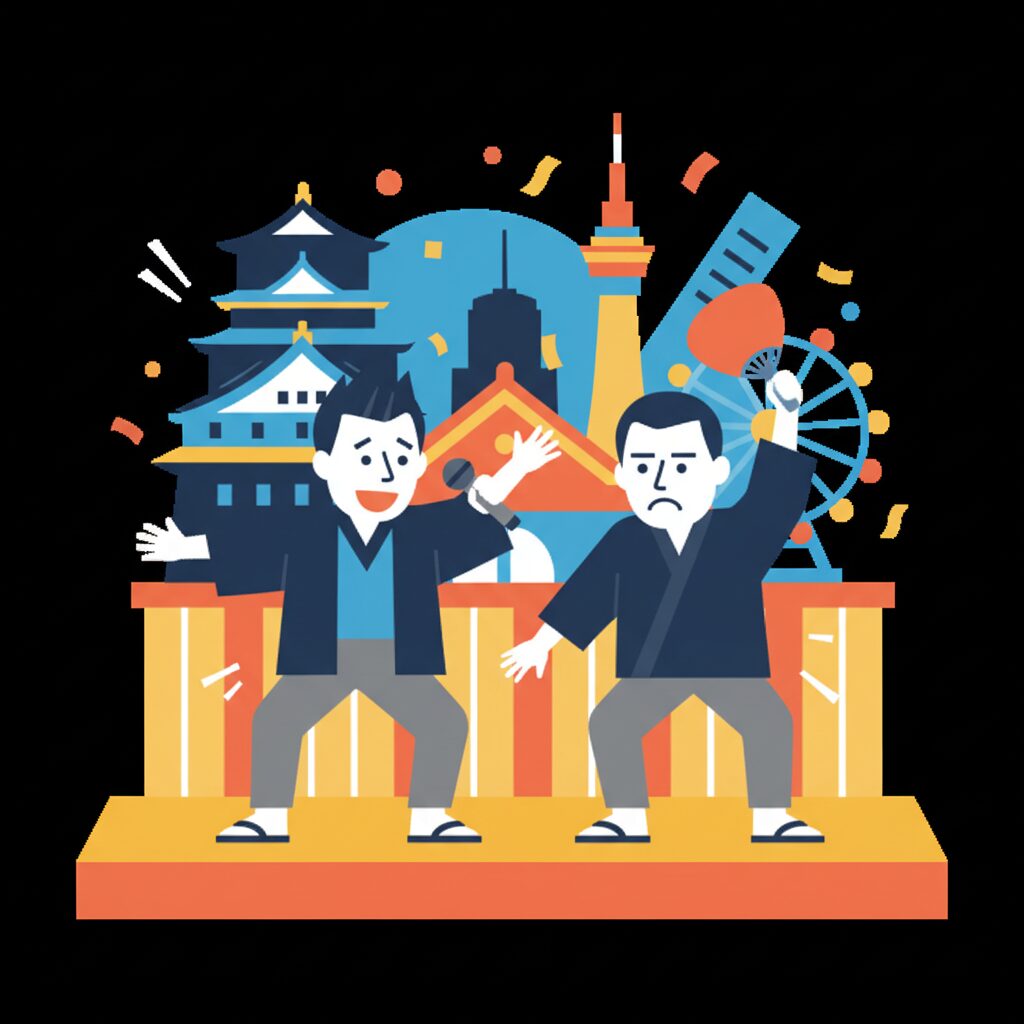
Let’s get one thing straight. You’ve heard the rumor, the one that gets whispered in Tokyo bars and written in bold letters in travel guides: everyone in Osaka is a comedian. You’ve been told that if someone points a finger gun at you and yells “Bang!”, you’re supposed to clutch your chest and perform a dramatic, sprawling death. You’ve been conditioned to expect a punchline at the end of every sentence, a city where the air itself seems to fizz with witty retorts and self-deprecating humor. It’s a compelling image, a metropolis of thirteen million amateur stand-ups navigating their day through a series of bits and gags. But as someone living here, trying to decipher the daily rhythms of this captivating, chaotic city, you quickly realize the truth is both simpler and infinitely more complex. The question isn’t whether every Osakan is funny. The real question is: what is the function of humor in Osaka’s daily communication, and how does it shape the very fabric of life here? This isn’t about performance; it’s about a deeply ingrained linguistic and social tool that defines the city’s character, setting it worlds apart from the buttoned-up formalism of Tokyo. For a non-speaker, or even a fluent one from a different cultural background, mistaking this tool for simple entertainment can lead to a profound sense of confusion, alienation, or the exhausting pressure to be constantly “on.” We’re going to dismantle this stereotype, look at its historical roots, and give you a practical guide to the reality of Osakan humor, not as a tourist spectacle, but as the engine of daily interaction.
Osaka’s seemingly effortless wit is just one facet of a multifaceted urban landscape where challenges like record high hotel prices in Kyoto serve as a reminder of the economic pressures shaping everyday life.
The Merchant’s Wit: Historical Roots of a Comic Culture
To grasp why a conversation in an Osaka supermarket feels distinct from one in Tokyo, you need to look back centuries. Osaka wasn’t shaped by samurai or shoguns; it was shaped by merchants. It was the nation’s kitchen (`tenka no daidokoro`), a lively, fiercely competitive port city where success relied not on heritage, but on the skill to build rapport, negotiate, and close deals. In the rigid, hierarchical society of feudal Japan, this was a revolutionary idea. While Edo (modern Tokyo) was the political center, marked by strict formalities, unspoken rules, and intense pressure to maintain face, Osaka was the heart of commerce. Here, communication had to be efficient, direct, and effective. Humor became the ultimate tool of the trade. A well-timed joke could ease a tense negotiation. A touch of self-deprecation could foster trust faster than a formal bow. Banter served as a quick way to assess a person’s character, to determine if they were sharp, relatable, and someone you wanted to do business with. This legacy continues to influence the modern Osakan mindset. The directness that sometimes surprises outsiders or people from other parts of Japan isn’t rudeness; it’s efficiency. The steady flow of jokes and playful teasing isn’t frivolity; it’s a social lubricant that removes pretense and gets to the core of the matter. This pragmatic, results-driven communication style sharply contrasts with the Tokyo ideal, where conversations often feel like a delicate dance of indirect statements (`tatemae`) aimed at preserving harmony at all costs. An Osakan might ask you outright how much you paid for your apartment, not out of curiosity, but as a practical way to gather information, often softened with a joke like, “Wow, you must be a millionaire!” In Tokyo, such a question would be almost inconceivable. Osaka’s commercial DNA nurtured a culture where relationships are built on candor, and humor is the preferred language of that candor.
The Conversational Duet: Understanding Boke and Tsukkomi
If you truly want to grasp the rhythm of everyday conversation in Osaka, you need to understand the concepts of `boke` and `tsukkomi`. These terms originate from `manzai`, the traditional Japanese stand-up comedy style perfected in Osaka, but they form the essential foundation of daily interactions. `Boke` is the fool, the airhead, the one who says something silly, absurd, or slightly offbeat. `Tsukkomi` is the straight man, who immediately points out the absurdity with a sharp, witty response. This relationship is not one-sided; it’s a dynamic—a conversational duet. It’s a continual back-and-forth that signals active listening and engagement. Living in Osaka means you are constantly surrounded by, and often an unwitting participant in, this interplay.
The Straight Man’s Jab as a Sign of Affection
A foreigner might easily misunderstand the `tsukkomi`. It can seem like criticism, correction, or even an insult. When you say you’re going to the beach and your Osakan friend immediately quips, “In this typhoon? Are you an idiot?” with a playful smack on the arm, your first reaction might be to take offense. But in fact, you’ve just received a compliment. That quick, sharp `tsukkomi` is a sign of affection and closeness. It says, “I’m paying attention to you, I’m engaged in what you’re saying, and I feel comfortable enough to break formalities and joke around.” A polite, non-committal nod would be the real insult; it would signal distance and disinterest. When the shopkeeper sees you buying instant noodles and says, “Cooking is too much trouble for you, eh?” they aren’t judging your choices. They are opening the door for a `boke/tsukkomi` exchange. The right response isn’t a detailed explanation of your busy schedule, but a `boke` comeback like, “Yes, I’m a very important person with no time!” This creates a momentary, shared connection that is distinctively Osakan. The real challenge for non-natives is learning to interpret the `tsukkomi` not as a personal attack, but as an invitation to join the playful exchange.
The Unspoken Demand for a Punchline (`Ochi`)
Another key feature of this communicative style is the expectation of an `ochi`, or punchline. When telling a story in Osaka, there is an unspoken understanding that the story is going somewhere—preferably somewhere funny or at least with a clear conclusion. Long, wandering stories without a clear point are met with visible impatience. You can almost sense the listener thinking, “So, what’s the point?” This isn’t because people are rude; it’s because conversation is viewed as a form of mutual entertainment. The goal is to share a moment, a laugh, a resolution. This can be challenging for those from cultures where storytelling is more descriptive or atmospheric. In daily life, it means learning to be more concise. You put the interesting part upfront. You craft your experiences into neat, digestible stories with a clear beginning, middle, and punchline. Forgetting to pay for your groceries becomes a short, funny anecdote about your absent-mindedness, not a lengthy, drawn-out saga of your stressful day. Mastering this doesn’t mean you have to be a professional comedian, but it does mean respecting the local conversational contract: don’t waste my time, and if you can make me laugh, even better.
A Foreigner’s Survival Guide to Osakan Banter
So, how do you handle this as a foreigner, especially when you’re still struggling with the language? The pressure can be overwhelming. You witness these rapid-fire exchanges happening all around you and feel a strong urge to either join in or retreat. The good news is, you don’t need to be the center of attention. Your position as a foreigner naturally lends itself to the role of an unintentional `boke` character. Your language errors, cultural misunderstandings, and general confusion—all of these provide perfect fodder for gentle humor.
You Don’t Have to Be Funny
The most crucial advice is to free yourself from the pressure to be witty. Trying to force a `tsukkomi` in a language you’re not fully comfortable with usually ends badly. It might come off awkward, be mistimed, or worse, unintentionally offensive. The best approach is to become a good audience. A genuine laugh, a broad smile, or an appreciative nod are all perfectly acceptable and welcomed reactions. Osakans aren’t testing you—they’re simply communicating in their native way. By showing that you enjoy the humor, even if you can’t keep up with the verbal tricks, you’re participating successfully. When the old woman at the fruit stand tells you that an apple a day keeps the doctor away, “but you look like you need two!”, just laugh. That’s all. You’ve passed the test and completed the interaction well.
The Finger Gun Dilemma
Ah, the notorious finger gun. A friendly stranger, a coworker, or a bartender might suddenly point their fingers your way and shout, “Bang!” This is the classic test of your Osakan social skills. The standard response is, naturally, to pretend to be mortally wounded. But if that feels awkward or unnatural to you, here’s the secret: that’s perfectly fine. You don’t have to do it. A confused look can be an ideal `boke` response in itself. A simple laugh and a wave works too. The gesture isn’t a command; it’s more like a playful probe to check if you’re on the same wavelength. Playing along will certainly earn you points and perhaps some free edamame, but politely smiling and declining to join in is not a social misstep. The only real error is taking it seriously or getting offended. It’s a joke, and recognizing it as such—however feels right to you—is all that’s needed.
Beyond the Joke: A Culture of Pragmatism and Warmth
It would be a serious error to reduce Osaka to a mere caricature of a city fixated on comedy. The humor is not the core; it’s the medium. The essence lies in a deeply rooted pragmatism, a distaste for pretense, and a form of human connection that is remarkably direct and unexpectedly warm. The jokes, the `tsukkomi`, the teasing—these serve as tools to cut through the layers of social formality that can make interactions in other parts of Japan seem opaque and distant. An Osakan might tease you about your poor Japanese, yet in the next moment, spend ten minutes patiently drawing you a map to the station. They may loudly complain about the price of something, but then readily share their umbrella with you during a sudden downpour. This is the Osakan paradox: communication can appear abrasive on the surface, but the true intention is often one of connection and unexpected kindness. It’s a culture that prioritizes genuine interaction, however imperfect, over polite distance. Living here teaches you to develop a thicker skin and also a more open heart. You come to understand that a playful insult can be a sign of affection, and that sharing a laugh with a stranger in a standing-only noodle shop is more valuable than a thousand polite bows. The stereotype of the Osakan as a comedian isn’t wrong, but it’s incomplete. The reality is someone who has harnessed humor for a greater purpose: to make life a bit more efficient, a bit more honest, and a lot more enjoyable.