Take the Nankai Line south from the roaring concrete heart of Namba, and in fifteen minutes, the city changes its tune. The frantic, vertical climb of Osaka’s downtown gives way to a lower, wider rhythm. The air itself seems to slow down, thickened with the salt of the nearby bay and the dust of centuries. You’ve arrived in Sakai, a city that feels less like a suburb and more like an anchor, a historical weight that keeps the wild, modern sprawl of Osaka tethered to its origins. People who think of Osaka as a single, homogenous blast of neon, takoyaki stands, and impossibly loud conversations are missing the point. Osaka isn’t a monolith; it’s a constellation of fiercely independent neighborhoods and satellite cities, each with its own gravity. And Sakai, with its legacy of master blacksmiths and colossal, ancient tombs, might just be the city’s historical center of mass. It’s here, in this port city that once operated as a free republic governed by merchants, that you can find the source code for the Osakan character: pragmatic, fiercely proud of its craft, and deeply unimpressed by the distant authority of whatever government happens to be in Tokyo. A weekend here isn’t about escaping Osaka; it’s about understanding it on a molecular level, by feeling the heat of a forge and standing in the shadow of a king’s final resting place.
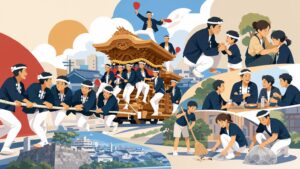
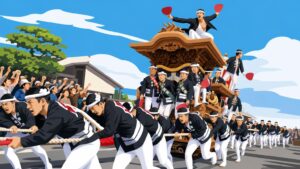
While Sakai captivates with its ancient legacy and artisanal mastery, exploring Kishiwada’s vibrant community spirit during the Danjiri festival offers another revealing glimpse into Osaka’s multifaceted cultural landscape.
The Echo of the Hammer: Sakai and the Soul of Craft
In Japan, the spirit of the shokunin, or master artisan, is frequently celebrated. In Tokyo, this idea often seems refined and commercialized for upscale magazines and luxury department stores. It’s treated like a brand. In Sakai, however, it’s simply the way things are done. The city’s identity is literally forged in steel. For over 600 years, Sakai has been the heart of Japanese blade-making, a craft that shapes its character. But to fully understand its significance, you must look beyond the polished display cases of finished knives and step into the forge’s heat.
More Than a Souvenir: Entering the Forge
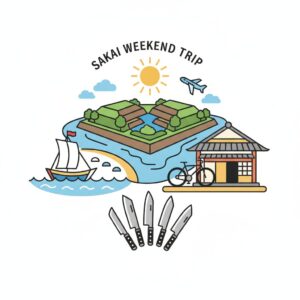
Several workshops in Sakai invite visitors to take part in the final stages of crafting their own knife. This is no casual tourist activity; it’s a deep immersion. The moment you step into one of these family-run operations, passed down through generations, the atmosphere changes. The air is thick with the metallic scent of grinding wheels and the sharp aroma of quenching oil. The sound is not chaotic but rhythmic, a steady, percussive language of creation. The master craftsman leading you is unlikely to be a lively tour guide. He’ll be a man of few words, his hands stained and scarred from years of working steel. His communication is through demonstration: the subtle adjustment of your grip, the slight nod signaling you’re on track. There’s no flowery praise. The finished product is the reward. This interaction embodies Osaka’s culture: a focus on substance over style and results over pleasantries. Visitors from Tokyo, accustomed to a softer, more formal service approach, might mistake this straightforwardness for gruffness. But it’s not; it’s respect. The shokunin values your time and aims to teach you a skill, helping you create something meaningful. Your success matters more than your entertainment. As you hammer the pre-forged blade, fit the handle, and sharpen the edge, you’re not simply crafting a kitchen tool. You’re embracing a philosophy that prizes utility, durability, and an unflinching pursuit of perfection. That knife you finish in your hand feels different because you recognize the focused, no-nonsense effort behind it—a perfect reflection of the Osakan business spirit.
Why Knives? Why Sakai?
The history of Sakai steel reveals the city’s practical nature. While other parts of Japan gained fame for forging katana for samurai elites, Sakai’s blacksmiths carved out a niche in making tools for everyday people. Their first notable product was the tobacco knife, used to shred leaves for the then-popular habit of smoking. When the market changed, they transitioned to making hocho, or kitchen knives. This emphasis on the domestic and commercial rather than the martial explains the historical cultural split between Kansai and Tokyo. Edo (old Tokyo) was the samurai city, a society structured around hierarchy, military skill, and loyalty to the shogun. Osaka and Sakai, by contrast, were merchant cities, built on trade, negotiation, and the quality of goods. A samurai’s sword symbolized status and power. A Sakai chef’s knife is a tool for making a living, for honing a craft that feeds the community. This fundamental difference in purpose bred two distinct cultures. People in Osaka and Sakai take pride in things that work well, endure, and serve a clear role in everyday life. This heritage is why Osaka today feels more grounded, more focused on the practicalities of living, compared to Tokyo’s sometimes status-driven atmosphere.
Living with Giants: The Kofun in Your Backyard
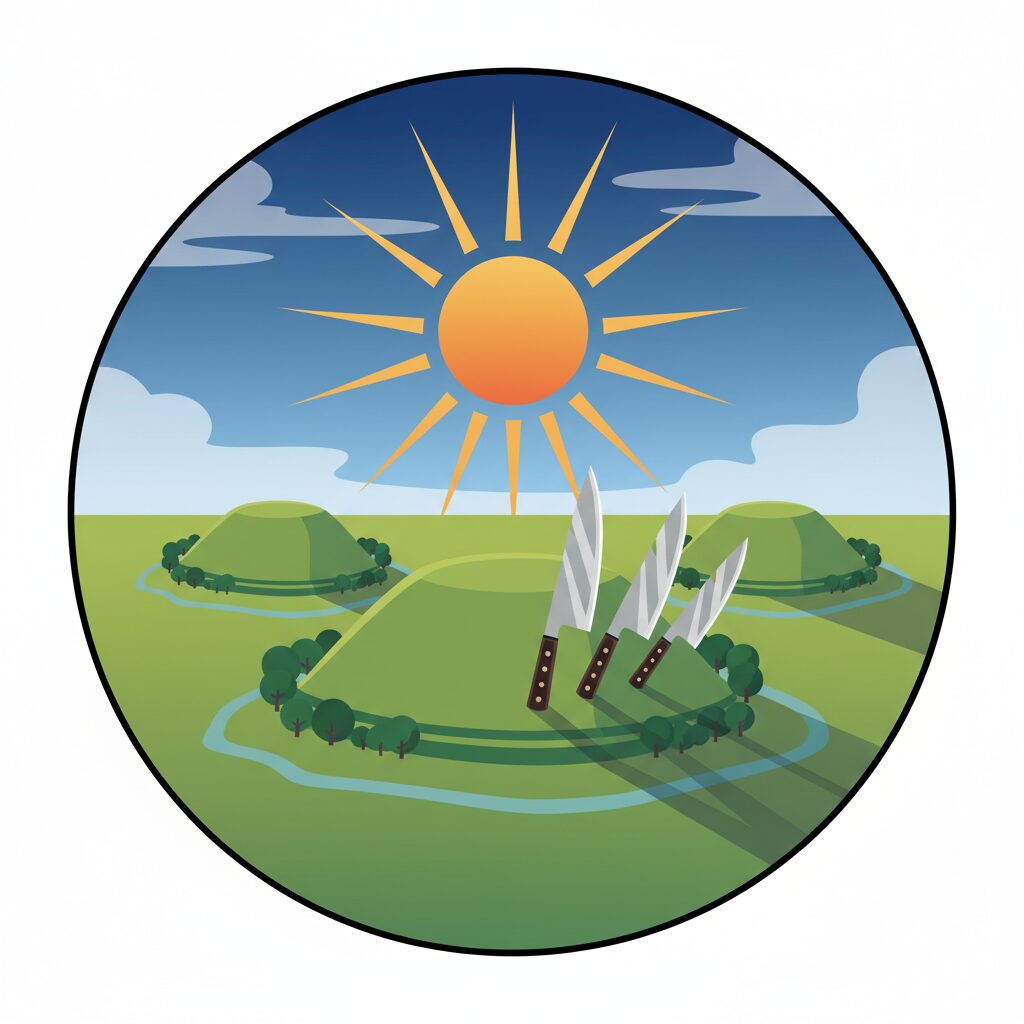
If the forges symbolize Sakai’s industrious spirit, the Mozu Kofungun embodies its ancient core. These are more than burial mounds; they are vast keyhole-shaped islands set within a sea of suburban expansion, silent witnesses to a power that ruled this land more than 1,600 years ago. The largest among them, the Daisen Kofun, believed to be the tomb of Emperor Nintoku, ranks as one of the world’s largest tombs by area, surpassing even the Great Pyramid of Giza. Yet, what stands out most about this UNESCO World Heritage site is its remarkable lack of pomp.
The Unassuming Grandeur of the Mozu Tombs
There are no grand entrances, no towering visitor centers, no elaborate audio-visual displays. You simply walk down a residential street, turn a corner, and there it is: a dense forest encircled by a triple moat, an enormous, silent presence intricately woven into the city’s fabric. The main viewing spot is a modest prayer area in front of a torii gate. The best way to experience it is to rent a bicycle and ride around its three-kilometer perimeter. As you cycle, you witness its integration into community life—a group of junior high students jogging by on a training run, an elderly woman walking her tiny dog along the moat, a salaryman on his lunch break sitting on a bench, gazing into the dense woods, lost in thought. The kofun are not preserved as delicate relics to be observed from afar; they serve as the local park, a neighborhood landmark, the backdrop to countless everyday lives. Their vast size, great age, and fundamental role in the landscape have made them a subconscious part of the city.
A Different Perspective on History
This casual blending of monumental history reveals much about the Kansai mindset. In many capital cities, history feels curated—sites carefully preserved, cordoned off, and presented with a reverence that can sometimes seem sterile. In Sakai, history simply exists. It is a foundation, not just a monument. This fosters a deep-rooted identity wholly separate from Tokyo. The narrative here does not start with the Tokugawa shogunate or the Meiji Restoration but with powerful clans capable of marshaling the resources to create these astonishing structures centuries before Tokyo was more than a fishing village. This gives Kansai residents a quiet confidence—a sense that their story is older and perhaps more authentic. They don’t need to loudly proclaim their history because they live atop it. It’s an unspoken acknowledgment that this land has always held significance. This outlook helps explain the well-known Osaka-Tokyo rivalry. It’s more than a contest between two large cities; it represents two distinct centers of gravity, two different historical narratives competing for the nation’s soul. For many in Kansai, Tokyo is the political capital, while their own region is the cultural and historical heartland.
The Sakai Mindset: An Osaka Origin Story
To truly grasp why people in Osaka behave as they do—their directness, humor, and love of a good deal—you need to understand Sakai’s golden age. In the 15th and 16th centuries, amidst the turmoil of the Warring States period, Sakai was far from an ordinary port town. It functioned as a de facto independent city-state, a thriving international hub secured by moats and ruled by a council of its most influential merchants. It was Japan’s Venice, a place where wealth and skill, rather than noble lineage, determined one’s power.
A City Governed by Merchants, Not Warriors
Picture a city where ultimate authority wasn’t held by a distant samurai lord but by your fellow merchant. This environment fostered a distinctive set of values. Pragmatism was paramount. A decision was considered good if it benefited business. Alliances were formed on mutual advantage rather than longstanding loyalty. This legacy is embedded in the DNA of the modern Osakan. Skepticism toward centralized authority, a mild distrust of edicts from Tokyo, and the belief in relying on one’s own wit and effort all stem from here. While much of Japan was mired in deadly feudal politics, Sakai was pioneering a brand of merchant-led capitalism. They traded with Ming China, the Portuguese, and anyone offering valuable goods. This nurtured an outward-looking, adaptable, and fiercely independent spirit that still characterizes the region today.
The Language of the Deal
This merchant culture directly influenced the way people communicate. In a formal, hierarchical samurai society, language tends to be indirect and coded, aimed at showing respect and avoiding offense. In a merchant’s council, however, the priority was getting straight to the point. Is this a good deal? What are the terms? Can we trust this person? That is why Osaka dialect, or Osaka-ben, is renowned for its directness and brevity. What outsiders may perceive as blunt or even rude is simply a conversational style refined for efficiency and honesty. The culture of haggling, so famous in Osaka, isn’t about stinginess; it’s a form of engagement—a dialogue about value. It’s a ritual recognizing that both buyer and seller are smart, savvy participants in the transaction. This commercial heritage holds the key to understanding much of Osakan behavior that often confounds foreigners and even other Japanese.
What Sakai Teaches Us About Modern Osaka
Visiting Sakai is like discovering a Rosetta Stone for Osaka culture. Standing in a workshop where a family has crafted knives for fifteen generations reveals the deep pride in tangible skill underpinning the city’s industrial strength. Cycling around a 1,600-year-old tomb used as a local jogging path reveals the steady, unshakable sense of history that shapes Kansai’s independent identity. Learning about its past as a free city of merchants finally explains why your neighbor in Osaka speaks with such candidness and is always on the lookout for a deal. Sakai shows that the vibrant, chaotic energy of modern Osaka is not a recent development but the blossoming of a culture seeded centuries ago—one that has always prized craft over class, commerce over conquest, and common sense over ceremony.
Beyond the Forge and Tombs: The Texture of Daily Life in Sakai
To complete the picture, you need to experience the city at its own distinctive pace. Beyond the major historical landmarks, the true charm of Sakai lies in the rhythms of its everyday life, which feel worlds apart from the relentless rush of Umeda or Shinsaibashi.
The Taste of a Port Town
Sakai’s character as a port town remains evident in its cuisine. It’s not a city dominated by fleeting food trends. Instead, you’ll find establishments quietly honing their craft over decades. Seek out small restaurants specializing in conger eel (anago), a local delicacy often grilled to perfection. Wander through the old covered shopping arcades, where shops sell traditional Japanese sweets (wagashi) with recipes unchanged for a century. These businesses embody the same shokunin spirit as the knife makers—a quiet commitment to quality and a deep bond with the community they serve. The food here is honest and satisfying, nourishment for a working city, much like its people.
The Chin-Chin Densha: A Ride into the Past
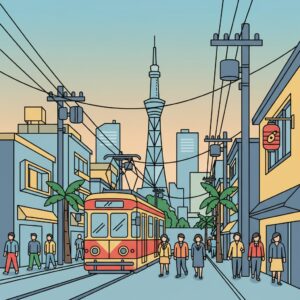
One of the most memorable experiences in Sakai is a ride on the Hankai Tramway, affectionately called the Chin-Chin Densha for the nostalgic ring of its bell. It’s a single-car streetcar, one of the region’s last, that slowly rolls through the city’s neighborhoods. Riding the tram is an embrace of deliberate slowing down. It rattles and sways, stopping every few blocks, inviting you to observe the city at a human pace. You pass small temples, local shotengai, and rows of houses, glimpsing the beautiful, everyday flow of life. The tram serves as a rolling metaphor for Sakai itself. In an era of bullet trains and express subways, it opts for a different route. It values connection to the street over speed, the journey over the destination. It reminds us that not everything in Japan is about hyper-efficiency. In places like Sakai, there remains space for a slower, more intentional rhythm—one that lets you notice details and appreciate the deep, quiet history lining every street.
Why a Weekend in Sakai Will Change How You See Osaka
Returning to the electric hum of Namba after a weekend in Sakai is a disorienting experience. The city you left feels altered, more profound. You begin to notice Sakai’s influence everywhere. You perceive the shokunin spirit in the focused intensity of the chef behind the counter at your neighborhood ramen shop. You sense the merchant’s pragmatism in the candid, friendly banter at Kuromon Market. You recognize the fierce independence in Osaka’s steadfast refusal to be a mere copy of Tokyo. Sakai strips away modern stereotypes and reveals the historical foundation of the Osakan identity. It teaches you that this region’s character isn’t defined by its pop culture exports, but by a long, proud history of crafting things, trading goods, and self-governing. It shows you that Osaka is more than just a city; it’s the heart of a distinct and enduring civilization with its own rules, its own language, and its own unique worldview. After experiencing the history in its soil and the heat of its forges, you don’t just see Osaka anymore. You begin to understand it.