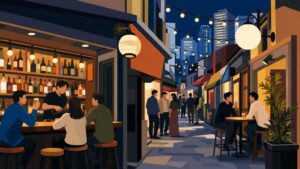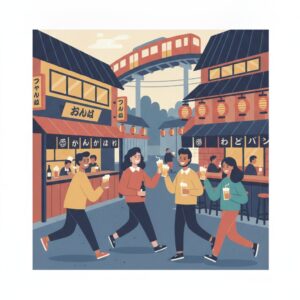
Walk out of JR Tenma Station on a Tuesday night, and you’re hit with a wall of sound. Not the polite, orderly hum of a Tokyo station, but a chaotic symphony of sizzling grills, booming laughter, and the thunderous rattle of the Loop Line train passing overhead. Red lanterns cast a warm, almost conspiratorial glow on faces packed shoulder-to-shoulder in tiny bars that spill out onto the pavement. The air is thick with the smell of grilled offal, cheap beer, and a palpable sense of release. This isn’t the Japan you see in guidebooks. This is Tenma, Osaka’s premier drinking labyrinth, and for the uninitiated, it can feel like trying to navigate a tidal wave.
Most foreigners, conditioned by experiences in other parts of Japan, approach a night out with a plan. You research the best spots on Google Maps, make a reservation, and settle in for a few hours of curated dining. Trying that in Tenma is like trying to catch rain in a thimble. You’ll be missing the entire point. Tenma doesn’t operate on reservations or five-star reviews; it runs on impulse, energy, and a uniquely Osakan social contract. It’s a place where the goal isn’t to find the perfect bar, but to lose yourself in the chaotic, joyful flow of the evening. Spending a night here isn’t just about drinking; it’s a crash course in the city’s soul. It teaches you how Osakans think, connect, and define value in a way that polished tourist districts never could. This is your guide to letting go of the plan and learning to swim in the glorious, messy deep end of Osaka life.
Embracing the unplanned spirit of Osaka, you might also enjoy exploring the Umeda labyrinth’s hidden soul for a fresh perspective on the city’s vibrant energy.
The Tenma Mindset: Forget Planning, Embrace the Flow

Your first step to becoming a regular in Tenma is to ceremoniously erase the concept of a fixed itinerary from your mind. The carefully planned, reservation-based evening is fundamentally a Tokyo idea, grounded in efficiency and predictability. In Tokyo, the city’s vast size and dense population mean that spontaneity often leads to disappointment—long lines, packed restaurants, and wasted trips across town. The solution there is to secure your evening in advance: you reserve a table for 7:00 PM, stay until 9:00 PM, then move on to the next scheduled spot. It’s a logical, effective way to navigate a night out in a city of 14 million.
Osaka, and Tenma especially, mock this approach. The local philosophy centers on hashigo-zake, the art of bar-hopping. An evening isn’t a fixed event at one place; it’s a flowing journey through varied tastes, sounds, and conversations. You don’t begin with a destination—you start with a direction. You roam. You follow your senses. The entire district becomes your venue.
The Anti-Tokyo Approach to an Evening Out
Picture yourself wandering through the labyrinthine alleys north of the station. In just two minutes, you pass a dozen establishments. A tachinomi, a standing bar, is packed with salarymen loosening their ties, laughing over plates of sashimi. Nearby, a yakitoriya specializing in grilled chicken has smoke billowing from its entrance, the aroma of charred chicken skin pulling you nearer. A few doors down, a Spanish-style bar hosts locals sipping wine from water glasses. To a Tenma native, this isn’t a list of options to analyze—it’s a river of possibilities.
They’ll glance into the tachinomi. Is it lively? Is there room at the counter? If yes, they step in without hesitation. They order a beer and a few small plates—maybe tempura or a stewed dish. They linger for twenty or thirty minutes—just enough time to absorb the atmosphere, chat briefly with the person beside them, and finish their drink. Then, they settle the bill and return to the street, moving on to the next current in the river. This isn’t seen as indecisive or fickle; it’s the essence of the experience. It’s about gathering moments, not committing to one place. This mindset represents a wider Osaka outlook: valuing flexibility and savouring the moment. Life is unpredictable—why shouldn’t your evening reflect that?
Reading the Room, Not the Menu
In this environment, online reviews and curated “best of” lists hold little weight. An Osakan doesn’t select a bar because it boasts a 4.7 rating on Tabelog. They pick it based on something far more vital: the nori, or vibe. Walking through the district, you’re constantly assessing. Are people leaning in, genuinely engaged in conversation? Is the laughter heartfelt and loud? Are the staff—the taisho or mama-san—joking with customers, fostering a sense of community? A cramped, noisy, slightly rough bar with great nori will always triumph over a pristine, half-empty venue with a polished menu.
The physical space itself tells a story. Many top spots are unapologetically rugged. You might be perched on an overturned beer crate, your back against a corrugated tin wall. Your table might be a wobbly plank of wood balanced on crates. This isn’t a sign of failure—it’s a badge of honor. It signals that the focus is on what truly matters: good, affordable food, strong drinks, and a warm atmosphere. Pretension is the enemy. Comfort takes a backseat to connection. A foreigner might view a place like this as dirty or uncomfortable, but a local sees it and thinks, “This place is authentic. They’re not wasting money on decor, which means the food is likely great value.” It’s a completely different way of judging quality—one that prioritizes substance and soul over superficial aesthetics.
The Language of Connection: More Than Just “Kanpai”
The physical closeness of Tenma’s bars—the cramped counters, the shared tables—isn’t a drawback; it’s a social trigger. It’s meant to break down barriers, whether you’re ready or not. This is perhaps the biggest cultural adjustment for many foreigners, especially those used to the polite, reserved social atmosphere of Tokyo.
Breaking the Barrier: The Art of Casual Conversation
In a typical Tokyo izakaya, your group forms a bubble. You might sit inches from another party, but an invisible, powerful wall separates you. Starting a conversation with a stranger is rare and can sometimes feel intrusive. In Tenma, that wall doesn’t exist. When you’re at a counter so crowded you have to turn sideways to let someone pass, keeping a personal bubble is physically impossible. The setting compels interaction.
This is where Osakans excel. They are experts in casual, low-stakes conversational gambits. The person next to you will notice what you ordered. “Oh, the doteyaki! That’s the best thing here. Good call!” they might say. Or they’ll catch you eyeing their plate. “This? It’s tuna cheek. Meccha umai de! (It’s super tasty!) You should try one.” These aren’t prying questions; they’re invitations. Simple gestures that say, “We’re all in this tiny, noisy space together. Let’s share the experience.”
For a foreigner, the key is to lean into it. Don’t shy away. Ask what they’re drinking. Compliment their choice. Ask the staff for a recommendation. The worst thing you can do is stand quietly in the corner, staring at your phone. That signals you want to be left alone, and while Osakans are friendly, they will respect that message. To fully enjoy Tenma, you have to be a participant, not just an observer. The social energy is the main attraction.
Understanding Osaka-ben and the Rhythm of Banter
Conversation in Osaka has a unique rhythm, a playful, percussive style that contrasts with the more formal, measured tone of standard Japanese. It’s rich with Osaka-ben, the local dialect, used not only for communication but also to create intimacy and humor.
You’ll hear honma instead of hontou for “really,” akan instead of dame for “no good,” and the ever-present suffix –nen adding a cheerful final touch to sentences. But more important than the vocabulary is the conversational flow, which often mimics the comedic duo dynamic of manzai comedy, featuring the boke (the funny one) and tsukkomi (the straight man).
This dynamic is ongoing in Tenma’s bars. A customer might loudly complain about the size of his drink: “Taisho, this is all foam! Are you trying to trick me?” That’s the boke. The owner, without hesitation, fires back the tsukkomi: “If you don’t want it, I’ll drink it myself! Next!” Everyone at the counter laughs. A foreigner may misinterpret this as a real complaint and a rude reply, but it’s a performance. It’s a ritual of mock-conflict that strengthens the bond between staff and regulars. It signals, “We know each other well enough to joke like this.” When the taisho starts teasing you, it means you’ve been accepted.
The Economics of a Tenma Night: Value Isn’t Just About Price

The driving force behind Tenma’s hashigo-zake culture is a passion for what the locals call kosupa, a shorthand for “cost performance.” This idea is key to grasping the Osaka mindset, and it extends far beyond merely being inexpensive.
C.P. (Cost Performance) as a Way of Life
Being cheap means simply chasing the lowest price without regard for quality. Kosupa, however, focuses on maximizing the value received for the money spent. An Osakan is willing to pay a little extra if the quality, portion size, or overall experience warrants it. On the other hand, they hold a strong disdain for anything that seems overpriced or pretentious. A small, artfully plated dish that commands a high price might be trendy in a stylish Tokyo district, but in Tenma, it would be met with skepticism and ridicule.
This explains why Tenma’s economy revolves around high-volume, low-margin offerings. A draft beer for 350 yen. Three skewers of grilled chicken for 400 yen. A generous plate of fresh sashimi for 500 yen. The objective isn’t to have one perfect, costly dish; it’s to enjoy a diverse range of good, straightforward food and drinks at multiple venues without feeling the pinch financially. A 5,000 yen note is not for a single upscale dinner; it’s your ticket to an entire evening’s exploration. This emphasis on concrete, measurable value over branding or presentation embodies pure Osaka. It’s the pragmatism of a merchant city applied to leisure: always get the best deal.
The Unspoken Tab: How to Pay Like a Local
The payment methods at many Tenma bars mirror the fast-moving, transient nature of hashigo-zake. Complex tabs settled at the end of the night are inefficient and slow things down. Instead, many establishments, especially standing bars, employ a system called kyasshu on (cash on).
When you find your place at the counter, you’ll often see a small tray or bowl in front of you. You place a 1,000 or 5,000 yen bill in the tray. When you order a drink, the staff member delivers it, takes the correct amount from your tray, and returns the change. Each transaction is immediate and self-contained. There’s no need to track down staff for the bill afterward.
When your tray is empty or you’re ready to move on, you simply gather your change and leave. The system is brilliantly efficient, designed for patrons who might stay just 15 minutes before moving on. It perfectly captures the Tenma spirit: low friction, high trust, and optimized for fluid movement. It keeps the river flowing.
Navigating the Labyrinth: From the Tracks to the Backstreets
Tenma is not a single, uniform entity. It’s a vast, organic network of unique zones, each possessing its own character and rhythm. Grasping the geography is essential to understanding its culture.
Under the Tracks: The Gritty Heartbeat
The area directly beneath and surrounding the elevated JR Loop Line tracks epitomizes classic Tenma. This is ground zero. The constant rumble of trains overhead creates a distinct, enclosed atmosphere. These spaces are often dark, cramped, and filled with smoke from numerous grills. For decades, this has been the working man’s domain—a spot to grab a quick, affordable drink and bite after a long day. The so-called “dirtiness” of these places is integral to their identity, underscoring their history and unpretentious nature. These establishments have served the same simple, delicious food for generations, long before Tenma turned into a trendy hotspot.
Tenjinbashi-suji: The Arteries of the Beast
Perpendicular to the station runs Tenjinbashi-suji Shopping Street, Japan’s longest shotengai. While the covered arcade itself draws crowds, the true magic lies in the dozens, perhaps hundreds, of tiny, unnamed alleys branching off like capillaries. This is where exploration truly pays off. You have to be willing to get lost. Wander down a narrow path that seems to lead nowhere. Follow the sound of laughter around a blind corner. Here, you’ll find hidden gems: a tiny sushi bar with only six seats, a family-run oden shop, a specialty sake bar operated by a passionate owner. The readiness to dive into these unknown alleys without a guide is a deeply Osakan trait—an embrace of serendipity over certainty.
The New Wave: Craft Beer and Wine Bars
Although Tenma’s reputation is rooted in old-school grit, it hasn’t remained stuck in the past. In recent years, a new generation of proprietors has arrived, opening craft beer pubs, natural wine bars, and modern bistros. Importantly, they have adapted to the Tenma ecosystem rather than trying to replace it. These new venues remain small, often owner-operated, and prioritize a laid-back, communal atmosphere. They might serve IPAs instead of Asahi and artisanal cheese instead of grilled squid, but the core principles endure. They keep prices reasonable, foster conversation among strangers, and become part of the hashigo-zake circuit. They showcase Osaka’s ability to absorb new trends without losing its cultural essence, blending the new with the old to create an even richer, more intricate labyrinth.
An evening in Tenma is more than just a night out—it’s an immersion. You learn that, in Osaka, community is forged in loud, cramped spaces, not quiet, orderly ones. You discover that value is found in laughter and shared plates, not merely yen. You realize that the best plan is to have no plan at all—to simply trust the energy of the street and see where it leads. As the last train roars overhead and you walk away, the smells of grills and the echo of a stranger’s joke still lingering, you’ll understand the people of Osaka a little better. You’ll see that their city isn’t just where they live; it’s a living, breathing, chaotic stage on which they perform their lives with gusto—and you’ve just been invited to join the show.