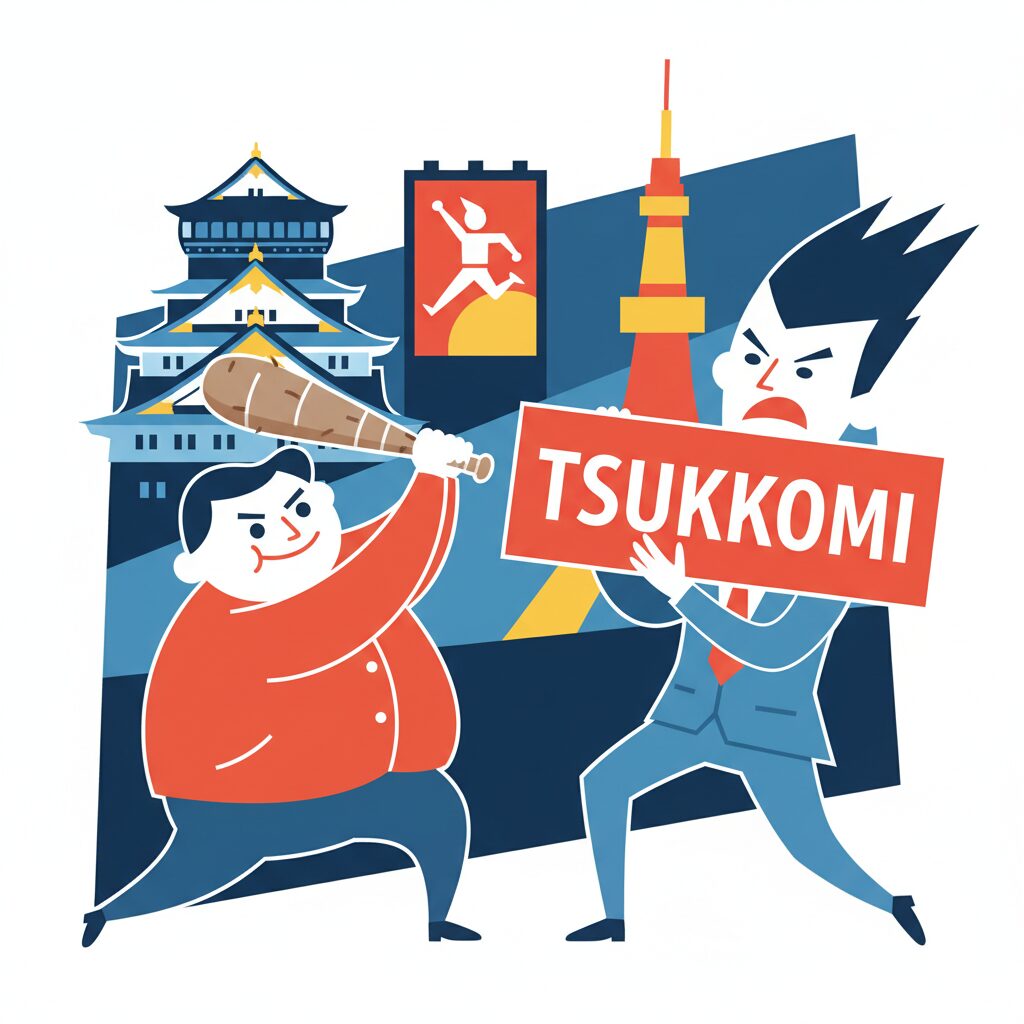
Walk through any bustling Osaka shotengai, the covered shopping arcades that pulse like arteries through the city, and you’ll hear it. It’s not just the clatter of pachinko parlors or the sizzle of takoyaki on a griddle. It’s a distinct cadence in the way people talk. A conversation might sound like a friendly argument, punctuated by a sharp retort and then, suddenly, a wave of shared laughter. A shopkeeper might say something outrageous to a customer, who, without missing a beat, serves back a perfectly timed comeback. As a Tokyo native, the first time I truly listened, I was baffled. Communication back home is a landscape of careful layers, of reading the air and prioritizing harmony. Here, it felt like a sport, a performance where everyone knew the rules except me. This is the world of Boke and Tsukkomi, the foundational rhythm of Osaka life that often leaves newcomers, especially those from outside Japan, feeling like they’ve walked into a comedy club without a ticket.
This isn’t about professional comedians on a stage. This is about the old woman selling pickled vegetables, the salaryman at a standing bar, the teenagers hanging out in Amerikamura. They are all, in their own way, masters of a comedic duet that defines Osakan identity. The Boke is the fool, the one who says something silly, absurd, or slightly off-kilter. The Tsukkomi is the straight man, the one who points out the absurdity, corrects the Boke, and brings the conversation back to reality, often with a theatrical exclamation. Understanding this dynamic is more than just learning slang; it’s about unlocking the entire social operating system of Japan’s vibrant second city. It explains why interactions here feel so direct, so energetic, and so profoundly different from the polite reserve of Tokyo. To live in Osaka is to learn the steps to this dance, a rhythm that turns a simple chat into a shared moment of connection and joy.
The spontaneity of Osaka’s street humor finds a complementary outlet in the city’s vibrant drinking culture, where a visit to an Osaka tachinomi offers locals a refreshing antidote to modern work isolation.
The Unspoken Rules of the Game
First, let’s address a common misunderstanding. Boke and Tsukkomi are not fixed personality types. You aren’t born a Boke or a Tsukkomi. These roles are fluid, hats that people put on and take off repeatedly within a single conversation. It’s a cooperative performance, like a conversational volleyball match. One person, the Boke, lobs a funny-shaped ball into the air. The other, the Tsukkomi, skillfully spikes it down, and the satisfying sound of that spike is shared laughter. The goal isn’t to win an argument or prove a point; it’s to keep the rally going. The success of the exchange depends on both parties understanding and committing to their temporary roles.
In Tokyo, if someone says something factually incorrect, the listener might gently correct them, ignore it to avoid embarrassment, or simply become confused. In Osaka, that same incorrect statement is often an invitation. It’s a deliberate, playful setup. The speaker is essentially saying, “Here, I’ve created a perfect opportunity for you to shine. Now, give me a good Tsukkomi.” Failing to respond is like leaving a high-five hanging. It breaks the rhythm and creates social awkwardness far greater than the initial silly comment ever could. This conversational structure is built on trust—the trust that your partner will catch what you throw and throw something back, maintaining the delicate, hilarious balance.
What Boke Looks Like in the Wild
The Boke’s role is to introduce a small, manageable dose of chaos into reality. It’s an art form of exaggeration, feigned ignorance, and playful absurdity. It’s rarely a complex lie or a deep intellectual error. It’s more subtle—a slight twist on the expected.
Imagine you’re at a takoyaki stand in Namba. The vendor hands you your piping hot octopus balls. A Tokyoite would say, “Thank you, they look delicious.” An Osaka Boke might look at the steam rising and say with deadpan seriousness, “Wow, you sure these aren’t active volcanoes? I didn’t bring my safety gear.” This isn’t a complaint. It’s an offering. The vendor is now expected to play along.
Among friends, the Boke role is constant. Someone might point at the Tsutenkaku Tower and ask, “Is that the Tokyo Tower? It looks smaller than I imagined.” This is a classic Boke. The person obviously knows it’s not the Tokyo Tower. The error is the joke. Or perhaps a friend shows up wearing a bright yellow shirt. The Boke might say, “Hey, I didn’t know you were working as a traffic light today!” The statement is absurd, but it opens the door for a witty response. It’s a way of saying, “I see you, I’m engaged with you, and I want to play.” It’s a sign of comfortable intimacy, a means to build rapport without the stiff formalities that govern so many social interactions elsewhere in Japan.
The Art of the Tsukkomi
The Tsukkomi role is equally crucial and requires just as much skill. A good Tsukkomi isn’t a bully or a know-it-all. They are the anchor, the one who grounds the Boke’s chaotic energy, and in doing so, creates the comedic release. The Tsukkomi’s reaction validates the Boke’s effort. It says, “I got your joke, and I’m completing it for you.”
Let’s return to our examples. The takoyaki vendor, hearing the “volcano” comment, might shoot back, “Of course not! Volcanoes are free, you have to pay for these!” A perfect Tsukkomi. It’s quick, witty, and keeps the game going. To the friend who mistook the tower, the Tsukkomi response is almost instinctual for an Osakan: “Nande ya nen!” This phrase, which roughly translates to “Why the heck?!” or “You’ve gotta be kidding me!”, is the soul of Osaka Tsukkomi. It’s a verbal Swiss Army knife. It can express surprise, disagreement, affection, or mock outrage. The tone is everything. It’s almost never truly angry. It’s a sharp, percussive sound that signals the punchline has landed.
Sometimes the Tsukkomi is physical. It might be a light, open-palmed tap on the Boke’s shoulder or the back of the head. To a Western observer, this can be shocking. It looks like casual violence. But it’s entirely theatrical. It’s the physical equivalent of an exclamation mark, a gesture that accompanies the “Nande ya nen!” to amplify the effect. It’s a sign of deep familiarity. You would never perform this kind of Tsukkomi on a stranger or a superior. It’s reserved for people you feel close to, a testament to a bond strong enough to endure a bit of performance art.
Why This Comedy Duo Exists in Every Conversation
This communication style is no accident; it’s ingrained in Osaka’s DNA. For centuries, Osaka served as Japan’s commercial center, known as the “nation’s kitchen.” It was a city of merchants rather than samurai. While Tokyo (then Edo) was home to the rigid, hierarchical warrior government, Osaka thrived on fast-paced negotiation, sharp wit, and practical, results-driven relationships. To succeed as a merchant, one needed to quickly establish rapport, read people effectively, and use humor to soften the edges of a business deal. A clever joke could disarm a tough customer and transform a transaction into a lasting relationship.
This history fostered a culture that values directness, pragmatism, and a good dose of irreverence. There is less focus on tatemae, the public facade so vital in more formal settings like Tokyo. In Osaka, revealing your true self (honne), including your flaws and sense of humor, often builds trust faster. The Boke/Tsukkomi dynamic is precisely a tool for this purpose. It acts as social lubricant, breaking down barriers and quickly creating a playful, egalitarian bond. By sharing and delivering a joke together, two people affirm that they are on the same wavelength, understanding each other’s rhythms. It’s an incredibly efficient way to build community, one punchline at a time.
Navigating as a Foreigner: To Boke or Not to Boke?
For a non-Japanese resident, this can be quite tricky. The most common mistake is misinterpreting a Tsukkomi as genuine anger or criticism. You might make a minor error, and a local shopkeeper might shout “Nande ya nen!” with a smile. Your natural reaction might be to feel embarrassed or offended. However, you need to understand the context: the grin, the laughter in their eyes, the playful tone. They aren’t scolding you; they’re welcoming you into their world. They are treating you like one of their own.
Taking part in the game yourself is even more challenging. Trying a Boke without a solid grasp of the language and cultural nuances can easily backfire. What you mean as a witty, playful remark might just sound like a strange, incorrect statement, causing real confusion instead of laughter. The timing and subtlety required are considerable. Likewise, a poorly done Tsukkomi can come across as genuinely harsh. A blunt “Why?” instead of a rhythmic “Nande ya nen!” lacks warmth and makes you seem rude rather than funny.
So, what’s a safe approach? Begin as an appreciative audience. When you observe the interaction, smile and laugh along. Show that you understand it. This alone often earns you goodwill with the locals. Your first active step could be to use “Nande ya nen!” in a straightforward situation. When a friend makes an obvious joke, give it a try. They will almost certainly appreciate it. As for being the Boke, it’s usually best to let your Osakan friends lead. They are experts at it. By learning to be a good Tsukkomi—a good responder—you’ll develop the rhythm and timing, and eventually, you might find yourself setting up your own jokes.
Where You’ll See It Most
While this dynamic infuses every aspect of life in Osaka, some places showcase it more vividly. The shotengai serve as lively stages for the Boke/Tsukkomi exchange. Listen to the playful banter between a fishmonger and a regular customer—it’s a quick-fire volley of teasing and witty comebacks honed over years. The shopkeeper might hold up a fish, saying, “This one’s so fresh it might swim out of your bag!” The customer could reply, “At that price, it better cook itself, too!” Here, commerce and entertainment blend seamlessly.
Step into an izakaya (a Japanese pub) in the evening, and the volume and energy rise exponentially. Friends mercilessly but affectionately roast each other, switching Boke and Tsukkomi roles so fast it’s dizzying. One might spill a bit of their drink, prompting a friend to say, “Are you a baby? Do you need a bib?” The spiller might shoot back, “I’m just marking my territory, since you take up so much space!” This cascade of playful insults only deepens their bond.
Even in the typically more reserved workplace, the Osaka spirit manages to shine through. A colleague might slip an obvious meme or funny picture into a serious presentation’s final slide. The first person to call it out with a good-natured Tsukkomi earns bonus points. It’s a way to ease tension and build camaraderie unique to Osaka. They work hard, but refuse to take themselves—or their work—so seriously that laughter has no place.
The Sound of a City That’s Alive
Ultimately, the constant interplay between Boke and Tsukkomi is more than just a quirk of communication. It is the city’s heartbeat. It embodies a core philosophy: life is tough, so you might as well laugh at it. It’s a resilience shaped by the demands of commerce, a belief that a shared joke creates a stronger bond than rigid formality. In Tokyo, silence may signify respect and reflection. In Osaka, it can indicate distance. The noise, the banter, the continuous, rhythmic back-and-forth—that is the sound of connection.
When an Osakan starts engaging in the Boke/Tsukkomi exchange with you, it’s a meaningful moment. It signifies acceptance. It means they feel comfortable enough to set aside polite pretenses and connect with you on a human level. They no longer see you as a guest or an outsider (yosomono), but as one of their own. So, the next time you’re in Osaka, don’t just listen to the words. Listen for the rhythm. Listen for the setup and the punchline, the playful silliness and the sharp, affectionate comeback. Once you catch the music in their conversations, you’ll realize you’re beginning to understand the warm, chaotic, and brilliantly unique soul of Osaka.