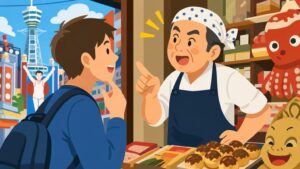
The first time it happened, I was utterly lost. Standing in the electric hum of the Kuromon Market, I watched an elderly shopkeeper hand a bag of tangerines to a customer. As the woman paid, she beamed and said, “So cheap! It’s like you’re giving them away!” The shopkeeper, without missing a beat, leaned forward with a mock-serious face and shot back, “Then give me back my tangerines!” The woman erupted in laughter, slapped his arm playfully, and walked away smiling. I stood there, a Canadian photographer trying to make sense of a city’s soul, completely baffled. Was that an argument? A complaint? A joke? It was none of those, and all of them. It was my first raw, unfiltered encounter with tsukkomi, the conversational lifeblood of Osaka.
This city moves to a different beat. If Tokyo is a meticulously composed symphony of polite nods and unspoken agreements, Osaka is a free-form jazz session, a riot of laughter, sharp retorts, and conversations that feel like a verbal dance. To an outsider, it can seem abrupt, even confrontational. But once you learn the rhythm, you realize it’s the sound of connection, a unique brand of communication that transforms the mundane into a stage for everyday comedy. Understanding tsukkomi isn’t just about learning a new word; it’s about unlocking the very code of how Osaka thinks, feels, and relates. It’s the key to moving from a visitor to someone who truly gets the vibrant, chaotic, and deeply human heart of this metropolis.
For those captivated by Osaka’s vibrant conversational style, uncovering the city’s after-work drinks ritual offers yet another layer to its lively social tapestry.
The Heartbeat of Osaka Banter: Boke and Tsukkomi
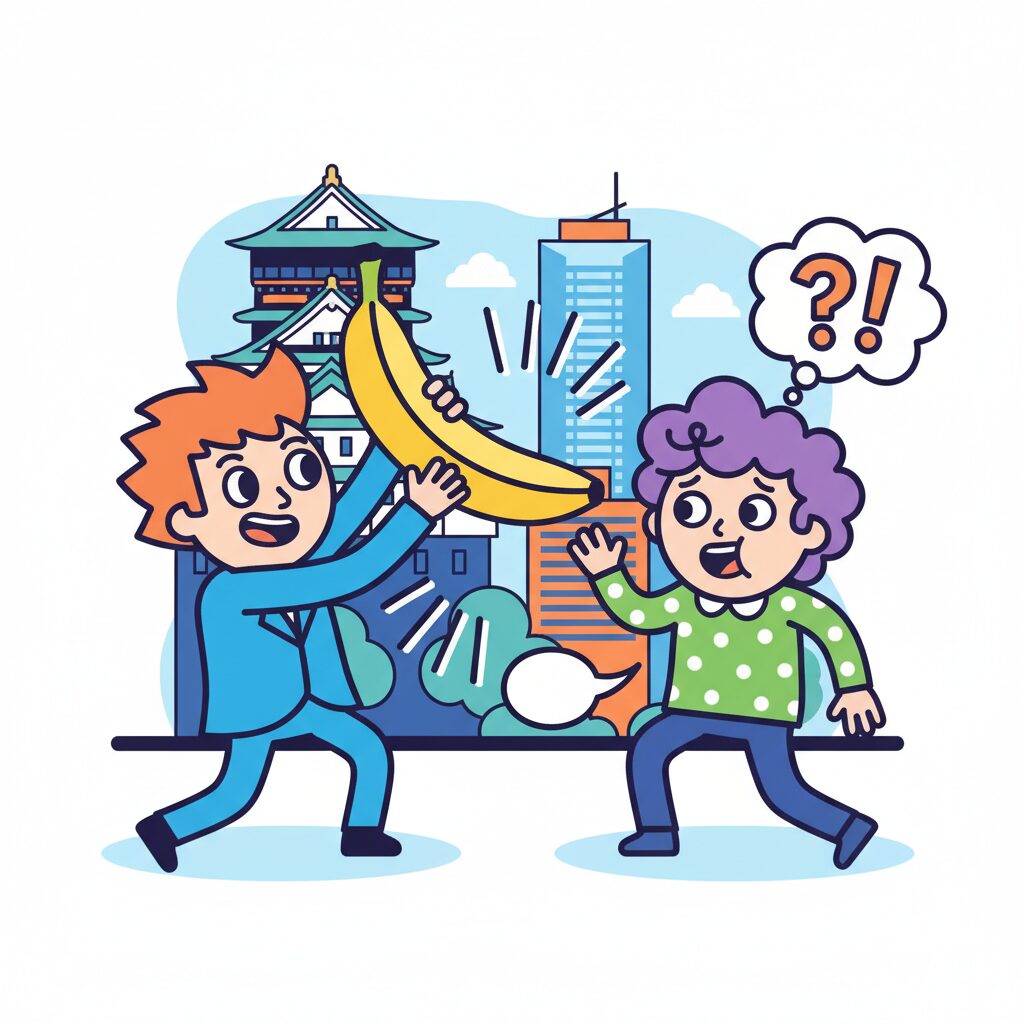
You can’t grasp tsukkomi by itself. It’s one half of a dynamic duo, a conversational partnership that underpins Osakan humor. This framework is famously showcased in manzai, Japanese stand-up comedy, but in Osaka, the stage is everywhere—the bus stop, the supermarket aisle, the office kitchenette. The two key roles are the boke and the tsukkomi.
The boke (ボケ) derives from the verb bokeru, which can mean “to be senile” or “to be hazy.” Comedically, the boke is the funny one, the airhead, the person who says or does something absurd, silly, or just plainly wrong. They are the setup. They might dramatically sigh and say, “I’m so broke, my wallet is crying,” or point to a cat and ask, “Is that a dog?” The boke deliberately, or sometimes inadvertently, creates a flaw in the fabric of reality, a small tear that demands fixing.
That repair is the task of the tsukkomi (ツッコミ). The word comes from the verb tsukkomu, meaning “to thrust into” or “to poke.” The tsukkomi is the straight man, the one who catches the absurdity and instantly corrects it with a sharp, witty response. They are the punchline. When the boke says the wallet is crying, the tsukkomi shoots back, “Wallets don’t have eyes!” When the boke confuses a cat for a dog, the tsukkomi retorts, “That’s a cat! Are your eyes just decorations?!”
This isn’t an argument. It’s a performance, a rapid-fire exchange that restores conversational balance in the most entertaining way. The boke throws out a ball of absurdity, and the tsukkomi returns it with pinpoint accuracy. In Osaka, this isn’t just for comedians. It’s how friends converse, how shopkeepers establish rapport, and how colleagues break the ice. It is the essential rhythm of social interaction, a shared game everyone knows how to play.
Tsukkomi in the Wild: Where You’ll See It, Hear It, and Feel It
Once you attune your ears to the rhythm of boke and tsukkomi, you’ll begin to notice it everywhere. It’s the unseen framework that supports the city’s vibrant energy. The true spirit of Osaka life reveals itself in these subtle, rapid-fire exchanges.
The Market Stall Tango
Nowhere does this performance come alive more vividly than in Osaka’s extensive shotengai, or covered shopping arcades. These are far from quiet, sterile commercial zones. They are dynamic stages. Stroll through Tenjinbashisuji or Shinsaibashi-suji, and listen closely. You’ll hear a clothing vendor call out to a passerby, “Madam, this shirt will make you look ten years younger!” A genuine Osakan woman might pause, inspect the shirt, and deadpan, “I need one that makes me look twenty years younger. Got anything better?” This isn’t a complaint; it’s an invitation to engage. The shopkeeper may clutch their chest dramatically, “Twenty years? For that, you’d need a time machine, not a T-shirt!” Both laugh, a connection forms, and perhaps a sale follows. The interaction is more important than the transaction. This banter, this quick-witted boke and tsukkomi dance, is a uniquely local form of customer service.
Izakaya Echoes
The buzz of a local izakaya provides the perfect setting to witness tsukkomi among friends. In Tokyo, conversations might be more measured, with pauses to avoid interruptions. In Osaka, dialogue overlaps, interjects, and builds with lively energy. Imagine a group of friends ordering. One friend—the boke—confidently asks the waiter for “that famous spicy fish.” Another immediately jumps in with a tsukkomi: “It’s beef, you idiot! Ever seen a fish with four legs?” There’s no malice in “idiot.” It’s said with a grin, a term of affection tied to correction. The aim isn’t to embarrass but to generate shared laughter, turning a simple ordering slip into a memorable moment. The absence of this playful teasing often signals distance or formality.
The Office Quick-Step
You might guess that this lively exchange would be toned down at work, but that’s only partly true. While language may be more refined, the underlying beat remains. In a Tokyo office, a colleague’s glaring typo might be pointed out delicately or in private. In an Osaka office, a boss might theatrically sigh mid-meeting, “Tanaka-san, I didn’t realize we were selling ‘bannas.’ Is this a new tropical business?” The room fills with gentle laughter, Tanaka-san included. The tsukkomi highlights the mistake in a way that eases tension rather than creating it. It’s a leadership style that corrects errors while boosting team spirit. It says, “You made a mistake, but it’s no big deal. We can laugh it off and fix it together.”
The Unspoken Rules of the Game
Participating in or even just watching this banter can feel intimidating for newcomers. Although it appears chaotic, there is an underlying set of rules that everyone implicitly knows. Understanding this code is key to realizing why tsukkomi acts as a social lubricant rather than a social irritant.
It’s About Speed and Rhythm
A tsukkomi loses its impact if it comes too late. The response must be immediate, almost instinctive. When the boke presents the absurdity, the tsukkomi has to follow on the very next beat. Any delay or hesitation causes the moment to slip away. The humor falls flat, and the conversation turns awkward. This explains why Osakans seem to be such quick thinkers and fast talkers; they are trained from birth to listen carefully for the next chance to complete the conversational exchange. It’s a rapid-fire game of verbal tennis, and keeping pace is part of the enjoyment.
It’s a Sign of Affection, Not Aggression
This is perhaps the most important rule for foreigners to understand. In many cultures, directly pointing out someone’s mistake, calling them an “idiot,” or delivering a sharp comeback may be seen as rude, aggressive, or condescending. In Osaka, however, it often means the opposite. A tsukkomi is a show of closeness. It communicates, “I’m paying close attention to you.” It says, “I know you well enough to tease you, and I trust you understand that I’m not being hostile.” The true insult in an Osaka conversation is silence. If you deliver a boke and receive a polite, non-committal nod, it can feel cold and dismissive. A sharp tsukkomi, on the other hand, is a warm embrace. It affirms your contribution and draws you deeper into the group.
The Physical Punctuation
Sometimes words alone aren’t enough. The classic image of manzai comedy shows the tsukkomi hitting the boke on the head with a large paper fan, or harisen. This has a softer, everyday equivalent in Osaka life. A sharp “Nande ya nen!” (“What the heck!” or “Why?!”) is often paired with a light, open-handed tap on a friend’s shoulder or arm. It’s important to realize that this is purely theatrical. The tap is for both auditory and visual emphasis; it’s not meant to cause pain. It serves as the physical exclamation point at the end of a verbal sentence. To outsiders, it might look surprising, but among Osaka locals, it’s as natural as a handshake or a high-five.
Why Osaka? The Cultural Soil for Tsukkomi
This distinctive style of communication didn’t emerge spontaneously. It was born from the very essence of Osaka, shaped over centuries by the city’s unique history, economy, and strong sense of identity. It directly mirrors a culture that has always cherished wit, practicality, and a generous dose of irreverence.
Merchant City Mindset
For much of its history, Osaka was Japan’s commercial core, known as the “nation’s kitchen.” It was a city of merchants, craftsmen, and deal-makers. In the high-pressure world of business, quickly and effectively building rapport was essential for survival. There was no room for the rigid formalities and layered indirectness typical of the samurai class in Edo (now Tokyo). Osaka merchants needed to size each other up, build trust, and close deals swiftly. Humor served as the perfect tool. A sharp, witty exchange could break the ice far more effectively than a series of deep bows. This straightforward, practical, and results-driven style of communication became embedded in the city’s DNA. Tsukkomi is the modern reflection of that merchant spirit: get straight to the point, be clever, and don’t take yourself too seriously.
The Capital of Comedy
Osaka is unquestionably the comedy capital of Japan. The city hosts Yoshimoto Kogyo, the entertainment giant that has shaped modern Japanese comedy for more than a century. The Namba Grand Kagetsu theater is a revered landmark for comedy fans, with its performers considered local heroes. Osakans grow up immersed in the culture of manzai. They watch it on television daily, quote famous comedians, and internalize the boke-tsukkomi rhythm as the natural way to converse. Being “omoshiroi” (funny or interesting) is highly valued social currency. While in Tokyo, reservedness and knowledge might earn respect, in Osaka, winning friends often comes from delivering a sharp tsukkomi.
The Anti-Tokyo Stance
A deep-rooted, mostly friendly rivalry exists between Osaka and Tokyo. Osakans often define their identity in contrast to the capital. Where Tokyo is viewed as formal, buttoned-up, and preoccupied with appearances (tatemae), Osaka prides itself on being informal, frank, and focused on genuine feelings (honne). The tsukkomi culture proudly expresses this identity. It rejects indirectness and celebrates saying what you mean, albeit through humor. For Osakans, this style of banter is more than just a way of speaking; it’s a declaration of who they are and the kind of open, down-to-earth society they embrace.
A Foreigner’s Guide to Playing Along
So you’re living in Osaka, immersed in a whirlwind of banter. How do you handle it? The good news is, no one expects you to become a manzai expert overnight. But grasping the basics and showing you’re willing to join in can greatly enhance your experience here.
You Don’t Have to Be a Comedian
The first step is to relax. You’re not on stage. Your main role, especially in the beginning, is to be a good audience. When a friend or the local baker makes a tsukkomi, just laugh. A genuine laugh is the best reaction. It shows you get the joke, appreciate the humor, and are part of the moment. Getting defensive, over-explaining, or taking offense will break the playful vibe. Just smile, laugh, and enjoy the performance.
Your Starter Kit: Simple Tsukkomi Phrases
If you’re feeling bold enough to join in, you don’t need a complicated vocabulary. A few key phrases, delivered with the right lighthearted tone, can go a long way.
- Nande ya nen! (なんでやねん!): The classic Osaka phrase. It’s a versatile “What the heck?!”, “No way!”, or “Why?!” Use it when someone says something unbelievable or does something silly. It’s the Swiss army knife of tsukkomi.
- Honma ka? (ほんまか?): “Really?” Delivered with a skeptical tone, it’s a fun way to call out a friend’s exaggerated story. It’s a gentle way of saying, “I think you’re joking.”
- Akan yaro! (あかんやろ!): Roughly translates to “That’s not right!” or “You shouldn’t do that!” Perfect when a friend jokingly suggests doing something lazy or mischievous. Remember, the tone matters. It should be playful, not serious.
Receiving a Tsukkomi: The Graceful Response
Sooner or later, you’ll be on the receiving end of a tsukkomi. This is a sign people feel comfortable around you. A colleague might point out your mismatched socks, or a friend tease you for putting ketchup on your okonomiyaki. Your response is simple: own it and laugh. A self-deprecating chuckle and a quick “Ah, you got me!” or “Oops!” is the perfect reply. This shows you’re not overly sensitive and that you get the affectionate nature of the jab. By accepting the tsukkomi gracefully, you complete the comedic exchange and strengthen your social connection.
The Deeper Meaning: Tsukkomi as Connection
At its core, tsukkomi is far more than just a comedic tool. It serves as the driving force of social interaction in Osaka. It represents a shared cultural language that helps people navigate life’s little absurdities, ease tension, and quickly build rapport. It functions as a mechanism for transforming mistakes into jokes, complaints into performances, and strangers into temporary co-stars.
Living in Osaka means embracing this rhythm. It involves recognizing that a sharp retort can express warmth, and that a shared laugh over a silly remark forms a strong bond. It’s the voice of a city that openly shows its emotions and refuses to let politeness block genuine human connection. The relentless, lively, and humorous exchange between boke and tsukkomi is the authentic, unfiltered soundtrack of everyday life in Osaka. And once you learn to appreciate this rhythm, you’ll never want to mute it.