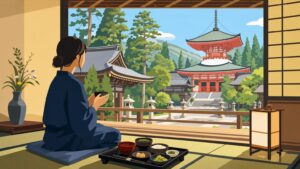
Osaka. Say the name and a certain image flashes to mind. Neon-drenched canals, steam rising from takoyaki stalls, and a whirlwind of voices, loud and laughing, that hit you like a friendly tidal wave. It’s a city that wears its heart on its sleeve, a place famous for food, comedy, and a commercial energy that never seems to sleep. We’re known for being direct, pragmatic, and maybe a little obsessed with getting a good deal. And while all of that is true, it’s not the whole story. It’s the flashy book cover, not the dense, fascinating pages within.
But what happens when you take a twenty-minute train ride south from the roaring hub of Namba? You arrive in Sakai, a city that’s technically its own entity but feels like Osaka’s soul laid bare. It’s a place that strips away the neon to reveal the bones of what makes this region tick. Here, two seemingly opposite worlds collide: the fiery, ear-splitting workshops of Japan’s most renowned knife makers and the silent, immense presence of ancient imperial tombs. It’s a city of sharp edges and deep, quiet history. Spending a weekend here isn’t about escaping Osaka; it’s about understanding its source code. It’s where you can finally grasp the deep-seated pragmatism and the understated, colossal history that hums beneath the surface of everyday Osaka life.
As you delve into Sakai’s blend of ancient tradition and artisanal prowess, you might also appreciate exploring the unspoken rules of public space that subtly orchestrate Osaka’s vibrant urban life.
The Craftsmanship That Cuts to the Chase

Stroll down a quiet residential street in Sakai, and you might hear it before you see it: the steady clang of a hammer striking steel, the sharp scream of a grinding wheel. This is the soundtrack of the Sakai hamono, the handcrafted knives that chefs worldwide speak of with admiration. Entering one of these workshops, often small, family-run businesses, feels like stepping back in time. The air is thick with the scent of metal and oil, and sparks fly in the low light. Men, frequently from generations of the same family, work with a focused intensity that’s almost mesmerizing. There’s no wasted movement, no showmanship—just pure, unfiltered craftsmanship.
More Than a Souvenir: The Sakai Knife Philosophy
What quickly becomes clear is that a Sakai knife represents the very essence of the Osaka mindset. In Tokyo, products are often wrapped in layers of elaborate branding, where the story and image matter as much as the item itself. In Osaka, especially in Sakai, the approach is different. It’s about the honma mon—the genuine article. The quality of a product must speak for itself, unmistakably and loudly. An Osakan doesn’t want to be sold a story; they want something that works—and works brilliantly.
That’s why holding a Sakai knife feels unique. You sense the balance, the razor-sharp edge, and the careful thought behind its specific purpose, whether slicing sashimi or chopping vegetables. The artisans here aren’t interested in making generic souvenirs for tourists. They craft tools for professionals, built to last a lifetime. This focus on utility and performance over superficial beauty is quintessential Osaka. It’s the same mindset that leads an Osakan to choose a humble, back-alley eatery with the best broth over a trendy but uninspired café. Results matter more than appearance. The knife doesn’t need fancy packaging because its performance is its entire advertisement. It’s a quiet confidence that says, “I’m excellent. You’ll notice.”
The Merchant’s Blade: A Legacy of Pragmatism
This attitude is far from new; it’s ingrained in the region’s history. Centuries ago, Sakai wasn’t governed by samurai lords but by wealthy, independent merchants. It was a free port, a center of international trade and skilled craftsmanship. This fostered a culture where reputation relied not on family name, but on the quality of one’s goods and the sharpness of one’s business acumen. That merchant spirit still runs deep in modern Osaka.
When you speak with a knife maker in Sakai, you’re not chatting with an elusive, mystical artist. You’re talking to a shrewd, straightforward small business owner. They’ll discuss the carbon content of various steels, the precise sharpening angle, and the competitive market with the same blunt honesty an Osaka shopkeeper uses to assure you’re getting a fair price on a bag of oranges. There’s no pretense. One craftsman told me, holding a gleaming blade, “Pretty is nice, but it has to cut. If it doesn’t cut perfectly, it’s just a piece of metal.”
That statement is central to everything. It captures the Osaka obsession with kosupa (cost performance). It’s not about cheapness; it’s about a near-religious dedication to value. Spending money on something that’s all style and no substance is, for lack of a better word, foolish. This pragmatism is often misunderstood by outsiders as a lack of refinement. But in Sakai, it’s recognized for what it truly is: a profound respect for skill, practicality, and honesty. The blade doesn’t lie, and neither, for the most part, will an Osakan.
Living with Giants: The Ancient Tombs of Mozu
After the intense, fiery world of the knife workshops, the other side of Sakai feels like an entirely different dimension. Amid perfectly normal suburban surroundings lie the Mozu-Furuichi Kofungun: a group of colossal, keyhole-shaped burial mounds constructed for emperors and powerful clans over 1,500 years ago. These are not mere hills; the largest, the Daisen Kofun, attributed to Emperor Nintoku, is one of the largest tombs on Earth by area, surpassing even the Great Pyramid of Giza.
Yet, the atmosphere on the ground is surprisingly, wonderfully ordinary. There are no grand, imposing entrances or velvet ropes. Instead, a three-layered moat encircles a dense, man-made forest, and just across the street, you’ll find a 7-Eleven, a local high school, and rows of modest family homes with laundry hanging on balconies. This perfectly illustrates Osaka’s unique relationship with its own history.
History as Your Neighbor, Not Your Museum
In cities like Kyoto or Nara, history often feels curated, preserved behind glass or within the pristine walls of a temple. It’s something you visit, an experience separate from everyday life. In Sakai, history is your neighbor. It’s the massive, silent park at the end of your street where you walk your dog. It’s the great green mound you cycle past on your way to the train station. People live their lives in the shadow of these sleeping giants with quiet respect.
This blending of the ancient into daily life reveals much about the local mindset. Osakans aren’t performative about their heritage. They don’t feel the need to constantly discuss it or package it for others. They simply live with it. This creates a relationship with the past that’s less formal and more personal. You don’t have to be a historian to sense its presence. This unpretentiousness is a core Osaka trait. We have this incredible, world-class historical site, and what do we do? We build our homes beside it and go about our day. There’s a quiet confidence in that—a feeling that the history is so immense and self-evident it requires no fanfare.
The Silent Scale of Osaka’s Ambition
From ground level, the kofun are so vast that their famous keyhole shape is indiscernible. You simply see a dense forest and a wide moat. Their true, astounding scale is hidden up close. This understated grandeur forms a perfect contrast to the city’s loud, modern character. Yet, it speaks to the same fundamental identity. The sheer ambition needed to build these tombs—to move that much earth and organize that much labor—is staggering. It was a monumental statement of power and vision.
That same bold, “go big or go home” spirit is woven into modern Osaka’s DNA. It’s the drive behind the massive commercial complexes of Umeda, the construction of the country’s tallest skyscraper, Abeno Harukas, and the wild, theatrical urban landscape of Dotonbori. Osaka’s ambition didn’t begin with neon signs; it began with moving mountains to bury its leaders. While Tokyo often feels sleek and centrally planned, Osaka’s grand projects reflect powerful merchants and ambitious city builders striving to outdo one another. The ancient kofun stand as the silent, sleeping ancestors of this very modern impulse. They are the oldest evidence that this region has always dreamed big.
Tying It All Together: What Sakai Teaches You About Osaka

A weekend in Sakai provides a profound insight into understanding the city you thought you knew. The sharp, functional elegance of a Sakai knife and the quiet, monumental presence of a kofun represent two sides of the same coin. They stand as the dual pillars of Osaka’s character: radical pragmatism and a deep, unspoken history.
The Pragmatic Soul
The philosophy of the Sakai knife maker—prioritizing function, honesty, and tangible quality above all else—is the very foundation of Osaka. It explains why people will wait an hour for an 800 yen bowl of ramen. It’s not only about the food; it’s about engaging in a culture that acknowledges and honors true value. It’s why conversations often feel direct and blunt; unnecessary fluff is inefficient, and the aim is to get straight to the point. This mindset, rooted in a merchant history rather than that of courtiers, is what gives Osaka its grounded, authentic feel. People value things that work, straightforward individuals, and sensible deals. Visiting a Sakai workshop is not just about watching a knife being crafted; it’s about witnessing an entire philosophy forged in fire and steel.
An Unspoken Depth
Meanwhile, the ancient tombs quietly nestled among the suburbs dispel the notion that Osaka has no regard for the past. The city is frequently misunderstood as being entirely transactional—a place of commerce without soul. But Sakai disproves this. The history is substantial—so substantial that it doesn’t need to be loudly declared. It has been woven into the landscape and the collective consciousness. This uncovers a hidden dimension of Osaka’s personality: a quiet confidence that requires no external validation. The city’s identity runs deep, even if its modern expression is bold and commercial.
What This Means for Daily Life
So, what does this signify for someone living here? It means appreciating that Osaka operates on a logic of substance. It means looking beyond the surface to discover quality, whether in a simple kitchen tool or the silent history of the nearby park. Living in Osaka is about recognizing the shokunin spirit not only in artisans, but also in the elderly woman who has perfected her okonomiyaki recipe over fifty years. It’s about realizing that the city’s energy isn’t chaotic; it’s the quiet hum of millions focused on creating, selling, and enjoying things of genuine, tangible worth.
A weekend in Sakai doesn’t take you away from Osaka; it draws you deeper into its soul. You return to the bustling streets of Namba or Umeda with fresh eyes, seeing the city not just as a dazzling spectacle, but as the modern-day bearer of a legacy of master craftspeople and visionary giants. And you come to understand that the true Osaka, the honma mon, resides in that beautiful, functional, and deeply authentic space between the razor’s edge and the ancient earth.