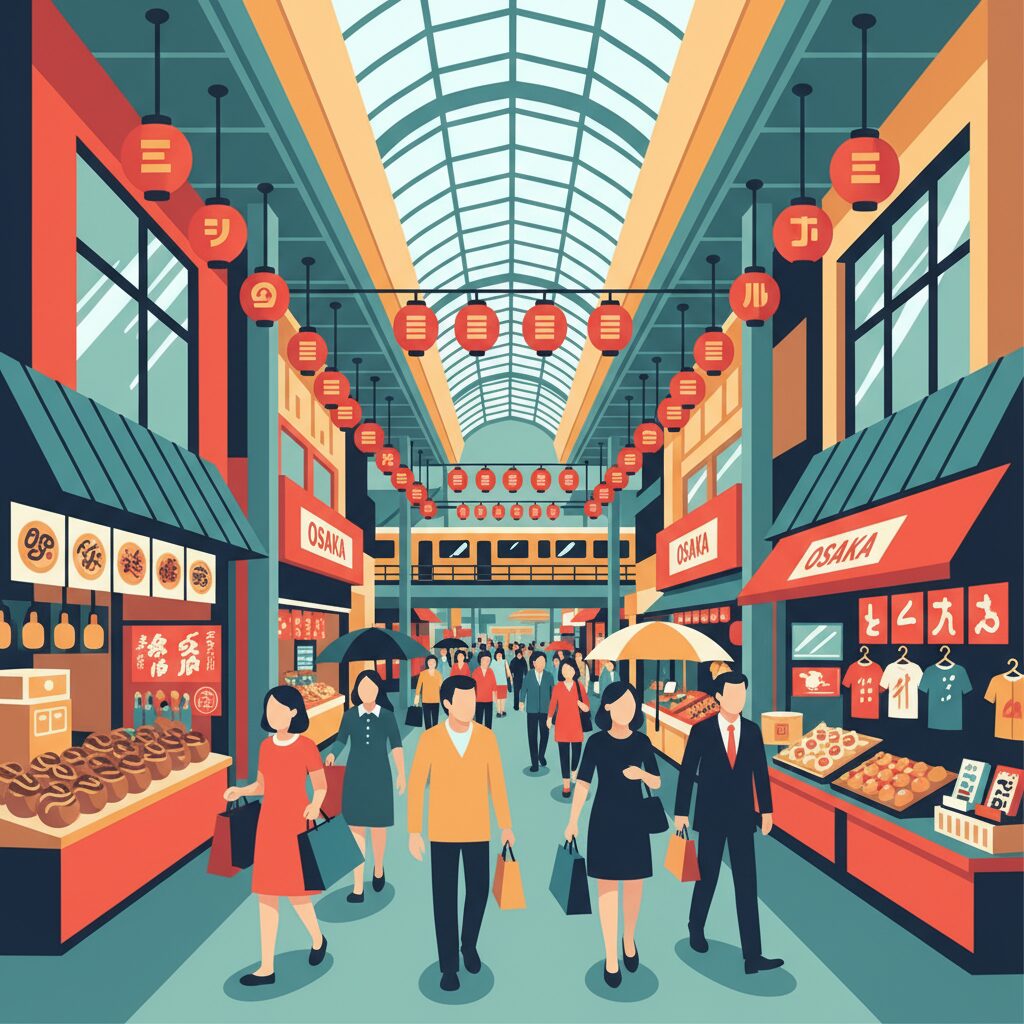
You’ve just moved to Osaka. You walk into a gleaming, brightly-lit supermarket, a sanctuary of order and calm. You pick up a single apple, perfectly round, individually wrapped, glowing under the fluorescent lights. You check the price. Your eyes widen. You quietly put the apple back. You wander over to the fish aisle. Symmetrical fillets of salmon sit on pristine styrofoam trays, each sealed in plastic. The price tag makes you wonder if they were flown in on a private jet. This, you think, is just the cost of living in Japan. Everything is beautiful, perfect, and breathtakingly expensive.
This is a common story, a universal experience for newcomers. But it’s based on a fundamental misunderstanding of how this city actually eats. The supermarket, with its silent aisles and fixed prices, is just one option. It’s the easy option, the convenient option, but it’s not the Osaka option. To truly understand how to live—and save—in this city, you have to turn away from the polished floors and automatic doors and walk into the glorious, roaring chaos of the shotengai.
These covered shopping arcades aren’t just relics of a bygone era or tourist traps filled with souvenir shops. They are the beating heart of Osaka’s real economy. They are where grandmothers, students, chefs, and families go to stock their kitchens. A shotengai is not just a place to buy things; it’s a living, breathing ecosystem built on a philosophy of commerce that feels worlds away from the corporate logic of a chain supermarket. It’s loud, it’s a bit messy, and it’s your single greatest weapon against an expensive grocery bill. This isn’t about being nostalgic; it’s about being smart. And in Osaka, being a smart shopper is the highest form of respect.
Embracing the spirited shotengai lifestyle is just one savvy way to save in Osaka, and staying informed about booking site scams can help travelers avoid costly pitfalls elsewhere.
The Supermarket vs. The Shotengai: A Tale of Two Mindsets

To understand why the shotengai can significantly reduce your food expenses, you first need to appreciate the cultural and economic divide it embodies. It represents a clash between two fundamentally different perspectives on food, money, and community.
The Silence of the Supermarket
Reflect on your last trip to the supermarket. What sounds did you notice? The low hum of refrigerators, the soft beep of scanners, perhaps some polite, pre-recorded announcements over the PA. The entire atmosphere is crafted for minimal human interaction. It’s a system of quiet efficiency.
The products mirror this approach. Every vegetable is cleaned, standardized, and packaged. There’s no allowance for unusual shapes or minor imperfections. Prices are fixed, determined by a distant head office. There’s no negotiation or flexibility. You are simply a consumer completing a transaction. You find what you need, pay the listed price, and leave. The relationship is with the brand, not the person selling the food. It’s predictable, sterile, and universally understood. It’s also remarkably wasteful and consequently costly. You’re paying for immaculate packaging, perfect lighting, the labor involved in removing imperfect produce, and substantial corporate overhead.
The Symphony of the Shotengai
Now, enter a shotengai like Tenjinbashisuji or Komagawa Nakano. The first thing that strikes you is the sound. It’s a symphony of commerce. Fishmongers with deep, gravelly voices call out the morning’s catch. Greengrocers announce unbeatable deals on daikon radishes or piles of onions. The sizzle from a takoyaki stand adds a rhythmic beat. Old friends greet one another, their laughter resonating under the arcade’s roof. This isn’t just noise; it’s information—a live, analog broadcast of what’s fresh, inexpensive, and ideal for tonight’s meal.
The entire experience is interactive. The shopkeeper isn’t a silent employee stocking shelves; they are the owner, the expert. They’ll look you in the eye. They’ll advise that those tomatoes are perfect for sauce today but recommend waiting until tomorrow for the ones meant for your salad. The atmosphere isn’t crafted for silent efficiency; it’s designed for human connection. And that connection is the key to unlocking value that a supermarket simply cannot offer.
Deconstructing the Shotengai Economy: Why Everything is Cheaper
The low prices found in a shotengai aren’t a gimmick but rather the natural outcome of a business model focused on volume, speed, and a distinct concept of “value.” This system has been refined over generations by Osaka’s merchant culture.
The Philosophy of “Shoubai” (Business)
In Osaka, doing business, or shoubai, is a way of life. The aim isn’t merely to maximize profit on a single transaction but to cultivate a loyal customer base that returns day after day. It’s all about turnover. An Osaka shopkeeper would prefer to sell 100 cucumbers with a small profit than 10 cucumbers with a large profit. The motto is “hakuri-tabai” — small profits, quick returns. Each morning, they purchase massive quantities directly from the wholesale market, with the goal of selling everything before closing. An empty stall at day’s end is a mark of success.
This creates a dynamic pricing environment that supermarkets can’t replicate. If the shop owner finds a great deal on sardines at the market, the savings are passed on to you immediately to ensure they sell out. In contrast, supermarkets set prices weeks in advance via corporate algorithms. Shotengai prices reflect the reality of that day’s market and the necessity to move goods, making you an active participant in the city’s food supply chain rather than a passive consumer.
“Wake-ari” – The Beauty of Imperfection
Here lies one of the biggest secrets to saving money. In supermarkets, produce with cosmetic imperfections is often considered waste. A crooked cucumber, a tomato with a blemish, or a two-legged carrot is deemed unsellable and frequently discarded before reaching shelves. This is madness and a cost passed on to you.
In the shotengai, these items are valued as wake-ari-hin, or “goods with a reason.” Why? Because they’re just as delicious but significantly cheaper. The Osaka mindset is highly practical. Why pay extra for a perfectly round tomato when a slightly misshapen one tastes the same and costs 30% less? Shotengai vendors proudly display boxes of these “imperfect” items. This isn’t about selling inferior products but about offering real goods. Food comes in all shapes and sizes, and the shotengai embraces this fact. Buying wake-ari items is one of the smartest and most Osakan choices you can make. You reduce food waste and save a considerable amount of money.
The Time-Sale Gauntlet
As afternoon passes, the atmosphere in the shotengai shifts. The morning’s lively rhythm turns into a frantic, high-stakes countdown — the time of the taimu seru (time sale). Shopkeepers know fresh produce, fish, and prepared foods won’t last until the next day. Their urgency to sell everything escalates. Handwritten signs begin to appear. Prices plunge. The shouting grows louder. The magic word to listen for is “Han-gaku!” — HALF PRICE!
This isn’t a pre-planned promotion but a spontaneous, real-time clearance. A tray of sashimi priced at 800 yen at noon may drop to 400 yen by 5 PM. Spinach might be bundled with mushrooms at a single low price. For shoppers, this presents a golden opportunity. Scheduling your grocery run for late afternoon can dramatically cut your costs. It’s an exhilarating game of patience, waiting for prices to drop before your desired items sell out.
The Unspoken Rules of Shotengai Shopping
For a foreigner, the shotengai can feel intimidating. It’s noisy, crowded, and seems to operate under a set of unfamiliar rules. However, the code of conduct is simpler than you might think, and it all revolves around one key element: communication.
It’s a Relationship, Not a Transaction
In Tokyo, efficiency and politeness often mean keeping interactions short and straightforward. In Osaka, it’s the opposite. The best way to secure the best deals and highest quality is to become a jouren-san, a regular customer. This begins with a simple “Konnichiwa.”
Don’t just grab what you want and stand silently. Ask a question. “Kyou no osusume wa?” (What’s your recommendation today?). Point to a fish and ask, “Kore, yaki-zakana ni oishii?” (Is this good for grilling?). Even if your Japanese is imperfect, the effort matters. The shopkeeper will see you as a person, not just a walking wallet.
Once you build this connection, the magic happens. They’ll start to recognize you. They may guide you away from something that isn’t at peak freshness and toward something newly arrived. They might throw in an extra potato or a spring onion for free – the famous Osaka omake (a little extra something). This is no longer just a transaction; it’s a relationship. You trust their expertise, and they reward your loyalty. This human element is completely missing from the self-checkout lane.
Cash is King (and Faster)
Although more places accept cards, many of the best and least expensive vendors in a shotengai remain cash-only. This isn’t because they are behind the times. It’s a fundamental part of their business model. Credit card companies charge transaction fees, which can significantly impact a small-margin business. By operating in cash, they eliminate that overhead and pass the savings directly to you. Carrying enough cash isn’t a hassle; it’s your way of participating in the low-cost ecosystem. It also helps keep the line moving quickly, which everyone values.
Don’t Be Afraid to Ask
Many foreigners worry about being a bother or that their limited Japanese will cause difficulties. In a formal Tokyo department store, this can sometimes be a valid concern. In an Osaka shotengai, it’s not. Osakans are known for being direct and easygoing. If they don’t understand you, they won’t get flustered. They’ll likely just speak louder, use more expressive gestures, or call a neighbor to assist with translation. They appreciate your effort. A hesitant customer who just points and grunts may receive a basic transaction. A customer who tries to engage, no matter how awkwardly, is seen as worth helping. Your curiosity and effort will be met with enthusiasm, not judgment.
A Practical Guide to Your First Shotengai Haul
Okay, you’re ready to dive in. But where should you begin? A shotengai isn’t a supermarket with everything under one roof. It’s a collection of specialists. Navigating it requires a different approach.
Mapping Your Route: The Specialist Strategy
Your first step is to let go of the one-stop-shop mindset. In a shotengai, you create your meal by visiting several experts.
- The Yaoya (八百屋): This is your greengrocer. You’ll find heaps of seasonal vegetables and fruits. Prices are often listed by the bag, pile, or box, rather than by individual items. This is where you’ll discover those incredible wake-ari deals.
- The Sakanaya (魚屋): The fishmonger. The fish is usually whole, incredibly fresh, and the vendor is skilled at preparing it. Don’t hesitate to ask them to prepare it for any dish you have in mind: “Sashimi ni shite kudasai” (Please prepare for sashimi) or “San-mai oroshi de” (Please fillet it into three pieces). They do it in seconds, and this service is included in the price.
- The Nikuya (肉屋): The butcher. This is where you get your meat. You can purchase exactly the amount you need, not just a pre-packaged portion. They also often sell delicious fried items like korokke (croquettes) or menchi-katsu (minced meat cutlets) at very reasonable prices.
- The Souzaiya/Okazuya (惣菜屋/おかず屋): The prepared food shop. This is your secret weapon. These shops offer a wide variety of ready-to-eat side dishes, from simmered pumpkin and grilled fish to salads and tempura. On days when you’re too tired to cook, you can put together a fantastic, healthy, and affordable meal just by stopping by the souzaiya. It’s often cheaper than buying ingredients yourself, especially if you’re cooking for one.
Reading the Signs: Beyond the Price Tag
Pay close attention to the visual cues of the shotengai. A large pile of cabbages at the front of a yaoya doesn’t just mean they have plenty of cabbage—it means cabbage is at its absolute peak season, the supply is high, and the price is incredibly low. That’s what you should be buying this week.
Look out for handwritten signs. These are often more important than printed ones. A printed sign might display the standard price, but a quickly scrawled cardboard sign signals a daily special, a flash sale, or a manager’s whim. That’s where the best deals lie. And most importantly, listen. What are the shopkeepers shouting about with the most enthusiasm? That’s almost certainly the best deal of the day.
Why This Culture Thrives in Osaka (and Not So Much in Tokyo)
The shotengai is more than just a commercial area; it is a cultural institution, and its vibrancy in Osaka is no coincidence. It directly reflects the city’s history, its people, and their outlook on life and money.
The Merchant City DNA
Tokyo was the city of samurai and government, characterized by rules, formality, and hierarchy. Osaka, on the other hand, was the city of merchants—known as the nation’s kitchen. Its culture was shaped in the marketplace, where success relied on being shrewd, nurturing relationships, and delivering value. This mercantile spirit is deeply embedded in the city’s DNA. The typical Osaka greeting, “Mokkari makka?” (Making a profit?), commonly answered with “Bochi bochi denna” (So-so), highlights how central business and finance are to the local identity. This mindset isn’t viewed as greed; it’s seen as practical. Everyone seeks a good deal, from shopkeepers to customers.
Community Over Convenience
Modern Tokyo often prioritizes convenience above all else. With 24-hour convenience stores, expansive underground malls linked to subway stations, and widespread automation, it is incredibly efficient but can also feel impersonal. While also a major metropolis, Osaka has preserved a different focus: community. The shotengai embodies this. It encourages interaction. It strengthens local ties. People don’t just shop there; they exchange gossip, inquire about each other’s families, and uphold a social network. This trade-off—a bit less polished convenience for much more human connection and lower prices—is one that Osakans wholeheartedly accept. It turns a city of millions into a collection of close-knit neighborhoods.
The “Kechi” Compliment
There is a Japanese word: kechi. It generally translates to “stingy” or “cheap.” In much of Japan, being called kechi is a harsh insult. In Osaka, however, its meaning is more subtle. While true stinginess is frowned upon, being a smart, frugal shopper—being kechi about getting value for your money—is often regarded as a virtue. It is a mark of pride. It means you’re not someone who wastes money. You understand quality, know what things are worth, and won’t be taken advantage of. This shared cultural appreciation for practical frugality fuels the entire shotengai ecosystem. Vendors keep prices low to attract savvy shoppers, and shoppers flock to the shotengai knowing they will find the value they seek. This mutually beneficial relationship is the heart of Osaka’s everyday life.