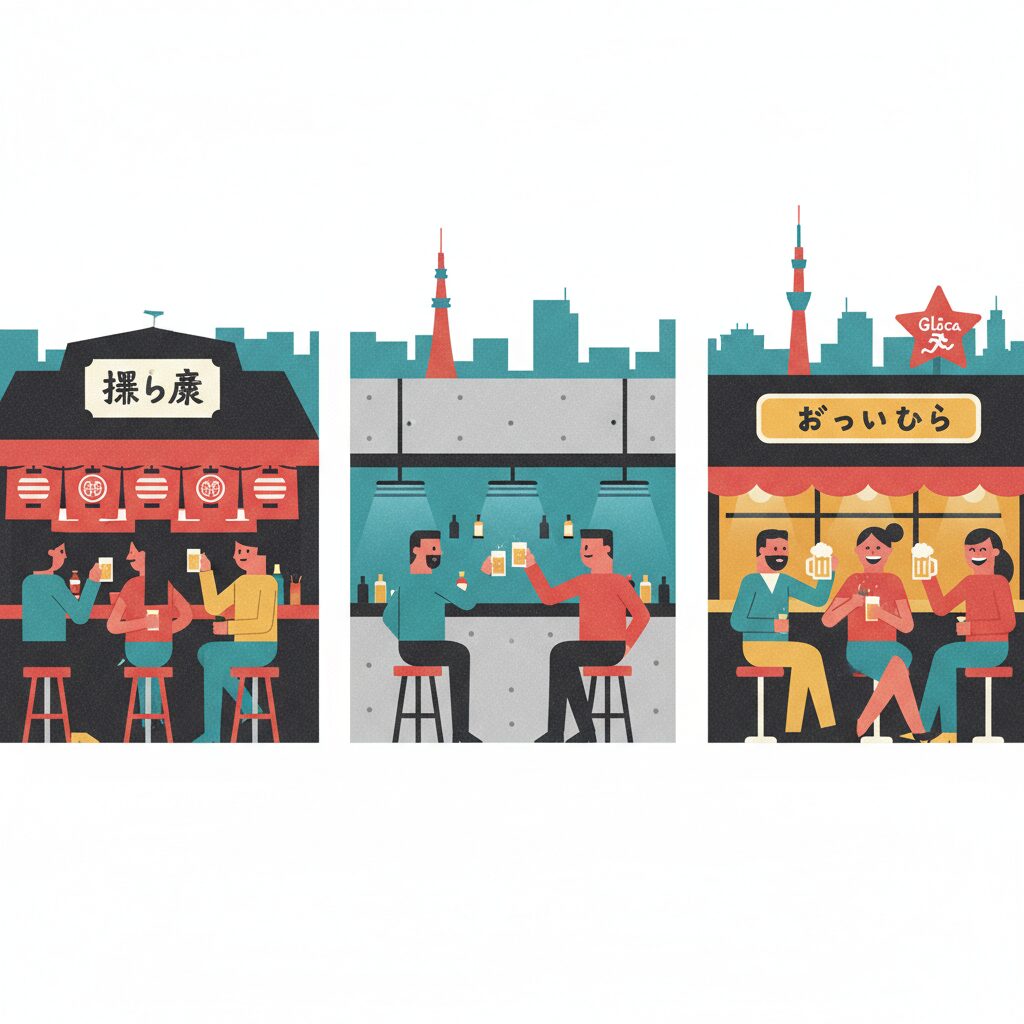
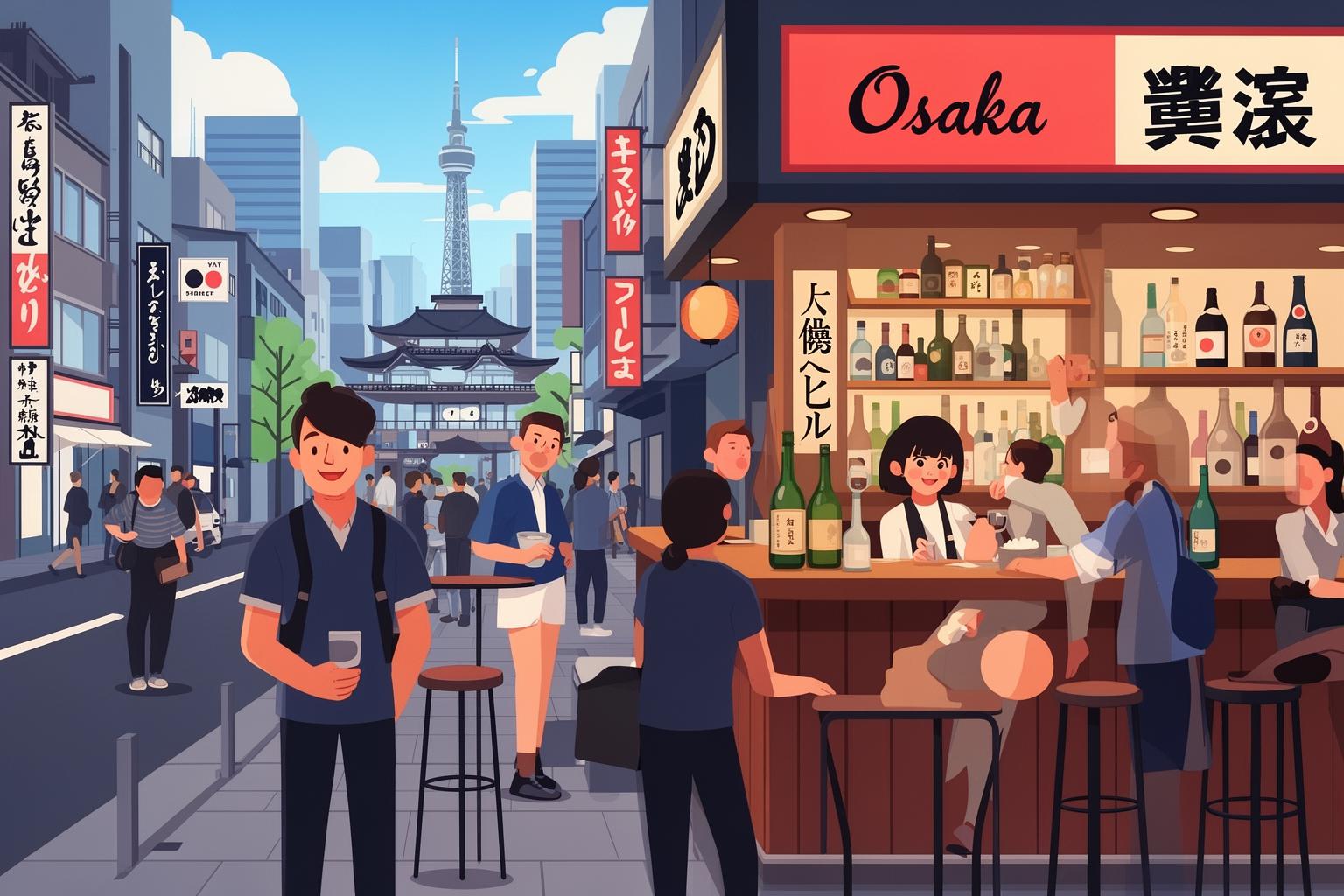
The first time I saw a real Osaka tachinomi, I didn’t get it. I was wandering through the labyrinthine corridors of the Umeda Ekimae Dai-san Building, a concrete maze humming with after-work energy. Tucked between ticket resale shops and dusty-looking electronics vendors were these tiny, brightly-lit boxes of noise and steam. People were crammed shoulder-to-shoulder, pressed against worn wooden counters, clutching glasses of beer and plates of grilled skewers. There were no chairs. Not a single one. It looked chaotic, uncomfortable, and utterly impenetrable. My Western brain, conditioned to associate a night out with settling into a comfortable seat for a few hours, just saw a problem to be solved. Why would anyone choose to stand?
It took me a few months of living here to understand that I wasn’t looking at a problem; I was looking at a solution. A uniquely Osakan solution. The tachinomi, or standing bar, isn’t just a bar without chairs. It’s a window into the city’s soul. It’s a finely-tuned machine built on the core Osaka principles of speed, value, and no-nonsense community. This isn’t the slow, deliberate art of a Kyoto tea ceremony or the polished, high-concept cocktail experience you might find in a Tokyo high-rise. This is life at street level, unfiltered and refreshingly direct. It’s a cultural classroom where you can learn more about the Osaka mindset in thirty minutes with a beer in your hand than you can in a week of visiting temples. To understand the tachinomi is to understand the city’s rhythm.
For those looking to delve deeper into the subtle social dynamics of these vibrant spaces, understanding the nuances of elbow room etiquette can further enhance your local experience.
The Soul of the Standing Bar: More Than Just a Cheap Drink
It’s easy to overlook tachinomi as merely a spot to get a cheap buzz—and indeed, you can do just that. The idea of senbero—getting buzzed for a single 1,000 yen coin—is a source of pride here. However, the affordability is a symptom rather than the cause. The true driving forces run deeper, embedded in Osaka’s history as a merchant city.
The Gospel of “Cost Performance”
In Tokyo, status, brands, and appearance are frequently discussed. In Osaka, the focus is on kosupa, a shortened form of “cost performance.” This concept influences everything from grocery shopping to selecting a place to drink. It’s not about being cheap; it’s about being wise. It’s about getting the absolute maximum value out of every yen spent. An Osakan will proudly recount the delicious 300-yen plate of doteyaki (beef sinew stewed in miso) they enjoyed, not because it was inexpensive, but because its quality greatly exceeded its price. This is the core appeal of tachinomi.
The entire business model is designed with ruthless efficiency to maximize kosupa for customers. No chairs mean that more people can fit into a small space, keeping rent-per-customer low. A simple menu of quick-to-prepare dishes reduces kitchen staff and food waste. Often, a cash-on-delivery system ensures no time is lost processing bills afterward. All these savings are passed directly to you in the form of a 400-yen draft beer or a 150-yen chicken skewer. Visiting a tachinomi isn’t viewed as a budget choice; it’s seen as the sensible choice. It expresses financial savvy and rejects paying for unnecessary luxuries like, well, chairs.
Built for Speed: The After-Work Pit Stop
Life moves fast in Japanese cities, and Osaka is no different. The tachinomi is perfectly suited for this pace. It’s not intended for long, lingering evenings. It serves as a transitional space—a cultural decompression chamber between the rigid structure of the office and the private refuge of home. The standing-only format subtly shapes the flow. You don’t get comfortable. You don’t settle in. You stop by for a quick drink, maybe two, and a couple of small plates. You catch up with the owner, perhaps exchange a few words with the person next to you, and then you’re on your way within the hour.
This transient nature is crucial. It lowers the barrier to entry, both socially and in terms of time commitment. You don’t need to coordinate with friends or make a reservation. You simply pop in on your way to the train station. This explains the high concentration of tachinomi near major transit hubs like Umeda, Kyobashi, and Namba. They act as pit stops for the city’s working population, a brief pause in the long sentence of a workday. It’s a system that respects your time and your wallet—an unmistakably Osakan way of showing respect.
Breaking Down Barriers, One Drink at a Time
Perhaps the most overlooked aspect of the tachinomi is its social role. In a society that can often seem reserved and structured, the standing bar is a place where the usual rules are more flexible. The physical arrangement acts as both an equalizer and a social catalyst.
The Unspoken Social Contract
In a typical seated bar or izakaya, your world is confined to your table. You interact with your own group, with an invisible social barrier separating you from others. In a tachinomi, there are no tables—only The Counter. This long wooden plank is a shared space, and by standing there, you implicitly agree to be part of a temporary, fluid community. Personal space diminishes, and social boundaries follow suit.
This is where the famed “friendliness” of Osaka becomes tangible. It’s not that people are simply bubbling with cheerfulness at random; the environment encourages natural, low-pressure interaction. A casual remark about the food, the Hanshin Tigers game on the small TV, or the weather can quickly evolve into a full conversation. You’re sharing an experience side-by-side. I’ve had my Japanese corrected by retired gentlemen, received sake recommendations from office workers, and shared laughs with people I’ll likely never see again. It’s a fleeting connection—a brief acknowledgment of shared humanity over a common counter. There’s an unspoken understanding that for these thirty or forty minutes, you’re all in it together.
Osaka vs. Tokyo: A Tale of Two Standing Bars
The difference with Tokyo is clear. While Tokyo certainly has its own tachinomi culture, the atmosphere can be quite distinct. Many standing bars in Tokyo, especially the newer, trendier ones, feel more like solitary experiences. You’ll find people standing quietly, absorbed in their phones or reading a book, maintaining that quintessential Tokyo bubble of personal space even in a crowd. The focus tends to be on the quality of craft beer or artisanal sake. It’s about consumption, but not necessarily communion.
In Osaka, the bar itself takes center stage. It’s often louder, filled with the sizzle of the grill and booming laughter. The decor is practical, not stylish. The aim isn’t quiet reflection; it’s spirited release. An Osaka tachinomi feels less like a library for drinkers and more like a bustling public square. Foreigners often misunderstand this, assuming that because it’s Japan, quiet and reserved behavior is expected. In many Osaka tachinomi, that would actually stand out as unusual. The key is to read the room, but more often than not, the room is inviting you to join the chorus.
A Practical Guide to Your First Tachinomi Adventure
Stepping into a tachinomi for the first time can feel like trying to jump on a moving train. But once you grasp the simple process, it becomes one of the most accessible and rewarding local experiences you can enjoy.
Spotting Your Target: Where to Go
Forget the flashy tourist guides. The best tachinomi are found in neighborhoods frequented by daily commuters. Look for them tucked under train tracks, squeezed into the basements of old office buildings, or lining the covered shotengai shopping streets.
- Tenma & Kyobashi: These areas are the undisputed heavyweights. Vast networks of streets where nearly every other spot is a standing bar or an affordable izakaya. The atmosphere is electric, especially on Friday evenings.
- Umeda’s Ekimae Buildings: The basements of the Dai-ichi, Dai-ni, Dai-san, and Dai-yon buildings form a salaryman’s dream—a subterranean world offering incredible value.
- Namba & Shinsekai: Though more touristy, the backstreets still hide authentic, gritty tachinomi that have stood the test of time.
Look for classic signs: a red lantern (akachochin) swinging outside, a simple cloth curtain (noren) over the doorway, and a crowd visible through the window. If it feels a bit daunting and packed, you’ve likely found the right spot.
The Art of the Order: Cash-on and Pointing
Many traditional tachinomi work on a cash-on-delivery system, or kyasshu on. Don’t be alarmed if you don’t see a cash register. Here’s how it goes:
- Find a Spot: Gently slip into an open space at the counter. Don’t shove or move others’ belongings. A simple nod and a quiet “sumimasen” (excuse me) will do.
- Stake Your Claim: Place your money (a 1,000 yen or 5,000 yen note is ideal) into the small tray or bowl in front of you. This signals to the staff that you’re ready to order.
- Order Your Drink First: This is typical. The simplest order is “Nama” (nah-mah), meaning draft beer. A “haibōru” (highball) is another safe choice.
- Order Food: Menus are often strips of paper stuck on the wall. Don’t worry if you can’t read them. See what your neighbor is eating and point. Saying “Are, hitotsu onegaishimasu” (One of those, please) is a handy phrase. The staff will take the right amount from your money tray and return any change.
Your Japanese doesn’t have to be perfect. A friendly attitude and a willingness to try matter much more. The staff are experts in efficiency and non-verbal cues.
Unwritten Rules of the Rail
To drink like a local, it’s important to know the subtle etiquette that keeps things running smoothly.
- Mind Your Space: Don’t spread out your belongings. Keep your bag on the hook beneath the counter or tucked between your feet. You’re occupying a small piece of vertical real estate, so be thoughtful of others.
- Keep It Moving: Tachinomi depend on quick turnover. It’s not a place to nurse a single drink for hours while scrolling your phone. Drink, eat, and when you’re finished, move on—especially if people are waiting.
- Tidy Up: Although staff will clear your plates, it’s polite to gather your empty glasses and dishes into a small area in front of you to help them.
- Be Ready: The pace is fast. When a staff member asks for your order, be prepared. Their quickness isn’t rudeness; it’s a way to efficiently serve everyone.
Beyond the Beer: What Tachinomi Teaches You About Osaka
A tachinomi is more than just a bar. It serves as a living museum of Osakan culture, where the city’s commercial history and its practical present merge in a vibrant, joyful, and flavorful fusion.
An Unfiltered Slice of Life
Visiting a tachinomi provides an authentic glimpse into everyday life that you won’t find at typical tourist spots. Construction workers in their gear stand side by side with bankers who have just loosened their ties. You hear the raw, unfiltered Osaka-ben dialect spoken naturally. People are simply themselves, not performing for outsiders. There’s a genuine honesty in these places that is both rare and deeply charming. You’re not just an observer; you become a temporary participant in the city’s daily ritual.
The Great Equalizer
Above all, the tachinomi is a place of equality. At the counter, everyone stands on equal footing. Corporate titles, social rank, and wealth lose their significance. What counts is the shared enjoyment of a good deal, a cold drink, and a moment of connection. It reflects the Osakan belief that everyone deserves a space to relax and be authentic, free from pretense or judgment. By doing away with chairs, these bars dismantle numerous social barriers. Ultimately, I realized I was mistaken to seek a seat. The essence of the tachinomi is that standing together offers a far better way to belong.