The first time you ride the Midosuji Line during rush hour, you might question everything you’ve ever been told about Japan. The quiet, orderly nation of polite nods and personal space seems to dissolve the moment the train doors hiss open. Instead of a silent, moving library, you find yourself in a rolling town square—a vibrant, noisy, and unapologetically human space. Friends are laughing over a shared story, a salaryman is finishing a quick phone call in a hushed but audible tone, and a group of high school students are debating their after-school plans with the energy of a rock concert. This isn’t chaos; it’s Osaka. And for anyone accustomed to the pin-drop silence of a Tokyo commute, the contrast is as stark as night and day.
This difference isn’t a flaw in the system or a sign of rudeness. It’s a profound expression of a city’s soul, played out daily on the steel tracks that crisscross the Kansai plain. While Tokyo’s train etiquette is built on a foundation of non-imposition and preserving individual bubbles of tranquility, Osaka’s is built on pragmatism, directness, and a sense of shared, public life. The unwritten rules are different because the people are different, shaped by centuries of a distinct history and a unique urban rhythm. Understanding the commute here is understanding the heart of Osaka itself—a city that values human connection over rigid formality and practical solutions over abstract principles. To navigate these rails is to learn the city’s true language, a dialect spoken not just in words, but in the way people share space.
Osaka’s dynamic urban rhythm is matched by its culinary creativity, as seen in the way locals celebrate traditional cured fish tailored for both pescetarian and health-conscious tastes.
The Sound of the City: Chatter, Laughter, and the Occasional Phone Call
Tokyo’s Vow of Silence
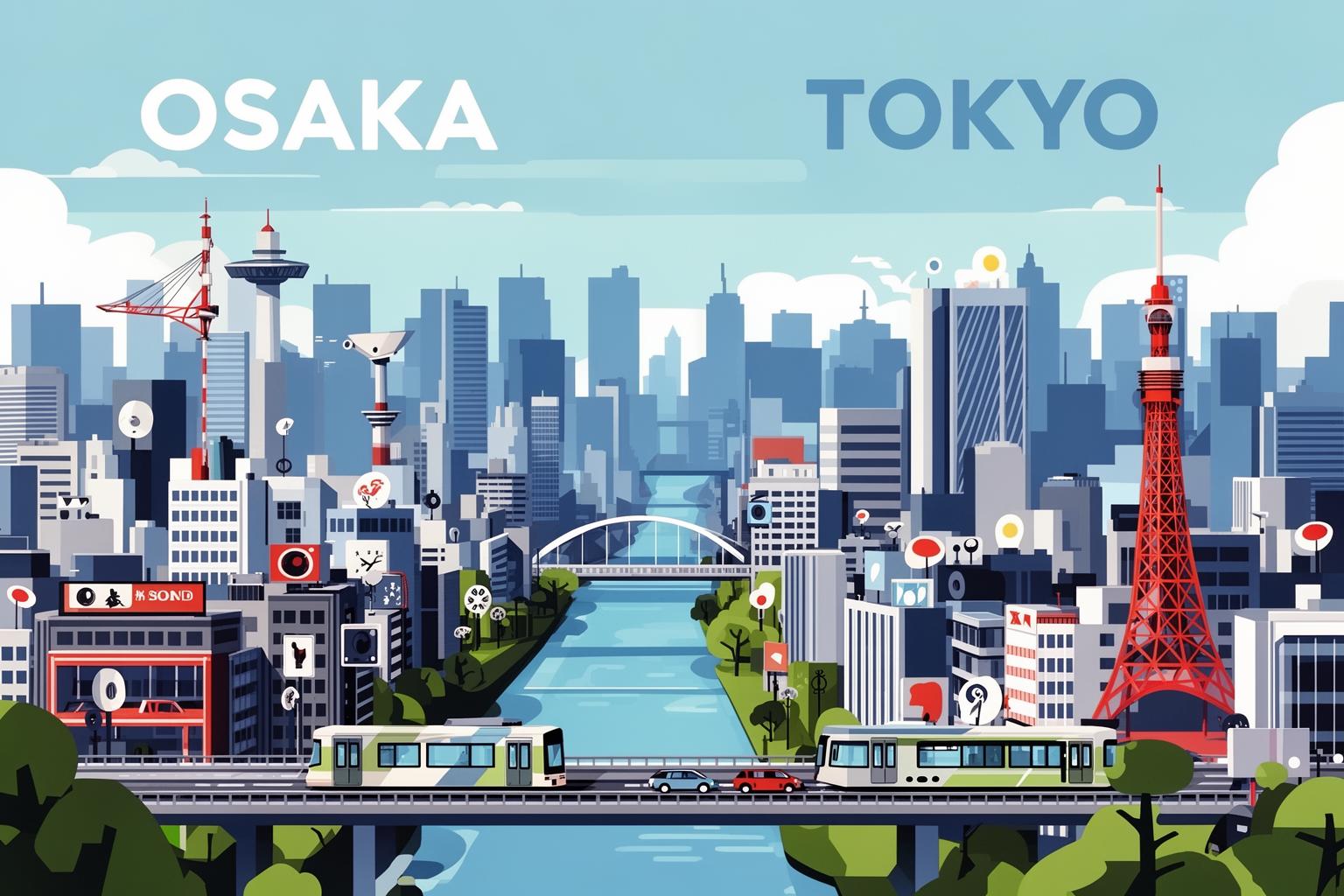
Step onto a train on Tokyo’s Yamanote Line, and you enter a sanctuary of quiet focus. The prevailing sounds are mechanical: the steady click-clack of the wheels, the soft hum of the air conditioning, the digital chime signaling the next station. The human presence is subdued, deliberately restrained. Passengers are immersed in their own worlds—scrolling through phones with silent attention, reading paperbacks with covers discreetly folded back, or simply closing their eyes for a brief moment of rest. Eye contact is avoided, voices kept to a whisper, if spoken at all. Signs posted on the walls politely yet firmly request that phones be switched to “manner mode” and that conversations be minimized. This is more than a rule; it’s a deeply rooted social contract. The train serves as a transitional space, a collective pause in a busy day. The highest form of politeness is to be invisible, not to impose your presence—your voice, your noise, your being—on the stranger beside you. It’s a discipline of mutual respect, creating an atmosphere that is serene, though somewhat sterile.
Osaka’s Rolling Conversation
Now, transfer to the Hankyu line departing from Umeda. The silence breaks. It’s replaced by the warm, lively rhythm of Kansai-ben, the local dialect that lilts and flows with its own musicality. Here, the social contract is different. The train is not a library; it’s a living room on wheels. You’ll hear friends animatedly sharing stories of their day, their laughter filling the carriage. You’ll see an elderly woman striking up a conversation with a young mother about her child. The dreaded phone call, a cardinal sin in Tokyo, is treated with surprising tolerance. While long, loud conversations remain frowned upon, a brief, quiet call—”Moshi moshi, 今電車やから、後でかけ直すわ” (Hello, I’m on the train now, so I’ll call you back later)—is common, greeted not with cold stares but with unspoken understanding. Life is busy, and sometimes a call must be taken. This greater acceptance of noise arises from a fundamentally different attitude toward public space. In Osaka, it’s a place for living, not just passing through. The city’s energy doesn’t stop at the ticket gates; it flows into the carriages, creating an environment that feels less like a commute and more like an extension of the city’s vibrant social life.
Personal Space: The Art of the ‘Osaka Squeeze’
Lines, Order, and the Tokyo Shuffle
On a Tokyo platform, you witness a flawless display of organized movement. Passengers line up neatly and parallel, standing patiently behind the painted ground markings. When the train arrives, the routine unfolds. Those disembarking exit first in a calm stream, and only then do those waiting to board proceed, a carefully choreographed dance of minimal contact and maximum efficiency. The system relies on precision and deep respect for personal space. The aim is to move as a collective while preserving individual boundaries. Pushing is almost unheard of; the strongest touch you’ll feel is a gentle nudge on the back, paired with a soft “sumimasen.” This meticulous coordination guarantees a smooth, predictable, and impersonal journey. You become a passenger, an anonymous cog in a well-oiled machine, and the system succeeds because everyone quietly fulfills their role.
Getting On, Getting Off, and Getting Real
Welcome to Osaka, where lines resemble loose guidelines and boarding is a more organic, fluid process. People cluster near the doors, and when they open, a dynamic surge ensues. It’s not the aggressive shoving seen in many global cities, but a pragmatic, assertive movement. Osakans call it the “Osaka squeeze.” People move purposefully, intuitively filling gaps with a keen sense of physics and human dynamics. Exiting the train requires different skills. Rather than a polite shuffle, you make yourself known. A firm but not hostile “すんまへん、降ります!” (Excuse me, getting off!) signals the crowd to part. This realm belongs to the legendary Osaka oba-chan—middle-aged or older women—who, with a shopping bag in one hand and years of commuting experience, navigate the thickest crowds like torpedoes. It’s not rudeness; it’s the city’s core philosophy: be direct, be efficient, and don’t hesitate to take the space you need. In Tokyo, you wait for space to be made. In Osaka, you are expected to seize it.
The Unspoken Rules of Food, Drink, and Courtesy
A Matter of Principle vs. A Matter of Practicality
In Tokyo, eating on a crowded commuter train is often regarded as a breach of etiquette. This rule is grounded in principle: eating can generate smells, sounds, and possible messes that may inconvenience others. Thus, it is best avoided entirely to preserve the collective wa, or harmony. The emphasis lies on the potential for disruption. In contrast, Osaka takes a much more practical approach. The question isn’t “Is it forbidden to eat?” but rather “Is my food bothering anyone?” A steaming cup of takoyaki dripping with sauce is an obvious no. But a simple onigiri rice ball, a pastry from a station bakery, or a can of coffee? If it’s not messy, smelly, or noisy, it’s generally acceptable. This attitude reflects Osaka’s merchant origins, where practicality and efficiency often outweigh abstract principles. If you’re hungry during a long commute, you eat. As long as you are considerate in a practical way—cleaning up after yourself and avoiding pungent foods—life goes on. It’s a case-by-case decision, not a blanket ban.
Helpfulness, Osaka Style
Both Tokyoites and Osakans are helpful, but their styles differ greatly. In Tokyo, help tends to be passive and polite. If you look lost, someone may hesitantly approach and quietly ask if you need assistance, careful not to impose. In Osaka, help is proactive and often startling. Stand in the middle of Umeda Station with a map looking confused, and you might suddenly find yourself surrounded. A local may grab the map from your hands, point emphatically, and launch into a rapid-fire Kansai-ben explanation, gesturing wildly to make their point. They may even walk part of the way to your destination. It can feel overwhelming, almost intrusive, but the intention is pure. It stems from genuine concern and a sense of communal responsibility. Osakans see a problem—your confusion—and feel an immediate urge to resolve it. This isn’t about formal politeness; it’s about real, tangible, human-to-human connection. It’s the city’s way of saying, “You’re in my town, and we take care of people here.”
Why the Rails Run on Different Tracks
The Merchant’s City and the Shogun’s Capital
These deep-rooted differences in train etiquette are not accidental; they reflect historical legacies. Tokyo, once Edo, was the center of the Tokugawa shogunate—a military government founded on hierarchy, order, and strict social protocols. Formality and strict rule-following were crucial to maintaining stability. The samurai class valued discipline and control, and this cultural heritage of structure and decorum still influences Tokyo’s social fabric today, even in the way people queue on subway platforms. Osaka, by contrast, emerged as Japan’s commercial center, known as the “nation’s kitchen.” Its power rested not with samurai but with a shrewd, pragmatic merchant class. Success in Osaka relied on negotiation, quick thinking, building personal relationships, and straightforward, no-nonsense communication. Time was money, and social harmony was achieved through practical interactions, not just rigid formality. This merchant spirit—practical, flexible, and unapologetically human—continues to drive Osaka’s culture.
What it Means for You, the Resident
For anyone living in Osaka, grasping this difference is essential to feeling at home. The city’s public spaces, especially its trains, operate on a different wavelength. Don’t confuse the noise for thoughtlessness or the directness for rudeness. It is simply a different way of sharing space. Living here means you can relax a bit. You don’t have to monitor your every move with the same intensity required in Tokyo. There is a social flexibility, a permission to be a bit more yourself. However, this freedom comes with an expectation: you are expected to be socially attuned, to read the atmosphere, and to engage with the city on its own terms. The Osaka commute is an invitation—to participate, to observe, and to find your place within its dynamic, moving community. It’s a daily reminder that you are not merely a passenger passing through but part of a lively, complex, and wonderfully human city.