When you picture working in Japan, your mind probably conjures images of gleaming skyscrapers in Tokyo’s Marunouchi district. You see crisp suits, silent elevators, and meticulously choreographed meetings where business cards are exchanged like sacred texts. It’s a world of precision, polish, and unspoken protocols. But travel about 500 kilometers southwest, deep into the heart of Osaka’s eastern sprawl, and you’ll find a universe that operates on a completely different code. This is Higashi-Osaka, the undisputed capital of Japan’s machi-koba, the small, often family-run local factories that form the backbone of the nation’s manufacturing prowess. From the outside, this world can seem opaque, even intimidating. It’s a landscape of corrugated metal, the constant hum of machinery, and a pace that feels both relentless and deeply personal. As a curator from Tokyo, accustomed to the curated silence of art galleries and the formal dance of corporate Japan, my first encounters here were a study in contrasts. The air smells of cutting oil and hot metal, not high-end perfume. Conversations are shouted over the din of a lathe, not whispered in a soundproofed boardroom. This isn’t just a different style of business; it’s a different philosophy of work, life, and human connection. For any foreigner living in Osaka or trying to understand its true character, exploring the world of the machi-koba is essential. It’s here, far from the neon glow of Namba or the tourist trails of Osaka Castle, that you discover the city’s raw, unfiltered, and incredibly powerful engine room. This guide is your look inside that engine, a map to a culture built on skill, trust, and a brand of communication that is unapologetically direct.
The exploration of Higashi-Osaka’s unique work environment reveals a dynamic blend of hands-on craftsmanship and community spirit that mirrors the collaborative pride of local industry.
The Landscape of ‘Genba’: Where the Work Speaks for Itself
First, you need to grasp the physical reality of Higashi-Osaka. This is not a planned industrial area with broad boulevards and manicured greenery. Instead, it’s a dense, organic labyrinth of narrow streets where small factories are nestled alongside residential homes, tiny noodle shops, and local parks. The line between work and life is not merely blurred; it often doesn’t exist at all. A factory owner might live in the house attached to his workshop. The steady clang of a metal press forms the soundtrack of daily life, constantly reminding everyone that this is a community that creates things. The Japanese term genba roughly means “the actual place” or “the scene of the action.” In corporate Tokyo, genba might mean the sales floor. In Higashi-Osaka, however, the genba encompasses everything. It’s the factory floor itself—slick with oil, crowded with tools, and buzzing with creative energy. This physical immersion influences the entire culture. There’s little room for showmanship when you’re surrounded by raw materials and heavy machinery. Your worth isn’t measured by your job title or the polish of your PowerPoint slides. It’s measured by what you can accomplish with your hands, your mind, and the machines around you. A young engineer from a large corporation might arrive at a machi-koba with a complex digital blueprint, only to be told by a seasoned, 60-year-old craftsman that the design won’t work. The craftsman then sketches a better solution on the back of a greasy napkin. In this world, the genba always comes first. Experience outweighs theory, and tangible results are the only currency that counts.
The ‘Shokunin’ Soul: More Than Just a Job
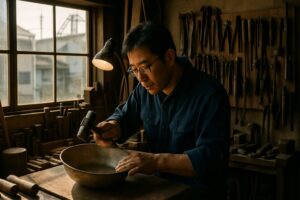
At the core of the machi-koba lies the spirit of the shokunin, or master craftsman. This idea fundamentally differs from the Western concept of a professional or employee. A shokunin holds a social and moral duty to perform at the highest level, not merely for financial reward but for the improvement of the community and the dignity of their craft. This is not a typical 9-to-5 mindset; it is a lifetime quest for perfection. You witness it in how a factory owner fixates on tolerances of just a few microns—measurements invisible to the naked eye. You hear it in fervent discussions about the optimal steel type for a given application or the most effective way to tool a complex part. This profound, almost spiritual commitment to quality defines the machi-koba culture and fills its workers with great pride. Despite their modest exteriors, many of these factories produce components critical to advanced technologies, from satellites and medical devices to Formula 1 race cars. They are the unsung heroes behind “Made in Japan.” The shokunin mindset shapes a unique working relationship: the bond between a senior craftsman and a junior apprentice is built on deep respect, but not the rigid, hierarchical structure common in Tokyo offices. Masters teach by demonstration rather than instruction. Young workers are expected to learn through observation, hands-on experience, and mistakes. A sharp word or stern correction is not a personal slight; it is a crucial part of knowledge transfer, a sign the master values the apprentice’s potential. Silence and focused attention often outweigh a flood of questions. One’s worth is proven through work, gradually earning the right to offer ideas.
The Language of the Factory Floor: Direct, Honest, and Loud
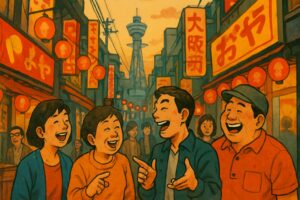
What surprises outsiders most—especially those familiar with Japan’s typically indirect communication—is how people speak in a Higashi-Osaka machi-koba. The politeness, honorifics (keigo), and careful phrasing designed to avoid conflict are largely stripped away in favor of clarity and efficiency. Communication is direct, functional, and often loud, to be heard over the machines. If there’s a problem with a design, you’ll hear, “Akan, kore ja dekin” (“No way, can’t make it like this”). There’s no gentle hint or sugarcoated criticism; it is a straightforward fact. If a deadline is impossible, you’ll get a blunt, “Muri ya” (“That’s impossible”). This is not rudeness but honesty. In an environment where errors can be costly or dangerous, ambiguity has no place. This contrasts sharply with Tokyo business meetings, where a proposal might receive a vague, “Kentou shimasu” (“We will consider it”), often a polite refusal. In Higashi-Osaka, you always know where you stand. This directness characterizes the broader Osaka dialect and culture, where practicality and efficiency are prized and beating around the bush is seen as a waste of time. Relationships are built on frankness and mutual understanding. Foreigners often misread this bluntness as aggression or disrespect. The key is to grasp the context: gruff feedback is professional, not personal. It shows you are regarded seriously as a collaborator in the creative process. The aim is to solve problems and produce the best product, and clear, unfiltered communication is the quickest path.
Business Etiquette Reimagined: Trust Over Formality
Discard what you know about Japanese business etiquette. The formal exchange of business cards, deep bows, and strict seating protocols hold far less weight in the machi-koba world. While politeness remains important, the focus is on forging authentic human connections rather than performing corporate rituals. On visiting a factory, the president (shacho) may greet you in work clothes with grease-stained hands. This is not disrespect but a mark of authenticity. He is revealing his true self: a worker, a creator, a master of his craft. The key meeting rarely takes place in a conference room—it happens on the factory floor. Here, you demonstrate genuine knowledge and respect. Don’t just talk about your product; ask insightful questions about their machines, processes, and challenges. Show sincere curiosity about their craft. This is how you gain respect. Real agreements are often sealed not by formal contracts, but over a shared meal and drinks at a local izakaya. There, the shacho judges you as a person: are you trustworthy? Reliable? Do you share their passion for quality? This is true due diligence. A contract is merely paper, but a relationship built on trust—a ningen kankei—is unbreakable. A promise made over sake can be more binding than any legal document. For outsiders, this can be disorienting. We are taught to separate personal from professional. But in the machi-koba, they are closely linked. Your character matters as much as your company’s financials.
The Ironclad Rule of ‘Nōki’: Time is Not a Suggestion
While the mood may feel informal and the communication relaxed, there is one area where machi-koba culture is strictly unforgiving: the delivery date, or nōki. Missing a nōki is the greatest sin. It is not merely a logistical failure but a serious breach of trust that can irreparably harm relationships. This obsession with punctuality underpins the entire Japanese manufacturing ecosystem. Each small factory plays a critical role within a vast supply chain. A delay at one machi-koba can trigger a domino effect, potentially halting production at major companies like Panasonic or Toyota. The entire system depends on the absolute certainty that every component arrives exactly as scheduled. This is a point foreign businesses often misunderstand. In many cultures, a deadline is a target or suggestion, negotiable if difficulties arise. In the machi-koba world, it is a sacred promise. Once you commit to a nōki, you must move heaven and earth to meet it—working overnight, canceling holidays, or calling in favors from other factories. “We ran into a problem” is not an excuse. The only acceptable answer is delivering the solution on time. Understanding the sanctity of the nōki is perhaps the most vital lesson for anyone seeking to work with these factories. It is the foundation of their professional honor.
The Spirit of Osaka: Resourceful, Practical, and Proud

The culture of the machi-koba perfectly embodies the broader Osaka mindset. Historically, Osaka was Japan’s commercial hub, a city of merchants known as Naniwa no akindo. This merchant spirit valued pragmatism, resourcefulness, and a sharp sense of value. It was a culture focused on getting things done, finding clever solutions to tough problems, and not being overly concerned with strict formality or status. This spirit is evident throughout Higashi-Osaka. The factory owners are masters of ingenuity, modifying their own machines, inventing new tools, and developing unique production methods to stay competitive. There’s a famous story about a Higashi-Osaka company tasked with creating the metal housing for the first iPod. The flawless, polished finish Apple required was deemed impossible by many, but they succeeded. This “can-do” mindset—the belief that any problem can be overcome with enough cleverness and hard work (kufuu)—is quintessentially Osaka. It contrasts sharply with Tokyo’s often more cautious, process-driven, and consensus-oriented approach. In Tokyo, the question tends to be, “Has this been done before? What’s the established procedure?” In Osaka, it’s, “Yatteminakare wakarahen” (“You won’t know unless you try”). This readiness to take calculated risks, experiment, and trust one’s own skill and judgment is what makes the machi-koba so dynamic and innovative. They are not merely following orders; they are active collaborators in the creative process, applying decades of accumulated know-how to every project. It’s a noisy, messy, and deeply human way of working—standing as a strong counterpoint to the automated, impersonal vision of the factory of the future. Here, the human element—the skill, pride, and trust between people—remains the most vital component of all.