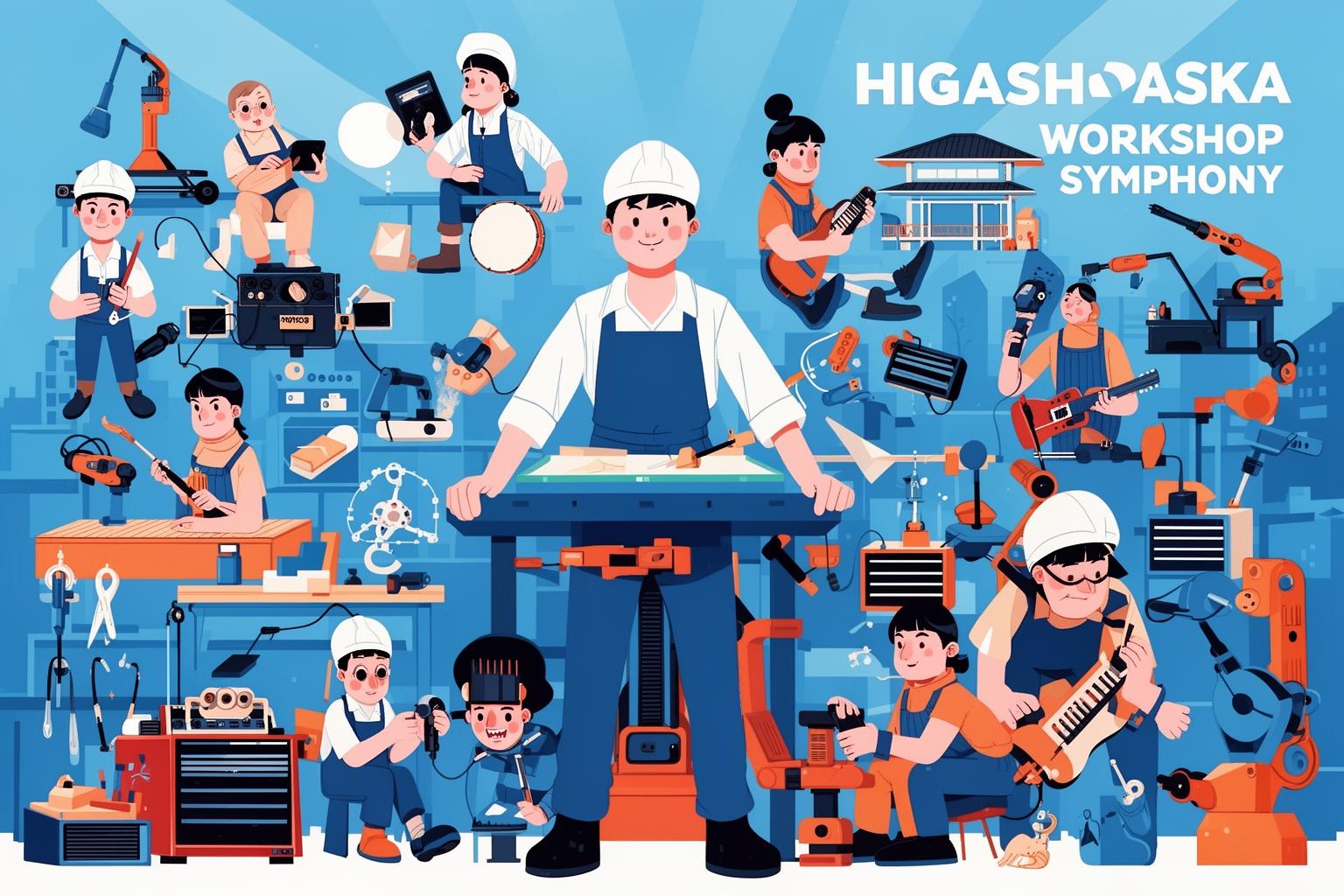
You feel it before you see it. Step off the train at any station along the Kintetsu Nara Line as it slices through the flatlands east of Osaka Castle, and the air changes. It’s not the electric hum of Umeda or the boisterous roar of Namba. It’s a different kind of energy, a low, persistent thrum that vibrates up through the soles of your shoes. It’s the sound of a city at work. This is Higashiosaka, a sprawling municipality that most tourists, and even many foreign residents, completely overlook. There are no grand temples here, no glittering shopping malls that grace the covers of magazines. Instead, there are streets lined with an improbable mix of modest family homes and small, unassuming buildings with roll-up metal doors. From behind these doors comes the symphony of industry: the rhythmic, percussive slam of a power press, the high-pitched whine of a metal lathe spinning at thousands of RPM, the sharp hiss of a welding torch. This is the heartland of Osaka’s ‘monozukuri’ culture, a term often translated as ‘craftsmanship’ but which fails to capture the sheer depth of its meaning. To understand Osaka, to truly get under its skin and see what makes it tick differently from the polished, corporate façade of Tokyo, you have to understand the philosophy humming away in these thousands of tiny factories. This isn’t just about making things; it’s a way of life, an identity forged in steel, sweat, and an unyielding pride in the tangible. Forget the glossy brochures of ‘Cool Japan’; this is the raw, unvarnished engine room of the nation’s third-largest city, and its rhythms dictate a worldview that is profoundly, unmistakably Osakan.
This deep-seated work ethic, which powers the small factories of Higashiosaka, is the same foundational spirit that propelled an Osaka-born global giant like Panasonic to worldwide success.
The Symphony of the Workshop Floor
Stroll through the neighborhoods of Takaida or Nagata in Higashiosaka, and you’ll encounter a Japan that feels utterly distinct from the polished charm of Kyoto or the sleek futurism of Tokyo. The streets here are narrow, often barely wide enough for a small delivery truck to pass. Two-story homes with laundry swaying on balconies stand side-by-side with corrugated metal workshops. There’s no clear zoning, no tidy division between residential and industrial areas. Life and work aren’t merely neighbors; they share the same space. The aroma of someone’s lunch—grilled fish and miso soup—blends with the faint metallic smell of cutting oil that lingers in the air. This mixture offers the first insight into the local mindset. Work isn’t someplace you commute to; it’s an extension of home, an essential part of the community’s fabric.
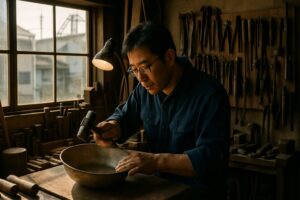
During the day, the garage-like doors of these factories, called ‘machi-koba,’ are often left wide open onto the street. You can peek inside and see a man in a grease-stained jumpsuit bent over a milling machine, metal shavings spiraling to the concrete floor. You might spot a woman carefully examining a tray of tiny plastic parts, her concentration absolute. This isn’t a show for outsiders; it’s a culture of openness and accessibility. There’s a strong sense that nothing is hidden. The work speaks for itself, visible and audible to the entire neighborhood. The rhythmic clang-clang-clang of a stamping press isn’t noise pollution—it’s the sound of a neighbor making a living. It’s the city’s heartbeat.
This setting fosters a completely different kind of work-life balance—or rather, a work-life integration. The factory owner, the ‘shacho,’ often lives in the house attached to the workshop, or perhaps in the floor above. Their children grow up playing in alleyways, familiar with the sounds and smells of industry. The workday doesn’t end with a bell or a timecard swipe. It flows into the evening, not necessarily as endless overtime, but as a continual immersion. The shacho might be tinkering with a machine late at night, not driven by a deadline, but because an idea for a small improvement came to him during dinner. This isn’t the soul-draining overtime of a Tokyo office; it’s a personal, almost obsessive pursuit of perfection. It’s a life centered on craft, where the boundaries between hobby, passion, and profession are beautifully—and sometimes brutally—blurred.
‘Monozukuri’ is More Than Just “Making Things”
The term ‘monozukuri’ is fundamental to the Japanese industrial vocabulary, yet its true meaning is frequently lost in translation. It merges ‘mono’ (thing) and ‘zukuri’ (the process of making), but it conveys a spirit and philosophy that transcends mere manufacturing. It represents a worldview that prioritizes substance over appearance, skill over status, and tangible outcomes over abstract theories. In Higashiosaka, this is not a theoretical concept debated in boardrooms; it is the everyday reality on every workshop floor. It embodies a philosophy that sharply, and sometimes defiantly, contrasts with the corporate culture prevalent in much of modern Japan, especially in Tokyo.
A Philosophy in Metal and Plastic
At its heart, the ‘monozukuri’ spirit rests on a few core principles that shape the local work ethic. The first is an intense, almost spiritual pride in craftsmanship. The aim isn’t merely to produce a part that meets blueprint specifications but to create a perfect piece. A screw isn’t just a fastener; it’s a testament to the precision of the machine and the skill of the operator. A metal mold isn’t simply a tool; it’s a piece of industrial art, polished to a mirror finish. This pursuit of perfection is profoundly personal. The factory’s name, often a family name, is metaphorically stamped on every single item that leaves the workshop. A defective component isn’t a statistical mistake; it is a personal failure and a blemish on the family’s honor.
From this flows the principle of ‘kaizen’, or continuous improvement. Although popularized and formalized by corporate giants like Toyota, its origins lie in the humble ‘machi-koba’. Here, ‘kaizen’ is not a catchphrase on a poster or a subject for a mandatory seminar. It is the daily, incremental effort to make things better. It might be the ‘oyaji’ (a colloquial, respectful term for an older man, often the boss) spending an hour sharpening a cutting tool to a finer edge, or rearranging a workspace to shave three seconds off a repetitive task. These are not groundbreaking innovations; they are thousands of small refinements, an endless series of little victories that accumulate over years and decades to forge world-class expertise. It is a mindset that is never content with ‘good enough’.
Most importantly, there is a deep respect for the human touch. Despite the presence of advanced, computer-controlled (CNC) machinery in many workshops, the ultimate authority is the ‘shokunin’—the master craftsman. Machines can execute instructions with remarkable precision, but they lack judgment, intuition, and experience. The ‘shokunin’ can diagnose a machine problem from its sound alone. They can detect a microscopic flaw on a surface with their fingertips. They hold deep, tacit knowledge built over a lifetime of practice that no computer program can replicate. This is a fundamental worldview distinction: technology is a tool wielded by a skilled human, not a substitute for one. The final quality check is not performed by a laser scanner, but by the discerning eye of a master.
The Anti-Tokyo Mentality
This entire philosophy fosters a work culture that is the polar opposite of the typical Tokyo ‘salaryman’ experience. In a Tokyo skyscraper, value is often placed on intangibles: navigating complex office politics, crafting flawless PowerPoint presentations, mastering the art of ‘nemawashi’ (subtle, behind-the-scenes consensus-building). Meetings can be held just to plan future meetings. Success is often measured by promotion, title, and corporate prestige. The actual product or service can feel removed, an abstract outcome of layered processes and strategies.
In Higashiosaka, this world is met with a blend of amusement and skepticism. The culture here is brutally pragmatic and results-driven. Value is placed on what you can create with your hands. Your worth isn’t defined by your suit, business card, or command of corporate jargon. It is defined by your skill. Can you hold a tolerance of one micron? Can you weld a seam both strong and beautiful? Can you solve a complex engineering challenge with a smart, practical solution? Communication mirrors this. It is direct, blunt, and stripped of the elaborate politeness and ambiguity often seen in Tokyo boardrooms. An Osaka craftsman might look at a blueprint and say, “Aho ka, konna dekiru wake naiyaro!” (“Are you an idiot? There’s no way to make this!”), before working together to figure out how it could actually be done. This is not rudeness; it is efficiency—focused on the problem, not on caressing egos.
This fosters a distinct social hierarchy. The owner of a small, ten-person factory producing a vital component for the Shinkansen bullet train commands respect in the community that a mid-level manager at a massive Tokyo trading firm might never attain. This respect is rooted in concrete skill and contribution, not corporate affiliation. This is one of the deepest contrasts between Osaka and Tokyo, influencing everything from business dealings to casual conversations in local bars. In Osaka, you are defined by what you can do.
The Ecosystem of a Factory Town

Higashiosaka’s industrial strength doesn’t stem from a single, massive entity. There is no dominant, city-defining mega-corporation. Instead, its power lies in being a complex, interconnected ecosystem. The thousands of ‘machi-koba’ aren’t so much competitors in a zero-sum game as they are symbiotic partners within a vast, decentralized manufacturing network. This structure is key to the region’s resilience, adaptability, and its renowned ability to create nearly anything.
A Network of Specialists
Imagine needing to produce a complex metal device. In a typical corporate model, you might turn to a large company capable of managing everything in-house. In Higashiosaka, the approach differs. You would bring your plans to a small factory specializing in crafting the initial metal mold. They might then direct you to a family-run shop nearby known for having the best lathe to precisely turn the main shaft. For anodizing and surface treatment, you’d be sent to another specialist just a few blocks away — a master who has perfected his chemical baths over forty years. A different tiny workshop might handle making the specialized screws needed for assembly. Every ‘machi-koba’ is a hyper-specialized node within a larger network, focusing on excelling at one specific process. One company might be renowned for deep-drawing sheet metal, another for wire-cut electrical discharge machining.
This ecosystem is maintained not by contracts or lawyers but by relationships and reputation. A handshake and a verbal promise carry great weight. Business is often done on a first-name basis between the ‘shacho’ of different companies, many of whom have known each other since childhood. Your reputation for quality and dependability is your most valuable asset. Deliver a substandard part or miss a deadline, and news spreads quickly through the dense social and professional network. Conversely, a factory known for impeccable work enjoys a steady flow of orders, often from other local factories that trust them implicitly. This creates a powerful, self-regulating system ensuring high quality. It’s a community where everyone is both customer and supplier, fostering a deep sense of shared fate and mutual reliance. This horizontal network of specialists is far more agile and flexible than a large, vertically integrated corporation, allowing the entire region to quickly pivot and adapt to new technologies and market demands.
The “I Can Make Anything” Attitude
This unique structure has fostered a legendary problem-solving culture in Higashiosaka. The area is famous for taking on the ‘muri nandai’—unreasonable, seemingly impossible requests that large corporations, with their rigid processes and risk-averse cultures, would outright reject. It’s a common story: an engineer from a major automaker or electronics firm arrives, blueprint in hand, with a component no one else can figure out how to manufacture. They come to Higashiosaka as a last resort.
What follows is a classic Osaka scene. The factory ‘oyaji,’ a man in his sixties with calloused hands and a constant squint of focus, studies the drawing. He draws in a breath through his teeth, signaling deep contemplation, and says, “Uwaa, muzukashii naa…” (“Wow, this is difficult…”). There’s a dramatic pause. The engineer’s heart sinks. Then comes the quintessential phrase, delivered with a challenging grin: “…demo, yattaroka.” (“…but, let’s give it a shot, shall we?”). This isn’t just a phrase; it’s an ethos. The thrill of the challenge, the pride in solving a puzzle that baffled everyone else. An unshakeable confidence, born from decades of experience, that with enough ingenuity and skill, anything can be made.
This attitude has led to remarkable achievements. The most famous is the story of the Maido-1 satellite. In the early 2000s, a group of Higashiosaka factory owners, frustrated by their lack of recognition, decided to build their own satellite. It was a bold, almost comical idea. But they succeeded. Dozens of ‘machi-koba’ collaborated, each contributing their specialized expertise to manufacture the satellite’s components. In 2009, Maido-1 was successfully launched into orbit by the Japan Aerospace Exploration Agency (JAXA). It was a powerful message to the world: don’t underestimate the small factories of Osaka. This ‘can-do’ spirit and willingness to tackle the impossible are the living embodiment of the city’s ‘monozukuri’ heart.
Daily Life Beyond the Factory Gates
The ‘monozukuri’ culture doesn’t end when the machines shut down; it permeates every facet of daily life in Higashiosaka, influencing social interactions, community ties, and the very identity of its residents. The workshop’s values—pragmatism, skill, and mutual reliance—mirror those that define the neighborhood.
From Work Clothes to the Izakaya
As evening descends, the hum of the workshops gives way to the clatter of shutters and the buzz of conversation. Workers don’t simply retreat to their homes. Often still clad in their blue or grey uniforms, they gather at local ‘tachinomi’ (standing bars) or modest neighborhood ‘izakayas’ (pubs). These are not trendy spots; they serve as practical, welcoming places for the working class. The beer is chilled, the food is simple and hearty, and the air is thick with camaraderie.
Conversations here reflect the ‘monozukuri’ lifestyle directly. You won’t overhear talk of stock markets or corporate shakeups. Instead, animated debates arise over the pros and cons of various carbide cutting tools, or the best techniques to machine titanium without distortion. One ‘shacho’ might sketch a design on a napkin to share a solution with a colleague wrestling with a problem. Work isn’t off-limits after hours; it’s a shared identity, a common language, and a continual source of fascination. These izakayas function as informal boardrooms, R&D labs, and the social glue of the entire industrial network. Here, information flows, deals are quietly made, and the trust binding the community is strengthened over sake and grilled chicken skewers.
What Foreigners Often Misunderstand
For outsiders—especially those from Western countries where white-collar roles often top the social hierarchy—this world can be hard to grasp. Mistakenly viewing such work as merely “dirty” or “blue-collar” labor is offensive in Higashiosaka. A ‘shokunin’ commands high respect; their skill, expertise, and commitment are sources of deep pride both individually and collectively. Grease-stained hands are not a mark of low status but a badge of honor, evidence of a day spent crafting something meaningful. While praising an office worker’s polished shoes is common, complimenting a craftsman’s steady hands honors the very essence of who they are.
Another common misconception is equating “small factory” with “low-tech.” Although some workshops operate older manual machines, many boast cutting-edge multi-axis CNC centers and advanced metrology tools that rival those at leading university engineering labs. Innovation here isn’t about flashy consumer apps; it’s about pushing the physical boundaries of materials and manufacturing processes. These workshops produce hyper-precise components for Japan’s most advanced sectors—robotics, medical devices, aerospace, and semiconductors. The smaller scale enables a focus and specialization often missing in larger firms. This understated but crucial work is where high technology quietly thrives.
Yet, this world faces anxieties. A recurring topic in izakaya talks is succession (‘kokeisha mondai’). For generations, family businesses passed from father to son. Today, young people, drawn to the perceived prestige and stability of university degrees and corporate jobs in Osaka or Tokyo, are often hesitant to inherit these businesses. The work is demanding, hours long, and financial rewards uncertain. Many aging ‘shokunin’ have no successor to entrust their decades of accumulated knowledge to. This silent crisis threatens to erode the entire ecosystem’s future. Pride in the craft now carries a bittersweet worry for its continuation.
The Higashiosaka Mindset: How It Shapes the City

The work ethic nurtured in the ‘machi-koba’ of Higashiosaka is not an isolated occurrence. It represents a concentrated embodiment of the mindset that shapes the character of Osaka as a whole. The principles of ‘monozukuri’—pragmatism, resilience, and an understated pride in substance—help clarify why Osaka feels fundamentally distinct from other Japanese cities, particularly its major rival, Tokyo.
First and foremost is an all-encompassing pragmatism. The ‘monozukuri’ world is one defined by physical limitations and tangible results. A part either fits or it doesn’t; a machine either functions or it’s broken. There is little space for ambiguity or abstract theory. This fosters a mentality that prioritizes what works over what appears attractive. It’s a focus on function over form, on outcomes over process. This is the very heart of the Osaka character. It explains why Osaka’s people are known for being direct and ‘ake suke’ (frank and outspoken). They prefer straightforwardness over layers of polite evasion. It’s why the city’s culture is famously obsessed with ‘cospa’ (cost performance). A good meal isn’t just tasty; it must offer good value for money. This isn’t about being cheap, but about being practical—a trait refined over generations in a world where wasted materials and inefficient methods directly impact livelihoods.
Second is a profound resilience. The small factories of Higashiosaka have endured tremendous challenges: post-war reconstruction, the oil shocks of the 1970s, the bursting of the economic bubble in the 1990s, and fierce competition from lower-cost manufacturers elsewhere in Asia. They survived by being tough, adaptable, and exceptionally resourceful. They couldn’t depend on government bailouts or the safety net of a large corporation. Instead, they relied on their skills, their networks, and sheer determination. This gritty, unyielding attitude is woven into Osaka’s DNA. It is a city of merchants and artisans who have always had to hustle to survive, living in the shadow of the imperial capital Kyoto and the political center Tokyo. There is a survivor’s spirit here, a pride in being able to meet whatever challenges life presents.
Finally, there is a unique form of quiet pride. A Tokyo executive might boast about their company’s brand power, the height of their office tower, or the exclusivity of the restaurants they frequent. The pride of a Higashiosaka craftsman is different—it is a subtle, internal confidence. They won’t boast about their achievements. Yet if you show genuine interest, they will pull out a small metal cube, a demonstration piece, and patiently explain with quiet intensity how they machined its surfaces to a flatness measured in nanometers. They will let you hold a part they made and feel its perfect balance and flawless finish. Their pride lies not in the brand but in the work itself. This appreciation for substance over style, for inherent quality over external recognition, is central to the Osaka experience. Living in Osaka means learning to value things that don’t glitter, to respect the skill in calloused hands, and to understand that the true heartbeat of this vibrant city is often found in the steady, rhythmic hum of a small machine working away in an unremarkable workshop on a narrow backstreet.