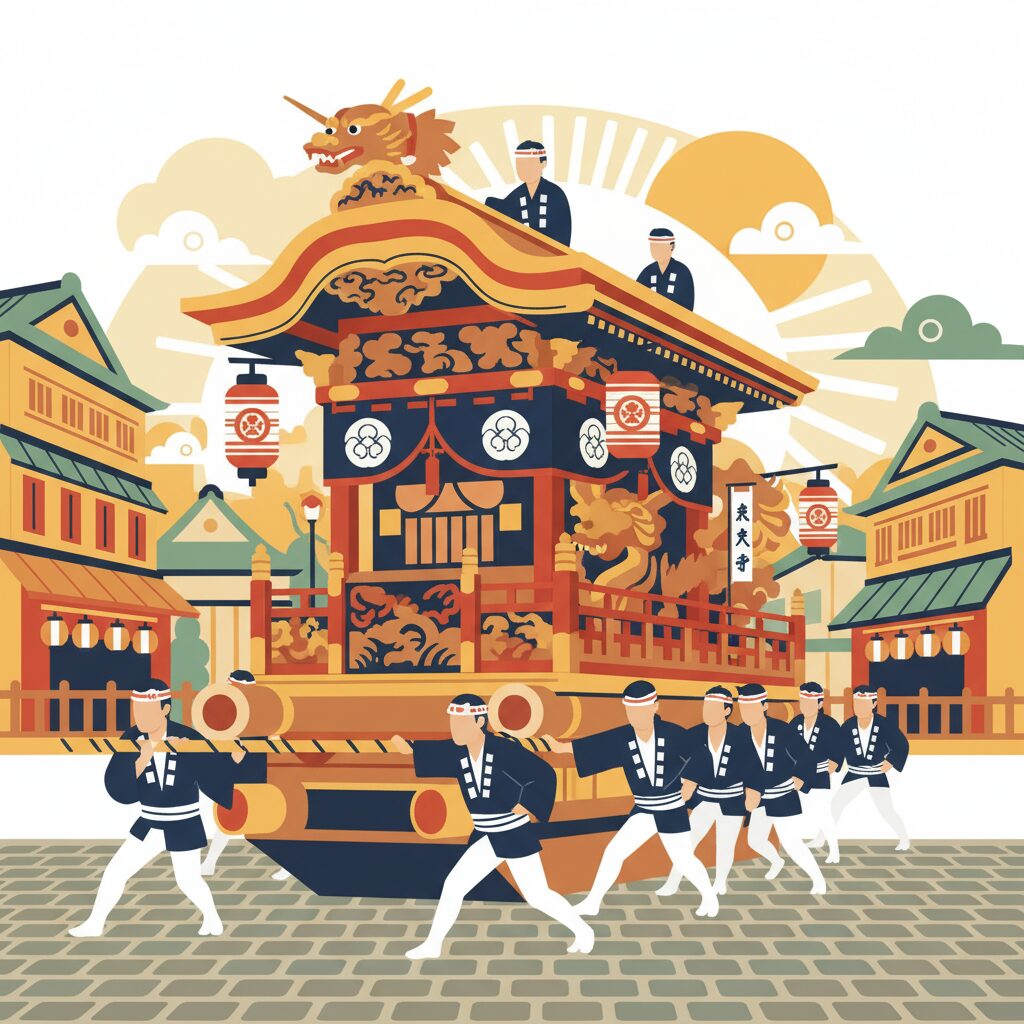
The first time you hear it, you don’t understand. It’s a low rumble in the distance, a rhythmic pulsing that vibrates through the soles of your shoes. Then it grows louder, a chorus of guttural chants, the frantic beat of drums, and the piercing wail of a flute. You rush to the street corner, and what you see defies easy explanation. A massive, four-ton wooden shrine, intricately carved and towering over the crowd, comes hurtling towards you at a terrifying speed. Men, sweat-drenched and screaming with exertion, pull on thick ropes, their bodies straining. On the rooftop, another man, balanced precariously, leaps and dances like a daredevil acrobat. The entire behemoth skids around a tight ninety-degree corner in a move of impossible physics and raw power, missing the corner store by mere inches. Your heart is in your throat. You might think, is this a riot? A protest? Some kind of out-of-control religious parade? Welcome to Kishiwada. This is the Danjiri Matsuri, and it’s one of the most potent, undiluted expressions of the Osaka soul you will ever witness. This isn’t the serene, choreographed elegance of a Kyoto festival. This is visceral, dangerous, and unapologetically loud. To understand why hundreds of men risk life and limb to drag a wooden float through the streets, and why an entire city shuts down to cheer them on, is to understand the very DNA of Osaka—a culture built on local pride, raw passion, and a community spirit so fierce it borders on tribal. This festival is the city’s personality made manifest: fast, powerful, a little bit reckless, and utterly captivating. It’s a spectacle that tells you more about daily life and the local mindset than any guidebook ever could.
Amid the visceral energy of the Danjiri Matsuri, you can also savor a different side of Osaka by exploring gluten-free takoyaki, a creative twist that brings local flavor to a modern table.
The Raw Mechanics: What Exactly is a Danjiri Matsuri?
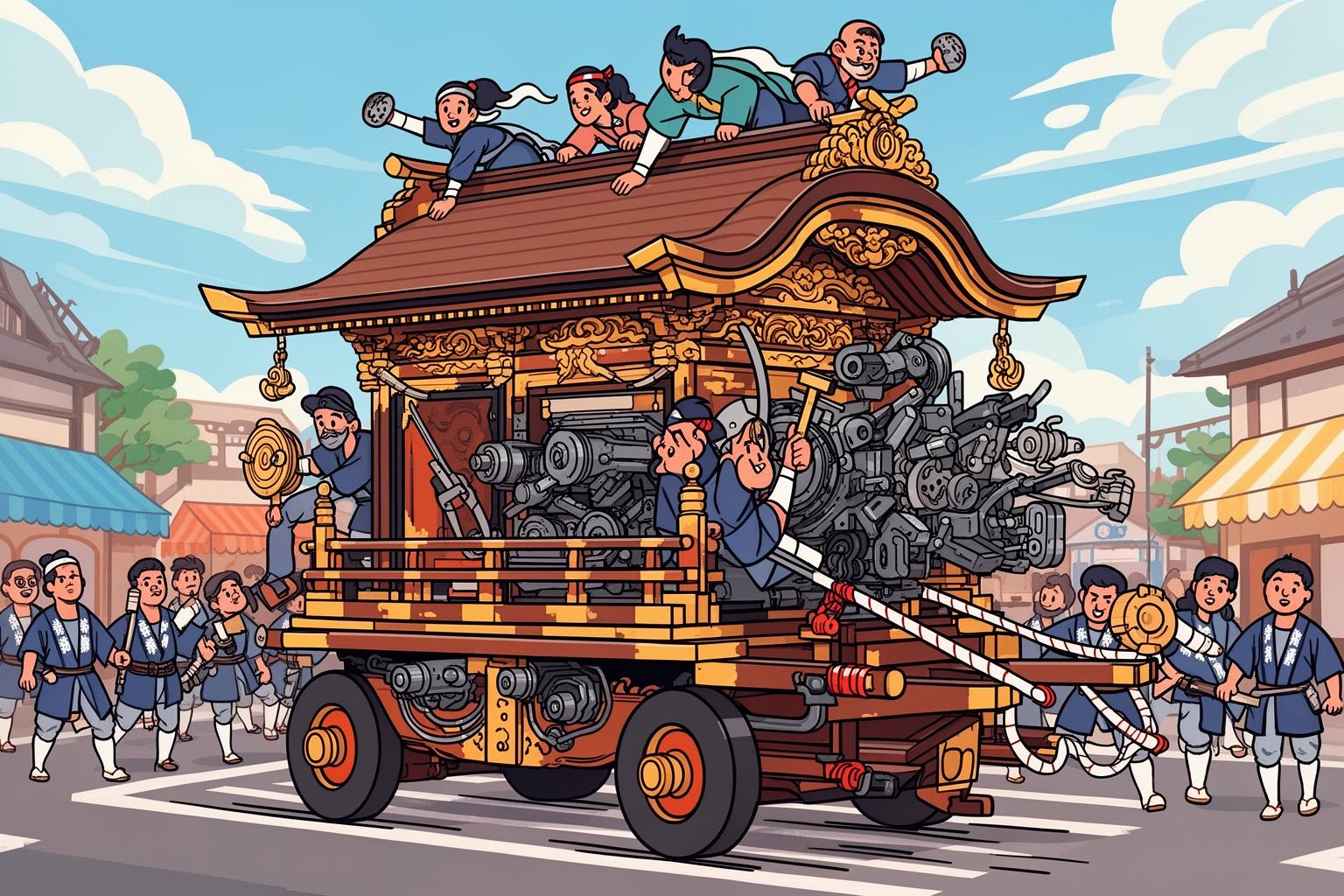
To an untrained eye, the Danjiri festival might appear as pure, unfiltered chaos. However, within that whirlwind of movement lies a system, a set of roles, and a piece of machinery that is simultaneously a work of art and a weapon. It’s a symphony of controlled violence, and to truly appreciate it, you must understand both the instruments and the players.
More Than Just a Wooden Cart
The centerpiece of the event is the danjiri itself. Calling it a ‘cart’ or a ‘float’ is a severe understatement. It’s a mobile masterpiece, carved from zelkova wood and weighing as much as four tons. These are not mass-produced items; each one is unique to its neighborhood, serving as a rolling symbol of its identity and history. The most stunning aspect is the kiborimono, the intricate wood carvings that cover every surface. These are far more than mere decorations. They are detailed, three-dimensional stories illustrating scenes from Japanese history and mythology—epic battles from the Genpei War, legendary samurai, and folkloric heroes. They embody a profound connection to the past and a respect for craftsmanship passed down through generations. Yet, the Danjiri’s most critical characteristic is what it lacks: modern brakes. Its direction and speed are governed solely by manpower, wooden levers, and two massive ropes. This single fact elevates the festival from a simple parade to an intense performance of skill and bravery.
The Team and The Roles
Maneuvering this four-ton giant requires a complex human machine, with each part fulfilling a crucial role. The most visible and celebrated figure is the daikugata, or the rooftop carpenter. This is the person you see dancing, leaping, and fanning himself atop the Danjiri as it careens through the streets. He serves as the navigator, the hype man, and the embodiment of the festival’s daredevil spirit. His balance must be impeccable, his courage unwavering. He signals directions to the team below and energizes both the pullers and the crowd with his performance. Below, steering duties are divided between two groups. The maeteko manipulate two long wooden levers at the front to initiate turns, while the crucial work is done by the ushiroteko, the person at the rear who operates a large lever like a ship’s tiller, guiding the back end of the float. Then there are the hundreds of pullers, the engine of the operation. The main group, the tsunamoto, grasps the two thick ropes extending from the front. Their synchronized pulling generates the raw power. These are not professional athletes or performers but community members—the local fishmonger, the salaryman, the mechanic, the shop owner. They train for months, conditioning their bodies and minds for these two days of intense physical exertion.
The Main Event: Yarimawashi
All—the art, the teamwork, the training—culminates in one single, heart-stopping maneuver: the yarimawashi. This is the signature move of the Kishiwada Danjiri Matsuri, a full-speed, ninety-degree turn at an intersection. It is a moment of breathtaking, terrifying precision. As the Danjiri nears the corner, the tempo accelerates. The chanting of “Sorya! Sorya!” swells into a deafening roar. The daikugata on the roof signals the turn. The rope pullers on the inside of the turn slacken their ropes, while those on the outside plant their feet firmly and pull with all their might, attempting to swing the heavy float’s front around. The maeteko jam their levers against the front wheels, and the ushiroteko leans his full body weight into the rear lever. For a split second, the Danjiri seems to pivot on a single point, its wooden wheels shrieking against the asphalt as it drifts around the corner. A successful yarimawashi is a masterpiece, greeted by a thunderous cheer from the thousands of spectators. A failed one can be disastrous—the float crashing into buildings or, in the worst cases, tipping over. It is the ultimate test of a team’s skill, unity, and nerve.
Beyond the Spectacle: The Kishiwada Mindset
To truly understand what Danjiri is all about, you need to look beyond the exciting visuals and grasp the deep-rooted cultural values that drive it. This is more than just a celebration. For the people of Kishiwada, it represents a way of life, a guiding principle for the entire community. It shapes their identity, social structures, and annual calendar. It reflects a particular Osaka mindset that values local ties over national ones and collective passion over individual comfort.
Jigawa: Your Neighborhood is Your Kingdom
Across Japan, the concept of jigawa (地元), or one’s local area, holds significance. But in Kishiwada, it is almost a religion. The city is split into dozens of neighborhoods or towns (chou), each boasting its own Danjiri, team, and fierce pride. Your primary identity is linked to your chou. Rivalries between these neighborhoods are intense and tangible. The festival essentially serves as a contest for honor and bragging rights. Whose yarimawashi was the cleanest? Whose team displayed the most spirit? This intense localism is a core aspect of the broader Osaka identity. While Tokyo often feels like a vast, impersonal metropolis, Osaka resembles a patchwork of distinct villages, each with its own character and loyalties. People in Osaka tend to identify more with their neighborhood or even their train station—such as Umeda, Namba, or Tennoji—than with the city as a whole. Kishiwada pushes this tendency to its passionate extreme. The Danjiri embodies the belief that your small part of the world is the most important place on earth and worth defending.
A Year-Long Obsession
It is a common misconception to see the Danjiri Matsuri as just a two-day event in September. For participants, it demands a year-round commitment. As soon as one festival ends, preparations for the next one begin. There are countless meetings for planning and fundraising. The floats require constant, costly upkeep, often performed by specialized local craftsmen whose skills have been handed down through generations. Teams practice relentlessly, running through the streets in the evenings for weeks ahead of the main event to build stamina and coordination. For Kishiwada’s young men, Danjiri is a core part of their upbringing. You can see small children wearing miniature happi coats, pulling tiny toy Danjiri floats, and imitating the rooftop dancers. They are immersed in this world from birth. This is not a casual hobby; it is an inheritance. This year-round dedication explains the remarkable skill and passion on display. It’s not just for enjoyment—it is serious. It is a sacred duty to the community and to past generations.
The Price of Passion: Injury, Cost, and Sacrifice
This devotion comes with a heavy price. The festival is undoubtedly dangerous. The combination of speed, weight, and manual control creates a high-risk environment. Injuries are common, from minor scrapes to severe, life-changing accidents. Ambulances are on standby every year. This contrasts sharply with the often sanitized, safety-conscious nature of many modern events in Japan and especially the West. In Kishiwada, the risk is embraced as part of the tradition. It demonstrates the participants’ bravery and dedication. Beyond the physical dangers, there are significant personal and financial sacrifices. The Danjiri floats themselves are enormously expensive, costing hundreds of thousands of dollars to build and maintain—funded through community donations and participant fees. The time commitment is substantial, often requiring men to take leave from work and sacrifice time with their families. So why do they do it? For honor. For the pride of their jigawa. For the unbreakable bonds forged with their teammates while pursuing a shared, perilous goal. It is a form of collective identity that transcends personal comfort and safety, a concept that can be hard for people from more individualistic cultures to fully grasp.
Osaka vs. Tokyo: A Tale of Two Festivals
One of the best ways to grasp the unique character of the Danjiri Matsuri, and by extension Osaka itself, is to compare it with Tokyo’s festival culture. Although both cities boast vibrant traditions, their flagship festivals highlight a fundamental contrast in their civic identities: Tokyo’s controlled precision versus Osaka’s raw, kinetic energy.
Controlled Precision vs. Raw Power
Take Tokyo’s renowned Sanja Matsuri in Asakusa. It’s a wild, energetic celebration where teams carry heavy mikoshi, or portable shrines, on their shoulders. The atmosphere is intense, with participants chanting and bouncing the mikoshi to awaken the spirit of the deity inside. However, the movement is mainly vertical and relatively contained within the group of carriers. It represents a powerful, yet controlled force. In contrast, the Kishiwada Danjiri channels the opposite energy. Its power is purely horizontal, centered on forward momentum, speed, and the exhilarating challenge of steering that momentum. While a mikoshi is lifted and carried, a danjiri is pulled and unleashed. The experience feels less like a sacred procession and more like a cavalry charge. This contrast serves as a vivid metaphor for the broader stereotypes of the two cities. Tokyo often embodies wa (和), or social harmony—a place where things are orderly, refined, and follow established protocols. Osaka, by contrast, is animated by ikioi (勢い)—energy, momentum, and spirit. It’s a city that prizes getting things done with passion and force, even if it’s a bit chaotic. The Danjiri represents ikioi in its purest, most exhilarating form.
Top-Down vs. Bottom-Up Community
The organizational frameworks of the festivals also tell a story. Many of Japan’s most famous festivals, especially in historical centers like Kyoto and Tokyo, trace their origins to the imperial court, powerful shrines, or aristocratic patrons. These often have a formal, top-down structure. For example, the Gion Matsuri in Kyoto is magnificent but carries an air of ancient, established authority. The Danjiri Matsuri, however, feels defiantly grassroots. It is organized, funded, and carried out by local neighborhood associations (chounaikai). The power structure is horizontal and deeply local. Leaders are community members who have earned their roles through years of dedication and experience, rather than inherited status. This reflects Osaka’s history as Japan’s great merchant city. During the Edo period, while Tokyo (then Edo) housed the samurai government, Osaka thrived as a city of commerce, governed by a powerful and independent-minded merchant class. Its strength came from the bottom up—from guilds, markets, and neighborhoods. That spirit of civic autonomy and a subtle wariness of centralized authority still runs strong in Osaka. The Danjiri is a living embodiment of that spirit: a festival of the people, by the people, and for the people.
What Foreigners (and Even Other Japanese) Get Wrong
Because the Danjiri is so intense and visually overwhelming, it is often misunderstood. Its raw masculinity and barely-contained chaos can be intimidating and easily misread by outsiders, including Japanese people from other regions. Uncovering these misconceptions is essential to appreciating the true spirit of the festival.
“It’s Just a Bunch of Reckless Guys”
The most common misconception is to regard the participants as reckless hooligans engaged in meaningless bravado. From an outsider’s perspective, the speed and close calls seem like pure chaos. However, this is far from the truth. The yarimawashi is a maneuver of remarkable precision, requiring months of practice and split-second communication among dozens of individuals. The entire process is regulated by a strict, nearly military-style hierarchy. The relationship between senpai (seniors) and kohai (juniors) within the Danjiri teams is absolute. Younger members learn by observing, listening, and performing demanding support tasks for years before gaining more responsibility. It is a martial art on wheels, demanding discipline, respect, and complete trust in teammates. This reflects a common misunderstanding about Osaka business culture. On the surface, Osakans may seem loud, informal, and even brash compared to Tokyoites. But beneath that exterior lies a highly pragmatic and results-driven system, governed by complex rules of engagement and a profound respect for experience and skill.
“Is it a Yakuza Festival?”
To be honest, for foreigners, the aesthetics can sometimes be confusing. The sight of large groups of intense, shouting men, some of whom may have tattoos, combined with the raw, aggressive energy of the event, leads some to speculate about ties to organized crime. It is important to emphasize: the Danjiri Matsuri is absolutely not a yakuza festival. It is a genuine and deeply respected community tradition with religious roots in prayers for a bountiful harvest at the local shrine. However, the festival’s culture celebrates a specific type of masculinity—one based on grit, physical toughness, loyalty to the group, and a certain anti-authoritarian pride. These values might visually resemble the romanticized image of the yakuza, but their origins and purpose are entirely different. One celebrates community identity; the other centers on crime. Confusing the two is a serious misinterpretation of a cherished local culture.
The Role of Women and Children
At first glance, the festival may appear to be solely a male domain. The most visible and risky roles—pulling the ropes, steering the float, and dancing atop the roof—are carried out by men. This can give the impression of a misogynistic event. While the roles are indeed traditionally gendered, this perspective misses the full picture. Women are the unseen backbone of the Danjiri Matsuri. They handle vital roles in organization, logistics, and fundraising. They manage finances, prepare vast amounts of food for the teams, mend festival garments, and provide the essential support network that enables men to participate. They are the managers, organizers, and community builders working relentlessly behind the scenes. Likewise, children are not merely spectators; they are active participants. From a young age, they are involved in the festival, learning the music, pulling smaller, child-sized Danjiri floats, and absorbing the traditions. The entire event is a community-wide effort, with every member playing a part in ensuring its continuation. It is a lesson in how tradition is passed on not as a static exhibit but as a living, breathing part of everyone’s life.
Living With Danjiri: The Reality on the Ground
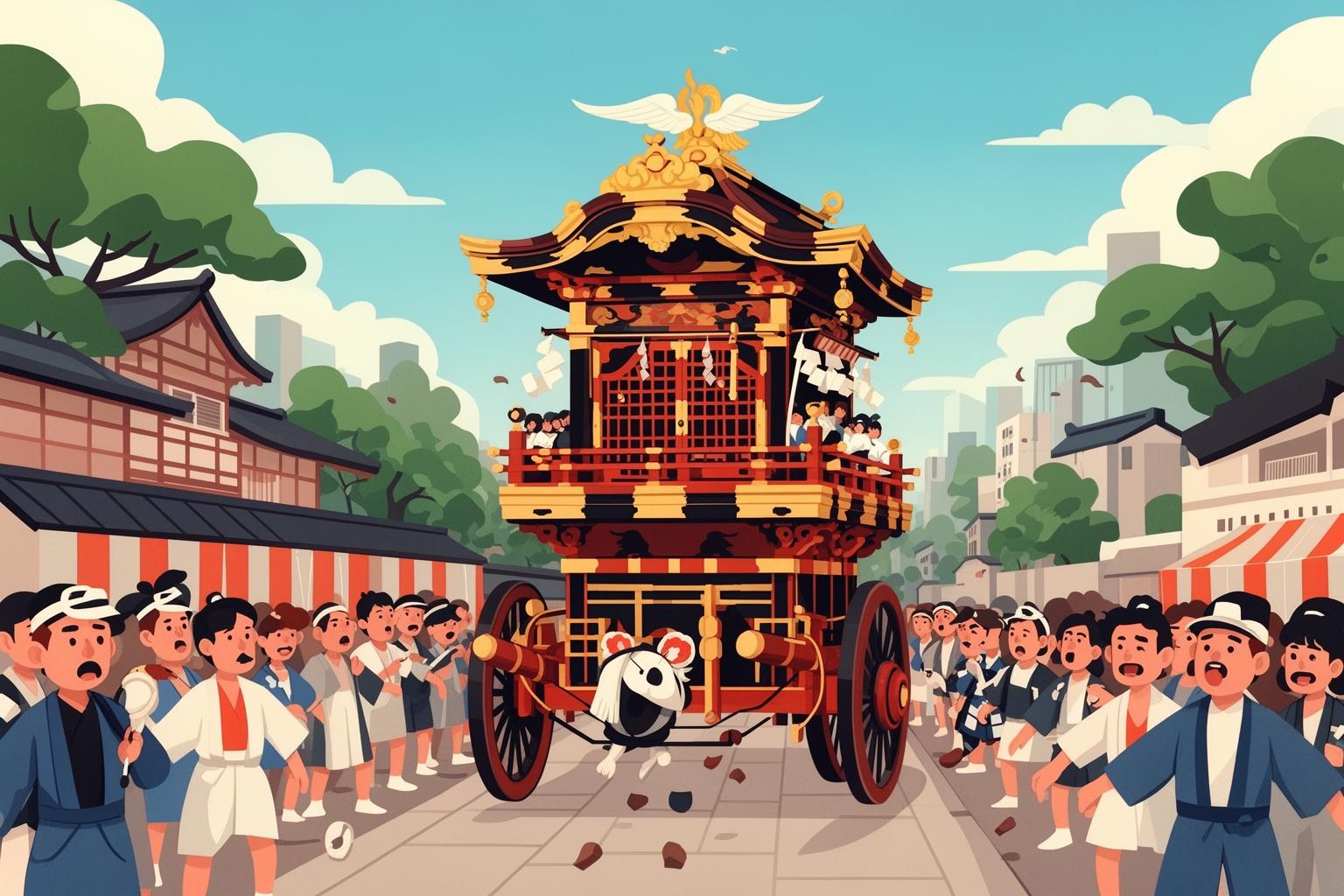
The Danjiri Matsuri is not something you can simply choose to attend or ignore if you live in Kishiwada. Throughout the entire month of September, the festival dominates the city. It becomes the soundtrack, the traffic pattern, and the central topic of conversation. Grasping this reality is essential to understanding what it means to live in a community with such a powerful, all-consuming tradition.
The Sound of September
Long before the main event, the festival announces its presence. On most evenings in the weeks leading up to it, the air fills with the sounds of drumming and chanting. It’s the local teams practicing, running drills through the neighborhood streets. It’s a constant, audible reminder that Danjiri is approaching. Roads are closed for these practices, and the city’s normal rhythm is disrupted. For residents, this is the reality of September. There’s a tangible energy in the air, a city-wide buzz of anticipation. Local shops display festival banners, and conversations at the local izakaya inevitably turn to which team looks strongest this year. For those who love the festival, it’s the most exciting time of the year. For those who don’t, it can be a month filled with noise and inconvenience. There is very little middle ground.
The Danjiri Economy
The festival is also a significant economic driver. An entire ecosystem of specialized businesses exists to support it. There are master carpenters (miyadaiku) who possess the rare skills needed to build and repair the priceless Danjiri floats. Tailors specialize in creating custom-designed happi coats and other festival clothing for each neighborhood. Local restaurants, bars, and convenience stores thrive during the festival weekend, which attracts hundreds of thousands of spectators from all over Japan. This economy reinforces the festival’s importance. It’s not just a cultural event; it’s a source of livelihood and a major force behind local economic activity, further embedding it into the fabric of daily life.
A Choice You Make
Ultimately, living in a place like Kishiwada means choosing to live with Danjiri. It is an inseparable part of the local identity. You cannot isolate yourself from it. It will influence your commute, your sleep schedule, and your social life. In this way, it serves as a perfect metaphor for what it’s like to live in Osaka. The city has a personality that is too strong to ignore. It is loud, direct, and relentlessly energetic. You can’t be neutral about Osaka. You either embrace its unique rhythm, its pragmatic mindset, and its intense community spirit, or you will likely feel overwhelmed. The Danjiri Matsuri is the ultimate test. It asks, are you ready for this level of intensity? Are you willing to immerse yourself in a culture that values passion over quiet reservation? If the answer is yes, then you’ve found your home. In the end, the festival isn’t just about pulling a float. It’s about a community pulling together with everything they’ve got, holding nothing back. That powerful, all-in spirit is what makes Osaka one of the most dynamic and deeply human places you’ll ever know.