Step off the train in Osaka, anywhere from the neon canyons of Namba to the quiet residential lanes of Tenma, and you’ll immediately hear it. Not the roar of traffic, not the rumble of the subway, but a softer, more intimate city soundscape. It’s the gentle whir of tires on pavement, the rhythmic click of a freewheel, the cheerful chime of a handlebar bell. This is the sound of the mamachari, the humble city bicycle, and it’s the true pulse of Osaka. Forget the train maps for a second. To understand how this city breathes, you need to understand its relationship with these two-wheeled workhorses. They’re everywhere, a flowing, metallic river of humanity carrying groceries, children, business documents, and late-night takoyaki. They represent freedom, a way to stitch together the gaps in the train network and make the sprawling metropolis feel like your own personal neighborhood. But this freedom comes with a question, a daily puzzle that confronts every resident, a challenge that separates the newcomers from the seasoned locals: when you get where you’re going… where in the world do you put the bike? The sidewalks are a chaotic gallery of parked bicycles, a jumble that looks like pure anarchy. But it’s not. It’s a system. A very Osaka system, built on a foundation of unspoken rules, mutual understanding, and a concept you won’t find in any official guide. Welcome to the real Osaka. Let’s go for a ride.
As you glide through Osaka’s vibrant streets on your mamachari, understanding the city’s unique escalator etiquette can make all the difference.
The Mamachari Reigns Supreme: Osaka’s Two-Wheeled Soul
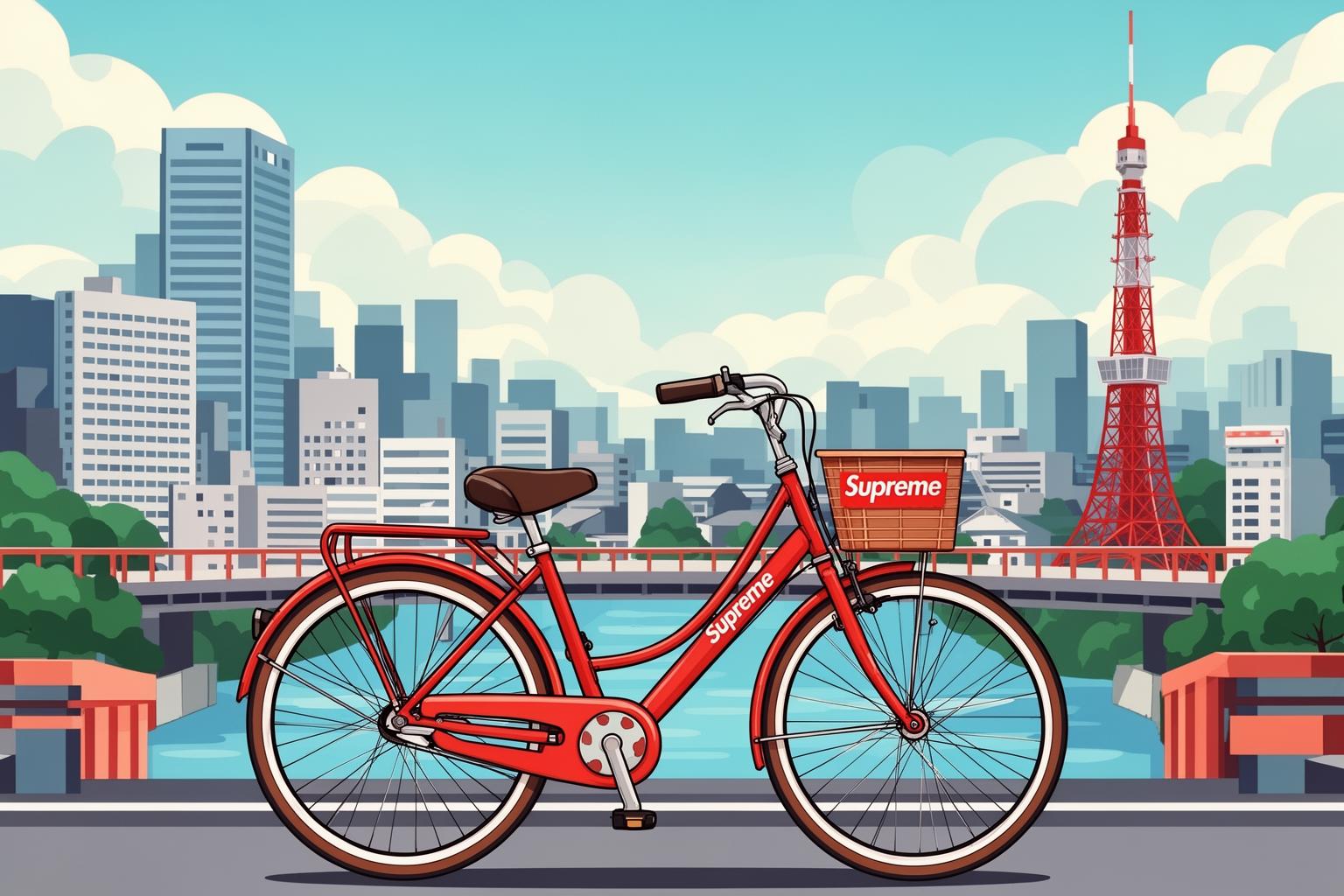
First, you need to appreciate the machine itself. The mamachari—literally “mom’s chariot”—is the undisputed king of Osaka’s streets. These aren’t sleek carbon-fiber racing bikes or rugged mountain climbers. They are tanks: sturdy, single-speed, designed for utility rather than style. They come with a large basket on the front for groceries, a heavy-duty rack on the back often fitted with a child seat, and a kickstand strong enough to support a small car. They are the city’s lifeblood. You’ll spot grandmothers, impossibly elegant in their posture, gliding through crowded shotengai, their baskets overflowing with daikon radishes and fresh fish. You’ll see salarymen in crisp suits, briefcases stowed, pedaling furiously to beat the morning rush to the station. Students, couples on dates, delivery workers—everyone rides. Why? Look at a map. Osaka is pancake-flat. Unlike Kobe, built on a hillside, or parts of Tokyo with subtle inclines, central Osaka is a cyclist’s paradise. The city is also a dense mosaic of neighborhoods, each with its own station, shopping street, and cluster of restaurants. The bike is the perfect tool for this setting. It’s faster than walking, cheaper than the train for short trips, and infinitely more flexible. It’s the key that unlocks the city, turning a 15-minute walk to a different subway line into a breezy 5-minute ride. In Tokyo, life revolves around the station. Your world is defined by what lies within a 10-minute walk of your nearest Yamanote or Chiyoda line stop. In Osaka, the bike shatters those boundaries. The entire city becomes accessible, interconnected, yours to explore on your own terms. This dependence on the bike fosters a different urban mindset—one that’s more grounded, more street-level, and profoundly pragmatic.
The Parking Paradox: A Sea of Bikes and Nowhere to Go
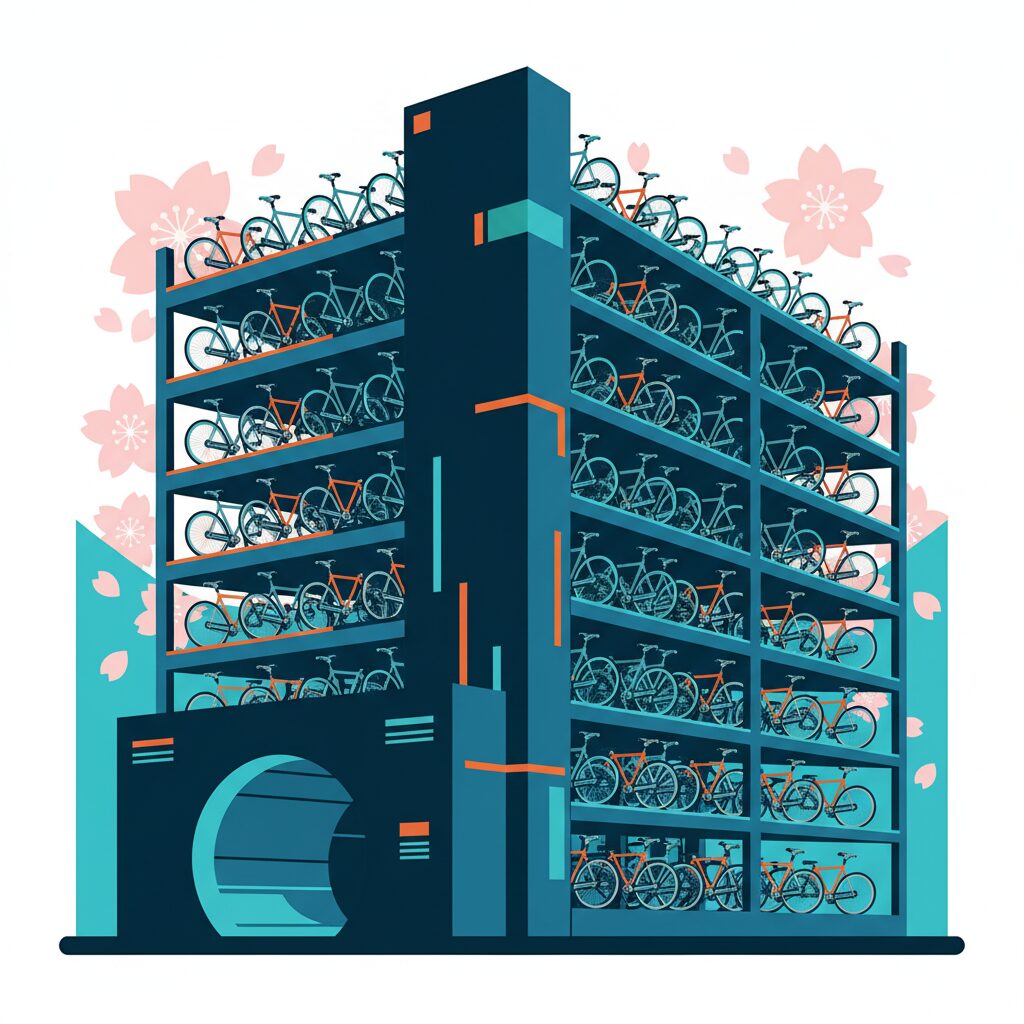
This city-wide passion for bicycles presents an immediate and clear issue: critical mass. Walk toward any major train station such as Umeda, Namba, or Tennoji, and you’ll witness it—a tidal wave of parked bicycles. They line the sidewalks, fill the underpasses, and cluster around every available guardrail and signpost. It’s an astonishing sight, showcasing the sheer number of people who depend on two wheels. For a newcomer, it’s puzzling. Is all of this legal? Is there an organized system? The answer is both yes and no. Naturally, the city has official regulations. There are designated paid parking lots, or `churinjo` (駐輪場), often situated beneath elevated train tracks or within multi-level garages. These serve as the city’s formal solution to the issue. You slot your bike into a metal holder, a lock secures your wheel, and you pay a small fee, usually between 100-150 yen for a few hours, upon your return. Many streets also feature silver-painted zones on the sidewalks, designated for short-term parking, often free for the first 60 or 90 minutes. Then there is everything else. That “everything else” is a minefield. Park in the wrong place, especially a designated “no parking” zone, and you risk the dreaded yellow tag. City workers make regular rounds, attaching these warning notices to offending bicycles. Finding one is a warning shot—it means your bike has been registered, and if it remains there during the next sweep, it will be gone. Vanished. Taken away to a remote impound lot, where you’ll need to retrieve it for a fee of several thousand yen, equipped with your key, your ID, and a heavy dose of embarrassment. This is the official system, the black and white. But Osaka, as you’ll soon discover, operates in the gray.
Welcome to the Gray Zone: Understanding ‘Kiccho’
Now we arrive at the core of the issue—the unspoken rule, the social contract that keeps this chaotic system functioning smoothly. Locally, this concept is known as `kiccho` (キッチョ). You won’t find this word in any dictionary or official pamphlet. It’s a living, breathing piece of Osaka slang, and grasping it feels like receiving a secret key to the city. `Kiccho` is not merely “illegal parking.” Calling it that misses the entire point. Instead, `kiccho` refers to parking your bike, typically in a technically illegal spot, but only for a very short, specific time and with a clear, immediate purpose. It is a temporary, pragmatic use of public space. It’s leaning your bike against a convenience store wall while you pop in to grab a drink. It’s resting it beside a vending machine for the 30 seconds it takes to buy a bottle of tea. It’s leaving it near the post office entrance while you drop off a letter. The crucial factors are intention and duration. A bike left for eight hours while you’re at work is not `kiccho`; that’s illegal parking and will get towed. But a bike left for two minutes during a quick errand? That’s `kiccho`. It’s a subtle dance, and Osakans have perfected its choreography.
The Art of the ‘Kiccho’
Pulling off a successful `kiccho` is truly an art. It demands a natural awareness of your environment and a deep respect for the cardinal rule of Osaka life: `jama ni naranai you ni` (邪魔にならないように)—don’t be a nuisance. A proper `kiccho` never blocks a path. It doesn’t obstruct a store entrance. It doesn’t hinder pedestrian traffic on a narrow sidewalk. It certainly doesn’t cover the textured yellow paving stones meant for the visually impaired. A good `kiccho` is discreet—parking the bike snugly against a solid wall, tucked into a corner, or lined up beside a row of planters. It’s an act of temporary invisibility. You are silently promising the city and its people: “I know this spot isn’t officially allowed, but I’ll be gone in a flash, and I won’t bother anyone.” It’s a system grounded in trust and mutual understanding that everyone is just trying to get through their day efficiently. You overlook my `kiccho` because you know you’ll need the same courtesy in an hour. It’s a fragile, unwritten social agreement.
Reading the Room
How do you tell when and where it’s acceptable? You learn to read the environment—or in this case, the street. Watch for signs. Is there already a neat line of two or three bikes tucked against a wall? That’s a good indication the spot is socially accepted as a `kiccho` zone. Is the sidewalk wide and mostly empty? You likely have some leeway. But is it a cramped, busy street outside a busy station? Forget it—that’s a high-enforcement zone, and more importantly, parking there would make you a huge nuisance. Reading the room means developing an instinct for the city’s rhythm. You begin to notice the invisible lines of pedestrian flow, the dead spaces where a bike can rest briefly without disrupting the urban movement. This situational awareness is a key survival skill in Osaka and applies to everything from queuing for ramen to maneuvering on a crowded train, but it’s nowhere more evident than in the culture of bicycle parking.
‘Kiccho’ vs. Tokyo: A Tale of Two Cities
This is where the difference between Osaka and Tokyo becomes clear. If you tried to apply the logic of `kiccho` in central Tokyo, you would fail quickly and at a high cost. Tokyo operates on a different, more rigid principle: the rules are the rules. A no-parking zone is simply a no-parking zone. The gray area is almost nonexistent. Sidewalks are for walking, and designated parking areas are for parking. The system is clear, orderly, and strictly enforced. This isn’t a criticism of Tokyo but rather a reflection of a distinct approach to managing a massive, dense population. Tokyo emphasizes public order and strict adherence to the manual. There is a correct way to do things, and everyone is expected to follow it. This results in a city that is remarkably clean, efficient, and easy to navigate, as long as you stick to the rules. Osaka, by contrast, favors a kind of messy, human-centered pragmatism. The official rules do exist, but they are regarded more as guidelines, a starting point for negotiating with reality. The unwritten rule—don’t cause trouble for others—is often more important than the written one. This is the well-known Osaka `ee yan` (ええやん) spirit: “It’s fine, isn’t it?” As long as things work and no one is hurt or seriously inconvenienced, there’s no need to get stuck in bureaucracy. This flexibility may seem chaotic to outsiders, but to locals, it’s simply common sense. It enables the city to function with more fluidity and a greater sense of give-and-take.
Navigating the System: Your Survival Guide to Osaka Biking

So, as a foreign resident, how do you navigate and thrive in this bike-centric world? How do you enjoy the freedom of cycling without constantly worrying about city workers tagging your bike? It’s easier than it seems. You just need to absorb the local mindset.
The Golden Rule: Don’t Be a Jerk (`Jama ni naru na`)
This is the core principle, distilled to its simplest form. Before you park your bike anywhere—in a paid lot, a silver zone, or a discreet `kiccho` spot—ask yourself one question: “Am I blocking someone?” If the answer is even possibly yes, find another spot. This idea of not being a nuisance (`meiwaku`) is central to Japanese life, but in Osaka, it serves as the main guideline where strict rules are absent. Don’t obstruct shop entrances. Don’t block fire hydrants. Don’t hinder access ramps. Don’t make life harder for others. Follow this, and you’re already 90% of the way to fitting in.
Know Your Zones
For anything longer than a quick `kiccho`, rely on the official bike parking facilities. They’re affordable and offer peace of mind. Get to know the `churinjo` near your home, workplace, and frequently used stations. Most have a great system where the first 30 to 90 minutes are free. This is specifically designed for quick stops, encouraging legal parking even for short errands. Learn how to use the simple locking system: roll your front wheel in, a bar locks into place, and that’s it. When you return, enter your spot number at a pay station, pay 100 or 150 yen, and your bike’s lock releases. It’s an elegantly simple and effective system.
The Yellow Tag of Shame
Inevitably, you might make a mistake. You could misjudge a spot or overstay, and when you return, you’ll find the dreaded yellow tag wrapped around your handlebars. Don’t worry. It’s usually just a warning. Read it (or have someone help you), understand your error, and move your bike right away. Think of it as a cheap lesson. But if you come back and your bike is gone, marked only by a chalk outline on the pavement, then you’re dealing with the next level: your bike has been impounded. The warning tag or a nearby sign will tell you where it was taken. These impound lots are almost always inconveniently located in distant, industrial areas—like under a highway overpass on the waterfront. You’ll need to go there with your bike key and photo ID, fill out paperwork, and pay a fine, usually about 2,500 yen. It’s a frustrating and time-consuming ordeal, one that most long-term residents experience exactly once. It’s the city’s way of enforcing the rules through tough lessons.
More Than Just Parking: The Bike and the Osaka Mindset
Ultimately, all this discussion about bikes, parking, and `kiccho` goes beyond mere transportation. It offers a glimpse into the essence of Osaka. The city’s bicycle culture reflects key aspects of the local spirit: a strong pragmatism, a disdain for inefficient rules, a trust in common sense, and a keen awareness of the people around you. It revolves around sharing crowded spaces through unspoken, mutual agreements rather than strict, top-down regulations. It’s somewhat chaotic, a bit disorderly, and profoundly human. In Tokyo, you might feel like a passenger on a flawless public transit system. In Osaka, riding your mamachari down a narrow lane with a basket full of groceries, you feel integrated into the city’s very lifeblood. And discovering the ideal, socially acceptable `kiccho` spot for a quick 60-second stop at your favorite bakery? That’s a small triumph—proof that you’re no longer merely living in Osaka, but beginning to truly understand it.