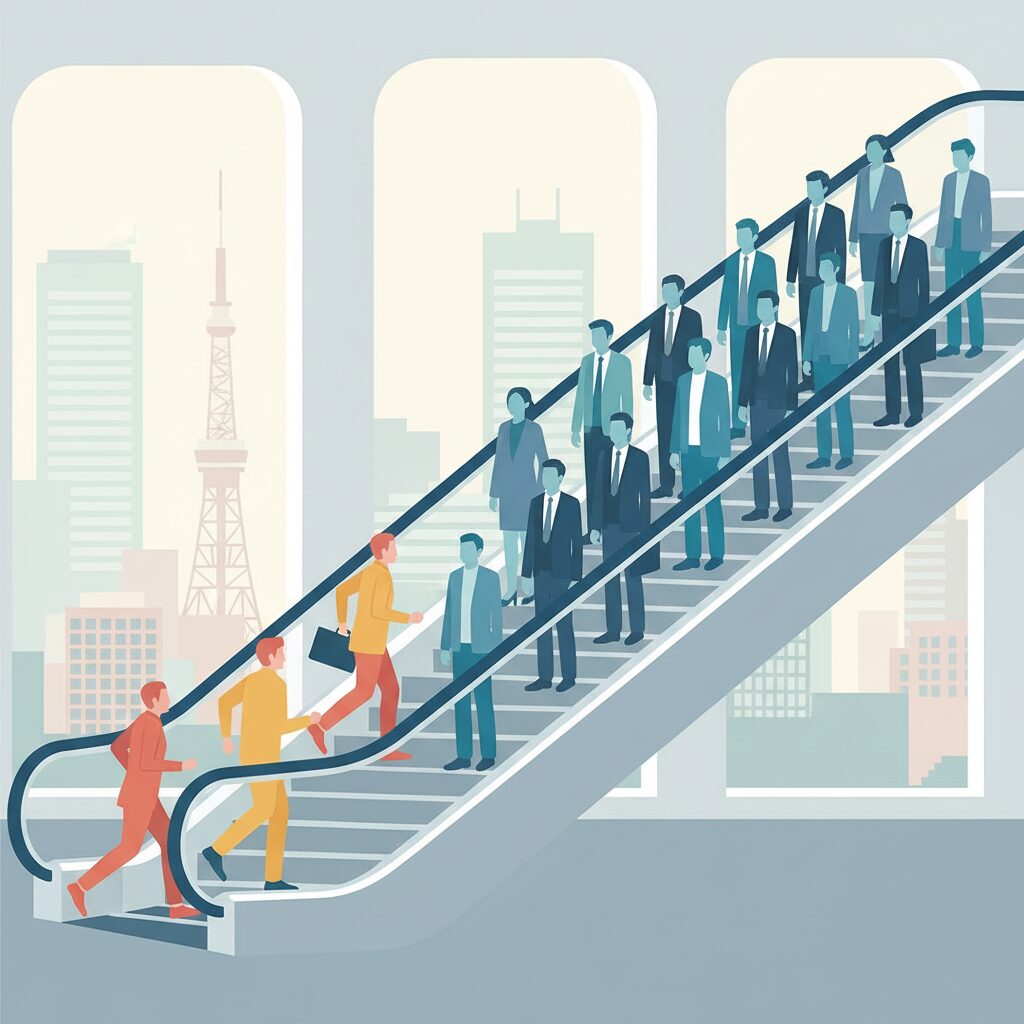
Alright, let’s talk about the first real test you face in Osaka. It’s not ordering takoyaki from a street vendor who speaks a dialect faster than a shinkansen. It’s not navigating the human labyrinth of Umeda Station on a Friday night. No, the first true initiation into the Osaka way of life happens on an escalator. You step on, and a silent, powerful force nudges you to the right. In Tokyo, you stand left. Here, in the heart of Kansai, you stand right. This is Rule Number One, the mantra chanted by every travel guide and expat forum. Stand right, walk left. Simple, right? But if you think that’s the end of the story, you’ve only read the book cover. Living here, you quickly realize this isn’t just a traffic rule for vertical transport; it’s a social barometer, a declaration of identity, and a daily performance of what it means to be an Osakan. It’s a rhythmic pulse that tells you everything you need to know about this city’s pragmatic, impatient, and fiercely independent soul. Forget the guidebooks for a moment. Let’s ride the escalator like a local and decode the real Osaka, one step at a time.
To further immerse yourself in Osaka’s distinctive urban rhythm, consider exploring vibrant neighborhood bathhouses that showcase the city’s deep-rooted communal spirit.
The Unspoken Rule: A Symbol of Osaka Pride
Why the right side? The explanations are as diverse and vivid as the neon signs in Dotonbori. Some believe it traces back to the 1970 World Expo in Osaka, when the city adopted a more “global” standard to welcome international visitors. Others whisper it’s a relic from samurai times, when men kept their swords on the left, leaving the right side free for drawing. But ask any local, and you’ll probably get a shrug and a simple, “That’s just how we do it here.” The true reason, however, is less about historical accuracy and more about modern identity. Standing on the right is, at its core, a subtle form of rebellion. It’s a daily, unconscious affirmation that Osaka is not Tokyo. In a country that values conformity and harmony, this small gesture is a powerful distinction. It physically represents the city’s enduring role as the foil to the capital. Tokyo was the city of the shogun and samurai, characterized by strict hierarchy and formal rules. Osaka was the city of merchants, a lively port where pragmatism, speed, and negotiation outweighed protocol. This spirit persists. Choosing the right side means choosing the Osaka way. You can sense this pride in the air. Observe a group of high school students instinctively moving to the right, or an elderly woman gently tapping a perplexed tourist on the shoulder to point it out. There’s a shared, silent understanding. Following this rule is more than politeness; it’s recognizing you’re on Osaka turf. It’s a small price of admission into the local culture, and doing it correctly earns a quiet, almost invisible nod of approval. It’s the city’s secret handshake, performed thousands of times each minute on every escalator from Shin-Osaka to Namba.
Beyond the Binary: The Escalator as a Social Stage
Once you’ve mastered the basic stand-right-walk-left choreography, you begin to notice the improvisational scenes. The rule provides the foundation, but the exceptions reveal the true, unscripted personality of Osaka. The escalator isn’t just a machine; it’s a moving stage where the city’s social dynamics are fully displayed. Life in Osaka is rarely black and white, and neither is its escalator etiquette. You learn to read the room—or in this case, the moving staircase—and adapt. This is when you graduate from a visitor who knows the rule to a resident who understands the rhythm.
The Double-Wide Dilemma: When Two Stand Side-by-Side
It’s rush hour at Yodoyabashi Station. The escalator is packed. Right in front of you, a young couple stands side-by-side, completely blocking both lanes, lost in their own world. The walking lane has vanished. What happens next is a masterclass in Osakan social negotiation. In a more rigid city, you might expect a stern clearing of the throat or a passive-aggressive sigh. Here, the reactions are more varied and revealing. The salaryman behind them might wait a few seconds, his foot tapping an impatient rhythm. If they don’t move, you might hear a soft, almost apologetic “suimasen” (excuse me), which usually works. Someone else might just accept their fate, pull out their phone, and use the extra 30 seconds to check their messages. This isn’t about a lack of rules; it’s about a flexible hierarchy of priorities. The unspoken consensus is that sometimes, human connection—a shared conversation, a moment between friends—can temporarily override the public demand for efficiency. It’s a fleeting, negotiated truce. The couple gets their moment, and those behind them understand, albeit with a touch of classic Osaka impatience simmering just beneath the surface. It reflects a culture that values human warmth as much as it values getting things done quickly.
The Luggage Lane: Navigating Tourist Traffic
At any major hub like Osaka Station or the Nankai Line platform heading to Kansai Airport, the escalator becomes an obstacle course. Giant suitcases, backpacks, and bewildered tourists create a rolling roadblock. The fast lane often becomes completely clogged. This is where Osaka’s unique blend of grumbling acceptance comes through. Osakans are immensely proud of their city’s international appeal, but they’re also people in a hurry. You’ll see it all: the expert weaver who slaloms through the tiniest gaps with practiced ease; the person who lets out a theatrical, audible “aaaaaah, mou” (oh, come on!) under their breath; and the surprisingly patient local who simply gives up and stands behind a massive suitcase, resigned to their fate. There’s a general understanding that this is part of living in a global city. They chose to live in the vibrant, chaotic heart of Kansai, and tourists are part of that package. While a Tokyoite might internalize their frustration, an Osakan is more likely to wear it on their sleeve with a sigh or a shake of the head, a small performance of impatience that fades as soon as they step off the escalator. It’s not hostile; it’s just honest. This emotional transparency defines much of the city’s character.
The Phantom Lane: The Empty Escalator Phenomenon
Perhaps the most fascinating behavior occurs when there’s no logical reason to follow the rule. Picture this: it’s late at night in a quiet subway station. An escalator stretches up, completely empty. One person steps on and without hesitation moves to the right. A second person gets on and dutifully lines up behind the first on the right, even though the entire left side remains wide open. Why? This is social conditioning at its purest. At this point, it’s no longer about efficiency. No one is rushing to get past. It’s about a deeply ingrained habit, a ritual that reinforces a sense of shared community. It’s the urban equivalent of a flock of birds turning in unison. This collective, automatic behavior testifies to the power of a shared local culture. It’s a silent, constant reminder: “We are in Osaka, and this is how we do things.” It’s a small act of belonging, a confirmation of the unwritten social contract that governs daily life here. Watching this quiet, almost meditative adherence to the rule on an empty escalator is strangely comforting. It’s a sign of a city with a strong, confident, and deeply rooted identity.
The Great Escalator Debate: Efficiency vs. Safety
Just when you think you’ve mastered everything, a new challenger appears: the official safety campaign. In recent years, railway companies throughout Japan, including those in Osaka, have launched efforts to completely change escalator behavior. You’ve seen the posters: charming cartoon characters illustrating the new ideal, with people standing on both sides. You’ve heard the announcements: a courteous, repeating voice advising, “for your safety, please do not walk on the escalator and hold the handrail.” The rationale behind it is solid. Walking increases the chances of falls and accidents, particularly for the elderly or those with mobility challenges. The aim is to establish a safer, more stable environment for everyone. The campaign is rational, well-meaning, and nationwide. Yet in Osaka, it has been almost entirely ignored. The walking lane remains as lively and busy as ever. This resistance isn’t mere stubbornness; it represents a clash between two fundamental perspectives.
The Logic of the “Hurry Culture”
To grasp the resistance, you need to understand Osaka’s “sekkachi,” or impatient culture. This city is rooted in commerce, where quick deals were made and fortunes depended on swift decisions. That tempo is ingrained in the city’s essence. People walk faster, speak faster, and expect efficiency. The idea of standing still on both sides of an escalator, forced to move at a snail’s pace despite an open lane, feels unnatural. It offends the Osakan belief that time is a precious resource not to be wasted. The walking lane isn’t a luxury; it’s a necessity. It serves those about to miss their train, parents rushing to pick up their children, or anyone who prefers to move at their own speed. The safety campaign’s attempt to enforce a single, slower pace clashes directly with this deep-rooted cultural drive for progress. Standing still feels, in some ways, riskier than walking.
A Distrust of Top-Down Rules
There’s another aspect to this resistance linked to the city’s historical mindset. Osaka has always trusted grassroots, community logic over decrees from distant authorities. The “stand right, walk left” rule was never mandated by the government. It developed naturally, a people’s solution created by the community itself. It works because it reflects the city’s character. The official “no walking” campaign, however, feels like a top-down directive. It’s a rule imposed by corporate or governmental entities, which Osakans view with healthy skepticism — especially when it contradicts a system they believe functions perfectly well. They listen to the announcement, glance at the poster, then promptly walk up the left side anyway. This quiet form of civil disobedience says, “Thanks for the suggestion, but we have our own way of doing things, and it works for us.” It’s a testament to a city that values its own time-tested customs over externally imposed regulations.
What This Teaches You About Living in Osaka
So, after everything, what’s the key takeaway? The simple escalator ride is your daily lesson in becoming an Osakan. It shows that rules here matter, but they often serve as a starting point for negotiation rather than a final decree. Standing on the right is your entry pass, signaling respect and awareness of your surroundings. Yet, true insight comes from knowing when and how that rule can be flexible. It teaches you to read the social environment—is it a moment for efficiency, or is it time to give a couple their space? Should you hurry along impatiently, or accept the slow pace caused by tourist congestion? Living in Osaka means mastering this flow. It means embracing a culture that is proudly distinct, resisting being a mere carbon copy of Tokyo or anywhere else. It means realizing that people here are direct and emotionally honest, yet pragmatic and surprisingly accommodating. So, the next time you step onto an escalator, pay attention. Are you standing on the right? Good. Now look around. Observe the interactions, feel the rhythm, and listen to the unspoken language of the steps. You’re not simply moving up or down—you’re engaging in the vibrant, chaotic, and wonderfully human pulse of Osaka. You’re learning to navigate the city not with a map, but through an understanding of its spirit. And that’s a story worth sharing.