When you first move to Japan, the public bath, or sento, feels like a cultural final boss. You’ve mastered the trains, you can navigate a convenience store, but the idea of getting naked with a bunch of strangers feels like a social minefield. The rules seem arcane, the etiquette terrifying. In most cities, this anxiety isn’t entirely misplaced. The sento is a functional space, a place to get clean, maybe have a quiet soak, and then leave. But in Osaka, you’re missing the entire point if that’s all you do. Here, the neighborhood sento isn’t just a place to wash. It’s the community’s living room, its unofficial town hall, and its steam-filled salon where the true rhythm of the city is laid bare. It’s what sociologists call a ‘third place’—that crucial ground between the home (first place) and work (second place)—where a community’s heart truly beats. While sento are vanishing across Japan, relics of a time before every home had a shower, they cling on with a particular tenacity in the dense, old neighborhoods of Osaka. They persist not out of nostalgia, but out of necessity. They are vital. To understand the soul of this city, you don’t go to a museum. You go to the local bathhouse on a Tuesday night.
For a broader taste of local life, many residents balance the urban energy of their sentō visits with a refreshing escape to a nature retreat in Nose during the weekend.
The Unspoken Etiquette of the Neighborhood Hub
Forget the tourist guides that offer you a sterile, three-step routine: wash, soak, repeat. The true etiquette of an Osaka sento is social, not merely hygienic. The first time you push aside the heavy noren curtain and step inside, the sudden wall of humid air and indistinct chatter hits you as a sensory shock. Your instinct is to stay quiet, invisible, and get through the ritual without error. In Tokyo, that would be the correct approach. In Osaka, it marks you as an outsider. The real first step is to acknowledge the room. A slight nod, a soft “Konnichiwa” or “Otsukaresama desu” to the regulars you meet eye contact with. You’re not just entering a facility; you’re entering a shared space, and your presence is recognized.
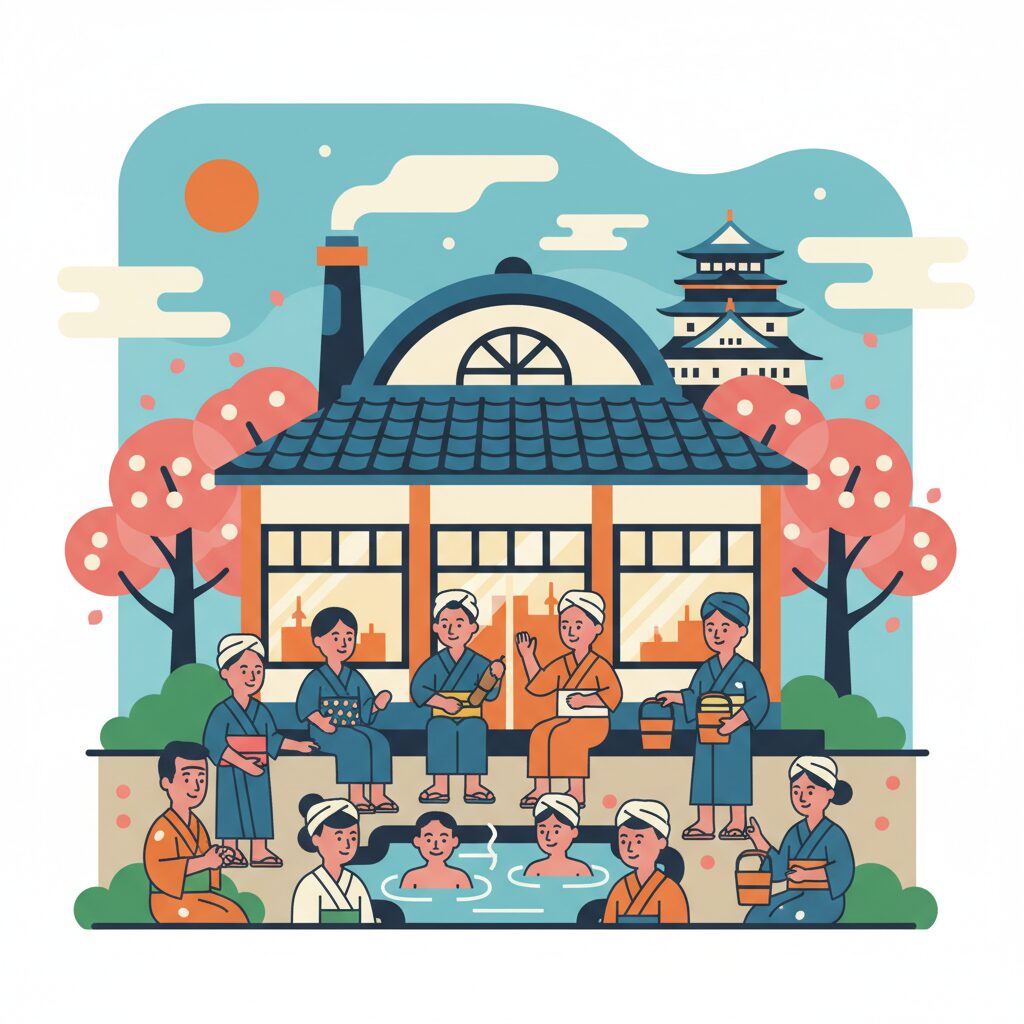
Before long, you’ll notice the landscape is dominated by the nushi, the unofficial ‘masters’ of the bath. These are elderly men and women who have attended daily, at the same time, for forty years. They have their assigned shower station, their favorite spot in the hot tub, and an unchanging post-bath routine. You don’t take their place. You learn their rhythm. At first, their territorial nature might seem intimidating, but you soon realize they are the anchors of this micro-society. They are the living archives of the neighborhood. Their conversations, spoken loudly enough to rise above the sound of running water, serve as the daily news broadcast. They’re not just chatting about the weather; they’re debating the Hanshin Tigers’ current slump, analyzing the price of cabbage at the local shotengai, and swapping gossip about who’s getting married, who’s ill, and whose son finally landed a job. Listening to them is like tapping directly into the neighborhood’s central nervous system. Silence is suspicious. Participation, even if just through attentive listening and a nod here and there, is expected. This is the opposite of the anonymous, orderly silence you often encounter in public spaces in Tokyo, where keeping to yourself is the highest form of respect. Here, engaging with your neighbors, even superficially, is the way you show you’re part of the community.
More Than a Tub: The Anatomy of an Osaka Sento
To view a sento merely as a collection of baths is like seeing a library as just a storage space for books. Every square meter of an Osaka sento is intentionally or unintentionally designed for social interaction. It begins at the entrance. You don’t simply purchase a ticket from a machine. Instead, you slide open a door and greet the owner, who sits on a raised platform called a bandai. From this vantage point, they observe everything and know everyone. They’ll accept your 500-yen coin but also inquire about your cold, mention that your neighbor Mr. Tanaka was there earlier, or remind you that tomorrow is the special yuzu-infused bath. They act as the community gatekeepers, the neighborhood receptionists. The transaction takes a backseat to the interaction.
Next is the changing room, the datsuijo. This is the true heart of the sento. It is a chaotic, delightfully human space. Old, precisely calibrated analogue scales stand in the corner, a perpetual source of remarks and groans. A vintage massage chair from the 1980s hums away, charging a hundred yen for five minutes of vigorous shaking that’s more amusing than therapeutic. High up in a corner, a small, boxy television is always tuned to a sumo tournament, a baseball game, or a lively manzai comedy show. Often, the naked audience’s commentary is sharper and funnier than what’s on screen. Men sip from small glass bottles of fruit milk, a post-bath tradition that is non-negotiable. Here, conversations that began in the bath deepen. It serves as a locker room, newsroom, and therapy session all in one. This is where informal business deals happen, advice is shared, and the day’s frustrations are aired out and left behind with your clothes in a wicker basket.
Within the bathing area, even the tubs fulfill a social role. Of course, there’s the main hot bath, but the true Osakan specialty is the denki buro, the electric bath. Two metal plates send a low-voltage current through the water, causing your muscles to pulse and tingle. To the uninitiated, it’s a strange and slightly intimidating experience. For the regulars, it’s a test of endurance and a source of mutual amusement. Watching a newcomer yelp after getting too close to the plates creates a bonding moment. Enduring a full minute inside earns a nod of respect. It’s an odd, shared rite of passage. This is what differentiates it. It’s not about quiet, meditative soaking; it’s about shared, active, and sometimes bizarre experiences.
Where Generations and Classes Dissolve
One of the most profound features of the sento is its function as a great equalizer. In a society as hierarchical and status-conscious as Japan, the sento remains one of the few places where those social structures completely dissolve. When everyone is naked, you can’t distinguish the CEO from the carpenter. The full-body tattoos of a yakuza member might be right beside the pale skin of a university professor. All external markers of rank, wealth, and profession are left behind in the lockers along with your wallet and watch.
This shared vulnerability creates a unique sense of intimacy and honesty. Conversations become grounded and genuine. People discuss their sore backs, troublesome children, and small triumphs. I once witnessed a scene that perfectly illustrates this. A young man, likely a student, was carelessly splashing water everywhere, not properly rinsing his stool after use. An elderly man with a weathered face and a towel wrapped like a crown on his head didn’t ignore it. He didn’t get angry. Instead, he approached and, in a gruff but gentle Osaka dialect, said, “Aniki, chanto arayade. Tsugi no hito ga komaru yaro.” (Hey, big bro, wash it properly. The next person will have trouble.) It wasn’t a reprimand; it was a lesson. It was a grandfather teaching his grandson. Outside this world, that interaction would likely never occur. But in the steam of the sento, social barriers become permeable. This is how community knowledge is passed on. It’s how unspoken rules are enforced—not by signs on the wall, but through direct, human connection. It’s a raw, unfiltered glimpse of society rarely seen anywhere else.
The Osaka Mindset, Steamed and Distilled
To grasp the core traits of the Osaka personality, spend a week visiting a neighborhood sento. The entire experience encapsulates the local character. First, there’s the renowned Osakan pragmatism and the preference for honne (one’s true feelings) over tatemae (the public facade). There is little room for pretense when you’re scrubbing your neighbor’s back. Conversations are direct, practical, and free from the delicate, multi-layered politeness often found in other parts of Japan. People say what they mean, frequently with a humorous, self-deprecating tone.
This contributes to a common foreign misunderstanding of Osaka. A visitor, especially one used to the quiet reserve of Tokyo, might find the sento chaotic, loud, and intrusive. The closeness of others, the volume of conversations, the casual nudity—it can all feel like a breach of personal space. But that’s because they are judging it by the wrong standard. The aim isn’t solitary reflection. It’s communal connection. The noise isn’t a disturbance; it’s the sound of a community in action. The closeness isn’t an invasion; it’s an embrace. In Osaka, the boundaries between public and private are beautifully blurred. Your personal space is smaller, but your support network is larger. The sento is the tangible expression of this philosophy. You trade a bit of personal space for a wealth of shared humanity.
The Sento’s Future in a Modernizing Osaka

Certainly, this world is delicate. The number of sento in Osaka, much like the rest of Japan, is steadily decreasing. The economics are harsh. Fuel expenses are steep, the owners are aging without successors, and modern apartments all come equipped with clean, private bathrooms. Each year, a few more historic bathhouses, adorned with splendid Mt. Fuji murals and intricate tilework, shut their doors forever, taking a piece of the neighborhood’s soul with them. Every closure represents a tear in the social fabric.
Nevertheless, there is a persistent resilience here. The sento that endure do so because they are more than mere businesses; they are vital services. They serve as lifelines for elderly individuals who may live alone, offering daily human interaction and a safety check. Additionally, a new generation is beginning to rediscover them. Young people, raised in an age of digital isolation, are seeking the analogue, authentic connections that sento provide. They come initially for the retro aesthetic but remain for the genuine sense of community. They find that a shared bath delivers a kind of warmth that no online chat room can match. To assess the health of an old Osaka neighborhood, you don’t examine property values or new condo developments. Instead, you look at the local sento. Is the light on? Is the parking lot filled with old bicycles? Can you hear laughter and chatter spilling out into the street when the door opens? If the answer is yes, then the heart of that neighborhood is still beating strong.