You hear it before you see it. A frantic, high-pitched chirin-chirin-chirin slicing through the ambient noise of the shotengai, the covered shopping arcade. You turn, expecting a child’s tricycle, but instead, you’re met with the determined gaze of an Osaka woman, piloting a bicycle laden with two kids and a week’s worth of groceries. She’s not slowing down. She’s not moving into the street. She’s on the sidewalk, she’s coming straight for you, and that bell is not a polite suggestion. It’s a command. Welcome to Osaka, where the bicycle, or ‘chari’ as it’s affectionately known, reigns supreme, and the sidewalks are its kingdom. For a newcomer, especially one from a place where sidewalks are sacred ground for pedestrians, this daily ballet of near-misses and aggressive bell-ringing can be utterly baffling, even terrifying. It feels like chaos, a city-wide breakdown of rules and common courtesy. But this isn’t chaos. It’s a system. It’s a culture. Understanding the unwritten rules of Osaka’s ‘chari’ phenomenon is your first, and perhaps most important, lesson in understanding the city’s pragmatic, impatient, and deeply efficient soul. This isn’t just about transportation; it’s a rolling, weaving, bell-ringing metaphor for how Osaka itself operates.
Embracing the dynamic energy of Osaka means not only mastering the art of sidewalk navigation but also learning about Osaka renting etiquette as a key part of integrating into the city’s practical and tightly knit community.
The Mamachari: Osaka’s Urban Workhorse
To truly understand the culture, you first need to understand the machine. The preferred vehicle is almost always the ‘mamachari‘ (ママチャリ), literally meaning “mom’s chariot.” This is not the sleek, lightweight road bike you might see a Tokyo creative riding through Daikanyama. No, the mamachari is more like the minivan of bicycles. It’s designed for practicality, not speed or style. Imagine a sturdy, step-through frame for easy mounting, usually in muted colors like silver, black, or beige. It features a wide, comfortable seat, a large wire basket at the front for groceries or a handbag, and a heavy-duty rear rack often fitted with a child seat. Fenders protect the wheels from splashes, and a chain guard shields pant legs. The most important features, however, are the solid kickstand that keeps the bike stable even when fully loaded, and the dynamo-powered front light that powers up as you pedal into the evening. More recently, the electric-assist ‘denki-chari’ version has become the dominant force on the streets, enabling riders to tackle Osaka’s few hills with what seems like superhuman power, often with two children riding—one at the front and one at the back—adding to its imposing silhouette. This machine is a tool, a vital part of domestic life, and the key to navigating the city’s dense urban environment.
More Than Just a Bike
In many cities, bicycles are for recreation or chosen as an eco-friendly commuting option. In Osaka, the mamachari is an extension of home and body. It serves as the main mode of transport for a large portion of the population, especially housewives, students, and the elderly. It’s how you take your kids to nursery, do daily grocery runs to multiple stores to catch the best deals, visit friends across town, and get to the nearest train station. Osaka’s geography is perfectly suited to this culture. The city is mostly flat, making cycling easy. Its neighborhoods consist of a dense patchwork of narrow streets, shotengai, and residential alleys—often inconvenient or inaccessible by car, but ideal for a two-wheeled vehicle. Owning and parking a car downtown is prohibitively expensive and impractical for short trips. The train system is excellent for traveling between major hubs, but when it comes to navigating neighborhood life, the mamachari is unbeatable. It symbolizes freedom and unmatched efficiency. Why walk fifteen minutes to the supermarket when you can bike there in four, fill your basket, and be home before the ice cream melts? This constant drive for micro-efficiency is what fuels Osaka’s cycling culture.
Why the Sidewalk?
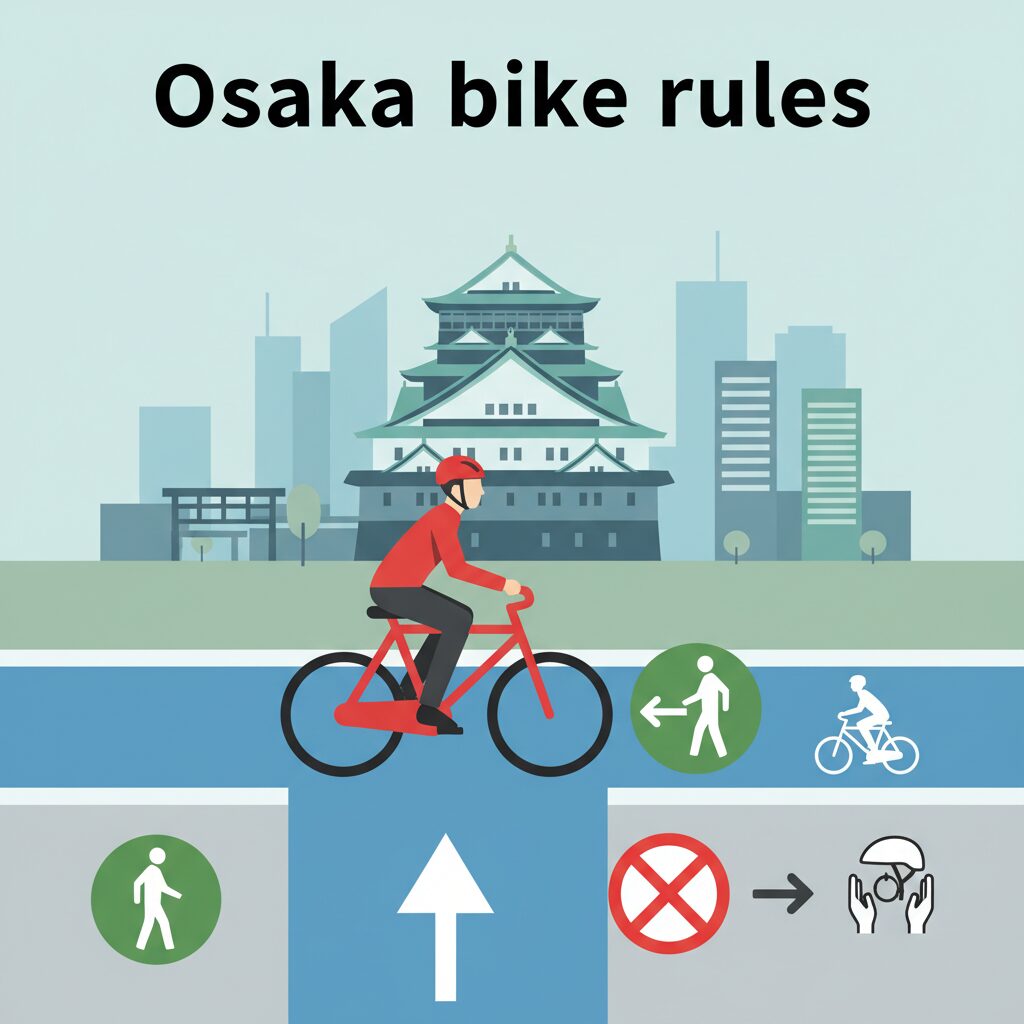
For every confused foreigner, the question remains: why ride on the sidewalk? The legal explanation is complex. Officially, bicycles are classified as light vehicles in Japan and should be ridden on the road, on the left, following traffic. Sidewalks are for pedestrians, with cycling only allowed on specially marked sidewalks. In Osaka, the reality is the exact opposite. Sidewalk riding is the norm, while riding on the road is the exception. The reasons, like everything in Osaka, are purely practical. Osaka’s roads are narrow, crowded, and dominated by assertive taxis, trucks, and buses that would intimidate even the most experienced cyclist. Dedicated, protected bike lanes are notably lacking. For the average rider on a heavy, slow-to-accelerate mamachari—especially when carrying a child on the back—cycling in traffic feels dangerously reckless. The sidewalk then becomes the easiest and safest option. It’s seen as safer not just for the cyclist but for their precious cargo. This situation creates an interesting social contract: pedestrians silently share part of their space with cyclists, and in return, an intricate, unspoken system of negotiation and movement unfolds from the pavement upwards.
The Unspoken Rules of the Road (or Sidewalk)
While it might appear to be lawless chaos, the sidewalk ecosystem is actually governed by a clear set of informal rules. Learning to recognize and anticipate these guidelines is what separates a pleasant walk from a nerve-wracking daily ordeal. These rules aren’t written in any official city regulation, yet they are enforced through countless small interactions every day. Mastering them is essential for anyone living here.
The Bell is Not a Polite Request
In Western cultures, a bicycle bell often sounds like a gentle, almost apologetic ‘ding-ding’ to signal, “Excuse me, I’ll pass when you’re ready.” In Osaka, however, the bell is a sonic bulldozer. The rapid-fire chirin-chirin-chirin proclaims intention: “I am here, I am maintaining my speed, and I do not plan to stop. It’s now your responsibility to notice me and move aside.” This is not out of hostility but born of momentum. A fully loaded mamachari is difficult to stop and start, so maintaining steady momentum is critical. Pedestrians, being more agile and able to stop easily, are expected to adjust accordingly. Responding with a subtle sidestep or slight change in course is the proper reaction. Standing your ground out of principle is a rookie error; it only leads to closer calls and a frustrated ‘tsk’ from the rider as they swerve at the last moment. In this dynamic, speed rules.
The Pedestrian Weave
As a pedestrian in Osaka, you quickly develop a kind of sixth sense. You learn to move differently, internalizing the rhythm of the sidewalk. Unpredictable or sudden moves are avoided; instead, you drift smoothly. You focus on walking straight, making it easier for cyclists approaching from behind to anticipate your path and choose whether to pass on your left or right. You also learn to listen—not just with your ears, but with the back of your neck. The faint sound of tires on pavement, the gentle whir of an electric motor, the distant ring of a bell become subconscious cues. This heightened state of spatial awareness is known as the “pedestrian weave.” You become part of a fluid organism where everyone continuously adjusts to one another. Foreigners accustomed to pedestrian-priority environments often struggle with this flow, stopping abruptly to check their phones, meandering, or walking in wide groups. These behaviors disrupt the delicate rhythm and often cause friction or near misses.
Reading the Rider’s Intent
Just as you learn to move predictably, you develop the ability to read cyclists. They are not a uniform group. There’s the high school student, rushing and weaving recklessly; the elderly man, cycling at a slow, steady pace, unwavering in his path; and then the apex predator of the sidewalk: the mother on her electric-assist mamachari. She is the most skilled and determined rider of all. Her movements are precise, calculated, and powered by the quiet torque of a small motor. She navigates crowded arcades like a surgeon, eyes fixed fifty meters ahead. She has no time for hesitation—neither yours nor hers. Recognizing the type of rider approaching or coming up behind you is crucial for predicting their behavior and giving them the appropriate space.
Parking: Anarchy with a Purpose
This culture extends to what happens when wheels stop turning. Outside train stations, supermarkets, and public buildings, you’ll find an astonishing sea of parked chari—a chaotic mass of frames, baskets, and handlebars. But look closer, and you’ll notice a loose, self-organizing order. While there are designated bicycle parking areas (usually for a small fee), most people park wherever they find even the smallest available space. The unwritten rules are straightforward: don’t block building entrances completely, leave a narrow path for pedestrians, and, if possible, align your bike parallel to others nearby. This “anarchic” parking is a practical response to the overwhelming number of bikes. The city’s infrastructure can’t keep up with daily demand, so people have created their own informal, highly functional system. It’s a classic Osaka solution: when formal systems fall short, informal ones arise to fill the gap.
The Osaka Mindset on Two Wheels
This entire mobile ecosystem offers a perfect glimpse into the Osaka mindset. It’s not merely about transportation; it reflects a fundamental worldview that values results over procedure and pragmatism over rigid rules. This mentality was shaped in a city of merchants, where time is money and the most direct path is always preferred.
Pragmatism Over Politeness
In Tokyo, there tends to be a stronger focus on following rules to maintain social harmony. Form is as important as function. In Osaka, however, if a rule proves inefficient or illogical in a certain situation, it is often considered optional. The question shifts from “What is the proper way to do this?” to “What is the fastest, most effective way to get this done?” Biking on a busy sidewalk is, according to the law, incorrect. But if the road is unsafe and the sidewalk offers a safer, quicker route, many in Osaka find the choice obvious. The sidewalk emerges as the sensible option. This behavior is not viewed as rudeness but as supreme rationality. There is a shared understanding that everyone is busy, everyone has somewhere to be, and the collective aim is to enable that movement as efficiently as possible, even if it means bending a few formal rules. It’s a ‘we’re all in this together’ kind of organized chaos.
“Akan Yaro, Demo Shaanai”: The Art of “Wrong, But Unavoidable”
A common phrase in the Osaka dialect perfectly captures this attitude: “Akan yaro, demo shaanai” (あかんやろ、でもしゃあない). It roughly translates to, “Yeah, it’s wrong, but what can you do?” or “You’re not supposed to do that, but it can’t be helped.” This sentiment forms the philosophical basis of the chari culture. People recognize that weaving rapidly through pedestrians isn’t ideal and know it’s technically ‘akan’. Yet, given the absence of bike lanes, the dangers of the road, and the essential role of bicycles in daily life, it is also ‘shaanai’—unavoidable and inevitable. This shared acceptance fosters a high tolerance for bending the rules. There is no widespread public outrage or demand for police crackdowns because most people either participate in this system or understand its necessity. It’s a collective shrug, a mutual agreement to navigate an imperfect but functional system because the alternatives are worse. This acceptance of a messy, flawed reality epitomizes Osaka’s down-to-earth character.
How to Survive (and Thrive) in Osaka’s Chari Culture
For foreign residents, adapting to the chari culture is not optional; it’s vital for a stress-free life. Whether you choose to walk or ride, you must learn to navigate this unique system.
As a Pedestrian: Situational Awareness is Crucial
Your greatest asset as a pedestrian in Osaka is your senses. First, ditch noise-canceling headphones or at least keep one ear open. You need to hear the bells, tires, and electric motors. Second, move predictably. Walk straight and avoid sudden stops or turns. Before stepping out of a convenience store or into an alley, pause and look both ways, as you would before crossing a street. Treat every sidewalk, especially in busy spots like Namba or Umeda, as a slow-moving, multi-use path. Stay to one side if possible, but always be ready for traffic from both directions. It’s not about fear; it’s about being mindful. Over time, this awareness will become second nature, and you’ll find yourself effortlessly weaving through crowds like a local.
As a Cyclist: Blend In, But Stay Safe
If you can’t beat them, join them. Getting your own chari is one of the best ways to experience Osaka. If you do, aim to blend into the existing flow. Choose a standard mamachari, not a racing bike, which might mark you as an outsider with different intentions. Equip yourself with a loud bell and use it as a communication tool—a clear signal of your presence and path—not as a weapon. Invest in a very strong lock; bike theft is a real concern. When riding, mimic local behavior by maintaining a smooth, predictable line. Though locals commonly use the sidewalk, remember that as a cyclist you control a vehicle. Your top priority is avoiding collisions. Be extra cautious around children and the elderly. Strike a balance between local customs and universal safety. When parking, follow the unwritten rules of organized chaos: choose a spot, park neatly, and avoid blocking the entire sidewalk.
It’s Not Chaos, It’s a Different Kind of Order
The initial perception of Osaka’s bicycle culture as chaotic and lawless is understandable, but ultimately, it misinterprets the city’s distinctive social fabric. It’s not a lack of rules; rather, it follows a completely different, unwritten code. This system is a grassroots response—a complex dance that has naturally developed from the city’s flat terrain, dense urban design, and the pragmatic spirit of its residents. It embodies the ‘shaanai’ philosophy, acknowledging that official methods aren’t always best and that sometimes, order must arise organically. The frantic bell ringing, the overloaded baskets, and the weaving through sidewalks aren’t signs of societal collapse. Instead, they signify a society adapting, valuing efficiency, and forging its own logic. Mastering the world of the chari goes beyond avoiding collisions; it’s your first real lesson in understanding Osaka. It reveals that this city doesn’t move to Tokyo’s rhythm or follow a bureaucrat-written rulebook. It moves to its own beat—a buzzing, rolling, bell-ringing rhythm that is practical, impatient, and unapologetically unique.