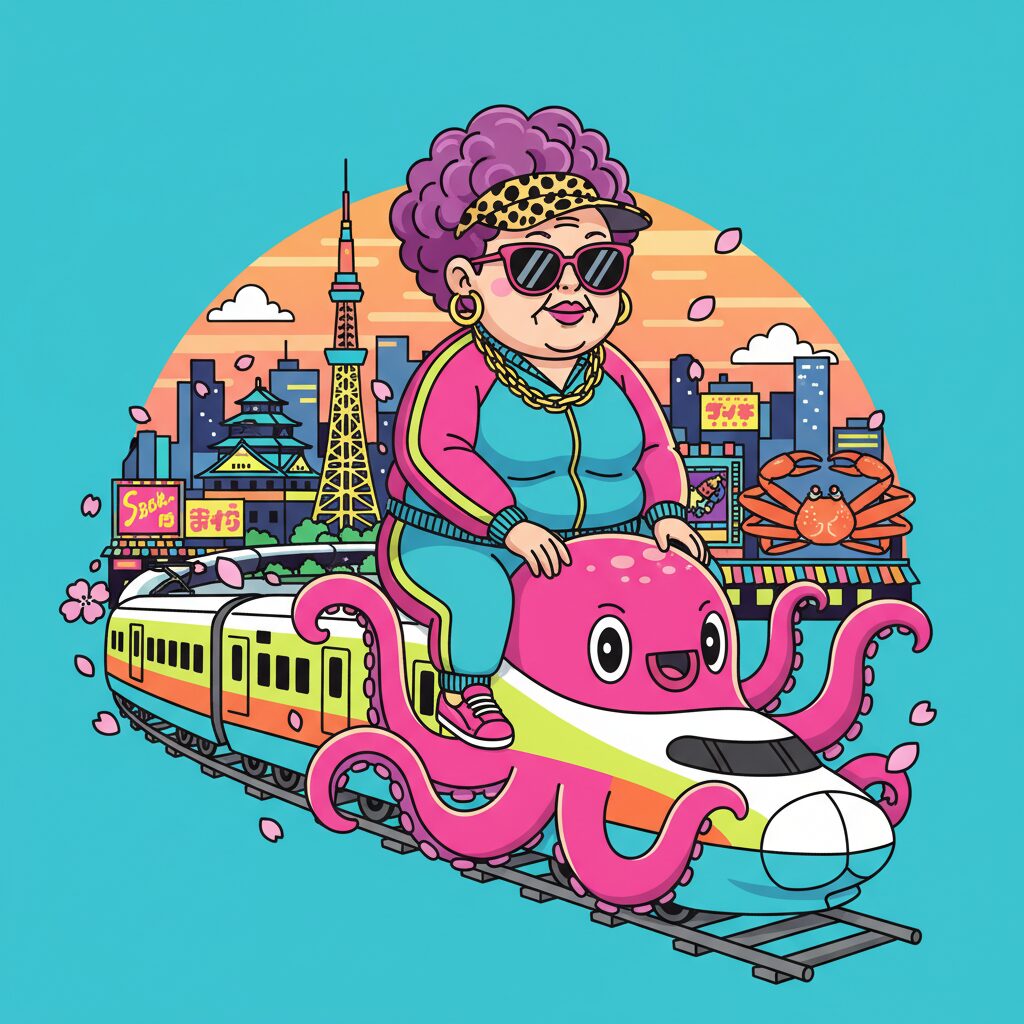
Picture this. You’re standing on the Midosuji subway line, swaying with the rhythm of the train, lost in your own world. It’s a typical Tuesday. Suddenly, a tap on your shoulder. You turn to face a woman who seems to be woven from pure energy. Her hair is a magnificent shade of purple, her blouse is a bold declaration of leopard print, and her eyes are scanning you with an intensity that’s both alarming and intriguing. “That bag,” she says, her voice a cheerful boom that cuts through the train’s rumble. “It’s fabulous! Where did you get it? Must have been expensive! You work hard, don’t you? Here.” Before you can process the rapid-fire compliments and questions, a small, brightly wrapped candy is pressed into your hand. “For your hard work. Eat up!” And just like that, she turns to her friend and continues a completely different conversation at the same volume.
Welcome to Osaka. You’ve just had your first encounter with the city’s most iconic and powerful social force: the Osaka Oba-chan. This isn’t just an interaction; it’s an initiation. It’s the moment you realize that the unspoken rules of polite distance that govern so much of Japan simply don’t apply here. As a foreigner building a life in this vibrant city, understanding this dynamic is everything. It’s the key to unlocking what makes Osaka tick. And as I’ve learned, this non-stop, high-energy social landscape is a paradise for the extroverted soul, a place where every day brings a fresh opportunity for connection. But for the introvert, it can feel like a gauntlet, a never-ending performance where the script is unwritten and the spotlight is always on. Forget what you think you know about Japanese society. We’re diving deep into the brilliant, baffling, and profoundly human world of the Oba-chan, and what it means for your life here.
Embracing Osaka’s colorful social tapestry means that even its diverse dining culture speaks volumes, inviting you to experience the city’s unique culinary conversation through a kappo dining dialogue.
The Unmistakable Force of Nature: Who is the Osaka Oba-chan?
Before we proceed, it’s important to clarify one thing. While the term “Oba-chan” may literally translate to “auntie” or “middle-aged woman,” in Osaka, that translation barely scratches the surface. It’s like calling a hurricane a mere breeze. Here, Oba-chan is not just a label but a title, a personality archetype, and a social role charged with unspoken authority and a distinct character. It represents a woman who has experienced life, worked hard, and navigated the practical streets of this merchant city, leaving no room for pretense.
More Than Just an “Auntie”
The visual stereotype is well-known for good reason: the brightly colored clothing, the fondness for animal prints (especially leopard, or “hyo-gara”), the perfectly permed hair, and the practical bicycle with a basket full of groceries. These are the outward signs, the uniform of the group. But focusing solely on the fashion misses the essence entirely. The true heart of the Oba-chan lies in her mindset. She embodies Osaka’s historical character as a city of merchants and artisans—a place where your value was measured by your skill, wit, and ability to swiftly close deals and build relationships. Subtlety was a luxury; directness was essential for survival.
The Oba-chan inherits this spirit. She is straightforward, often bordering on bluntness. She is curious, seeing personal questions not as intrusive but as the quickest way to forge a connection. She is fiercely practical, always hunting for a good bargain, useful information, or a way to help others (whether asked or not). Above all, she boldly disregards the delicate social boundaries carefully observed elsewhere in Japan. She doesn’t just cross lines; she acts as though they don’t exist at all.
The Candy in the Handbag Philosophy
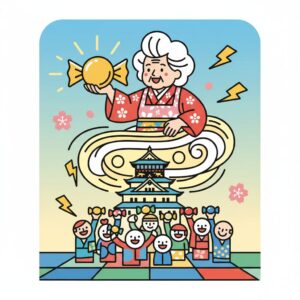
To grasp the Oba-chan mindset, one must understand the cherished tradition of the “ame-chan.” This small candy, often butterscotch or a fruit drop, is kept in her handbag, ready to be shared. The ame-chan is more than just a sweet treat—it is a powerful social tool. It breaks the ice, sparks conversation, expresses goodwill, and serves as a tiny symbolic exchange that says, “We share this space together, let’s acknowledge it.”
When an Oba-chan offers you an ame-chan on the train or at the supermarket, she is doing more than showing kindness. She is extending an invitation. Accepting the candy is akin to accepting a social contract, signaling your openness to interaction. The candy acts as the opening line of a conversation that could go anywhere—about the weather, cabbage prices, your questionable shoe choice, or your love life. The topic hardly matters. The aim is simply connection. This gesture perfectly encapsulates Osaka culture: it’s about creating an immediate, tangible sense of community, however brief. It’s a mindset that sees strangers as friends waiting to start a conversation—a sharp and refreshing contrast to the capital’s culture of polite, respectful anonymity.
An Extrovert’s Playground: Thriving in the Oba-chan Ecosystem
If you draw energy from social interaction and thrive on the excitement of spontaneous conversations with strangers, then congratulations—you’ve found your paradise. Living in Osaka as an extrovert is like being constantly plugged into a vibrant source of social energy. The city’s entire infrastructure, both physical and social, is built for the casual, lively encounters you enjoy. Every errand becomes an opportunity for a performance, a joke, or a shared moment of connection.
The Joy of Spontaneous Connection
Forget the quiet, impersonal aisles of a typical supermarket. Visiting a local “shotengai” (a traditional covered shopping arcade) is a full immersion into this social world. Stroll down Tenjinbashisuji Shotengai, the longest in Japan, and you aren’t just a shopper; you become part of a living, breathing social organism. The woman selling pickled vegetables will comment on your Japanese skills. The butcher will ask what you’re cooking for dinner and offer unsolicited yet genuinely helpful advice. The elderly man running the tiny tea shop will ask where you’re from and share a story about his cousin who visited your country thirty years ago.
For an extrovert, this isn’t noise—it’s music. These low-stakes, high-reward interactions make you feel recognized, welcomed, and woven into the community’s fabric. You might step out to buy a single daikon radish and return an hour later, your bag brimming with free samples and your mind full of stories from half a dozen new acquaintances. This city rewards engagement: the more you give, the more you receive in laughter, warmth, and a deep sense of belonging.
Breaking the Language Barrier with Laughter
One of the biggest concerns for foreigners in Japan is the language barrier—fear of making mistakes, sounding foolish, or failing to follow complex rules of polite, humble speech. The Osaka Oba-chan cheerfully smashes through all of that. Their communication style is a masterclass in conveying meaning without perfect grammar. It’s a lively mix of gestures, expressive faces, onomatopoeia, and Osaka-ben, a dialect that’s more direct and informal than standard Japanese.
They have little patience for stiff, textbook Japanese. Their goal is connection, using any means necessary. They’ll speak slowly if you seem confused, repeat themselves loudly as if volume alone can bridge gaps, and even grasp your arm to emphasize a point. Most importantly, they laugh. Their joy and amusement in trying to connect is inclusive, never mocking. This creates an incredibly liberating environment for language learners. You lose the fear of imperfection because the effort to connect is valued far more than grammatical accuracy. Every conversation with an Oba-chan is a free, intense language lesson where the only measure of success is the size of your smile.
Instant Community and Unspoken Support
These daily interactions quickly build a real, tangible community. In Tokyo, you might live in an apartment for years without knowing your neighbors’ names, where privacy and non-interference are the norm. In Osaka, if you become a familiar face in your neighborhood, you become part of a local ecosystem. The Oba-chan at the corner store will know exactly how you take your coffee. The staff at the local bathhouse will ask if you’re feeling well if you miss a few visits.
This creates an informal support network that can be invaluable for foreign residents. I’ve heard countless stories of people looking lost who were personally escorted to their destination by an Oba-chan who canceled her own plans to help. I’ve seen them rush out with an umbrella when someone is caught in a sudden rainstorm. This isn’t calculated kindness; it’s instinctual, rooted in a deep belief that community members look out for each other. For an extrovert who thrives on these bonds, it transforms the city from a massive, anonymous metropolis into a series of small, interconnected villages where someone is always watching out for you.
An Introvert’s Gauntlet: Navigating the Overwhelm
Now, let’s flip the coin. If you are an introvert—someone who values personal space, finds small talk exhausting, and needs quiet time to recharge—much of what I’ve just described might come across less as an ideal scenario and more like a waking nightmare. The same social dynamics that invigorate an extrovert can be deeply tiring and stressful for an introvert. The Oba-chan ecosystem, with its constant, unsolicited interactions, can feel like a social obstacle course you must navigate every time you step outside your apartment.
The Invasion of Personal Space
Japanese culture is often associated with a strong respect for personal space and the concept of “ma,” the idea of negative space or pauses in conversation. The Osaka Oba-chan, however, operates according to an entirely different set of rules. Their personal bubble is much smaller, both physically and conversationally. It’s common for them to stand very close while talking, touch your arm or shoulder to emphasize a point, or gaze directly into your shopping basket with unabashed curiosity.
The questions can feel just as intrusive. While intended as simple conversation starters, inquiries about your marital status, job, salary, or why you’re choosing a specific brand of tofu can seem highly personal and invasive to someone used to greater social distance. For an introvert, often a keen observer, this can feel like being abruptly pulled from the audience and shoved onto the stage. The sensation of being constantly watched, assessed, and engaged with can be utterly draining when all you want is to quietly buy your milk and go home.
The Pressure to Perform
Perhaps the toughest challenge for an introvert is the unspoken expectation to respond in a particular way. Osaka communication famously revolves around the rhythm of comedy, specifically “nori-tsukkomi,” a playful exchange of setup and punchline or witty retort. When an Oba-chan teases—“Oh, buying instant noodles again? So lazy!”—she’s not truly criticizing you. She’s tossing a conversational ball, and you’re expected to hit it back with matching energy. The appropriate response is to laugh and play along: “Of course! I’m saving all my energy for my glamorous nightlife!”
For an introvert, having to constantly be “on” and generate this performative, high-energy banter is draining. A quiet smile, a polite nod, or a straightforward, serious answer can be misread. It might be interpreted as coldness, sadness, or even rudeness. This often prompts the Oba-chan to try even harder to “cheer you up” with more questions and prodding, creating a cycle of social anxiety. In Tokyo, quiet reserve is understood and respected—it’s the default mode. In Osaka, it can be seen as a problem to fix, placing the introvert in an uncomfortable, defensive position.
When “Kindness” Feels Like an Obligation
That ame-chan we mentioned? For an introvert, it’s not a gift; it’s a summons. It signals an unavoidable social obligation. Accepting it means you have to talk, smile, and expend social energy you might not have. The constant stream of unsolicited advice—from how to dress for the weather to how to cook your vegetables—creates a similar dynamic. You feel pressured to show gratitude for help you never requested.
This creates an ongoing internal conflict. You understand the intention is genuinely kind, coming from a place of communal concern. But the delivery feels like a demand on your limited social resources. Learning to politely disengage without offending becomes a vital survival skill. You find yourself carefully planning your routes, shopping times, and destinations to minimize encounters. It’s a mental burden extroverts don’t typically carry, turning a simple trip to the post office into a strategic mission to preserve social energy.
Practical Strategies for Survival and Success
Whether you’re an extrovert eager to jump in or an introvert aiming to keep your balance, living happily in Osaka is about finding the right approach. It’s not about changing who you are, but about learning how to navigate the local rhythms. This city doesn’t demand conformity, but it does reward understanding.
For the Extroverts: Leaning In
If you’re an extrovert, your path is straightforward: embrace the vibrant chaos. Make the shotengai your second home. Visit the stand-up-drinking bars, the “tachinomi,” in neighborhoods like Kyobashi or Tenma, where conversation flows as freely as the inexpensive beer. Learn a few key phrases in the local dialect. A well-placed “Meccha sukiyanen!” (I love it!) or “Nande ya nen!” (Why the heck!) will earn you instant smiles and a deeper level of acceptance. Compliment an Oba-chan on her colorful scarf or her speedy bicycling skills; it’s a guaranteed way to spark a memorable conversation. Treat every interaction as an opportunity to play, connect, and collect stories. The city will open up to you in ways you can hardly imagine.
For the Introverts: Setting Gentle Boundaries
For introverts, the aim is balance, not avoidance. You need to create a toolkit for managing interactions. The “smile and nod” is your best ally—it’s a polite acknowledgment that doesn’t invite follow-up questions. A good pair of headphones can serve as a strong (though not foolproof) social shield on public transport. Master a polite but firm exit phrase, like “Sumimasen, chotto isoidemasu node…” (Excuse me, I’m in a bit of a hurry…), delivered with a slight bow. Most importantly, know your sanctuaries. The vast, anonymous Kinokuniya bookstore in Umeda, a quiet coffee shop with counter seating in a trendy area like Nakazakicho, or a stroll along the peaceful paths of Osaka Castle Park can be your spots to recharge. Opt for the large, impersonal supermarket on low-energy days, and save the bustling shotengai for moments when you feel ready to engage.
The Tokyo vs. Osaka Mindset: A Final Comparison
Ultimately, the difference comes down to the core social contracts of the cities. Tokyo’s social contract is based on the principle of non-imposition. Harmony is maintained by preserving personal space, anticipating others’ needs silently, and avoiding any actions that might trouble or inconvenience others. It’s a society of beautiful, respectful distance. Osaka’s social contract hinges on the principle of mutual participation. Harmony is created by actively bridging that distance, by assuming a default state of shared community and caring about your neighbor’s affairs. In Tokyo, trust is built slowly, from a distance. In Osaka, trust is assumed from the start, and interactions serve to reinforce that assumed bond. One is like a library, the other a lively market. Neither is inherently better, but they call for very different social skills to navigate.
Why It Matters: Understanding the Heart of Osaka
The Osaka Oba-chan is neither a caricature nor just a quirky cultural stereotype. She embodies the very soul of the city in a living, breathing form. Her spirit is shaped by Osaka’s rich history as Japan’s kitchen, a bustling port town, and a commercial hub where success relied on charisma, quick wit, and the ability to connect instantly. While Tokyo’s efficiency was founded on systems and regulations, Osaka’s vibrancy stems from its people and relationships.
This dynamic is what shields Osaka from the overwhelming anonymity that can characterize other major global cities. It is a persistent, humanizing force that insists you are not a faceless cog in a machine but a person with a story, a face, and a shopping basket deserving of notice. It can be intense, loud, and draining, but never, ever dull. Whether you are an extrovert plunging in with open arms or an introvert who gracefully observes from a distance, grasping the Oba-chan is key to truly understanding Osaka. It is both the challenge and the reward of living in a city that proudly wears its large, generous, and sometimes blunt heart on its leopard-print sleeve.