When I first moved from Tokyo to work on a project in Osaka, the initial culture shock wasn’t the dialect or the way people stood on the right side of the escalator. It was the shopping. In my Tokyo neighborhood, a trip to the supermarket was a quiet, orderly affair. People glided through aisles, politely considering artisanal soy sauces and organic vegetables, the price a secondary consideration to the story the product told. My first weekend trip to a supermarket in Osaka felt like stepping into a different dimension. The lights were brighter, the music was louder, and a man with a microphone was enthusiastically announcing a time-sensitive deal on eggs with the fervor of a sports commentator. People were buzzing, their carts overflowing, their eyes sharp and calculating. It wasn’t just commerce; it was a city-wide sport, and I didn’t know the rules. This guide is for anyone who has felt that same sense of disorientation. It’s an attempt to decode the city’s unique and deeply ingrained philosophy of ‘value for money,’ a mindset that shapes everything from a trip for groceries to a major electronics purchase. This isn’t about being cheap. It’s about being smart, savvy, and deeply engaged in the art of the transaction. To understand Osaka, you must first understand how it shops.
To truly grasp the city’s character beyond shopping, consider how Osaka’s sento reveal its true nature.
The Unspoken Language of “Mokkari-makka?”
In Tokyo, business greetings are formal affairs, involving a series of bows and polite questions about the weather. In Osaka, however, you’ll often hear a phrase that gets straight to the point: “Mokkari-makka?” Literally translated, it means “Are you making a profit?” To someone unfamiliar, it may seem unusually blunt, even rude. Imagine greeting a shop owner in New York or London by asking if their business is profitable. But in Osaka, this isn’t an intrusive financial inquiry. Instead, it’s a cultural handshake, a remnant of the city’s rich history as Japan’s merchant hub, known as the ‘Nation’s Kitchen,’ where rice and goods were traded and fortunes were built. The typical reply, “Bochi-bochi denna,” meaning “So-so, getting by,” completes the exchange. This interaction isn’t about exact figures; rather, it’s a mutual recognition of the daily hustle. It conveys, “We’re all part of this commercial game. How’s your side going?” This simple phrase captures the city’s spirit. In Osaka, business, value, and money flow are not topics to be concealed behind layers of politeness—they’re integral to life, as natural to discuss as the changing seasons. Grasping this greeting is key to understanding that in Osaka, commerce is a form of communication.
It’s Not ‘Cheap,’ It’s ‘Cost-Effective’: The Kosupa Mindset
To truly understand the Osaka approach, you need to grasp the concept of kosupa, a Japanese shorthand for ‘cost performance.’ Although the term is used throughout Japan, in Osaka it is considered an art form. While a Tokyoite might take pride in buying a handbag from a renowned luxury brand, valuing its prestige and craftsmanship, an Osakan will take equal or greater pride in discovering a beautifully made, durable, and stylish bag at a fraction of the cost—and will eagerly share exactly how and where they found such a great deal. The excitement lies not in spending, but in saving; not in the brand name, but in the undeniable logic behind the purchase. This is not about a poverty mindset—Osaka is an affluent city—but rather a deep respect for money and a refusal to be deceived by marketing or inflated prices. Spending money on something that doesn’t justify its price is, for lack of a better term, foolish. The ultimate status symbol isn’t what you can afford, but how smartly you acquired it.
The Anatomy of a Value-Driven Decision
Let’s explore this mindset through a common activity: grocery shopping. In Tokyo, you might shop at a pristine Kinokuniya or Seijo Ishii, where imported cheeses are artfully arranged and the lighting is designed to create a calm, sophisticated atmosphere. In Osaka, the temple of kosupa is Super Tamade. Walking into a Tamade for the first time is an assault on the senses. The exterior blazes with gaudy neon lights that flash day and night. Inside, a relentlessly upbeat jingle loops continuously while fluorescent handwritten signs loudly announce the day’s deals. Here, aesthetics take a backseat to pure, straightforward information. The goal is to ensure you can’t possibly miss the 1-yen sale on chives (with a qualifying purchase, of course). An Osakan shopper moves through this chaotic space with hawk-like focus. They’ve probably already checked the chirashi (flyers) from three competing stores that morning. They know Tamade offers the cheapest tofu today, but the supermarket down the street, Gyomu Super, has better prices on frozen chicken. They balance the time and effort of visiting both stores against the potential savings. They’ll examine the daikon radishes, assessing not just freshness but also size and weight, mentally calculating price per gram. This isn’t a chore; it’s a complex optimization problem, a puzzle to be solved. Winning means a fridge full of quality ingredients and the quiet satisfaction of having outsmarted the system.
The Art of the Deal: Negotiation as Conversation

One of the most enduring clichés about Osaka is that everyone haggles. This is both true and misleading, and recognizing the distinction is essential for any resident. You don’t haggle at a 7-Eleven, a Uniqlo, or in the basement food hall of the Hankyu department store. Trying to do so would be met with confused silence and considerable awkwardness. The price is fixed. However, in other situations, a friendly negotiation is not only accepted but anticipated. The key is to realize that it’s less a confrontation and more a shared storytelling experience. The main venues for this are the city’s vast electronics district, Nipponbashi (commonly known as Den Den Town), and the numerous independent, family-run shops within the covered shopping arcades, or shotengai.
“Chotto Makete”: Beyond a Simple Discount
When the time feels right, the classic opening phrase is, “Chotto makete kureru?” which means, “Can you give me a little discount?” The tone matters. It should be light, friendly, and curious, not forceful. This is not a demand. It’s an invitation to engage. The shopkeeper might laugh and say their prices are already as low as possible. You might smile in return and mention you’re buying two items instead of one. They might respond by offering to include a free accessory—a screen protector for the camera you’re purchasing, for example. This exchange is the essence of the process. It creates a human connection. It transforms a routine transaction into a memorable experience. The shopkeeper feels generous, and you feel like a clever customer who earned their bargain. Often, the final ‘discount’ is small in financial terms. It might be just 100 yen off or a minor extra item, an omake. But the value isn’t in the money saved. It lies in the success of the social ritual. You’ve both taken part in a bit of theater, and in doing so, you’ve moved from being strangers to valued customers. In Tokyo’s retail world, which often emphasizes quiet, seamless efficiency, this kind of personal interaction over pricing is exceptionally uncommon. In Osaka, it’s a sign of a healthy, thriving marketplace.
Where to See the Philosophy in Action: A Tour of Osaka’s Shopping Terrains
To experience this culture in its most authentic form, you need to know where to look. Certain neighborhoods and streets serve as living museums of the kosupa philosophy, providing a masterclass for any aspiring Osakan shopper.
The Shotengai: The Vibrant Core of Community Commerce
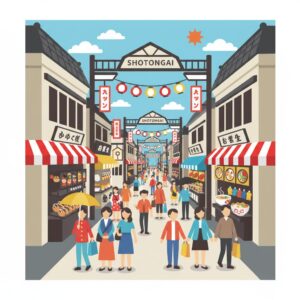
The shotengai, or covered shopping arcade, represents the lifeblood of Osaka’s neighborhoods. Tenjinbashisuji Shotengai, proudly known as the longest in Japan, exemplifies this perfectly. Stretching over 2.6 kilometers, it’s a world unto itself. Here, tiny stalls selling handmade korokke (croquettes) for 80 yen sit alongside bustling greengrocers, old-fashioned tea shops, and discount clothing stores. The air buzzes with vendors advertising their goods, the sizzle of takoyaki grills, and neighbors catching up on the latest news. Strolling through a shotengai is an education in value. You discover which butcher gives a little extra pork for free to regulars, which fishmonger offers the freshest catch of the day, and which pickle shop lets you sample three different varieties before you buy. Prices are clear and competitive, and relationships with vendors are paramount. It’s a hyper-local ecosystem built on trust, community, and the shared pursuit of a good deal.
Doguyasuji: The Professional’s Haven for Home Cooks
Just a short walk from the culinary bustle of Dotonbori lies Sennichimae Doguyasuji, Osaka’s ‘Kitchen Town.’ Here, restaurant owners, chefs, and takoyaki stand operators buy their essential tools: high-quality knives, industrial-sized pots, custom-made signage, and ultra-realistic plastic food models. For locals, Doguyasuji is a treasure trove. It embodies the kosupa ethos of securing professional-grade quality without paying for a consumer brand’s marketing overhead. Why buy a flimsy frying pan at a department store when you can get a durable, heavy-duty one here for the same price—or less? This is a place that values function over form, substance over style. You can find the perfect ceramic bowl for your ramen or a specialized ginger grater built to last a lifetime. Shopping here is a declaration: you are serious about your craft, whether cooking or simply living well, and smart enough to go straight to the source.
Kuromon Market: The Crossroads of Tourists and Locals
Kuromon Ichiba Market is often dismissed by locals as a tourist trap, and to some extent, they’re right. Recently, prices for grilled scallops and sea urchin have soared to meet tourist demand. Yet, it remains a compelling example of the Osaka mindset. While tourists flock to the flashy stalls near the entrance, savvy residents know to venture deeper into the market. They skip the skewers of pricey wagyu and head straight to the trusted fishmonger they’ve shopped with for years. They know the best times to visit, just before closing when some vendors begin marking down remaining fresh produce. They can easily tell the difference between a stall catering to one-time visitors and a legacy business serving the local community. Navigating Kuromon as a resident is a test of your Osaka savvy. It demands a sharp eye and an internal filter to separate genuine value from tourist spectacle—a skill essential for everyday life in the city.
What Foreigners Often Misunderstand
Living in Osaka requires unlearning certain assumptions. The city’s straightforwardness and emphasis on value can easily be misunderstood by those used to different cultural norms.
Misconception 1: “Osaka is just cheap and tacky.”
This is perhaps the most common and superficial judgment. The bright, bustling look of areas like Shinsekai or the frantic energy of Super Tamade may seem to lack the refined, minimalist elegance valued in cities like Kyoto or parts of Tokyo. However, this completely misses the point. Osaka’s aesthetic is based on functionalism and clear communication. The giant mechanical crab above the Kani Doraku restaurant isn’t meant to be subtle; it’s meant to clearly and joyfully announce that they serve delicious crab. The flashing lights of a pachinko parlor serve as a beacon of entertainment. This visual language is direct, honest, and democratic. It’s not about concealing information behind a chic exterior; it’s about presenting everything openly for all to see. The focus on “value” is not an endorsement of cheapness but a celebration of substance. An Osakan will proudly claim their 500-yen bowl of Kitsune Udon is the best in the world because it delivers maximum satisfaction—flavorful broth, perfectly chewy noodles, and a generous piece of sweet fried tofu—at a very reasonable price. The value lies in the quality of the experience, not its cost.
Misconception 2: “Haggling is always acceptable and expected.”
As noted earlier, this is a risky oversimplification. The “art of the deal” is a subtle performance that requires an understanding of the context. A foreigner who hears that “people bargain in Osaka” and attempts to negotiate the price of a rice ball at a FamilyMart will cause confusion and offense. The unspoken rule is that negotiation applies only to non-standardized goods at independent retailers. It’s for situations where a personal connection with the seller can be established. Think flea markets, second-hand shops, independent electronics stores, and mom-and-pop stalls in a shotengai. It’s a dance, not a right. The objective is a mutually beneficial interaction, not a battle to squeeze every last yen from a deal. Approaching it with humor, respect, and a readiness to walk away empty-handed is essential.
How to Embrace the Osaka Way of Shopping
Adapting to Osaka’s vibrant commercial culture is one of the most rewarding aspects of living there. It calls for a shift in mindset—from being a passive consumer to becoming an active participant in the marketplace.
Learn the Lingo
Beyond just “makete kureru?”, sprinkling your speech with some local Osaka-ben can instantly build rapport. Instead of the usual “Ikura desu ka?” (“How much is it?”), try the more direct and friendly “Kore, nanbo?” When a shopkeeper shows you something good, you can say, “Ee mon, yasui mon!” (“Good stuff, cheap stuff!”), which is the highest compliment. These small linguistic touches show you’re not merely a passing tourist but someone genuinely trying to engage with and understand the local culture.
Do Your Homework
Approach shopping strategically. Start by collecting the chirashi flyers that arrive in your mailbox. Even if you can’t read all the kanji, the pictures and prices are clear. You’ll quickly get the weekly sales rhythm: which day is best for eggs, when veggies are discounted, and so forth. Follow local supermarkets on social media or download their apps. Planning your shopping around these deals isn’t seen as stingy—it’s viewed as smart and responsible resource management.
Build Relationships
This is the most crucial step. Find your neighborhood shotengai and become a regular. Buy your bread from the same bakery, your vegetables from the same grocer. Make small talk. Ask the fishmonger for cooking tips on a particular fish. In Osaka, loyalty is a powerful currency. It might not always bring direct discounts, but it will be rewarded in other ways: a slightly larger portion, the freshest cuts of meat reserved for you, or a friendly greeting that makes you feel at home. This is the true benefit of Osaka commerce—the creation of community through the simple daily acts of buying and selling.
Shopping in Osaka quickly reveals itself as a reflection of the city’s character: pragmatic, lively, unabashedly direct, and deeply human. It’s a world apart from Tokyo’s quiet, curated consumption. Here, the marketplace is loud, competition is fierce, and the ultimate reward is the satisfaction of knowing you’ve got the absolute best value for your hard-earned yen. Mastering this art means more than just saving money. It’s about connecting with the city’s merchant spirit and earning your place in its vibrant, ongoing conversation. It’s the moment when you stop being just a resident and begin, in a small but meaningful way, to truly become an Osakan.